Automatic Duplex Water Softener System for Cooling Tower Makeup Water
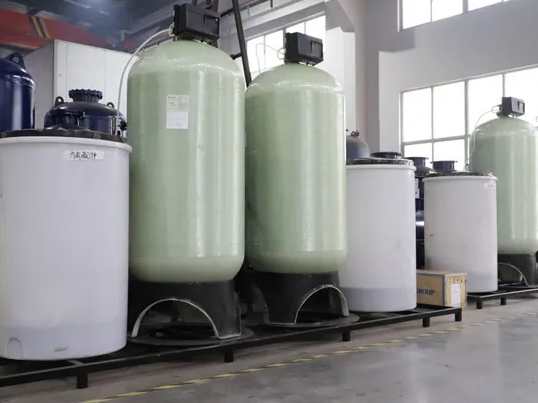 Our company develops and manufactures automatic water softeners (automatic sodium‑ion exchangers), mainly equipped with well‑known domestic and international automatic control valves such as Fleck and Runxin.
Except for manual regular salt replenishment, all other working procedures run fully automatically.Multiple configuration options are available: single‑tank, double‑tank and multi‑tank combinations. Control modes include time‑type and flow‑type. Domestic manual or semi‑automatic control devices can also be selected upon customer requirements.Water output capacity ranges from 0.5 t/h to 500 t/h.
Widely applied in industrial boilers, central air‑conditioning systems, heat exchangers, hotels, food & chemical industries, laundry & printing‑dyeing, medical and health‑care industries and other fields.
Automatic Water Softener System Overview
Structure and Working Principle
Structure
The automatic water softener mainly consists of three parts:
1. Automatic Control Device: Depending on user requirements, the system can be equipped with either time-based or flow-based fully automatic controllers. Optional control valves include Runxin, Fleck, etc. Hydraulic, pneumatic, or electric multi-valve control systems are also available.
2. Tank Section: The exchange tank and brine tank can be made of fiberglass reinforced plastic (FRP), carbon steel with rubber lining, or stainless steel, according to user requirements.
3. Accessories: Including water distributors, brine suction devices, piping fittings, etc.
Working Principle
Water hardness is mainly caused by cations: calcium (Ca⊃2;⁺) and magnesium (Mg⊃2;⁺) ions. When raw water containing hardness ions passes through the resin bed in the exchanger, the calcium and magnesium ions are adsorbed by the resin, while sodium ions are simultaneously released. Thus, the water flowing out of the exchanger is softened water with hardness ions removed.
When the resin adsorbing calcium and magnesium ions reaches a certain saturation level, the hardness of the effluent increases. At this point, the softener automatically performs regeneration of the exhausted resin according to a pre-programmed cycle, using a high-concentration sodium chloride (NaCl) solution to pass through the resin, restoring the exhausted resin to the sodium form.
Device Features
1. The energy consumption indicators of the equipment are significantly lower than those of conventional water softening equipment. The automatic control device requires no dedicated operator, bringing considerable convenience and economic benefits to users.
2. Water Consumption: < 2% of production volume
Salt Consumption: Approximately 160 grams of salt per liter of resin regenerated; the actual salt consumption depends on the raw water quality indicators.
Power Consumption: 40W. Since no salt pump is required and the system operates on a standard 220V lighting power supply, power consumption is only 1% of that of conventional softeners.
3. Compact structure with a small footprint. No dedicated equipment foundation is required; the unit can be placed directly on a level concrete floor.
4. Easy to use — installation, commissioning, and operation are simple and straightforward. Stable performance of control components eliminates user concerns.
5. Corrosion-resistant, anti-fouling, and non-toxic. The control valve body is made of lead-free brass or PPO material, the exchange tank is made of fiberglass, and the brine tank is made of PE — all ensuring excellent corrosion resistance, anti-fouling properties, and non-toxic, odorless, and harmless performance.
Important Design Notes
1. The distance between the filter/softener and the drain outlet should be as short as possible.
2. Keep away from heat sources. Do not expose the valve outdoors; direct sunlight and rain may damage the system.
3. Do not install the system in environments with acids/alkalis, strong magnetic fields, or strong vibrations, as these may cause failure of the electronic control system.
4. Ensure the floor or foundation is level.
5. Users only need to connect the inlet, outlet, and drain piping to the system according to the installation drawing.
6. Note: When the inlet pressure is below 0.15 MPa or the water supply is unstable, the backwash effect cannot be achieved, or brine suction may become difficult, and even brine tank overflow onto the equipment room floor may occur. An automatic booster pump must be installed at the water inlet (pressure must be maintained constant between 0.3–0.4 MPa). If there is no soft water tank at the outlet, a vacuum breaker valve must be installed at the softener inlet to prevent tank deformation or rupture caused by negative pressure inside the resin tank.
7. A pressure gauge must be installed on the inlet pipeline.
8. A drainage ditch should be reserved within a 1-meter radius around the softener. The drain pipe must never touch the liquid level of the drainage ditch; an air gap must be maintained to prevent sewage from being siphoned back into the water treatment system.
9. A storage tank should be provided at the softener outlet. The storage tank volume should be ≥ 2.5–3 times the hourly production capacity, and an automatic water level control device should be installed.
10. If the outlet pipeline or storage tank is higher than the control valve, a liquid level controller must be installed in the brine tank, or a check valve must be installed at the outlet. Otherwise, during backwash, water in the outlet pipeline or storage tank may flow back into the brine tank.
11. Piping should preferably be made of corrosion-resistant materials, and union fittings must be installed on the pipelines for future maintenance and disassembly.
12. An appropriate filtration device must be installed on the inlet pipeline to prevent large impurities from entering the main control valve body and causing damage.
13. If the user uses underground well water or surface water as the water source, it is recommended to install an appropriate precision filtration device before the equipment to prevent the resin from being contaminated by sediment or other impurities, which would significantly reduce the resin service life.
14. Media loading precautions: (When the resin tank diameter is ≥ φ1200mm, a quartz sand cushion layer must be loaded at the bottom; when the resin tank diameter is < φ1200mm, resin can be loaded directly.)
Media types: ① Quartz sand 2–4mm; ② Resin
Operation steps:
Step 1: First, pour quartz sand into the resin tank through the top opening. Pour slowly to avoid damaging the water distributor. After loading, spread the quartz sand evenly. Quartz sand mainly protects the water distributor and prevents resin from clogging the distributor holes.
Step 2: Then pour in the resin. After loading, spread the resin evenly.
! Start-up Precautions:
The control valve of each softener must be set with an appropriate brine tank refill duration (in minutes) based on the site inlet pressure. Otherwise, the brine solution may be insufficient or overflow onto the equipment room floor!
Control Modes
1. Time-based Control:
Suitable for locations with relatively stable daily water consumption. The regeneration process starts automatically when the user-set regeneration time is reached. The regeneration time can be set by the user during off-peak water usage hours. This control mode features simple operation, low cost, and easy use. It is mainly used for conditions with low hardness (≤8 mmol/L), stable water consumption (fluctuation not exceeding 15%), moderate effluent requirements, and small water volumes.
2. Flow-based Control:
The equipment operation is metered by a flow meter. When the set water volume is reached, regeneration starts automatically. The set volume is calculated based on the total working exchange capacity of the exchanger and the inlet hardness equivalent value. This system features high precision, stable and reliable effluent quality, and a memory function — no need to reset values after a power outage.
System configurations available:
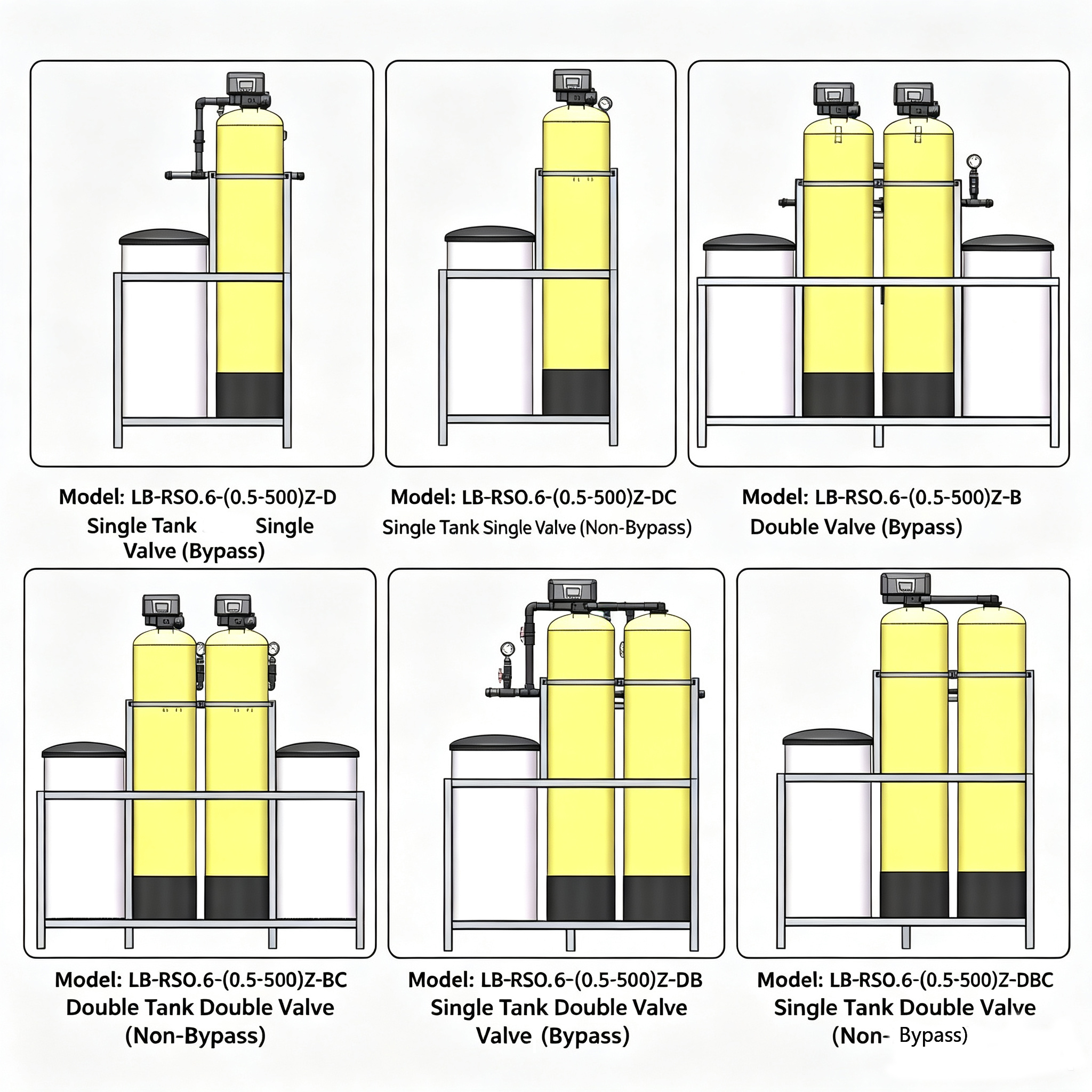
• Single valve & single tank — time/flow type
• Single valve & dual tank — one operating / one standby, flow type
• Dual valve & dual tank — simultaneous production, time/flow type
• Dual valve & dual tank — one operating / one standby, flow type
Operating Cycle
1. Service (Water Supply):
Untreated water passes through the resin bed, an exchange reaction occurs, and soft water is produced.
2. Backwash:
Water enters from the bottom of the resin bed, loosening the resin and removing fine debris.
3. Brine Regeneration:
A high-concentration brine solution (NaCl) flows through the resin, reducing exhausted resin back to the active sodium form.
4. Rinse (Fast Rinse):
Water passes through the resin in the same flow direction as service, flushing out excess brine and the calcium/magnesium ions exchanged during regeneration.
5. Brine Refill:
Water is injected into the brine tank to dissolve salt pellets, preparing brine for the next regeneration cycle.
6. Technical Specifications Parameters required for model selection:
1. Hourly production capacity (unit: m³/h);
2. Raw water source and its total hardness, total alkalinity, and total dissolved solids;
3. Required effluent hardness (unit: mmol/L);
4. Inlet pressure (unit: MPa), optimal range: 0.25–0.35 MPa.
Automatic Water Softener — Basic Specifications
Basic Parameters
|
Brand: | Lihuei Environmental |
Control Mode: | Fully Automatic |
Type: | Vertical Cylindrical |
Filtration Rate: | 20–25 m/h |
Design Pressure: | ≤ 0.6 MPa |
Operating Pressure: | 0.2–0.4 MPa |
Working Temperature: | 5–50 °C |
Installation Method: | Floor-standing (level surface) |
Inlet Hardness: | ≤ 6.5 mmol/L |
Outlet Hardness: | ≤ 0.03 mmol/L |
Valve Parameters
|
Valve Type: | Flow-metered type |
Voltage: | 220V / 50Hz |
Power Consumption: | 150W |
Resin Tank Parameters
|
Design Pressure: | 0.6 MPa |
Test Pressure: | 0.75 MPa |
Brine Tank Parameters
|
Brine Tank Material: | PE |
Softening Resin Parameters
|
Resin Model: | 001×7 Strong Acid Cation |
Appearance: | Brownish-yellow spherical beads |
Shipping Form: | Sodium form (Na⁺) |
Moisture Content: | 45%–50% |
Effective Particle Size: | 0.400–0.700 mm |
Other Accessories
|
Upper Water Distributor: | ABS |
Lower Water Distributor: | ABS |
Brine Suction Pipe: | Material: UPVC |
Note: Due to manufacturing tolerances in actual production, the above dimensions are for reference only. The actual dimensions shall be subject to the physical product.
Operation and Maintenance
Routine Maintenance
The following maintenance work should be performed during the operation of the water softening equipment:
(1) Ensure stable input voltage and current to prevent damage to the electronic control device. A sealed cover should be installed outside the electronic control device to prevent moisture and water immersion.
(2) Regularly add solid granular salt to the brine tank (refined salt or iodized salt is strictly prohibited). Ensure that the salt solution in the brine tank remains in a supersaturated state. When adding salt, be careful not to spill solid granular salt into the brine well, as this may cause salt bridges to form on the salt valve and clog the brine suction pipeline. Since solid granular salt contains a certain amount of impurities, a large amount of impurities will settle at the bottom of the brine tank and clog the salt valve. Therefore, the impurities at the bottom of the brine tank should be cleaned regularly. During cleaning, open the drain valve at the bottom of the brine tank and rinse with clean water until no impurities flow out. The cleaning cycle should be determined based on the impurity content of the solid granular salt.
(3) Regularly check the airtightness of the ejector and brine suction pipeline to prevent air leaks that would affect the regeneration effect.
(4) Disassemble the softener once a year to clean impurities from the upper and lower water distributors and the quartz sand cushion layer, and inspect the resin loss and exchange capacity. Replace severely aged resin.
Conditions for resin replacement:
a. The simplest method is to observe the water condition. If the soft water hardness exceeds 3 PPM after regeneration and the production volume is significantly reduced, it indicates that the boiler softening resin has failed and needs to be replaced.
b. If the resin strength drops to 40% or lower, replacement is required. If the resin exchange capacity decreases by 30%, replacement is required. If the regeneration effect is poor and effluent quality is significantly reduced, the resin needs to be replaced.
c. Resin contaminated by iron will appear significantly darker in color — dark reddish-brown or black. The resin strength will decrease, production volume will be significantly reduced during operation, and regeneration will be difficult.
d. Under the premise that the inlet water quality meets our company's requirements, it is recommended to replace the softening resin after 18–24 months of continuous production use.
(5) Before the equipment is taken out of service, the ion exchange resin in the tank should be fully regenerated once, converting the resin to the sodium form for wet storage maintenance. If the equipment is shut down in summer, perform at least one rinse per month to prevent microbial growth in the exchange tank that could cause resin mold and agglomeration. For winter shutdown, take anti-freezing measures to prevent resin cracking caused by freezing water inside the resin. The resin can be stored in a salt solution, with the concentration adjusted according to the ambient temperature. Regular daily maintenance of the automatic water softener can effectively extend the equipment service life, reduce replacement frequency, and lower production costs.
Troubleshooting
Common tools used in water softening equipment maintenance include: screwdrivers, needle-nose pliers, wrenches, multimeters, etc.
When the effluent hardness of the softening equipment exceeds the standard, there are three main causes:
(1) Mechanical failure of the softening equipment, preventing normal operation;
(2) Resin aging or failure, resulting in decreased working exchange capacity. Severely aged or failed resin should be replaced regularly;
(3) Changes in inlet water conditions resulting in incorrect softener parameter settings. The softener should be commissioned regularly according to inlet water conditions.
After-Sales Service Commitment
While delivering high-quality and reliable products, our company makes the following commitments regarding after-sales service:
1. The product is warranted for one year and maintained for life. (If a malfunction occurs due to product quality issues during the warranty period, our company will provide free repair.)
2. If a malfunction occurs during use, we commit to resolving it promptly.
3. We conduct regular customer follow-up visits to understand usage conditions and make timely improvements.
4. If you are dissatisfied with the service attitude of after-sales personnel, you may file a complaint directly.
Custom Automatic Water Softener Solutions
Cooling tower applications vary significantly in flow rate and water chemistry. For this reason, automatic duplex softeners can be configured according to project requirements.
Customization may include:
For replacement projects, customers should provide the existing softener model, dimensions, connection sizes, flow requirements, and water-analysis data whenever available.
Frequently Asked Questions
What is an automatic water softener for a cooling tower?
It is a water-treatment system designed to reduce calcium and magnesium hardness in cooling tower makeup water. Automatic controls manage service and regeneration cycles.
Why does a cooling tower need softened water?
Cooling towers lose water through evaporation and require continuous makeup water. Hardness minerals in makeup water can become concentrated and contribute to scale formation. Softening reduces the amount of calcium and magnesium entering the system.
What is a duplex water softener?
A duplex water softener uses two treatment vessels. The vessels can alternate between service and regeneration, providing greater continuity of softened-water supply than many single-tank systems.
Does a water softener remove TDS?
A conventional ion-exchange softener does not remove all dissolved solids. It primarily exchanges hardness ions such as calcium and magnesium for sodium ions.
Can softened water completely prevent cooling tower scale?
No. Softening reduces hardness-related scaling potential but does not eliminate all possible scaling mechanisms. Cooling-water chemistry, pH, alkalinity, silica, cycles of concentration, temperature, and other factors must also be considered.
How often does the softener need regeneration?
Regeneration frequency depends on resin capacity, raw-water hardness, treated-water volume, and control settings. Metered regeneration is often used to initiate regeneration based on water consumption.
What salt is used in the water softener?
Sodium chloride is commonly used as the regenerant for conventional sodium-cycle ion-exchange softeners.
Can the system operate continuously?
A properly designed duplex configuration can provide continuous or near-continuous softened-water availability by alternating between vessels. Actual continuity depends on system sizing and control configuration.
Can this softener be used with an HVAC cooling tower?
Yes. Automatic water softeners can be integrated into HVAC cooling tower makeup-water systems when water hardness is a concern.
How do I select the correct model?
The most important selection parameters are makeup-water flow, raw-water hardness, required treated-water quality, operating schedule, regeneration requirements, and installation conditions.
Technical Data Required for Quotation
To recommend a suitable automatic duplex cooling tower water softener, please provide:
Cooling tower or system name
Makeup-water flow rate
Raw-water hardness
Raw-water analysis, if available
Required softened-water capacity
Operating hours per day
Inlet water pressure
Water temperature
Available power supply
Required inlet/outlet connection size
Installation dimensions
Destination country
This information allows the softener capacity, resin volume, valve configuration, and regeneration settings to be evaluated more accurately.
Order Automatic Water Softener for Cooling Tower
Looking for an automatic water softener for cooling tower makeup water?
Our duplex water softener systems can be configured for industrial cooling towers, HVAC systems, chillers, process cooling equipment, and other water-treatment applications.
Contact us with your flow rate, raw-water hardness, water analysis, and cooling tower application to receive a suitable configuration and quotation.


 Our company develops and manufactures automatic water softeners (automatic sodium‑ion exchangers), mainly equipped with well‑known domestic and international automatic control valves such as Fleck and Runxin.


