PVC Fills Cooling Tower Applications: A Practical Industry Guide
Cooling tower performance depends heavily on the quality and design of its fill media. Among the most widely used options, PVC fills for cooling towers offer a practical combination of heat-transfer efficiency, durability, chemical resistance, and cost-effectiveness. They are used across HVAC systems, industrial plants, power facilities, manufacturing processes, and many other applications where reliable evaporative cooling is required.
A well-designed PVC cooling tower fill increases the contact area between water and air, helping transfer heat more effectively while maintaining reasonable airflow resistance. However, choosing the right PVC fill requires more than simply selecting a material. Application conditions, water quality, temperature, airflow pattern, fill geometry, and maintenance requirements all influence performance.
This practical guide explains PVC fills cooling tower applications, how PVC fill media work, where they are commonly used, and how to select the appropriate fill for different cooling requirements.
What Are PVC Fills for Cooling Towers?
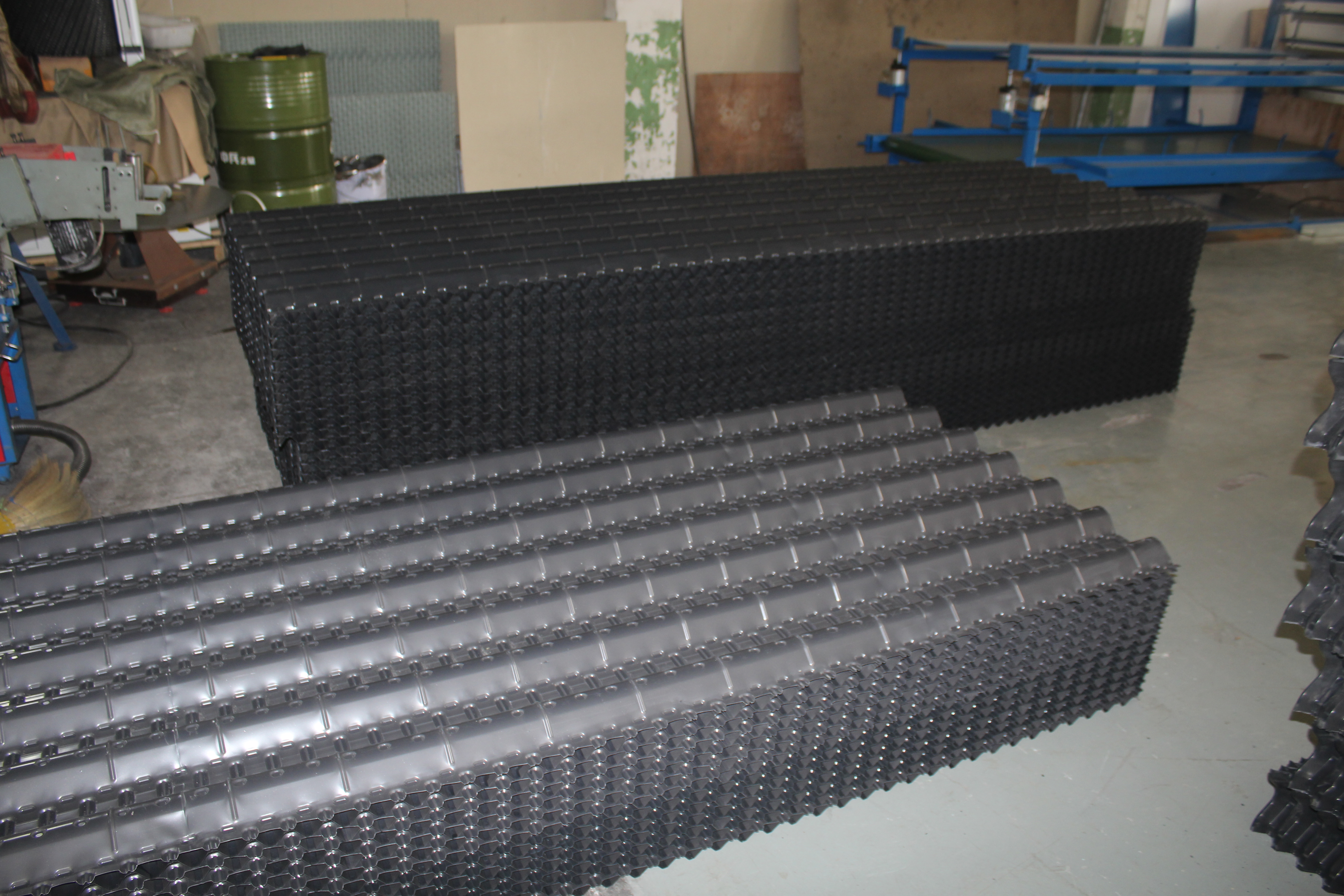
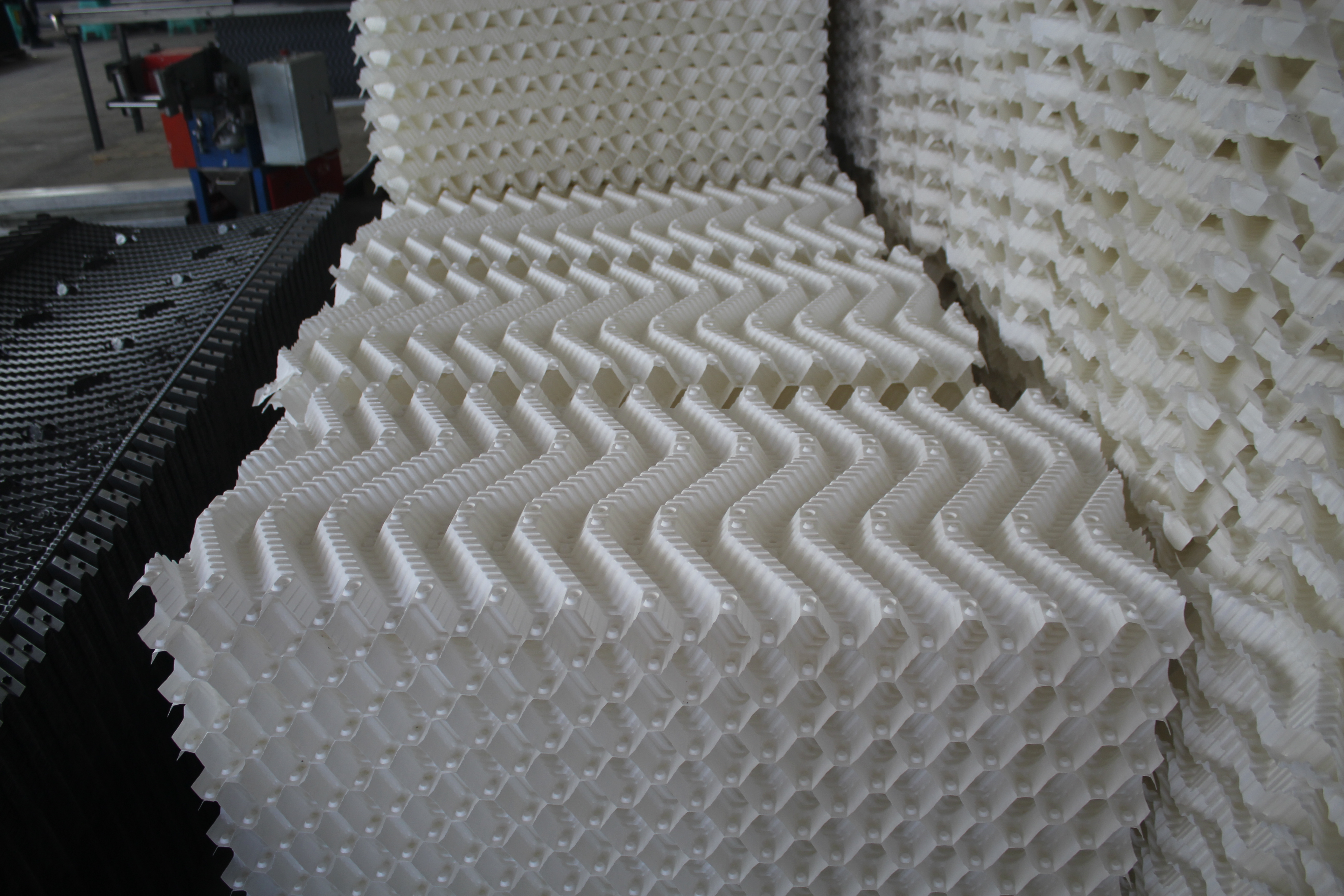
PVC fills are structured or film-type heat-transfer media installed inside a cooling tower. They are commonly manufactured from rigid PVC sheets formed into corrugated or specially patterned surfaces.
The primary purpose of cooling tower PVC filler is to increase the contact area between warm circulating water and the moving air stream.
How Does PVC Cooling Tower Fill Work?
When hot water enters the cooling tower, it is distributed over the upper surface of the fill. The water then flows downward across the specially designed PVC sheets.
At the same time, air passes through the fill in either a counterflow or crossflow direction.
Increasing Water-Air Contact
The patterned surface spreads water into thin films and droplets. This creates a larger effective contact area between water and air.
Improving Heat Transfer
As air moves through the fill, a portion of the water evaporates. The evaporation process removes heat from the circulating water, reducing its temperature.
Supporting Efficient Cooling
A properly designed PVC fill can provide high heat-transfer performance without creating excessive air resistance, helping the cooling tower achieve stable operation.
Why Are PVC Fills Widely Used in Cooling Towers?
PVC has become a popular material for cooling tower fill media because it combines several characteristics required for industrial and commercial cooling applications.
What Are the Main Benefits of PVC Cooling Tower Fills?
High Heat-Transfer Surface Area
PVC film fill can be manufactured with complex surface patterns that create a large contact area between air and water.
A larger effective surface area can improve the cooling process without requiring a proportional increase in tower size.
Lightweight Construction
PVC sheets are relatively lightweight compared with many traditional fill materials. This can simplify transportation, installation, replacement, and maintenance.
Good Chemical Resistance
PVC offers good resistance to many chemicals commonly encountered in cooling-water systems. This makes it suitable for a wide range of industrial environments.
Cost-Effective Performance
For many cooling tower applications, PVC provides a practical balance between initial cost, cooling efficiency, service life, and maintenance requirements.
Easy Replacement
PVC fill sheets can be cut, assembled, and configured to match different cooling tower dimensions, making them convenient for replacement projects.
Where Are PVC Fills Cooling Tower Applications Most Common?
The application of PVC fill varies according to cooling capacity, water quality, temperature, and tower design. However, several industries use PVC fill extensively.
1. HVAC Cooling Tower Applications
One of the most common uses of PVC fills for cooling towers is commercial and industrial HVAC.
Large buildings use cooling towers to reject heat from chilled-water systems. The cooling tower removes heat from condenser water before it returns to the chiller.
Where Is PVC Fill Used in HVAC Systems?
PVC cooling tower fill can be found in:
Why Is PVC Fill Suitable for HVAC?
HVAC systems generally require stable cooling performance and predictable operating costs. Properly selected PVC fill can provide efficient water-air contact while helping maintain compact tower dimensions.
For systems with relatively clean circulating water, PVC film fill can be an efficient solution.
2. Power Plant Cooling Tower Applications
Power generation facilities require substantial cooling capacity. Cooling towers are often used to reject waste heat from condensers and other process systems.
How Does PVC Fill Support Power Plant Cooling?
The fill provides a large surface area where hot water interacts with air.
This helps:
Distribute water across the fill surface.
Increase evaporation.
Transfer sensible and latent heat.
Reduce circulating-water temperature.
Improve overall cooling tower performance.
What Should Power Plants Consider?
Power plants may operate continuously under demanding conditions. Therefore, fill selection should consider:
In severe high-temperature applications, engineers should verify the PVC fill's allowable operating temperature before installation.
3. Manufacturing and Process Cooling
Many manufacturing processes generate heat that must be removed continuously.
Industries such as plastics, chemicals, steel, food processing, and machinery manufacturing may use cooling towers as part of their process cooling systems.
Why Is PVC Fill Useful for Industrial Cooling?
Industrial cooling systems often require continuous heat rejection. A suitable cooling tower fill media design can help maintain the desired process-water temperature.
Plastics Manufacturing
Injection molding and extrusion equipment can generate significant heat. Cooling towers can help remove this heat from circulating process water.
Chemical Processing
Chemical plants may use cooling water for heat exchangers and process equipment. PVC fill may be suitable when water chemistry and temperature remain within the material's operating limits.
Machinery Manufacturing
Cooling towers can provide cooling water for compressors, machining systems, hydraulic equipment, and other heat-generating machinery.
4. Data Center Cooling Tower Applications
Data centers require reliable heat rejection because servers operate continuously and generate significant amounts of heat.
Cooling towers may be integrated with chilled-water or heat-rejection systems.
How Can PVC Cooling Tower Fill Support Data Center Cooling?
A properly designed PVC fill can help maintain efficient heat transfer between circulating water and air.
Key Considerations for Data Centers
Because data centers prioritize reliability, engineers should evaluate:
For relatively clean water systems, PVC cooling tower fill media can provide an efficient heat-transfer solution.
5. Chemical Industry Cooling Towers
Chemical manufacturing facilities often use cooling towers to remove heat from process equipment and heat exchangers.
Is PVC Fill Suitable for Chemical Cooling Systems?
It depends on the specific operating environment.
PVC has good resistance to many common chemicals, but chemical compatibility should always be evaluated based on:
Chemical concentration
Water temperature
Exposure time
pH
Oxidizing agents
Cleaning chemicals
Why Is Water Chemistry Important?
A chemical that is harmless to PVC at low concentration may have a different effect at higher concentration or elevated temperatures.
Therefore, the cooling tower fill material should be selected according to the actual circulating-water chemistry rather than based solely on the general reputation of PVC.
6. Food and Beverage Processing
Food and beverage plants often use cooling towers for refrigeration, process cooling, and heat rejection.
What Makes PVC Fill Useful in These Applications?
PVC fill can provide efficient heat transfer while being relatively lightweight and easy to maintain.
However, cooling-tower water is generally a utility stream rather than direct product-contact water. Proper water treatment, hygiene management, and system design remain essential.
What Types of PVC Fills Are Used in Cooling Towers?
Not every cooling tower requires the same fill geometry. PVC fill is available in different designs to accommodate different airflow patterns and operating conditions.
What Is PVC Film Fill?
PVC film fill consists of thin sheets with formed surface patterns.
Water spreads across the sheets and forms thin films, while air passes through the channels created by the fill geometry.
What Are the Advantages of PVC Film Fill?
High effective surface area
Efficient heat transfer
Compact design
Relatively low material weight
Suitable for many HVAC and industrial applications
Film fill generally performs best when circulating water is reasonably clean and solids are controlled.
What Is PVC Splash Fill?
Splash fill breaks falling water into smaller droplets through repeated impact.
When Is Splash Fill Preferred?
Splash fill can be considered when water contains higher levels of suspended solids or when fouling resistance is a major concern.
Compared with film fill, splash fill typically uses a different heat-transfer mechanism and may require more tower volume for comparable thermal performance.
How Does Counterflow PVC Fill Differ From Crossflow PVC Fill?
Cooling tower configuration strongly influences fill selection.
Counterflow Cooling Tower PVC Fill
In a counterflow tower, water flows downward while air moves upward.
This arrangement creates opposing air and water movement through the fill.
Typical Advantages
Crossflow Cooling Tower PVC Fill
In a crossflow tower, air travels horizontally across the falling water.
Water distribution is generally arranged above the fill, while air enters through the tower sides.
Typical Advantages
Convenient maintenance access
Simple airflow arrangement
Common in many HVAC installations
Flexible tower configuration
How Should You Choose PVC Fills for Cooling Tower Applications?
Selecting the correct PVC fills cooling tower solution requires evaluating the complete operating environment.
What Water Quality Should Be Considered?
Water quality is one of the most important factors.
Suspended Solids
High concentrations of dirt, algae, scale particles, or other solids can block narrow fill passages.
Why Does Clogging Matter?
Blocked passages reduce airflow and water distribution, which can decrease cooling performance and increase pressure drop.
For dirty-water applications, a fill design with larger passages or splash characteristics may be more appropriate.
Scaling Potential
Hard water can create mineral deposits on fill surfaces.
Scale buildup reduces the effective heat-transfer area and can interfere with water distribution.
Biological Growth
Algae and microorganisms can form deposits on wet fill surfaces.
A suitable water-treatment program can help control biological fouling.
What Temperature Range Should You Check?
PVC fill selection should always consider operating temperature.
Why Does Temperature Matter?
As temperature increases, the mechanical properties of plastic materials can change. Therefore, the maximum continuous operating temperature should be confirmed with the fill manufacturer.
For applications involving unusually high water temperatures, specialized fill materials may be required.
How Does Fill Geometry Affect Cooling Performance?
Fill geometry is more than a visual design feature. It directly influences water distribution, air movement, surface area, and pressure drop.
What Should Fill Geometry Optimize?
A good fill design should balance:
Heat-transfer area
Water distribution
Airflow resistance
Fouling resistance
Mechanical strength
Cleaning requirements
Does More Surface Area Always Mean Better Performance?
Not necessarily.
Increasing surface area can improve heat transfer, but a very dense structure may also increase the risk of clogging and airflow resistance.
The best cooling tower filler is therefore not simply the one with the highest surface area. It is the one that provides an appropriate balance for the operating conditions.
How Can PVC Cooling Tower Fill Improve Energy Efficiency?
Cooling tower energy consumption is affected by fans, pumps, water distribution, heat load, ambient conditions, and fill performance.
How Does Efficient Fill Reduce Cooling-System Load?
When fill media provide effective water-air contact, the tower can reject heat more efficiently under the same operating conditions.
This may help the system achieve the required leaving-water temperature without unnecessary fan or pump operation.
Why Is Pressure Drop Important?
If the fill creates excessive airflow resistance, the cooling-tower fan may need to operate at higher power.
Therefore, fill selection should consider both thermal performance and aerodynamic characteristics.
What Maintenance Is Required for PVC Cooling Tower Fill?
Regular maintenance is essential for maintaining the performance of PVC fill.
How Often Should PVC Fill Be Inspected?
Inspection frequency depends on:
What Should You Check?
During inspection, look for:
Scale deposits
Sludge
Algae
Dirt accumulation
Broken sheets
Deformation
Blocked passages
Poor water distribution
When Should PVC Fill Be Cleaned?
Cleaning should be considered when deposits begin to restrict airflow, water distribution, or heat-transfer performance.
Cleaning methods should be selected carefully to avoid damaging the fill material.
When Should Cooling Tower PVC Fill Be Replaced?
PVC fill does not necessarily require replacement according to a fixed calendar schedule.
Instead, replacement should be based on its actual condition and performance.
What Are the Main Signs of Fill Failure?
Consider replacement when you observe:
Severe deformation
Brittle or damaged sheets
Persistent clogging
Significant biological fouling
Poor water distribution
Reduced cooling performance
Structural deterioration
Can Cleaning Restore Old PVC Fill?
Sometimes.
If performance problems are caused mainly by removable deposits, cleaning may restore part of the original performance.
However, cleaning cannot repair severely damaged or permanently deformed fill.
How Can You Extend the Service Life of PVC Cooling Tower Fill?
Proper maintenance can significantly improve the operating life of fill media.
Maintain Water Treatment
A reliable water-treatment program helps control scale, corrosion, suspended solids, and biological growth.
Maintain Proper Water Distribution
Uneven water distribution can create dry areas and overloaded areas within the fill.
Regularly inspect nozzles, distribution pipes, and spray systems.
Prevent Excessive Fouling
Monitoring water quality and cleaning the tower when necessary can reduce fouling.
Inspect the Fill Periodically
Early detection of deformation, clogging, and damage makes maintenance easier and can reduce unexpected replacement costs.
PVC Fill vs. Other Cooling Tower Fill Materials
PVC is widely used, but it is not the only material available.
PVC vs. PP Cooling Tower Fill
Polypropylene, or PP, is another common plastic used for cooling tower fill.
PVC
PVC is widely available and offers good chemical resistance and cost-effective performance.
PP
PP can offer advantages in certain higher-temperature or chemically demanding environments, depending on the specific formulation and application.
The choice should be based on actual operating conditions rather than material preference alone.
PVC vs. FRP Fill
FRP can provide high mechanical strength and durability in specialized applications.
However, FRP fill may have different cost, weight, manufacturing, and maintenance characteristics.
How Can You Select a Reliable PVC Cooling Tower Fill Supplier?
The supplier can have a major influence on the success of a replacement or new cooling tower project.
What Technical Information Should You Provide?
Before requesting a quotation, provide:
Cooling tower model
Tower dimensions
Fill dimensions
Fill type
Sheet thickness
Water temperature
Design flow rate
Airflow direction
Water quality
Operating environment
Why Are Accurate Dimensions Important?
Even high-quality PVC fill may perform poorly if the dimensions or configuration do not match the cooling tower.
A reliable supplier should be able to confirm whether the proposed fill matches the tower's physical and thermal requirements.
What Should You Ask a PVC Cooling Tower Fill Manufacturer?
Before purchasing, consider asking about:
Material Quality
Confirm the PVC material specification and manufacturing consistency.
Fill Design
Ask about sheet geometry, thickness, surface area, and application suitability.
Temperature Resistance
Confirm the recommended operating temperature range.
Customization
Check whether the supplier can provide custom dimensions, blocks, or sheet configurations.
Quality Control
Ask about production inspection, dimensional accuracy, and packaging procedures.
What Are the Future Trends in PVC Cooling Tower Fill?
Cooling tower fill technology continues to evolve as industries seek greater efficiency and lower operating costs.
Higher-Performance Fill Geometry
Modern fill designs increasingly focus on improving heat transfer while controlling airflow resistance.
Anti-Fouling Designs
Applications with challenging water quality are driving interest in fill geometries that are easier to clean and less prone to blockage.
Customized Cooling Tower Fill
Different towers have different dimensions and operating requirements. Customized PVC fills for cooling towers can help match the fill to specific tower configurations.
Improved Water and Energy Efficiency
As industrial facilities focus on reducing water consumption and energy use, cooling tower fill will remain an important component of overall system optimization.
Conclusion: Choosing PVC Fills for the Right Cooling Tower Application
PVC fills for cooling towers are widely used because they offer an effective balance of heat-transfer performance, lightweight construction, chemical resistance, cost, and installation flexibility.
From HVAC systems and data centers to manufacturing plants, chemical facilities, and power-generation applications, PVC cooling tower fill can support efficient heat rejection when properly selected and maintained.
The most important consideration is not simply choosing PVC. Instead, engineers should match the cooling tower PVC filler to the tower configuration, water quality, operating temperature, heat load, airflow requirements, and maintenance conditions.
By selecting the right fill geometry, maintaining proper water treatment, monitoring fouling, and replacing damaged media when necessary, operators can maintain reliable cooling performance and extend the service life of their cooling tower system.