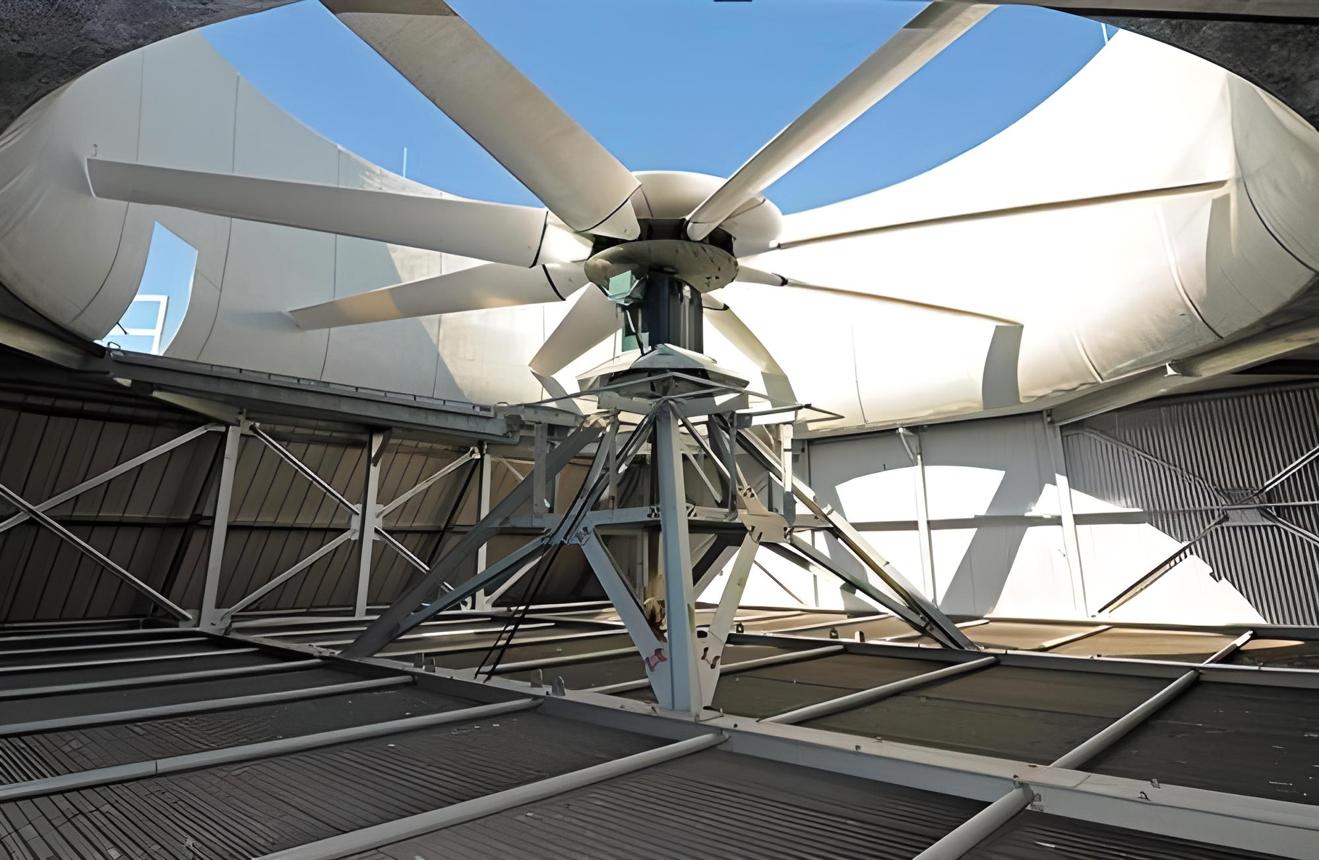
Measuring the cooling tower fan blade pitch angle correctly is essential for maintaining proper airflow, cooling performance, and energy efficiency. The blade pitch angle affects the aerodynamic load on the fan, motor power consumption, and the amount of air moved through the cooling tower. Incorrect measurements can lead to improper adjustments, excessive motor current, vibration, and reduced cooling capacity.
For engineers, maintenance technicians, and cooling tower operators, understanding the correct measurement method helps ensure consistent blade settings and reliable fan operation.
This guide explains how to measure cooling tower fan blade pitch angle, select suitable measuring tools, avoid common errors, and verify the final results.
1. What Is Cooling Tower Fan Blade Pitch Angle?
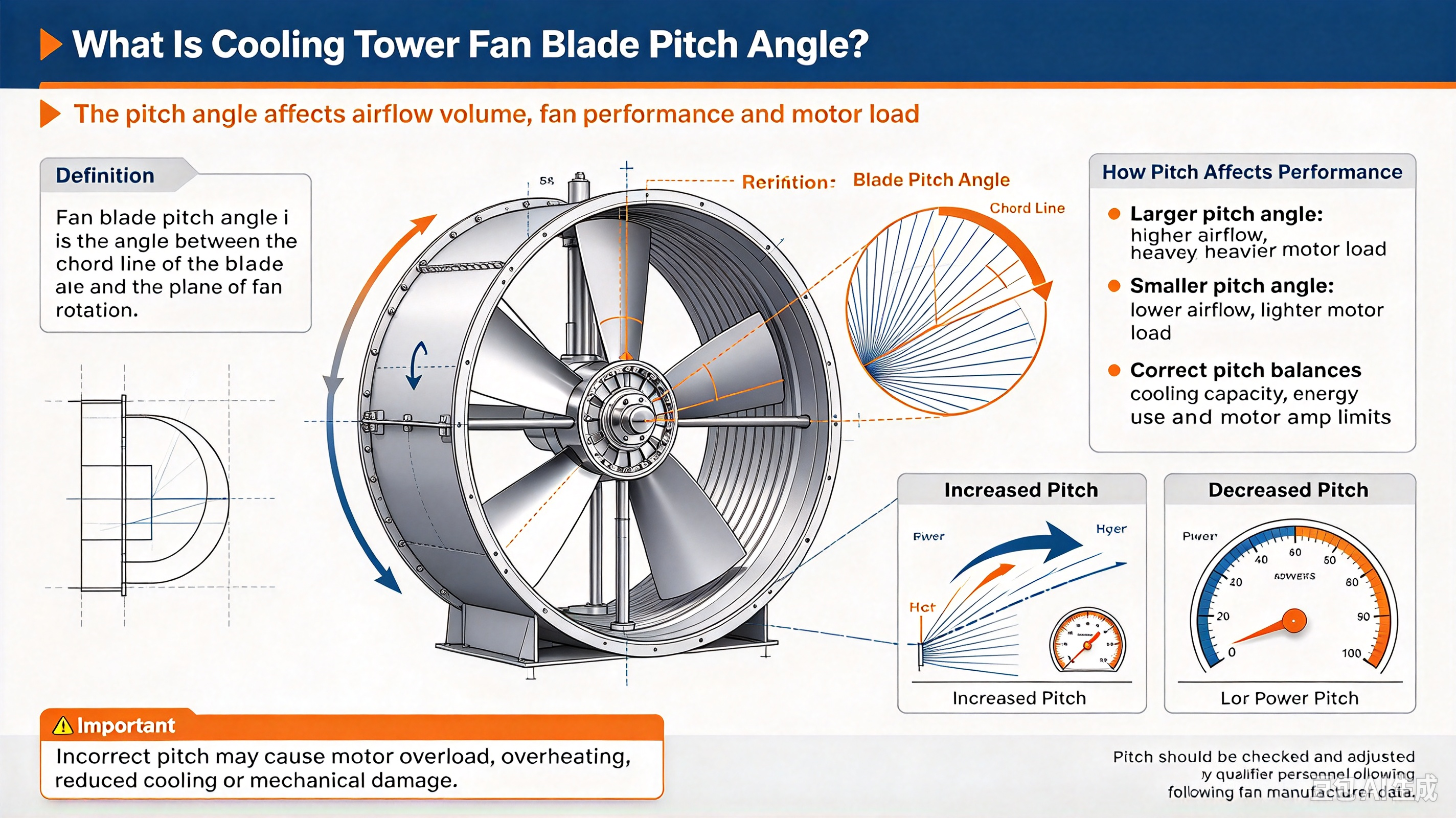
Cooling tower fan blade pitch angle describes the orientation of a fan blade relative to a defined reference plane or direction. In axial-flow cooling tower fans, the pitch angle influences how the rotating blades move air through the tower.
If the pitch angle is too low, airflow may be insufficient for the required cooling duty. If it is too high, the fan may consume excessive power and overload the motor.
The correct pitch angle depends on:
Fan model and blade geometry
Fan diameter and rotational speed
Motor capacity and operating limits
Cooling tower airflow requirements
Manufacturer specifications and measurement conventions
There is no universal pitch angle suitable for all cooling tower fans. Always confirm the specified target and measuring method for the installed fan.
2. Tools Required to Measure Fan Blade Pitch Angle
Choosing the correct tool helps improve measurement consistency.
| Measuring Tool | Main Function |
| Digital inclinometer | Measures the angle of a blade reference surface |
| Blade pitch gauge | Measures pitch according to a specified fan reference |
| Protractor or angle finder | Provides basic angular measurements |
| Tape measure | Identifies the specified radial measurement position |
| Marker and inspection sheet | Identifies blades and records measurements |
| Torque wrench | Tightens blade fasteners to the specified torque after adjustment |
A digital inclinometer is convenient for field inspections, but its reading is only meaningful when the gauge is aligned according to the manufacturer's measurement procedure. A displayed angle does not automatically represent the fan's specified pitch angle.
3. Safety Precautions Before Measuring
Cooling tower fan blade pitch must be measured with the fan safely shut down.
Before starting:
Stop the fan and isolate the electrical power supply.
Apply the site's lockout/tagout (LOTO) procedure.
Verify that unexpected startup is prevented.
Confirm that all fan movement has stopped.
Use appropriate access equipment and fall protection.
Inspect the work area and follow site safety requirements.
Never attempt to measure blade angles while the fan is rotating. Only rotate an isolated fan manually if the manufacturer's procedure permits it and the movement can be performed safely.
4. How to Measure Cooling Tower Fan Blade Pitch Angle Correctly
Step 1: Confirm the Manufacturer's Measurement Method
Before measuring, check the fan installation manual or maintenance documentation.
Manufacturers may define pitch relative to the plane of fan rotation, a blade chord reference, or a particular gauge orientation. These methods are not necessarily interchangeable.
Confirm the target pitch angle, measurement location, gauge alignment, and allowable blade-to-blade variation. Using the wrong reference can produce incorrect readings even when the measuring tool is accurate.
Step 2: Identify the Measurement Radius
The blade angle may vary from the root to the tip because of blade twist and aerodynamic design.
Locate the specified measurement radius, such as a defined distance from the hub or a stated percentage of the blade radius. Mark the same position on every blade.
Measuring different blades at different radial positions can create misleading differences.
Step 3: Position the Blade Safely
Position the first blade where it can be accessed securely. Ensure the blade is stationary and stable.
Identify the surface or reference line specified by the manufacturer. Avoid using a curved edge, damaged area, or arbitrary surface that does not correspond to the intended measurement method.
Step 4: Align the Measuring Tool
Place the pitch gauge or digital inclinometer against the designated blade reference surface.
Keep the tool aligned in the specified direction and orientation. If the manufacturer's procedure requires a reference fixture, use it rather than estimating the reference plane by eye.
Check that the tool is properly zeroed or calibrated according to its instructions.
Step 5: Record the First Blade Angle
Take the measurement and record the result against the blade number.
Include the fan identification, measurement radius, tool used, date, and target angle. If repeated readings differ, check the tool's positioning and repeat the measurement.
Step 6: Measure Every Blade Consistently
Repeat the same procedure for all blades.
Use the same measurement radius, gauge orientation, and reference method each time. Record every result instead of measuring only one blade and assuming the remaining blades match.
Consistent measurements help identify incorrect settings, installation differences, or potential blade mounting problems.
Step 7: Compare Measurements with Specifications
Compare each measured angle with the approved pitch setting and permitted tolerance for the specific fan model.
For example, an inspection sheet may contain the following fields:
| Blade No. | Measured Angle | Target Angle | Difference |
| 1 | Record actual value | Manufacturer's setting | Calculate |
| 2 | Record actual value | Manufacturer's setting | Calculate |
| 3 | Record actual value | Manufacturer's setting | Calculate |
| 4 | Record actual value | Manufacturer's setting | Calculate |
These are recording fields, not recommended angle values. Use actual measurements and manufacturer-approved specifications for the installed fan.
Step 8: Adjust and Recheck if Necessary
If any blade is outside the permitted range, follow the manufacturer's adjustment procedure.
Make controlled adjustments, tighten the fasteners to the specified torque, and remeasure every blade using the same method. Check the hub and blade mounting hardware for damage or looseness.
After the fan is safely returned to service, verify motor current, vibration, airflow, and cooling performance.

5. Common Mistakes When Measuring Fan Blade Pitch
Using the Wrong Reference Plane
An inclinometer measures its orientation relative to gravity or its own reference. That reading may not directly equal the manufacturer's defined fan pitch angle.
Solution: Follow the manufacturer's reference method and use the specified fixture or gauge orientation.
Measuring at Different Positions
Blade twist can cause different angles along the blade span.
Solution: Mark and use the same radial measurement position for every blade.
Ignoring Tool Calibration
An improperly zeroed or inaccurate measuring tool can produce misleading readings.
Solution: Check the tool's condition and calibration requirements before use.
Measuring Only One Blade
One blade's angle does not confirm that every blade is correctly installed.
Solution: Measure and record every blade individually.
Using a Generic Target Angle
Different fan designs require different pitch settings.
Solution: Obtain the correct setting and tolerance from the documentation for the exact fan model.
6. How Often Should Cooling Tower Fan Pitch Be Measured?
Inspection frequency depends on the fan design, operating environment, maintenance schedule, and manufacturer's recommendations.
Check blade pitch during:
Initial installation and commissioning
Scheduled preventive maintenance
Blade replacement or hub servicing
Investigations into reduced cooling performance
Troubleshooting abnormal vibration or motor current
Inspections following mechanical damage
Maintain a record of measurements over time. Changes in blade angles or operating conditions can help maintenance teams identify developing problems.
7. Why Accurate Fan Blade Pitch Measurement Matters
Correct measurement and adjustment can help cooling tower operators:
Maintain required airflow and cooling capacity
Avoid unnecessary motor loading
Control fan energy consumption
Identify uneven blade settings
Reduce risks associated with improper installation
Improve maintenance planning and operational reliability
However, blade pitch is only one factor affecting cooling tower performance. Dirty fill media, blocked air inlets, poor water distribution, incorrect fan rotation, and other mechanical problems can also reduce cooling efficiency.
8. Frequently Asked Questions
What Is the Correct Cooling Tower Fan Blade Pitch Angle?
The correct angle depends on the fan design, blade geometry, rotational speed, and operating requirements. Always use the manufacturer's specified value and measurement method.
Can I Use a Digital Inclinometer to Measure Fan Pitch?
Yes. A digital inclinometer can be useful when aligned according to the manufacturer's instructions. Its reading must be interpreted using the correct reference plane and measurement convention.
Should All Cooling Tower Fan Blades Have the Same Angle?
Blades generally need consistent settings within the manufacturer's specified tolerances. Some designs use specific measurement procedures or allowable variations, so consult the relevant documentation.
What Happens if Fan Blade Pitch Is Incorrect?
Incorrect pitch can cause insufficient airflow, excessive motor current, higher energy consumption, or uneven aerodynamic loading. The actual symptoms depend on the fan and operating conditions.
Can I Adjust the Pitch Without Measuring Every Blade?
Measuring every blade is the recommended practice. It helps identify differences and confirms that the final settings meet the manufacturer's requirements.
Conclusion
Correctly measuring cooling tower fan blade pitch angle requires the right tools, a consistent reference method, and accurate records. By following the manufacturer's instructions, measuring every blade at the same specified radius, and comparing the results with approved tolerances, maintenance teams can reduce adjustment errors and support reliable cooling tower operation.
For industrial cooling tower maintenance and retrofit projects, always verify fan specifications, blade compatibility, motor limits, and fastener requirements before making adjustments. Accurate measurement is an essential step toward safe operation, dependable cooling performance, and effective energy management.
Recommended internal links for CoolingTowerPart.com:


