Cooling Tower Fan Gearbox Types and Industrial Applications
A Cooling Tower Fan Gearbox is one of the most important mechanical components in an industrial cooling tower system. It transfers power from the electric motor to the cooling tower fan while reducing rotational speed and increasing the torque required to drive large fan blades.
In industrial cooling applications, cooling tower fans must operate reliably under continuous workloads, high humidity, temperature fluctuations, and sometimes corrosive environmental conditions. A properly selected gearbox helps maintain stable fan operation, improve transmission efficiency, and reduce unexpected equipment failures.
With the development of industrial cooling technology, cooling tower fan gearboxes are available in different configurations, transmission ratios, structural designs, and power capacities. Understanding these differences helps industrial buyers select suitable products for their cooling tower systems.
This article explores the main types of cooling tower fan gearboxes, their working principles, industrial applications, selection criteria, maintenance requirements, and future technology trends.
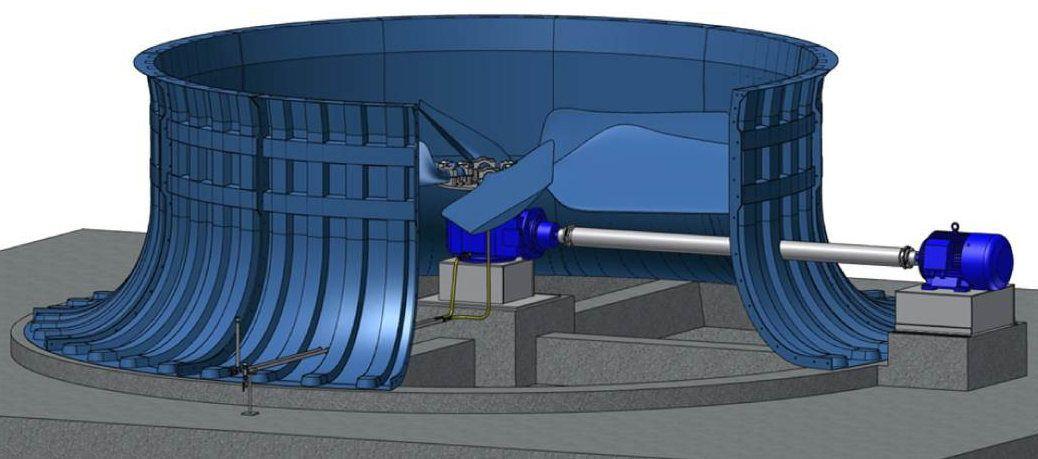
1. What Is a Cooling Tower Fan Gearbox?
A cooling tower fan gearbox is a mechanical speed reducer installed between the electric motor and the fan assembly.
Its primary function is to convert the high rotational speed of the motor into a lower rotational speed suitable for the cooling tower fan.
Most industrial cooling tower fans are large-diameter axial fans. They require sufficient torque to move large volumes of air through the cooling tower.
The gearbox makes it possible to operate these fans at the appropriate speed without requiring an electric motor with an extremely low rotational speed.
1.1 Main Functions of a Cooling Tower Fan Gearbox
A cooling tower fan gearbox performs several important functions.
Speed Reduction
Electric motors commonly operate at speeds higher than the required fan operating speed.
The gearbox reduces motor speed according to the selected transmission ratio.
For example, a gearbox with a reduction ratio of 10:1 reduces an input speed of 1,500 RPM to approximately 150 RPM, assuming the stated ratio represents the actual reduction.
Torque Increase
When rotational speed decreases, output torque increases, allowing the fan to drive large blades.
This is particularly important for industrial cooling towers with large fan diameters and substantial airflow requirements.
Power Transmission
The gearbox transfers mechanical power from the motor to the fan shaft.
A properly designed transmission system helps maintain stable operation and minimize unnecessary mechanical losses.
1.2 Main Components of a Cooling Tower Fan Gearbox
A typical cooling tower fan gearbox consists of several mechanical components.
Component | Main Function |
Gear housing | Protects internal transmission components |
Input shaft | Receives power from the motor |
Output shaft | Transfers power to the fan |
Gears | Reduce rotational speed and increase torque |
Bearings | Support rotating shafts |
Lubrication system | Reduces friction and wear |
Seals | Prevent lubricant leakage and contamination |
Waterproof components | Help protect against moisture intrusion |
The quality of these components directly affects gearbox performance, operating stability, and service life.
2. Main Types of Cooling Tower Fan Gearboxes
Different cooling tower designs require different gearbox configurations.
The selection depends on fan diameter, motor power, installation space, operating speed, transmission requirements, and maintenance conditions.
2.1 Right-Angle Cooling Tower Fan Gearbox
A right-angle gearbox is one of the common configurations used in mechanical cooling tower fan drive systems.
It changes the direction of power transmission, typically through 90 degrees.
This arrangement is suitable for cooling tower structures where the motor and fan shaft are positioned at right angles.
Working Principle
The gearbox receives rotational power from the motor through its input shaft.
Internal bevel gears or spiral bevel gears transfer the power to the output shaft while reducing rotational speed.
The output shaft then drives the cooling tower fan assembly.
Main Advantages
Compact transmission arrangement
Convenient motor and fan shaft positioning
Suitable for many industrial cooling tower designs
Efficient power transmission when properly selected
Available in different reduction ratios
Industrial Applications
Right-angle cooling tower fan gearboxes are commonly considered for:
Counterflow cooling towers
Crossflow cooling towers
Industrial water cooling systems
Power plant cooling towers
Petrochemical cooling installations
2.2 Bevel Gear Cooling Tower Fan Gearbox
Bevel gearboxes use gears with intersecting shaft arrangements to transmit power between different directions.
Spiral bevel gears are often used where smooth transmission and suitable load capacity are required.
Key Characteristics
Bevel gear transmission is suitable for applications requiring a change in the direction of the drive.
Important design factors include gear tooth geometry, material strength, lubrication, and manufacturing precision.
Benefits of Bevel Gear Transmission
Efficient power transmission.
Compact shaft arrangement.
Suitable for high-torque applications.
Smooth operation with properly manufactured gears.
Flexible installation configurations.
Where Are Bevel Gearboxes Used?
They can be used in industrial cooling tower fan systems where the drive arrangement requires a right-angle transmission.
2.3 Helical Gear Cooling Tower Fan Gearbox
Helical gearboxes use gears with angled teeth that engage progressively during rotation.
This design can provide smoother engagement and lower noise compared with some conventional straight-tooth gear arrangements.
Main Advantages
Smooth gear engagement
High load-carrying capability when properly designed
Stable transmission performance
Suitable for continuous industrial operation
Available in different configurations
Industrial Applications
Helical gear technology is widely used in industrial speed reducers.
Depending on the shaft arrangement and gearbox design, it can be applied to cooling tower drive systems and other industrial transmission equipment.
2.4 Worm Gear Cooling Tower Fan Gearbox
Worm gearboxes use a worm screw and worm wheel to transmit power.
They provide significant speed reduction in a compact structure.
Main Characteristics
Compact construction
Large reduction ratios in a single stage
Different shaft arrangement
Potentially high friction losses
Heat generation that requires careful management
Are Worm Gearboxes Suitable for Cooling Tower Fans?
Worm gearboxes are not the default choice for many large industrial cooling tower fan drives.
Their efficiency and thermal performance must be carefully evaluated, especially in continuous-duty, high-power applications.
For large cooling tower fans, other gear arrangements may offer more suitable efficiency and load characteristics.
2.5 Customized Cooling Tower Fan Gearbox
Some industrial cooling towers require special gearbox configurations because of their existing structures or operating conditions.
Customized gearboxes can be designed according to specific project requirements.
Common Customization Parameters
Customized solutions are particularly useful for cooling tower replacement projects where the original gearbox model is no longer available.
3. Cooling Tower Fan Gearbox Types by Transmission Structure
Besides gear tooth design, cooling tower fan gearboxes can also be classified according to their transmission structure.
3.1 Single-Stage Gearbox
A single-stage gearbox uses one gear reduction stage to achieve the required speed reduction.
Advantages
Relatively simple structure
Fewer transmission components
Convenient maintenance
Compact construction for suitable ratios
Applications
Single-stage gearboxes may be used in cooling tower fan systems where the required speed reduction can be achieved within the design limits of one gear stage.
3.2 Two-Stage Gearbox
A two-stage gearbox uses two gear reduction stages.
Each stage contributes to the overall transmission ratio.
Main Benefits
Can achieve larger reduction ratios
Offers flexible transmission design
Suitable for specific speed and torque requirements
Industrial Applications
Two-stage gearboxes may be selected for industrial cooling tower systems requiring particular motor speeds and fan operating speeds.
3.3 Vertical Shaft Gearbox
Vertical shaft gearboxes are designed for drive systems where the output shaft is arranged vertically.
This configuration is commonly associated with induced-draft cooling tower fans installed above the fan deck.
Important Design Considerations
The gearbox must be selected according to the actual fan assembly and cooling tower structure.
4. Industrial Applications of Cooling Tower Fan Gearboxes
Cooling tower fan gearboxes are widely used in industries that require continuous heat rejection.
Different applications have different requirements for power transmission, operating reliability, and maintenance.
4.1 Power Generation Industry
Power plants use large cooling tower systems to remove heat from circulating water.
Cooling tower fans provide the airflow required for effective heat exchange.
Why Is Gearbox Reliability Important in Power Plants?
Power generation facilities often operate for extended periods.
A gearbox failure can reduce cooling capacity and potentially affect the operation of associated equipment.
Important gearbox requirements include:
High load-carrying capacity
Stable continuous operation
Reliable lubrication
Effective heat dissipation
Low vibration
Convenient maintenance
4.2 Petrochemical and Chemical Industries
Chemical and petrochemical plants require reliable cooling systems for different production processes.
Cooling towers help maintain suitable operating temperatures for industrial equipment.
Special Operating Requirements
Gearboxes used in these facilities may need to withstand:
High ambient temperatures
High humidity
Corrosive atmospheres
Continuous operating loads
Demanding maintenance schedules
Selecting suitable housing protection, seals, bearings, and lubricants is essential.
4.3 Steel and Metallurgical Industry
Steel production generates substantial heat during manufacturing and processing.
Cooling tower systems support equipment cooling and industrial water circulation.
Gearbox Requirements
Steel plants often require heavy-duty cooling tower fan gearboxes capable of handling demanding operating conditions.
Important considerations include mechanical strength, thermal stability, and resistance to vibration.
4.4 Commercial HVAC Systems
Large commercial buildings use cooling towers as part of central air-conditioning systems.
Hotels, shopping centers, hospitals, and office buildings may use mechanical cooling tower fans to reject heat.
Important Product Requirements
Commercial applications may place greater emphasis on operating noise and energy consumption.
4.5 Data Center Cooling Systems
Data centers require reliable thermal management to protect servers and computing equipment.
Cooling towers can support heat rejection in facilities using suitable water-based cooling architectures.
Future Demand for Cooling Tower Gearboxes
As data center infrastructure expands, demand for reliable cooling equipment may create additional opportunities for gearbox manufacturers.
Gearboxes used in these applications must support stable fan operation and continuous-duty requirements.
5. How to Select the Right Cooling Tower Fan Gearbox?
Selecting the correct gearbox is essential for ensuring cooling tower performance and mechanical reliability.
A gearbox that is incorrectly sized may experience overheating, excessive vibration, premature wear, or mechanical failure.
5.1 Determine the Required Motor Power
The first step is to identify the motor power required by the cooling tower fan.
Motor power is usually expressed in kilowatts (kW) or horsepower (HP).
The gearbox must have sufficient rated capacity for the actual operating conditions.
Why Is Service Factor Important?
The service factor accounts for operating conditions and additional mechanical demands.
A gearbox operating under continuous industrial loads may require a different design margin from equipment operating intermittently.
Buyers should follow the gearbox manufacturer's selection guidelines and applicable engineering standards.
5.2 Calculate the Required Gear Ratio
The gear ratio determines the relationship between input and output rotational speeds.
The basic formula is:
\[ i=\frac{n_1}{n_2} \]
Where:
\(i\) = Gear reduction ratio
\(n_1\) = Input speed (RPM)
\(n_2\) = Output speed (RPM)
For example, if the motor input speed is 1,500 RPM and the required fan speed is 150 RPM:
\[ i=\frac{1500}{150}=10 \]
The required reduction ratio is 10:1.
The actual selection should also consider fan aerodynamic performance, motor characteristics, and gearbox operating limits.
5.3 Evaluate Output Torque Requirements
The gearbox must provide sufficient output torque to drive the fan.
The approximate relationship between power, speed, and torque is:
\[ T=\frac{9550P}{n} \]
Where:
For example, if the gearbox output power is 15 kW and the output speed is 150 RPM:
\[ T=\frac{9550\times15}{150}=955 \]
The approximate output torque is 955 N·m.
Actual gearbox selection must account for transmission efficiency, service factor, operating conditions, and applicable load requirements.
5.4 Check Installation Dimensions
Physical compatibility is especially important when replacing an existing cooling tower gearbox.
Important Dimensions to Confirm
Technical drawings should be reviewed before production or ordering.
5.5 Consider Operating Environment
Cooling tower gearboxes often operate in humid environments.
Moisture, temperature changes, and airborne contaminants can affect gearbox performance.
Buyers should evaluate housing protection, shaft seals, lubrication systems, and corrosion protection according to the installation environment.
6. Common Cooling Tower Fan Gearbox Problems and Solutions
Even high-quality gearboxes require proper installation, lubrication, and maintenance.
Understanding common problems helps operators reduce unexpected shutdowns.
6.1 Gearbox Overheating
Overheating is a common warning sign of gearbox operating problems.
Possible Causes
Insufficient lubrication
Incorrect lubricant viscosity
Excessive mechanical load
Misalignment
Internal gear damage
Inadequate heat dissipation
Recommended Solutions
Check lubricant level.
Verify the recommended oil specification.
Inspect operating loads.
Check shaft alignment.
Examine the cooling and ventilation conditions.
Contact a qualified technician if overheating continues.
6.2 Excessive Gearbox Vibration
Abnormal vibration may indicate mechanical problems.
Common Causes
Incorrect installation
Shaft misalignment
Worn bearings
Damaged gear teeth
Fan imbalance
Loose mounting bolts
How to Reduce Gearbox Vibration
Inspect the complete drive system rather than focusing only on the gearbox.
Fan blade balancing, shaft alignment, coupling inspection, and mounting checks are all important.
6.3 Lubricant Leakage
Lubricant leakage can reduce internal lubrication and damage gearbox components.
Common Causes
Damaged oil seals
Loose connections
Excessive oil filling
Housing damage
Incorrect installation
Regular inspections can help identify leakage before it causes serious mechanical problems.
6.4 Unusual Noise During Operation
Abnormal gearbox noise may indicate internal wear or improper operating conditions.
Potential causes include:
Operators should investigate unusual noise promptly and avoid continued operation if serious mechanical damage is suspected.
7. Cooling Tower Fan Gearbox Maintenance Tips
Regular maintenance helps improve gearbox reliability and extend equipment service life.
7.1 Check Lubricant Regularly
Lubrication is essential for reducing friction and protecting gear teeth and bearings.
Important Lubrication Practices
Use the lubricant recommended by the manufacturer.
Maintain the correct oil level.
Replace oil according to the maintenance schedule.
Check for water contamination.
Inspect lubricant condition and appearance.
The correct oil type and replacement interval depend on gearbox design and operating conditions.
7.2 Inspect Bearings and Seals
Bearings support rotating shafts and help maintain stable mechanical operation.
Damaged bearings may cause excessive vibration, noise, and overheating.
Seals should also be checked to prevent lubricant leakage and moisture contamination.
7.3 Monitor Operating Temperature
Regular temperature monitoring helps identify possible lubrication or mechanical problems.
Unexpected temperature increases should be investigated before they lead to serious equipment damage.
7.4 Inspect the Fan Drive System
A cooling tower fan gearbox operates as part of a complete mechanical system.
Maintenance should also include:
Fan blade inspection
Hub connection inspection
Coupling inspection
Motor mounting inspection
Shaft alignment
Dynamic balancing when required
8. How to Identify a Reliable Cooling Tower Fan Gearbox Manufacturer?
Choosing a reliable manufacturer is important for industrial buyers who need stable equipment performance and long-term technical support.
8.1 Evaluate Manufacturing Experience
A professional gearbox manufacturer should understand industrial transmission requirements and cooling tower operating conditions.
Buyers should review manufacturing capabilities, product specifications, and previous industrial applications.
8.2 Check Gearbox Materials and Manufacturing Quality
Gearbox performance depends on the quality of internal gears, shafts, bearings, seals, and housing materials.
Important Quality Factors
8.3 Request Technical Drawings and Specifications
Before purchasing, buyers should request detailed technical information.
This helps confirm whether the gearbox matches the existing cooling tower fan system.
8.4 Compare Total Ownership Costs
The purchase price is only one part of the overall cost.
Industrial buyers should also consider energy efficiency, maintenance expenses, spare parts availability, expected service life, and technical support.
9. Future Trends in Cooling Tower Fan Gearbox Technology
The cooling tower gearbox industry is developing alongside improvements in industrial transmission technology.
Several trends are expected to influence future product development.
9.1 Higher Transmission Efficiency
Manufacturers are focusing on improving gear tooth profiles, reducing friction, and optimizing internal mechanical structures.
These improvements can help reduce transmission losses and improve operating efficiency.
9.2 Improved Corrosion and Moisture Protection
Cooling tower environments expose mechanical equipment to moisture and temperature changes.
Future gearbox designs will continue to emphasize improved sealing, protective coatings, and durable housing structures.
9.3 Intelligent Condition Monitoring
Industrial operators are increasingly interested in monitoring gearbox conditions through sensors and digital systems.
Important Monitoring Parameters
Vibration levels
Oil temperature
Bearing temperature
Operating speed
Lubricant condition
Mechanical load
These technologies can help identify potential failures and support predictive maintenance.
9.4 Customized Gearbox Solutions
Different cooling tower manufacturers and industrial projects have different transmission requirements.
Customized gearbox solutions will remain important for replacement projects and specialized cooling tower installations.
10. Why Choose Power Tower Cooling Technology (Shaoxing) Co., Ltd?
Selecting suitable cooling tower components is essential for maintaining reliable cooling system operation.
Power Tower Cooling Technology (Shaoxing) Co., Ltd focuses on cooling tower products and related industrial components, supporting customers involved in cooling tower construction, maintenance, and replacement projects.
10.1 Cooling Tower Transmission Component Solutions
Cooling tower fan systems require compatible mechanical components to transfer power effectively.
Gearboxes, motors, fan hubs, and blades must work together according to the required operating specifications.
10.2 Support for Cooling Tower Replacement Projects
Replacement projects often require accurate measurements and compatibility checks.
Customers should confirm gearbox ratios, mounting dimensions, shaft configurations, and operating parameters before selecting replacement products.
10.3 Customized Industrial Cooling Tower Products
Different industrial cooling towers require different component specifications.
Working with a supplier that understands cooling tower applications can help buyers identify suitable product configurations for their projects.
11. Conclusion
A Cooling Tower Fan Gearbox plays a critical role in the operation of industrial cooling tower systems.
Different gearbox types, including bevel gear, helical gear, worm gear, and customized transmission configurations, offer different performance characteristics and application advantages.
Selecting the right gearbox requires careful consideration of motor power, reduction ratio, output torque, installation dimensions, lubrication, and operating conditions.
As industrial cooling requirements continue to increase, cooling tower fan gearbox technology will continue to develop toward higher transmission efficiency, improved reliability, better environmental protection, and intelligent condition monitoring.
For industrial buyers, selecting a suitable gearbox and working with a reliable supplier can help improve cooling tower performance, reduce maintenance costs, and support long-term equipment operation.
FAQ About Cooling Tower Fan Gearboxes
1. What Is the Main Function of a Cooling Tower Fan Gearbox?
A cooling tower fan gearbox reduces motor rotational speed and increases output torque to drive the cooling tower fan at the required operating speed.
2. What Types of Cooling Tower Fan Gearboxes Are Available?
Common gearbox configurations include right-angle gearboxes, bevel gearboxes, helical gearboxes, worm gearboxes, and customized industrial speed reducers.
3. What Is the Typical Gear Ratio of a Cooling Tower Fan Gearbox?
The gear ratio depends on motor speed and required fan speed. It must be calculated according to the actual cooling tower fan specifications rather than selected using a universal value.
4. How Often Should a Cooling Tower Fan Gearbox Be Maintained?
Maintenance frequency depends on gearbox design, operating hours, lubricant type, and environmental conditions. Operators should follow the manufacturer's maintenance recommendations and inspect the equipment regularly.
5. Why Does a Cooling Tower Fan Gearbox Overheat?
Common causes include insufficient lubrication, excessive load, incorrect lubricant viscosity, shaft misalignment, and internal mechanical damage.
6. How Can I Choose the Right Cooling Tower Fan Gearbox?
Consider motor power, input speed, output speed, reduction ratio, torque requirements, mounting dimensions, lubrication requirements, and operating conditions.
7. What Causes Cooling Tower Fan Gearbox Vibration?
Possible causes include shaft misalignment, damaged bearings, worn gears, fan imbalance, loose mounting bolts, and incorrect installation.
8. Can a Cooling Tower Fan Gearbox Be Customized?
Yes. Depending on the manufacturer's capabilities, gearboxes can be customized according to power, reduction ratio, shaft dimensions, mounting configuration, and other project requirements.


