A cooling tower plays an essential role in industrial cooling systems by removing excess heat from circulating water and maintaining stable operating temperatures. However, have you ever wondered what keeps the air moving through a cooling tower and makes the heat rejection process possible? One of the most important components is the cooling tower axial fan.
The axial fan provides the airflow required for effective heat and mass transfer inside the cooling tower. Its performance directly influences cooling efficiency, energy consumption, operating stability, and equipment service life. Whether you operate an industrial cooling tower, manage an HVAC system, or purchase replacement cooling tower components, choosing the right axial fan is an important decision.
Today, cooling tower axial fans are available in different materials, diameters, blade configurations, and performance specifications. FRP, aluminum alloy, and stainless steel are among the commonly considered materials, while fixed-pitch and adjustable-pitch designs offer different installation and operating characteristics.
So, how do you choose the right cooling tower axial fan? What specifications should you check before purchasing? And when should you replace an existing fan?
In this guide, Power Tower Cooling Technology (Shaoxing) Co.,Ltd explains the main types, functions, materials, specifications, selection methods, and maintenance considerations of cooling tower axial fans to help you make a more informed decision.
1. What Is a Cooling Tower Axial Fan?
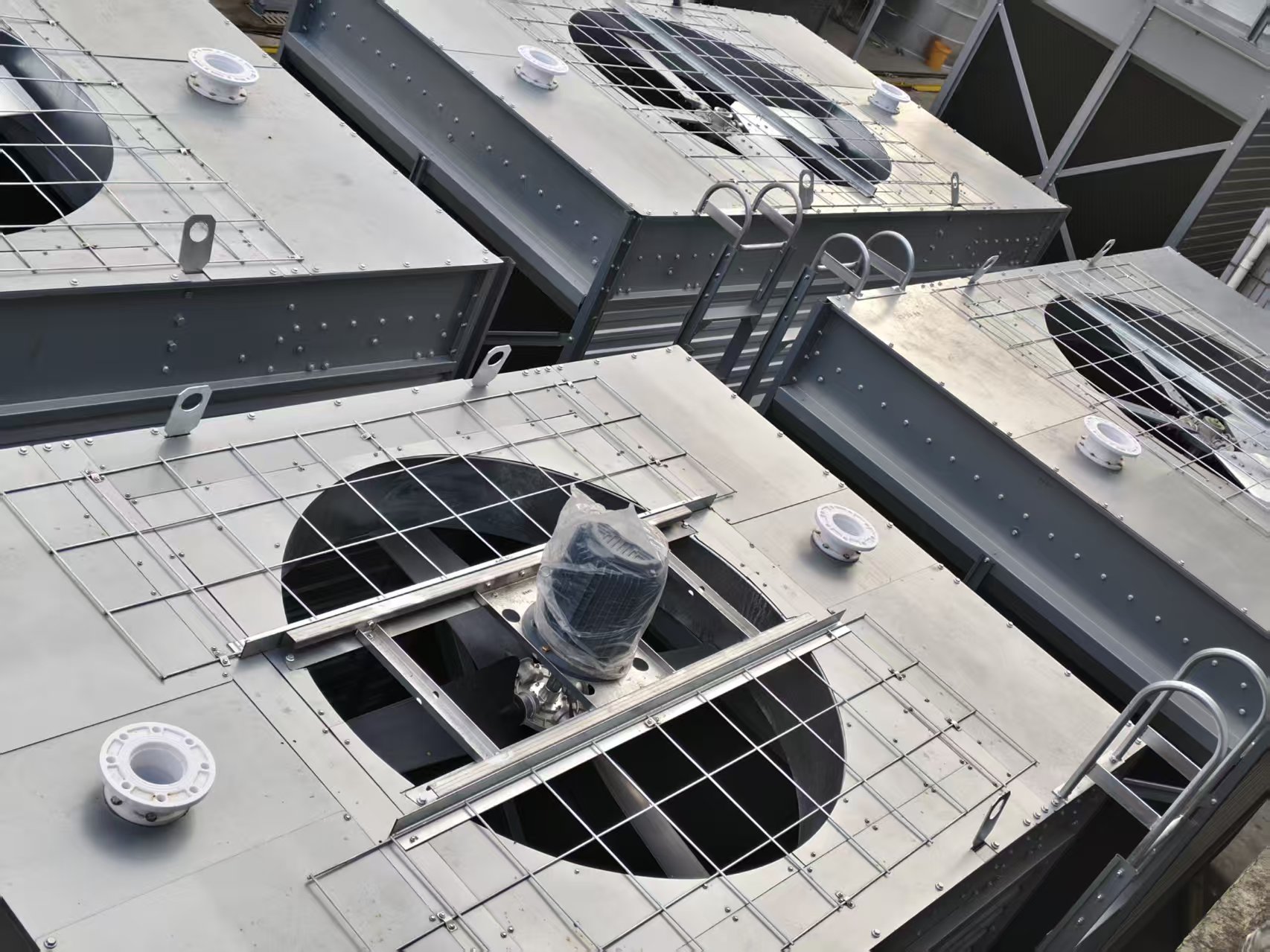
A cooling tower axial fan is a mechanical ventilation device designed to move large volumes of air through a cooling tower. It uses rotating blades to generate airflow primarily parallel to the fan shaft.
You can think of an axial fan as a large industrial propeller. When its blades rotate, they create a pressure difference that moves air through the cooling tower.
In most mechanical-draft cooling towers, axial fans are installed near the top of the tower. They draw warm, humid air through the cooling tower fill and discharge it into the atmosphere. At the same time, fresh air enters through the tower's air inlets.
This continuous airflow supports the heat exchange process between circulating water and air.
Cooling tower axial fans are widely used in:
Industrial cooling towers
HVAC cooling systems
Power generation facilities
Chemical processing plants
Petrochemical facilities
Steel manufacturing plants
Food and beverage factories
Industrial refrigeration systems
Compared with many other fan designs, axial fans can move large volumes of air through relatively compact installations. This makes them particularly suitable for mechanical-draft cooling towers.
1.1 How Does a Cooling Tower Axial Fan Work?
The working principle of an axial fan is relatively simple.
First, an electric motor supplies mechanical power to the fan shaft or drive system. The shaft rotates the fan hub and blades. As the blades move through the air, their aerodynamic shape generates a pressure difference.
This pressure difference pushes or pulls air along the fan axis.
In an induced-draft cooling tower, the fan is normally installed at the top of the structure. It draws air through the fill section and discharges heated, moisture-laden air upward.
Meanwhile, hot water is distributed over the cooling tower fill. As air passes through the fill, part of the water evaporates and carries heat away.
The fan does not directly cool the water. Instead, it provides the airflow needed to support the cooling process.
This is why fan selection and cooling tower fill selection should always be considered together.
1.2 Main Components of a Cooling Tower Axial Fan
A typical cooling tower axial fan consists of several important components. Each one contributes to the fan's performance and operating reliability.
| Component | Main Function |
| Fan Blades | Generate airflow through aerodynamic movement |
| Fan Hub | Connects and supports the blades |
| Fan Shaft | Transfers rotational power |
| Electric Motor | Provides mechanical driving power |
| Gearbox or Drive System | Transfers and adjusts rotational speed where applicable |
| Fan Cylinder | Guides airflow and provides installation clearance |
| Supporting Structure | Holds the fan assembly in position |
The quality of these components affects overall fan performance.
For example, an improperly designed blade can increase power consumption, while an unbalanced fan assembly may cause excessive vibration and premature bearing damage.
Therefore, evaluating the complete fan assembly is more important than looking at the blades alone.
2. Main Functions of Cooling Tower Axial Fans
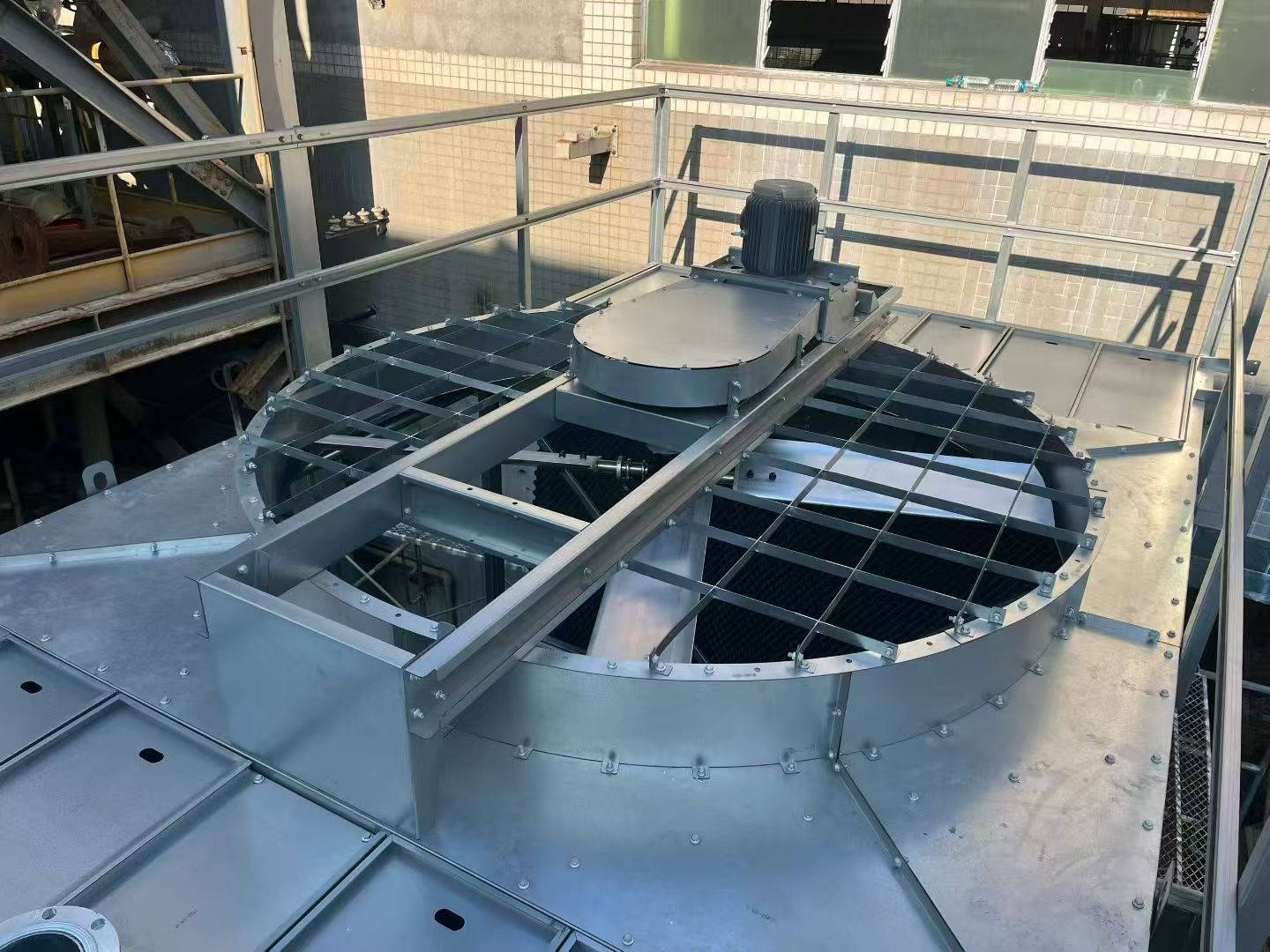
A cooling tower axial fan performs several essential functions. Its performance directly affects airflow distribution, cooling capacity, energy consumption, and operating stability.
2.1 Providing Consistent Airflow
The primary function of an axial fan is to move air through the cooling tower.
Consistent airflow allows the tower to maintain suitable air-water contact conditions. If airflow is too low, the cooling process may become less effective, and the cooling tower may struggle to achieve its required outlet water temperature.
On the other hand, excessive airflow can increase electricity consumption without providing a proportional improvement in cooling performance.
The objective is to achieve the required airflow at the design operating point.
2.2 Improving Heat Transfer Efficiency
Cooling tower performance depends on the interaction between hot water and moving air.
When air passes through the fill, it absorbs heat and moisture from the circulating water. This process reduces the water temperature before it returns to the industrial cooling system.
A properly selected axial fan helps maintain the airflow required for this heat transfer process.
However, airflow is only one part of the equation. Water distribution, fill condition, ambient wet-bulb temperature, and water loading also influence cooling tower performance.
2.3 Supporting Stable Cooling Tower Operation
A well-matched fan helps the cooling tower operate under stable conditions.
Incorrect fan selection can result in:
Insufficient airflow
Excessive motor loading
High vibration
Increased noise
Uneven air distribution
Reduced cooling capacity
A suitable fan assembly helps reduce these risks and supports long-term industrial operation.
3. Different Types of Cooling Tower Axial Fans
Cooling tower axial fans are available in different designs and configurations. The best choice depends on the cooling tower structure, airflow requirements, environmental conditions, and maintenance expectations.
3.1 FRP Cooling Tower Axial Fans
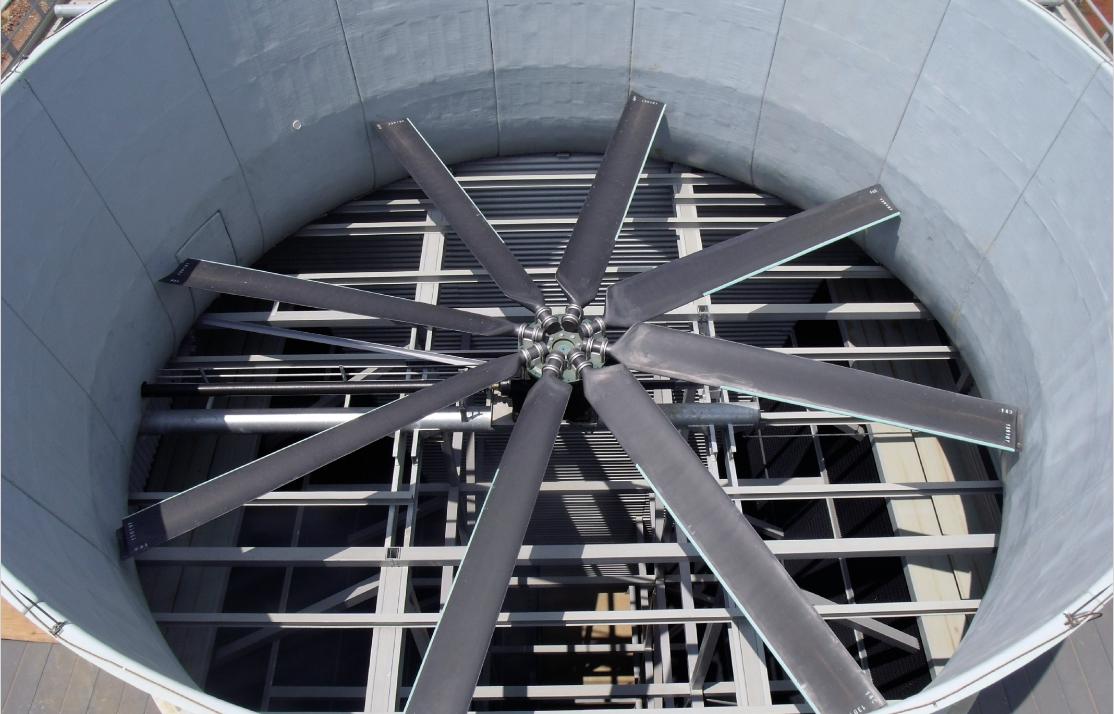
FRP stands for fiberglass reinforced plastic. These fans use composite materials reinforced with glass fibers to provide strength and corrosion resistance.
FRP cooling tower axial fans are popular in industrial applications because they offer several advantages:
Lightweight construction
Good corrosion resistance
High strength-to-weight ratio
Low maintenance requirements
Flexible aerodynamic design
Because cooling towers operate in humid environments, corrosion resistance is particularly important.
FRP blades are suitable for many industrial cooling tower installations, especially where moisture and water treatment chemicals may affect conventional metal components.
However, the resin system, fiber structure, manufacturing quality, and operating temperature must be considered when selecting FRP blades.
3.2 Aluminum Alloy Cooling Tower Axial Fans
Aluminum alloy fans are another common option for cooling tower applications.
They combine relatively low weight with good mechanical strength and can be manufactured into aerodynamic blade profiles.
Their main advantages include:
Aluminum alloy fans may be suitable for facilities that require metal fan blades with manageable weight.
However, aluminum can be affected by certain corrosive environments. Protective coatings and suitable alloy selection may be necessary.
3.3 Stainless Steel Cooling Tower Axial Fans
Stainless steel axial fans are designed for applications where mechanical strength and corrosion resistance are important considerations.
They may be used in demanding industrial environments, depending on the stainless steel grade and operating conditions.
Their advantages include:
However, stainless steel is generally heavier than FRP and aluminum alloy.
The increased weight may require stronger supporting components and careful consideration of motor loading.
3.4 Adjustable Pitch and Fixed Pitch Axial Fans
Cooling tower axial fans can also be classified according to blade pitch design.
Adjustable pitch fans allow the blade angle to be changed to achieve different aerodynamic operating conditions. This flexibility can be useful when adjusting fan performance to match a cooling tower's airflow requirements.
Fixed pitch fans use a predetermined blade angle. Their design is generally simpler and may require less adjustment during installation.
| Feature | Adjustable Pitch Fan | Fixed Pitch Fan |
| Blade Angle | Can be adjusted | Fixed |
| Performance Adjustment | More flexible | Limited |
| Installation | Requires accurate setting | Generally simpler |
| Maintenance | Pitch settings need inspection | Fewer adjustment points |
| Application | Systems requiring configuration flexibility | Stable design operating conditions |
The correct option depends on whether the cooling tower requires adjustable airflow or operates under relatively consistent conditions.
4. Cooling Tower Axial Fan Materials
Material selection is one of the most important parts of choosing a cooling tower axial fan.
A cooling tower operates in a challenging environment. High humidity, circulating water, airborne contaminants, and chemical treatment can all influence component service life.
The following table provides a practical comparison of commonly considered materials.
| Material | Main Advantages | Potential Limitations | Typical Applications |
| FRP | Lightweight, corrosion-resistant | Depends on resin and manufacturing quality | Industrial cooling towers |
| Aluminum Alloy | Lightweight, good strength | May require surface protection | HVAC and industrial towers |
| Stainless Steel | High strength, corrosion resistance | Higher weight and cost | Demanding industrial environments |
4.1 Fiberglass Reinforced Plastic
FRP is particularly attractive for cooling tower applications because it combines structural strength with corrosion resistance.
It can also be molded into different aerodynamic shapes.
When purchasing FRP blades, buyers should check the material specification, manufacturing consistency, blade thickness, connection design, and suitability for the intended operating environment.
4.2 Aluminum Alloy
Aluminum alloy is suitable where lightweight metal construction is preferred.
However, the specific alloy and surface treatment matter. Not all aluminum materials provide the same resistance to moisture and chemical exposure.
4.3 Stainless Steel
Stainless steel can be appropriate for installations with demanding mechanical requirements.
Buyers should identify the required stainless steel grade rather than simply specifying stainless steel without further details.
5. Key Specifications of Cooling Tower Axial Fans
Before purchasing a cooling tower axial fan, you should understand its main technical specifications.
These parameters help determine whether the fan can meet the cooling tower's operating requirements.
5.1 Fan Diameter
Fan diameter refers to the overall diameter of the rotating blade assembly.
It affects the fan's airflow capability and installation compatibility.
A larger fan diameter may provide greater airflow at a given rotational speed, but actual performance depends on blade geometry, pitch, motor speed, and system resistance.
You should never select a fan diameter based only on the cooling tower's nominal capacity.
The available fan cylinder dimensions and installation clearances must also be checked.
5.2 Airflow Capacity
Airflow capacity describes the volume of air moved by the fan over a given period.
It is commonly expressed in:
Cubic meters per hour (m³/h)
Cubic meters per second (m³/s)
Cubic feet per minute (CFM)
Airflow is one of the most important parameters when matching a replacement fan.
An undersized fan may fail to provide sufficient ventilation. An oversized fan may create unnecessary power consumption or operating problems.
5.3 Rotational Speed
Fan rotational speed is usually measured in revolutions per minute (RPM).
It influences airflow, pressure development, noise, and power requirements.
Increasing fan speed does not automatically mean better cooling.
For geometrically similar fans operating under comparable conditions, fan affinity laws provide useful relationships:
Airflow is approximately proportional to rotational speed.
Pressure is approximately proportional to rotational speed squared.
Power is approximately proportional to rotational speed cubed.
These relationships are useful for preliminary engineering analysis, but actual performance must be verified against the fan curve and system operating conditions.
5.4 Motor Power
Motor power indicates the mechanical power required to drive the fan.
It is commonly expressed in kilowatts (kW).
The required motor power depends on airflow, pressure, fan efficiency, and operating conditions.
A suitable motor should provide sufficient capacity without operating beyond its rated limits.
When replacing a fan, confirm motor power, voltage, frequency, RPM, and the drive arrangement.
5.5 Static Pressure
Static pressure represents the resistance the fan must overcome while moving air through the cooling tower.
This resistance comes from components such as:
Air inlet openings
Cooling tower fill
Drift eliminators
Fan cylinder
Air discharge structures
A fan that provides sufficient airflow under low resistance may not perform as expected when installed in a system with higher resistance.
That is why airflow and static pressure should always be evaluated together.
6. How to Choose the Right Cooling Tower Axial Fan
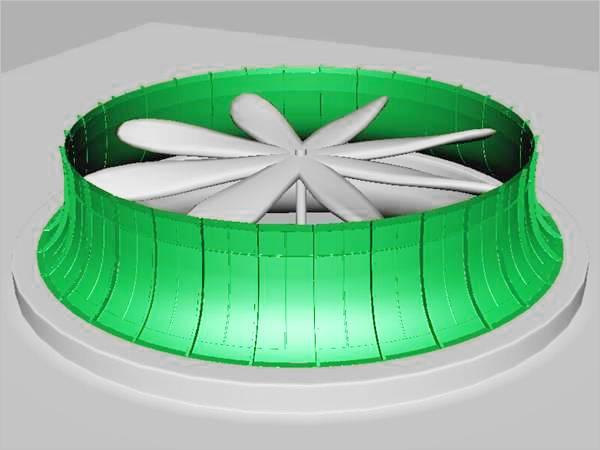
Choosing the right cooling tower axial fan requires more than comparing product prices.
You need to match the fan's performance with the cooling tower's design and operating conditions.
Here are five important steps to help you make the right decision.
6.1 Identify Cooling Tower Requirements
Start by identifying the existing cooling tower information.
Useful details include:
Cooling tower manufacturer and model
Cooling capacity
Number of fan cells
Fan cylinder diameter
Existing fan diameter
Required airflow
Operating water temperature
Ambient wet-bulb temperature
If you are replacing an existing fan, collecting the original equipment information can make the process much easier.
6.2 Calculate Required Airflow
Airflow requirements should be determined according to the cooling tower's thermal design.
A simplified starting point is to consider the heat balance:
Q = m × Cp × ΔT
Where:
Q = heat removed from water
m = water mass flow rate
Cp = specific heat capacity of water
ΔT = water temperature reduction
This equation estimates the sensible heat reduction in the water. It does not independently determine the required fan airflow because evaporation and mass transfer also contribute significantly to cooling tower performance.
For accurate fan selection, use the cooling tower manufacturer's design data or a qualified thermal and aerodynamic calculation.
6.3 Select the Right Fan Material
Consider the environmental conditions before selecting a material.
For example:
FRP is attractive for lightweight, corrosion-resistant construction.
Aluminum alloy may be suitable when lightweight metal blades are preferred.
Stainless steel can be considered for applications requiring specific mechanical and corrosion properties.
The right choice depends on water chemistry, ambient environment, temperature, and maintenance expectations.
6.4 Match the Fan with the Motor and Drive System
The fan, motor, and drive system must work together.
Check the following information:
Motor power and rated speed.
Electrical voltage and frequency.
Gearbox ratio or belt drive arrangement.
Shaft and hub compatibility.
Rotation direction.
Maximum allowable fan speed.
A replacement fan should not simply be installed because its diameter matches the original equipment.
The complete drive arrangement and aerodynamic operating point must also be compatible.
6.5 Consider Operating Conditions
Different industries have different operating environments.
A cooling tower in a chemical plant may face more aggressive chemical exposure than one installed in a commercial HVAC system.
Consider the following factors:
A fan selected according to actual site conditions is more likely to deliver reliable long-term performance.
7. Cooling Tower Axial Fan vs. Centrifugal Fan
Axial fans and centrifugal fans both move air, but their airflow directions and performance characteristics are different.
An axial fan moves air mainly parallel to its shaft, while a centrifugal fan draws air into the center and discharges it radially outward.
| Comparison | Axial Fan | Centrifugal Fan |
| Airflow Direction | Parallel to shaft | Radially outward |
| Typical Application | High-volume ventilation | Higher-pressure air movement |
| Installation | Often compact for large airflow | Depends on duct and blower arrangement |
| Airflow Capacity | Generally high | Depends on impeller design |
| Pressure Capability | Often lower than comparable centrifugal designs | Can achieve higher pressure |
| Cooling Tower Use | Common in mechanical-draft towers | Used in selected ventilation systems |
For many industrial cooling towers, axial fans are preferred because they can move large volumes of air through relatively open airflow paths.
However, the best choice always depends on the system's airflow and pressure requirements.
8. Common Cooling Tower Axial Fan Problems
Even a high-quality fan can develop problems after long periods of operation.
Recognizing early warning signs helps prevent unnecessary downtime and expensive repairs.
8.1 Excessive Noise and Vibration
Excessive noise and vibration may indicate:
Fan imbalance
Loose blade connections
Damaged bearings
Shaft misalignment
Structural resonance
Incorrect blade pitch
Start by checking the fan assembly and supporting structure.
If vibration suddenly increases, stop the equipment when necessary and carry out a proper inspection before restarting it.
8.2 Reduced Airflow
Low airflow may result from several issues.
For example, dirty or damaged blades can affect aerodynamic performance. Incorrect blade pitch may also reduce airflow.
Other possible causes include:
A complete inspection should cover both the fan and the cooling tower airflow path.
8.3 Blade Damage and Corrosion
Fan blades are exposed to continuous rotation, moisture, and environmental conditions.
Over time, they may develop cracks, surface deterioration, corrosion, or deformation.
Damaged blades can affect fan balance and operating safety.
Never continue operating a fan with significant structural blade damage simply because it still rotates.
9. Cooling Tower Axial Fan Maintenance Guide
Regular maintenance is essential for protecting fan performance and extending equipment service life.
A simple maintenance plan can help identify small problems before they become expensive repairs.
9.1 Regular Blade Inspection
Inspect blades for:
Cracks
Surface damage
Corrosion
Loose connections
Deformation
Uneven wear
Clean the blades when necessary to remove dirt and deposits that may affect aerodynamic performance.
Always follow appropriate equipment isolation and safety procedures before inspection.
9.2 Check Motor and Gearbox
The motor and gearbox provide the power needed for fan operation.
Check motor temperature, unusual noise, electrical connections, and operating current.
For geared fan systems, inspect lubrication condition, oil level, leakage, and signs of abnormal wear according to the equipment manufacturer's instructions.
9.3 Inspect Fan Balance
Fan imbalance can produce vibration and increase stress on bearings, shafts, and supporting structures.
If blades are replaced or adjusted, verify that the complete assembly remains properly balanced.
Dynamic balancing may be necessary after certain repairs or component changes.
10. When Should You Replace a Cooling Tower Axial Fan?
Not every fan problem requires a complete replacement.
Sometimes, a damaged component can be repaired or replaced individually.
However, full fan replacement may be more practical when:
Multiple blades have significant damage.
The hub has structural deterioration.
The fan cannot maintain the required airflow.
Repeated vibration problems occur.
Replacement parts are no longer available.
The existing fan is unsuitable for upgraded operating conditions.
When replacing an existing fan, compare the new design with the original equipment specifications.
Pay particular attention to diameter, blade count, blade pitch, hub dimensions, rotational speed, airflow, and motor compatibility.
A properly engineered replacement can restore performance without requiring unnecessary modifications to the cooling tower structure.
11. Applications of Industrial Cooling Tower Axial Fans
Cooling tower axial fans are used across many industries because reliable heat rejection is essential for industrial production.
11.1 Power Plants
Power generation facilities use cooling towers to remove heat from circulating cooling water. Axial fans help maintain the airflow required for heat rejection.
11.2 Chemical and Petrochemical Plants
Chemical facilities often operate large cooling systems that require continuous and dependable airflow.
Material selection is particularly important in environments where moisture and chemicals may affect equipment.
11.3 Steel and Metallurgical Industries
Steel production involves significant heat generation. Industrial cooling towers support equipment cooling and process temperature control.
11.4 HVAC Systems
Commercial buildings, shopping centers, hospitals, and industrial facilities use cooling towers as part of centralized air-conditioning systems.
11.5 Manufacturing Facilities
Manufacturing plants rely on cooling water for machinery, production equipment, and process temperature management.
In all these applications, correct fan selection helps maintain stable cooling tower performance.
12. How to Find a Reliable Cooling Tower Axial Fan Manufacturer
Choosing a reliable manufacturer is just as important as selecting the right fan specifications.
A professional supplier should understand not only fan manufacturing but also the cooling tower environment in which the fan will operate.
Here are several factors to evaluate before placing an order.
Manufacturing Experience
Look for a manufacturer with experience in cooling tower components and industrial ventilation products.
Material Quality
Ask about blade materials, manufacturing processes, corrosion protection, and quality inspection procedures.
Technical Support
A reliable supplier should help verify fan diameter, blade configuration, motor requirements, and installation compatibility.
Customization Capability
Different cooling tower brands and models may require different fan dimensions and mounting arrangements.
OEM and customized manufacturing capabilities can be valuable when standard products do not fit existing equipment.
Quality Control
Ask about dimensional inspection, blade consistency, balancing procedures, and product testing.
After-Sales Support
Clear technical communication and replacement-part support can make future maintenance easier.
Do not make your decision based on the lowest quotation alone. A fan with the wrong specifications may create much higher costs during installation and operation.
13. Why Choose Power Tower Cooling Technology (Shaoxing) Co.,Ltd?
Power Tower Cooling Technology (Shaoxing) Co.,Ltd focuses on cooling tower components and related industrial cooling solutions.
Through its website, https://www.coolingtowerpart.com, the company provides product information and sourcing support for customers looking for cooling tower replacement components.
When selecting cooling tower axial fans, compatibility is a major concern.
Different cooling tower manufacturers may use different fan diameters, blade configurations, hub structures, and drive systems. A replacement product must be evaluated against the actual equipment requirements.
Power Tower Cooling Technology understands the importance of matching replacement components with existing cooling tower specifications.
For customers evaluating cooling tower fan replacement options, the following information is useful:
Cooling tower model and manufacturer
Fan diameter and blade quantity
Blade material and configuration
Required airflow and rotational speed
Hub and shaft connection dimensions
Motor and drive system information
Installation and operating conditions
Providing photographs, nameplate information, and dimensional drawings can help make product identification more accurate.
Instead of choosing a fan based on appearance alone, work with a supplier that understands the technical requirements of your cooling tower.
Visit https://www.coolingtowerpart.com to explore cooling tower products and contact Power Tower Cooling Technology for product information and replacement component inquiries.
14. Frequently Asked Questions About Cooling Tower Axial Fans
14.1 What Is the Main Purpose of a Cooling Tower Axial Fan?
The main purpose of a cooling tower axial fan is to provide the airflow needed for heat rejection.
It moves air through the cooling tower, allowing heat and moisture to transfer from circulating water into the air.
Without sufficient airflow, the cooling tower may not achieve its required thermal performance.
14.2 Which Material Is Best for Cooling Tower Fan Blades?
There is no single material that is best for every application.
FRP is widely considered for its lightweight structure and corrosion resistance. Aluminum alloy offers a lightweight metal option, while stainless steel can be suitable for applications requiring specific mechanical and corrosion properties.
The correct choice depends on operating conditions, material specifications, and maintenance requirements.
14.3 How Do I Calculate the Required Fan Diameter?
Fan diameter should be selected according to required airflow, fan rotational speed, aerodynamic design, and available installation space.
It should also match the fan cylinder and supporting structure.
For replacement projects, the original fan diameter is a useful starting point, but it should be verified against the actual operating requirements.
14.4 How Long Does a Cooling Tower Axial Fan Last?
The service life depends on material quality, operating conditions, maintenance, installation quality, and operating hours.
A properly selected and maintained fan can provide long-term service. However, there is no universal replacement interval that applies to every cooling tower.
Regular inspections help identify deterioration before it causes serious operating problems.
14.5 Can I Replace an Existing Fan with a Different Brand?
Yes, in many cases, a compatible fan from another manufacturer can replace the original product.
However, the replacement must match the important technical parameters, including:
Brand compatibility alone does not guarantee engineering compatibility.
Always verify the specifications before purchasing.
14.6 What Information Should I Provide When Requesting a Cooling Tower Fan Quotation?
To help a supplier identify a suitable replacement fan, provide as much of the following information as possible:
Cooling tower brand and model
Existing fan diameter
Number of fan blades
Blade material
Hub dimensions
Motor power and rotational speed
Fan photographs
Technical drawings, if available
The more accurate the information, the easier it is to evaluate product compatibility and avoid purchasing the wrong fan.
15. Conclusion
A cooling tower axial fan is one of the most important components in a mechanical-draft cooling tower. It provides the airflow needed for heat rejection and directly influences cooling performance, energy consumption, and operating stability.
Choosing the right fan requires careful consideration of material, diameter, airflow, rotational speed, static pressure, motor power, and installation conditions.
FRP, aluminum alloy, and stainless steel fans each offer different advantages. The best solution depends on the specific requirements of your cooling tower and industrial environment.
Regular inspection and maintenance are equally important. Checking blade condition, motor performance, gearbox operation, and fan balance can help prevent unexpected downtime and extend equipment service life.
If you are planning a new installation or replacing an existing cooling tower axial fan, make sure you evaluate the complete operating system rather than selecting a product based on dimensions alone.
Power Tower Cooling Technology (Shaoxing) Co.,Ltd is committed to supporting customers with cooling tower component solutions.
Visit https://www.coolingtowerpart.com to explore cooling tower products and contact the company for replacement component inquiries.


