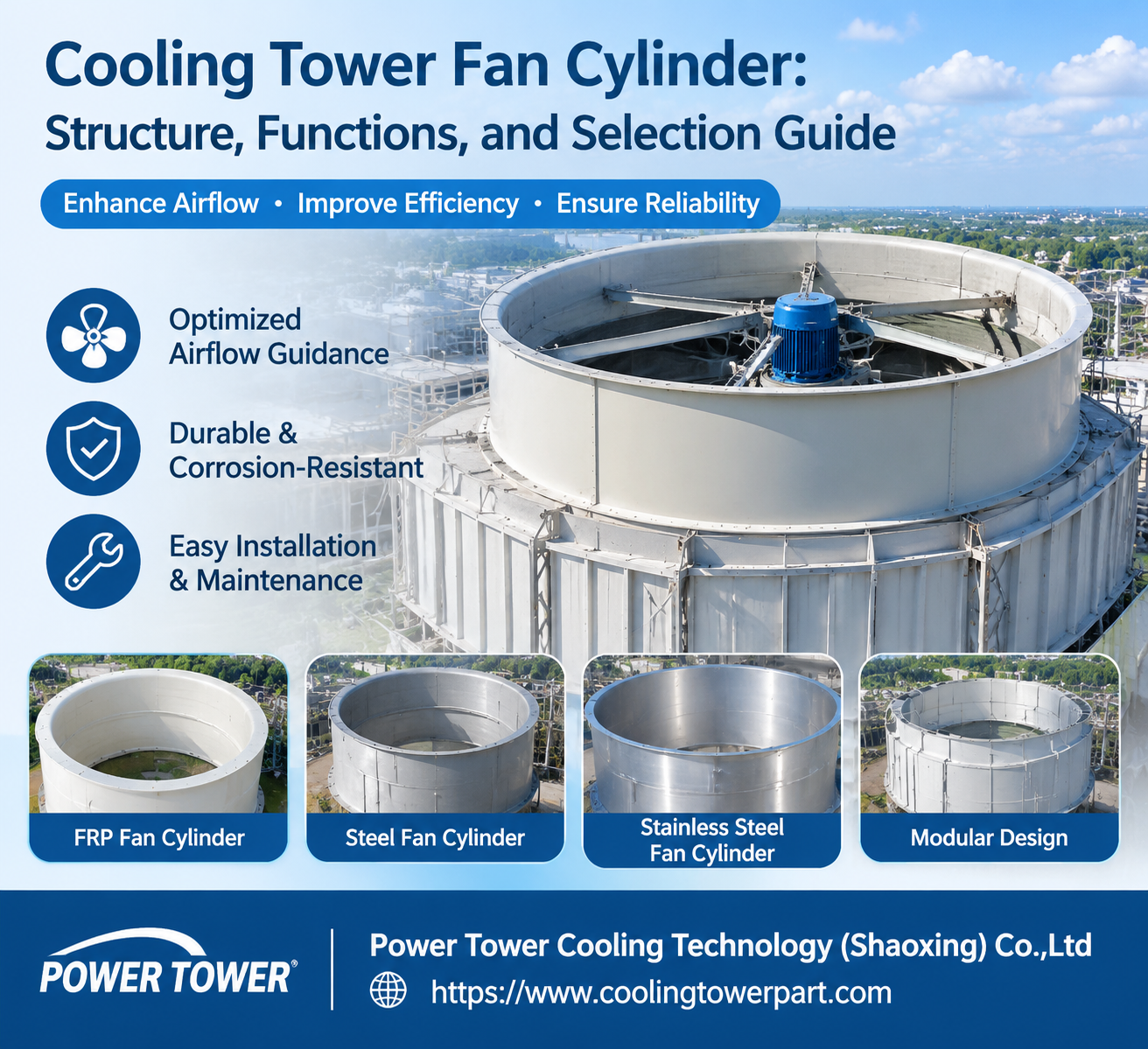
1. Introduction to Cooling Tower Fan Cylinders
When people discuss cooling tower performance, they usually focus on the fan, motor, gearbox, or fill material. But there is another component that deserves attention: the cooling tower fan cylinder.
A fan cylinder may look like a simple circular shell surrounding the fan. However, its design has a direct relationship with airflow guidance, fan installation, mechanical clearance, and overall cooling tower operation.
Think of it as a guide tunnel for the fan. Just as a well-designed road helps vehicles move smoothly, a properly designed fan cylinder helps guide air through the cooling tower fan assembly.
If the cylinder is too small, poorly aligned, damaged, or incorrectly installed, it can create unnecessary airflow resistance and mechanical risks. On the other hand, a suitable fan cylinder helps the fan operate within its intended design conditions.
So, what exactly is a cooling tower fan cylinder? What materials are commonly used? How do you select the correct dimensions?
In this guide, we will explain its structure, functions, materials, design considerations, installation requirements, and maintenance methods. Whether you are maintaining an existing cooling tower or sourcing replacement components, this information can help you make a better decision.
2. What Is a Cooling Tower Fan Cylinder?
A cooling tower fan cylinder is a circular housing or duct installed around the cooling tower fan. It is commonly found in mechanical draft cooling towers, especially induced draft cooling towers.
Its main purpose is to provide a defined airflow passage around the fan and guide discharged air away from the tower.
Depending on the cooling tower design, the fan cylinder may be manufactured as a single structure or assembled from multiple sections.
It is also commonly called a cooling tower fan stack, fan shroud, or fan discharge cylinder. The exact terminology can vary between manufacturers and cooling tower designs.
2.1 Fan Cylinder vs. Fan Stack
Are a fan cylinder and a fan stack the same thing?
In many cooling tower applications, the terms are used interchangeably. Both generally refer to the structure surrounding the fan and guiding airflow through the discharge area.
However, some manufacturers use "fan stack" to describe the complete discharge assembly, which may include the cylinder, inlet profile, support structure, and associated components.
When purchasing a replacement, it is better to confirm the actual structure and dimensions instead of relying only on the product name.
2.2 Where Is the Fan Cylinder Installed?
In a typical induced draft cooling tower, the fan cylinder is installed at the top of the tower.
The axial fan is positioned inside the cylinder, usually with a carefully specified clearance between the blade tips and the cylinder wall.
The fan draws air through the tower and discharges warm, humid air upward. The cylinder helps guide this air into the surrounding atmosphere.
The exact position, height, and geometry depend on the cooling tower's design and the fan manufacturer's recommendations.
3. How Does a Cooling Tower Fan Cylinder Work?
A cooling tower fan cylinder does not generate airflow by itself. The fan creates the airflow, while the cylinder provides the surrounding passage that guides it.
This distinction is important. The cylinder is a passive structural component, but its geometry can influence the airflow behavior of the complete fan assembly.
3.1 Guiding Airflow Through the Fan
When the fan rotates, its blades accelerate air and move it through the cooling tower.
In an induced draft system, the fan draws air through the cooling tower's internal sections and discharges it through the upper fan cylinder.
The cylinder helps define the airflow passage and provides a controlled space around the rotating blades.
Its diameter and shape must be compatible with the fan design. Incorrect dimensions may interfere with airflow or create mechanical clearance problems.
3.2 Reducing Airflow Disturbance
Airflow can become disturbed when it passes through poorly designed transitions, uneven surfaces, or obstructed passages.
A properly designed fan cylinder provides a smoother passage around the fan assembly.
However, the cylinder alone cannot guarantee smooth airflow. Fan blade geometry, inlet conditions, fan speed, tower layout, and surrounding structures also influence performance.
That is why fan cylinder design should always be considered as part of the complete cooling tower airflow system.
3.3 Supporting Efficient Air Discharge
In an induced draft cooling tower, warm and humid air leaves the tower through the fan discharge area.
The fan cylinder helps direct this air upward. A suitable discharge arrangement can also help reduce the possibility of warm exhaust air returning to the cooling tower air inlets.
This phenomenon is called air recirculation. It can increase the temperature of incoming air and reduce the cooling tower's thermal performance.
The effectiveness of recirculation control depends on the complete tower layout, discharge velocity, exhaust height, wind conditions, and nearby structures.
4. Main Functions of a Cooling Tower Fan Cylinder
Although the fan cylinder is not a moving component, it performs several important functions.
4.1 Improving Airflow Direction
The cylinder provides a defined passage for air moving through the fan.
This is especially important in induced draft cooling towers, where the fan discharges air vertically above the tower.
A correctly designed cylinder helps guide the exhaust stream and supports the intended airflow arrangement.
4.2 Supporting Fan Performance
The fan and cylinder must be designed to work together.
The cylinder diameter, inlet profile, fan position, and blade-tip clearance can influence the airflow around the rotating fan.
If the cylinder is incorrectly sized, the fan may experience additional airflow losses or mechanical interference.
A suitable design helps the fan operate closer to its intended performance conditions.
4.3 Protecting the Fan Assembly
The cylinder also acts as a physical enclosure around the fan.
It helps separate the rotating fan assembly from surrounding structures and reduces the risk of accidental contact with the blade area during normal operation.
It does not replace proper guarding, lockout procedures, or other required safety measures.
4.4 Reducing Air Recirculation Risks
Warm, humid exhaust air should ideally move away from the cooling tower air inlets.
The fan cylinder contributes to the discharge arrangement by guiding air upward.
A suitable discharge height and outlet configuration may help reduce the chance of hot exhaust air being drawn back into the tower.
For installations in confined areas or locations with complicated wind conditions, the complete tower layout should be reviewed.
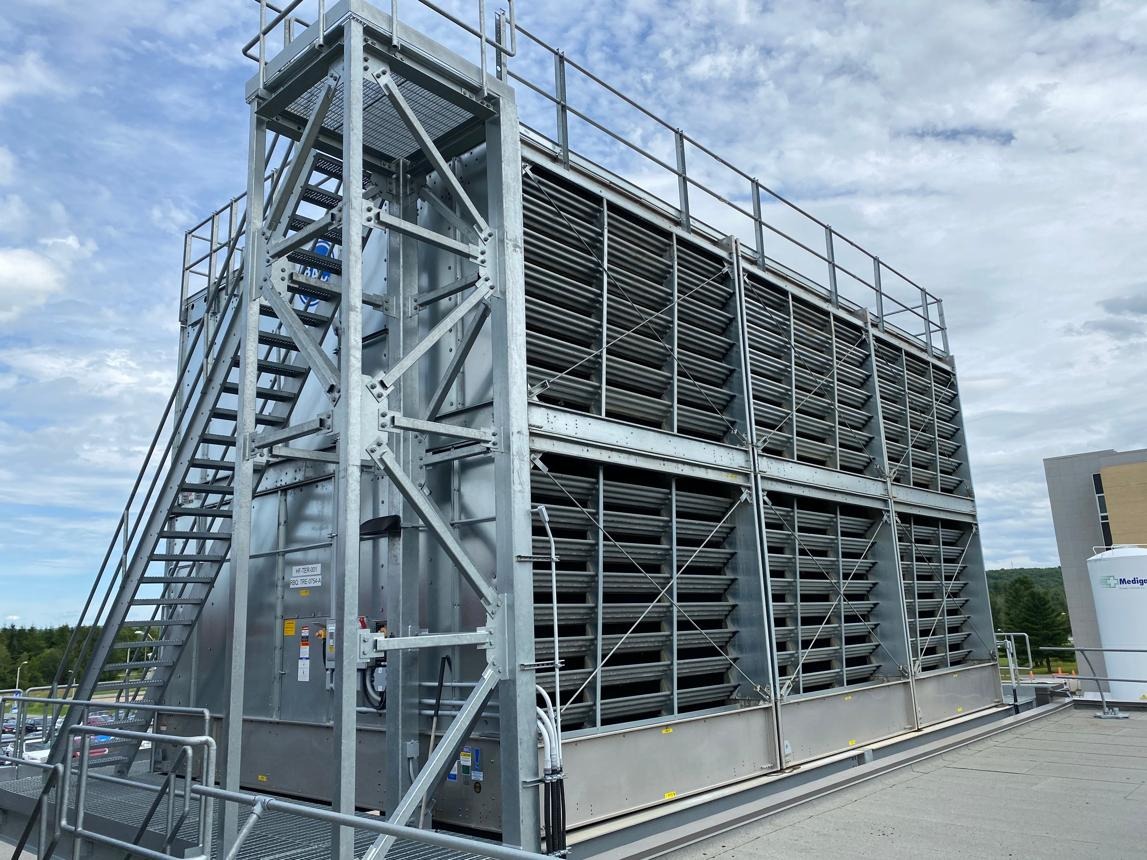
5. Main Components and Structural Design
A cooling tower fan cylinder may appear simple, but several structural details determine whether it fits and performs properly.
5.1 Cylinder Body
The cylinder body is the main circular shell surrounding the fan.
It may be manufactured from fiberglass-reinforced plastic, steel, stainless steel, or other suitable materials.
The body must maintain its shape under operating loads and environmental exposure.
Its roundness is particularly important because the fan blades rotate inside it. Excessive deformation may reduce blade clearance and create a mechanical hazard.
5.2 Inlet and Outlet Sections
The inlet and outlet sections influence how air enters and leaves the fan passage.
Some fan cylinders use specially shaped inlet profiles to improve airflow entry conditions.
The upper discharge section may also be designed to guide exhaust air away from the tower.
The shape and dimensions should follow the original cooling tower design or an engineering-approved replacement specification.
5.3 Mounting Flange and Support Structure
Mounting flanges connect the fan cylinder to the cooling tower structure.
Depending on the design, these connections may use bolts, brackets, support rings, or reinforced mounting sections.
The support system must withstand the cylinder's own weight, wind loading, and other applicable structural loads.
A poorly supported cylinder may deform, vibrate, or become misaligned over time.
5.4 Connection to the Fan and Drive System
The fan cylinder must be compatible with the installed fan assembly.
Important details include:
Fan outside diameter.
Cylinder inside diameter.
Blade-tip clearance.
Hub and shaft arrangement.
Fan elevation and mounting position.
Access requirements for inspection and maintenance.
The motor and gearbox are not usually part of the cylinder itself, but their location and arrangement can affect the cylinder's overall installation design.
6. Common Types of Cooling Tower Fan Cylinders
Cooling tower fan cylinders can be classified by material, construction, and installation arrangement.
6.1 FRP Fan Cylinders
FRP stands for fiberglass-reinforced plastic.
FRP fan cylinders are widely considered for cooling tower environments because they combine relatively low weight with good corrosion resistance.
They are particularly useful in environments where moisture and water treatment chemicals may affect conventional metal structures.
Other potential advantages include:
Relatively lightweight construction.
Good resistance to many corrosive environments.
Flexibility in shape and size.
Potential for molded or fabricated designs.
Reduced need for corrosion-related surface treatment compared with some metals.
However, FRP performance depends on the resin system, fiber reinforcement, manufacturing process, temperature, and chemical exposure.
Buyers should confirm that the selected FRP construction is suitable for the actual operating environment.
6.2 Steel Fan Cylinders
Steel fan cylinders offer good structural strength and are used in various industrial cooling tower designs.
They can be fabricated into large circular structures and reinforced where necessary.
However, ordinary steel requires suitable corrosion protection in humid cooling tower environments.
Protective coatings, galvanizing, material thickness, and maintenance procedures should be considered during selection.
6.3 Stainless Steel Fan Cylinders
Stainless steel may be selected when specific corrosion resistance and mechanical strength are required.
Different stainless steel grades have different resistance to chemicals and environmental conditions.
Stainless steel is not automatically corrosion-proof. The correct grade should be selected according to water treatment chemicals, atmospheric exposure, and operating conditions.
Its higher material cost and weight may also influence the project decision.
6.4 Modular and Segmented Fan Cylinders
Large fan cylinders may be manufactured in multiple sections rather than as one complete piece.
A segmented structure can make transportation, lifting, and on-site installation easier.
This design is especially useful for large cooling towers or projects with limited access.
The connecting joints must be properly designed and assembled to maintain structural stability, dimensional accuracy, and the intended airflow passage.
7. Materials Used in Fan Cylinder Manufacturing
Material selection affects service life, structural performance, transportation, installation, and maintenance.
The following table summarizes common options.
| Material | Main Advantages | Considerations |
| FRP | Lightweight, corrosion-resistant, adaptable in shape | Resin compatibility, UV protection, temperature limits |
| Carbon steel | High structural strength, widely fabricated | Requires corrosion protection |
| Galvanized steel | Steel strength with protective zinc coating | Coating condition and exposure affect service life |
| Stainless steel | Good mechanical properties and grade-dependent corrosion resistance | Higher cost; grade selection is important |
Which material is best?
There is no universal answer.
For many cooling tower applications, FRP is an attractive option because of its weight and corrosion resistance. Steel may be suitable where structural requirements and project economics favor metal construction.
The final decision should consider the tower's location, wind loading, operating environment, expected service life, and maintenance resources.
8. Key Design Dimensions and Technical Specifications
When selecting a cooling tower fan cylinder, dimensions matter just as much as material.
A cylinder that looks similar to the original may still be unsuitable if its internal diameter, height, or mounting arrangement is incorrect.
8.1 Fan Cylinder Diameter
The inside diameter of the cylinder must be compatible with the fan diameter and the specified blade-tip clearance.
A diameter that is too small may cause blade interference, while an excessively large or poorly configured passage may affect airflow behavior.
Do not determine the cylinder diameter from the tower model alone. Confirm the actual fan dimensions and manufacturer's design requirements.
8.2 Cylinder Height
Cylinder height affects the physical discharge arrangement.
It also influences how the fan assembly fits into the tower structure and how exhaust air is directed.
The correct height depends on the original design, fan position, tower layout, and surrounding installation conditions.
8.3 Fan Blade Clearance
Blade-tip clearance is the gap between the outer tips of the rotating blades and the inside wall of the cylinder.
This clearance must be sufficient to prevent contact during operation, including under expected thermal expansion, mechanical movement, and structural deformation.
However, it should also follow the fan manufacturer's recommendations because clearance can influence fan performance.
Never guess this dimension when designing a replacement.
8.4 Wall Thickness and Structural Strength
Wall thickness depends on the material, cylinder diameter, height, support arrangement, wind exposure, and other design loads.
For FRP cylinders, laminate structure and reinforcement are also important.
For metal cylinders, material grade, thickness, stiffeners, and corrosion protection must be evaluated.
A qualified structural design should determine the appropriate specifications.
9. How Fan Cylinder Design Affects Cooling Tower Efficiency
A cooling tower fan cylinder does not directly remove heat from water. Instead, it supports the fan's airflow arrangement, which contributes to the tower's heat rejection process.
A cooling tower needs sufficient air movement to support heat and mass transfer between water and air.
If the fan cylinder is poorly designed or incorrectly installed, it may contribute to airflow losses, turbulence, or mechanical problems.
For example, consider a fan with the correct diameter and motor power. If the surrounding cylinder is distorted or the blade clearance is incorrect, the complete assembly may not operate as intended.
Several factors should therefore be considered together:
Fan diameter and blade geometry.
Cylinder internal diameter.
Inlet and outlet profiles.
Fan elevation and blade clearance.
Air inlet and discharge conditions.
Tower internal resistance.
Wind and surrounding building conditions.
The goal is not simply to install a larger cylinder. It is to match the cylinder geometry to the fan and the complete cooling tower system.
10. How to Choose the Right Cooling Tower Fan Cylinder
Selecting a fan cylinder requires both dimensional and environmental evaluation.
Here are the main factors to check before placing an order.
10.1 Identify the Cooling Tower Type
First, identify whether the tower is induced draft or forced draft.
Induced draft cooling towers commonly use an upper fan cylinder surrounding the discharge fan.
Forced draft designs may have different fan and duct arrangements.
Also confirm whether the tower is crossflow or counterflow. This information helps suppliers understand the overall configuration, although the actual fan cylinder dimensions must still be verified.
10.2 Match the Fan Diameter
Fan diameter is one of the most important dimensions.
Measure or confirm the existing fan diameter and cylinder internal diameter.
Also record the fan hub position, blade-tip clearance, mounting arrangement, and fan elevation.
If you are replacing an old cylinder, original drawings or manufacturer specifications are preferable to estimates.
10.3 Select the Right Material
Choose the cylinder material according to the environment.
For example:
FRP may be suitable for humid and corrosive environments.
Galvanized steel may be considered where a protected metal structure is preferred.
Stainless steel may be appropriate for specific chemical or structural requirements.
Always check material compatibility rather than relying on general material names.
10.4 Consider Weather and Operating Conditions
A cooling tower installed in a coastal area may face different corrosion challenges from one installed in an inland industrial facility.
Consider:
These factors influence material choice and structural design.
10.5 Check Installation and Maintenance Requirements
A replacement cylinder should be easy to transport, lift, install, and inspect.
For large structures, modular construction may simplify site work.
Also consider whether inspection access is available and whether the design allows safe maintenance of the fan assembly.
11. Fan Cylinder Installation Guidelines
Correct installation is essential for safe and reliable operation.
Even a high-quality cylinder can cause problems if it is misaligned or poorly supported.
Before installation, verify the dimensions and inspect all components for transportation damage.
A typical installation process includes:
Confirm the tower structure and mounting dimensions.
Check the cylinder sections for deformation or damage.
Position the cylinder according to the approved drawings.
Align the mounting flanges and support structure.
Tighten fasteners according to the specified procedure.
Check cylinder roundness and vertical alignment.
Install or position the fan assembly as specified.
Verify blade-tip clearance around the full rotation path.
Inspect the drive system and electrical connections.
Conduct a controlled test run after completing safety checks.
Important: All work around cooling tower fans should follow site safety procedures. Isolate electrical power and prevent unexpected fan startup before inspection or installation.
The fan should never be operated if blade-to-cylinder contact is possible.
12. Common Problems and Maintenance Methods
Fan cylinders operate outdoors and are exposed to moisture, wind, sunlight, and industrial contaminants.
Regular inspection helps identify damage before it affects the fan assembly.
12.1 Cracks and Structural Damage
Cracks may develop due to impact, excessive stress, material aging, poor installation, or environmental exposure.
For FRP cylinders, inspect for cracks, delamination, damaged laminate, and weakened connection areas.
For metal cylinders, look for deformation, fatigue damage, and damaged welds or joints.
Structural damage should be assessed by qualified personnel before the equipment returns to service.
12.2 Corrosion and Surface Deterioration
Metal cylinders may suffer corrosion when protective coatings become damaged.
Inspect coating condition, weld areas, fasteners, and locations where water can collect.
For FRP cylinders, check surface deterioration, UV-related damage, and chemical compatibility.
Cleaning and protective treatment should follow the material manufacturer's recommendations.
12.3 Vibration and Loose Connections
Unusual vibration may indicate loose mounting bolts, structural misalignment, fan imbalance, or problems with the drive system.
The cylinder itself should be inspected for loose supports, damaged brackets, and abnormal movement.
Because vibration may originate from the fan or motor, inspect the complete assembly rather than assuming the cylinder is the only cause.
12.4 Airflow Leakage and Deformation
Gaps between cylinder sections or around mounting connections may create unintended airflow paths.
Deformation can also affect the fan clearance and airflow passage.
Check the joints, flanges, cylinder roundness, and support arrangement during routine maintenance.
Any repair should restore the original structural strength and required dimensions.
13. When Should You Replace a Cooling Tower Fan Cylinder?
A damaged fan cylinder does not always require complete replacement. Some minor surface issues may be repairable, depending on the material and manufacturer's recommendations.
However, replacement may be necessary when:
The cylinder has serious structural cracks.
FRP laminate damage is extensive.
Metal corrosion has significantly reduced structural strength.
The cylinder is permanently deformed.
Fan blade clearance cannot be maintained.
Mounting connections are seriously damaged.
The existing cylinder no longer matches the replacement fan.
Repeated repairs are no longer practical or reliable.
Before ordering a new cylinder, collect the original drawings, measurements, material specifications, and fan details.
A replacement should match both the mechanical installation and the intended airflow arrangement.
14. Fan Cylinder vs. Other Cooling Tower Components
The fan cylinder works together with several other cooling tower components, but each has a different function.
| Component | Main Function |
| Fan cylinder | Provides the passage surrounding the fan and guides discharged air |
| Axial fan | Generates airflow through the cooling tower |
| Fan hub | Connects fan blades to the rotating assembly |
| Fan motor | Supplies mechanical power |
| Gearbox | Reduces speed where a geared drive is used |
| Drift eliminator | Reduces water droplet carryover in discharged air |
| Cooling tower fill | Provides surface area for heat and mass transfer |
Understanding these differences is useful when sourcing replacement parts.
For example, replacing a fan cylinder will not solve a problem caused by damaged fan blades or blocked fill material. Correct troubleshooting starts by identifying the component responsible for the problem.
15. Applications Across Industrial Cooling Systems
Cooling tower fan cylinders are used in many mechanical draft cooling tower installations.
HVAC and Commercial Buildings
Large air-conditioning systems use cooling towers to reject heat from condenser water.
The fan cylinder supports the airflow discharge arrangement, helping the fan move air through the tower.
Power Generation
Power stations use cooling towers to remove heat from condenser and auxiliary cooling systems.
Large fan cylinders may be required to accommodate high-capacity axial fan assemblies.
Chemical and Petrochemical Plants
Chemical processing facilities often operate under demanding environmental conditions.
Material compatibility and structural durability are important when selecting fan cylinders for these installations.
Manufacturing Facilities
Factories in industries such as plastics, metal processing, textiles, and food production may use cooling towers for continuous process cooling.
The fan cylinder contributes to reliable air movement and the overall operation of the cooling tower.
16. How to Find a Reliable Cooling Tower Fan Cylinder Supplier
Choosing the right supplier is about more than finding a company that can manufacture a circular structure.
You need a supplier that understands cooling tower components and can help verify the required dimensions and materials.
Before purchasing, consider the following:
Technical capability: Can the supplier review drawings, dimensions, and installation requirements?
Material selection: Can the supplier explain the advantages and limitations of FRP, steel, and stainless steel?
Dimensional accuracy: Can the supplier confirm the internal diameter, height, wall thickness, and mounting details?
Manufacturing quality: Can the supplier provide relevant quality information and product documentation?
Communication: Can the supplier respond clearly to technical questions and confirm missing information before production?
Replacement support: Can the supplier evaluate an existing cylinder and help identify the correct replacement requirements?
Avoid choosing a product based only on its advertised diameter or price. A fan cylinder must fit the actual cooling tower and fan assembly.
17. About Power Tower Cooling Technology (Shaoxing) Co.,Ltd
Power Tower Cooling Technology (Shaoxing) Co.,Ltd serves the cooling tower industry through its website, www.coolingtowerpart.com.
For cooling tower maintenance and replacement projects, component compatibility is an important consideration. Fan cylinders, axial fans, fill materials, and other tower components must work together as part of the complete cooling system.
When discussing a fan cylinder requirement, customers should prepare the following information:
Cooling tower manufacturer and model.
Existing fan diameter.
Fan cylinder inside diameter.
Cylinder height.
Material requirements.
Mounting dimensions.
Photos of the existing installation.
Original technical drawings, if available.
Providing these details makes technical evaluation more accurate and helps reduce the risk of purchasing an incompatible replacement.
If you are sourcing cooling tower components or planning a replacement project, visit https://www.coolingtowerpart.com to explore the available product information and discuss your requirements with Power Tower Cooling Technology (Shaoxing) Co.,Ltd.
18. Frequently Asked Questions
18.1 What Is the Main Purpose of a Cooling Tower Fan Cylinder?
Its main purpose is to provide a defined passage around the fan and guide air through the discharge area. It also provides a mounting and enclosure structure for the fan assembly.
18.2 Is a Cooling Tower Fan Cylinder the Same as a Fan Stack?
The terms are often used interchangeably. However, some manufacturers use fan stack to describe a larger assembly that includes the cylinder, inlet profile, and supporting structure. Always confirm the exact product configuration.
18.3 Which Material Is Best for a Cooling Tower Fan Cylinder?
FRP is often considered because it is relatively lightweight and offers good corrosion resistance. Steel and stainless steel are also used where their structural and material properties suit the application. The best choice depends on the operating environment and design requirements.
18.4 How Do I Measure a Cooling Tower Fan Cylinder?
Important measurements include the internal diameter, external diameter, overall height, wall thickness, mounting flange dimensions, and fan blade clearance. Use original drawings whenever possible and confirm measurements before ordering.
18.5 Can I Replace a Steel Fan Cylinder With an FRP Fan Cylinder?
Potentially, yes. However, the replacement must meet the required structural loads, dimensions, mounting requirements, and operating conditions. Material substitution should be reviewed by qualified engineering personnel.
18.6 Does a Larger Fan Cylinder Improve Cooling Tower Performance?
Not necessarily. The cylinder must match the fan and tower design. Increasing its diameter or height without engineering evaluation may not improve airflow and could create installation or performance problems.
18.7 How Often Should a Fan Cylinder Be Inspected?
Inspection frequency depends on operating conditions and manufacturer recommendations. Include the cylinder body, joints, mounting supports, surface condition, alignment, and fan clearance in the regular maintenance program.
18.8 Can a Damaged FRP Fan Cylinder Be Repaired?
Some FRP damage may be repairable using an appropriate repair system. However, the repair method depends on the damage depth, laminate condition, structural location, and manufacturer's recommendations. Serious structural damage may require replacement.
19. Conclusion
A cooling tower fan cylinder may look like a simple component, but it plays an important role in the fan assembly and airflow arrangement.
It provides a defined passage around the fan, supports the intended discharge direction, and helps maintain the required mechanical clearance.
When selecting a cooling tower fan cylinder, pay close attention to its material, internal diameter, height, wall thickness, mounting structure, and compatibility with the fan assembly.
FRP, steel, and stainless steel each offer different advantages. The right material depends on the operating environment, structural requirements, and maintenance expectations.
For replacement projects, accurate measurements and technical drawings are essential. Do not choose a cylinder based only on its appearance or nominal size.
Power Tower Cooling Technology (Shaoxing) Co.,Ltd encourages customers to confirm their cooling tower model, fan dimensions, and installation requirements before sourcing replacement components.
With the correct specifications and a suitable design, a cooling tower fan cylinder can support reliable airflow, safe fan operation, and long-term cooling tower performance.


