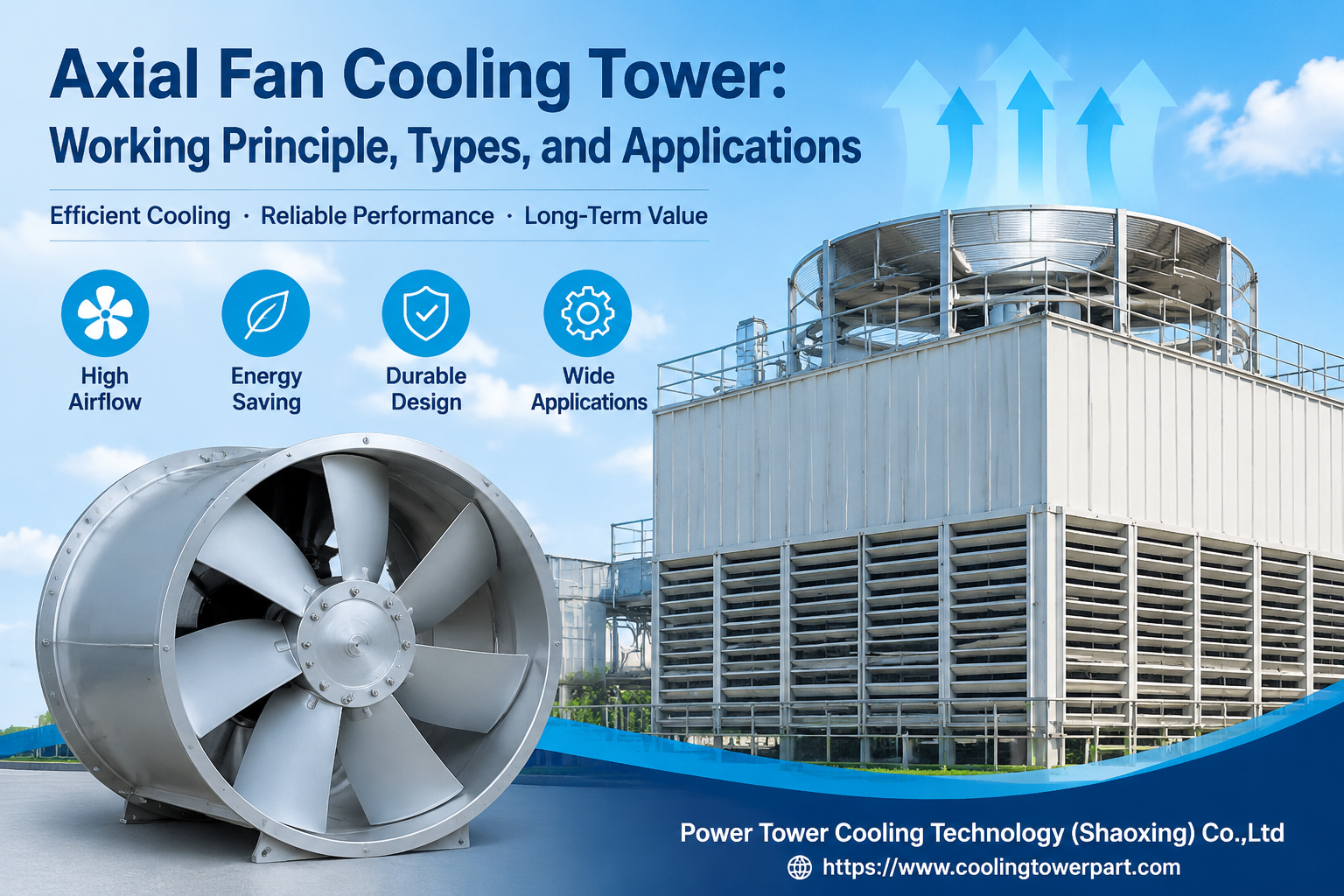
1. Introduction to Axial Fan Cooling Towers
Cooling towers play an essential role in industrial heat rejection. They help factories, power stations, HVAC systems, and many other facilities remove unwanted heat from circulating water. But have you ever wondered what keeps the air moving through a cooling tower?
In many industrial cooling systems, the answer is an axial fan cooling tower.
An axial fan is one of the most important components in a mechanical draft cooling tower. It moves large volumes of air through the tower, helping water release heat through contact with the surrounding airflow. Without sufficient airflow, even a well-designed cooling tower may struggle to achieve its expected cooling performance.
So, how does an axial fan cooling tower work? What types of fans are available? And how can you select the right fan for your application?
This guide explores the working principle, major components, fan materials, technical specifications, industrial applications, and maintenance requirements of axial fan cooling towers. Whether you are designing a new cooling system or replacing an existing fan, understanding these factors can help you make a more informed decision.
2. What Is an Axial Fan Cooling Tower?
An axial fan cooling tower is a mechanical draft cooling tower that uses an axial flow fan to move air through the tower. The fan is generally installed at the top of the cooling tower in a forced or induced draft arrangement, depending on the tower design.
The word "axial" describes the direction of airflow. Air travels approximately parallel to the fan shaft, entering and leaving the fan along its rotational axis.
This design allows axial fans to handle relatively large airflow volumes. That makes them suitable for cooling towers, where continuous air movement is necessary for effective heat exchange.
2.1 What Is an Axial Flow Fan?
An axial flow fan consists of rotating blades mounted around a central hub. When the motor turns the fan, the blades push air in an axial direction.
You can think of it as a propeller. A boat propeller moves water backward to push a boat forward. An axial fan uses a similar principle to move air through a cooling tower.
However, industrial cooling tower fans are engineered for specific airflow, pressure, diameter, rotational speed, and operating conditions. Their blade geometry is carefully selected to achieve the required performance.
2.2 Why Are Axial Fans Used in Cooling Towers?
Cooling towers need to move substantial amounts of air while maintaining reasonable energy consumption.
Axial fans are widely used because they can provide:
High airflow volume.
Relatively compact installation arrangements.
Good energy efficiency when properly selected.
Compatibility with different cooling tower sizes.
Options for different blade materials and configurations.
Their suitability depends on the tower's air resistance, required airflow, fan diameter, and operating conditions. An axial fan is not automatically the best choice for every cooling tower, but it is a practical solution for many mechanical draft systems.
3. Working Principle of an Axial Fan Cooling Tower
The working principle of an axial fan cooling tower combines mechanical airflow with evaporative heat transfer.
Hot water enters the cooling tower and is distributed over the fill material. At the same time, the axial fan moves air through the tower. As air contacts the falling water across the fill surface, a small portion of the water evaporates and carries heat away.
The remaining water becomes cooler and collects in the cold-water basin before returning to the industrial process.
3.1 How Air Moves Through the Cooling Tower
In an induced draft cooling tower, the axial fan is normally installed near the top of the tower. It draws air through the air inlets, across the fill and water distribution area, and then discharges the warm, moist air upward.
In a forced draft cooling tower, the fan pushes air into the tower, and the airflow moves through the internal structure before leaving the discharge area.
The two arrangements use different airflow paths, but both rely on mechanical ventilation to support heat rejection.
The actual airflow pattern depends on the tower structure, fan location, fill arrangement, and air inlet design.
3.2 How Airflow Supports Heat Rejection
The cooling process depends on the interaction between water and air.
When water flows over the fill material, it spreads into thin films or droplets, increasing the contact area between water and air. The moving air removes heat through sensible heat transfer and evaporation.
Evaporation is particularly important. When a small amount of water changes from liquid to vapor, it takes energy from the remaining water. This reduces the water temperature.
The axial fan supports this process by continuously supplying fresh air and removing warm, humid air from the tower.
3.3 The Relationship Between Airflow and Cooling Efficiency
Airflow has a direct influence on cooling tower performance, but more airflow does not always mean better efficiency.
If airflow is too low, the tower may not remove enough heat. Water temperature may rise above the required operating level.
If airflow is unnecessarily high, the fan may consume more electricity without delivering a proportional improvement in cooling performance.
The goal is to achieve an appropriate balance between airflow, fan power, water flow, fill performance, and ambient conditions.
A properly selected axial fan helps the cooling tower operate within its intended thermal and energy requirements.
4. Main Components of an Axial Fan Cooling Tower
An axial fan cooling tower includes several components that work together to produce stable airflow and reliable operation.
Understanding these components is useful when selecting replacement parts or diagnosing equipment problems.
4.1 Fan Blades and Fan Hub
Fan blades generate airflow as they rotate. Their number, length, profile, pitch angle, and surface condition all affect fan performance.
The fan hub connects the blades to the rotating shaft or drive assembly. It must provide sufficient mechanical strength to withstand rotational forces and operating loads.
Blade design should match the fan's intended operating conditions. Incorrect blade pitch or unsuitable blade dimensions may result in insufficient airflow, excessive motor loading, or vibration.
4.2 Fan Cylinder and Air Inlet
The fan cylinder, also called the fan stack or fan shroud, surrounds the fan and helps guide airflow.
A properly designed fan cylinder reduces unnecessary airflow disturbance and helps the fan discharge air efficiently.
The inlet area also matters. Poor inlet geometry, obstructions, or unsuitable clearances can increase airflow losses and reduce overall performance.
4.3 Motor and Drive System
The motor provides the mechanical power needed to rotate the fan.
Depending on the cooling tower design, the fan may be driven through a direct-drive arrangement, belt transmission, or gearbox.
When selecting a motor, engineers should consider:
The motor must be compatible with the fan load throughout the expected operating range.
4.4 Gearbox and Transmission Components
Some cooling tower axial fans use a gearbox to reduce motor speed and deliver the required fan rotational speed.
Transmission components must be selected according to the fan load and operating conditions.
For gearbox-driven systems, routine inspection should include lubrication, oil condition, unusual noise, vibration, and temperature.
The drive system should also be correctly aligned. Misalignment can create additional mechanical stress and shorten component service life.
5. Common Types of Axial Fans for Cooling Towers
Cooling tower axial fans are available in different materials and configurations. The right choice depends on fan diameter, required airflow, environmental conditions, maintenance expectations, and budget.
5.1 FRP Axial Fans
FRP stands for fiber-reinforced plastic. FRP axial fans are commonly considered for cooling tower environments because they offer a combination of relatively low weight and corrosion resistance.
Their lightweight construction can reduce the load on the drive system and supporting structure compared with some heavier metal alternatives.
FRP blades are available in different designs and sizes. However, the resin system, reinforcement, manufacturing quality, and operating temperature limits should all be checked before selection.
For cooling towers exposed to moisture and water treatment chemicals, material compatibility is especially important.
5.2 Aluminum Alloy Axial Fans
Aluminum alloy axial fans are another option for industrial cooling towers.
Aluminum offers a useful strength-to-weight ratio and can be manufactured into different blade profiles. It is also relatively easy to machine and process.
However, aluminum is not immune to corrosion. Its suitability depends on the alloy, surface treatment, water chemistry, and surrounding environment.
For applications involving aggressive chemical exposure, buyers should confirm the manufacturer's material recommendations.
5.3 Stainless Steel Axial Fans
Stainless steel fans may be selected for applications requiring high mechanical strength or specific corrosion resistance.
Different stainless steel grades have different corrosion characteristics. Therefore, the grade should be chosen according to the operating environment rather than simply assuming that all stainless steel performs the same way.
Stainless steel construction may also increase fan weight. The supporting structure and drive system must be capable of handling the resulting loads.
5.4 Fixed-Pitch and Adjustable-Pitch Axial Fans
Axial fans can also be classified according to blade pitch configuration.
Fixed-pitch fans have blades installed at a predetermined angle. Their design is relatively straightforward, making them suitable for applications with stable operating requirements.
Adjustable-pitch fans allow the blade angle to be changed to modify airflow and fan loading. Depending on the design, adjustment may be performed during installation or through a specific adjustment mechanism.
Adjustable-pitch fans can offer greater flexibility, but they require correct configuration and careful maintenance.
| Feature | Fixed-Pitch Fan | Adjustable-Pitch Fan |
| Blade angle | Predetermined | Adjustable |
| Configuration | Relatively simple | More flexible |
| Airflow adjustment | Usually through speed or system changes | Can also use blade pitch |
| Maintenance | Generally straightforward | Requires inspection of adjustment components |
| Typical use | Stable operating conditions | Applications requiring operating flexibility |
6. Materials Used in Cooling Tower Axial Fans
Material selection affects fan weight, mechanical strength, corrosion resistance, maintenance requirements, and expected service life.
The most common considerations include:
| Material | Main Characteristics | Important Considerations |
| FRP | Lightweight and corrosion-resistant | Check resin system and temperature limits |
| Aluminum alloy | Good strength-to-weight ratio | Confirm alloy and surface protection |
| Stainless steel | High mechanical strength and grade-dependent corrosion resistance | Select the correct grade for the environment |
| Other engineered composites | Can offer application-specific properties | Verify mechanical and environmental performance |
There is no single material that is best for every cooling tower.
For example, an FRP fan may be suitable for a wet environment where weight and corrosion resistance are important. A metal fan may be more appropriate where its mechanical characteristics match the application.
Before purchasing, compare material properties with the actual operating environment, including temperature, humidity, chemical exposure, and expected mechanical loads.
7. Key Technical Specifications of Cooling Tower Axial Fans
Choosing a cooling tower axial fan requires more than matching the fan diameter. Several technical parameters must work together.
7.1 Fan Diameter
Fan diameter is the overall diameter measured across the rotating blade assembly.
A larger fan can potentially move more air, but the actual airflow also depends on rotational speed, blade geometry, pitch, and system resistance.
When replacing a fan, confirm the available installation space, fan cylinder dimensions, hub arrangement, and blade clearance.
7.2 Airflow Volume
Airflow volume indicates how much air the fan moves over a given period. It is commonly expressed in cubic meters per hour (m³/h) or cubic feet per minute (CFM).
The required airflow depends on the cooling tower's thermal duty and design conditions.
A fan with insufficient airflow may reduce cooling capacity. An oversized fan may increase energy consumption or cause motor overload if the system is not designed for it.
7.3 Rotational Speed
Rotational speed is usually expressed in revolutions per minute (RPM).
Fan speed affects airflow, pressure, and power consumption. For a geometrically similar fan operating under comparable conditions, the fan affinity laws provide useful approximations:
Airflow changes approximately in proportion to rotational speed.
Pressure changes approximately with the square of rotational speed.
Power changes approximately with the cube of rotational speed.
These relationships are useful for understanding fan behavior, but actual results depend on the system operating point and the fan's performance characteristics.
7.4 Motor Power and Static Pressure
Motor power must be sufficient for the fan to operate at the required duty point without exceeding its rated load.
Static pressure describes the resistance the fan must overcome to move air through the cooling tower. Fill material, drift eliminators, louvers, internal structures, and discharge arrangements can all influence system resistance.
A fan should therefore be selected using its performance curve and the cooling tower's system requirements, not by motor power or diameter alone.
8. Main Applications of Axial Fan Cooling Towers
Axial fan cooling towers are used across many industries where equipment or processes generate heat that must be removed continuously.
8.1 HVAC and Commercial Buildings
Large commercial buildings, hospitals, shopping centers, hotels, and office complexes often use cooling towers as part of their central air-conditioning systems.
Axial fans help maintain airflow through the cooling tower, allowing condenser water to release heat before returning to the chiller system.
Reliable fan operation supports stable HVAC performance, especially during periods of high cooling demand.
8.2 Power Generation
Power plants use cooling systems to remove heat from steam condensers and other process equipment.
Depending on the plant configuration, cooling towers may use large axial fans to move air through substantial heat-transfer areas.
These fans must be selected for continuous operation, environmental exposure, and the specific thermal requirements of the facility.
8.3 Chemical and Petrochemical Plants
Chemical and petrochemical facilities often operate heat exchangers, reactors, compressors, and other equipment that generate significant heat.
Cooling towers provide an important way to maintain process temperatures.
Axial fans support the heat rejection process by maintaining the airflow required for water cooling. In these environments, material compatibility and maintenance planning are especially important.
8.4 Manufacturing and Industrial Processing
Many manufacturing operations depend on stable cooling water temperatures.
Examples include:
Plastic injection molding.
Metal processing.
Food and beverage production.
Textile manufacturing.
Industrial compressors.
Machinery and equipment cooling.
In these applications, the cooling tower axial fan helps maintain the airflow needed to support continuous process cooling.
9. Advantages of Axial Fan Cooling Towers
Axial fan cooling towers offer several practical advantages when their design matches the operating requirements.
High airflow capacity: Axial fans can move large quantities of air, making them suitable for many industrial cooling tower designs.
Space-efficient arrangement: Their structure can fit well into mechanical draft cooling towers, particularly induced draft configurations.
Flexible material options: FRP, aluminum alloy, stainless steel, and other designs provide choices for different operating environments.
Potential energy savings: A properly selected fan can deliver the required airflow without unnecessary motor power consumption.
Wide range of applications: Axial fan systems are used in HVAC, power generation, manufacturing, and process industries.
However, these advantages depend on proper engineering. Incorrect fan selection, poor installation, or unsuitable operating conditions can reduce performance.
10. Axial Fan vs. Centrifugal Fan Cooling Towers
Axial and centrifugal fans move air in different ways.
An axial fan moves air approximately parallel to its shaft. A centrifugal fan draws air into its center and accelerates it outward through the impeller.
| Comparison | Axial Fan | Centrifugal Fan |
| Airflow direction | Parallel to the shaft | Enters centrally and exits radially |
| Typical strength | High airflow volume | Higher pressure capability in many designs |
| Installation | Often suitable for direct vertical airflow | Requires a different duct and installation arrangement |
| Common cooling tower use | Mechanical draft cooling towers | Selected systems requiring different pressure characteristics |
| Selection priority | Air volume and system resistance | Pressure requirement and airflow |
For many large mechanical draft cooling towers, axial fans are a practical choice because of their ability to move substantial air volumes.
Centrifugal fans may be considered where the system has higher resistance or a particular duct arrangement.
The best option depends on the actual system curve, required airflow, available space, energy targets, and operating conditions.
11. How to Choose the Right Axial Fan Cooling Tower
Selecting the right axial fan is essential for achieving reliable cooling performance and controlling operating costs.
Instead of choosing a fan based only on price, evaluate the complete cooling tower system.
11.1 Determine the Required Cooling Capacity
Start by identifying the cooling tower's thermal duty.
Important information includes:
Hot-water inlet temperature.
Cold-water outlet temperature.
Water circulation flow rate.
Design wet-bulb temperature.
Required cooling range and approach.
Expected operating hours.
The cooling range is the difference between the hot-water inlet temperature and cold-water outlet temperature.
The approach is the difference between the cold-water outlet temperature and the ambient wet-bulb temperature.
These values help define the tower's thermal requirements. Fan airflow must then be selected as part of the overall cooling tower design.
11.2 Match Fan Diameter and Airflow
The fan diameter must fit the cooling tower structure while providing the required airflow.
Check the following dimensions and specifications:
Existing fan diameter.
Fan cylinder internal diameter.
Blade length and clearance.
Hub diameter and mounting arrangement.
Required rotational speed.
Fan airflow and pressure duty point.
When replacing an existing fan, do not assume that a fan with the same diameter will automatically deliver the same performance. Blade geometry, pitch, and rotational speed also matter.
11.3 Consider Operating Conditions
The cooling tower environment can be demanding.
High humidity, chemical exposure, temperature changes, dust, and water treatment substances may affect fan materials and component life.
Consider the following questions:
Is the fan exposed to corrosive substances?
Does the cooling tower operate continuously?
Are there seasonal changes in operating conditions?
Is the installation located near the coast?
Are there limits on noise or vibration?
What maintenance resources are available?
These details help determine the most suitable material and configuration.
11.4 Evaluate Energy Efficiency and Noise
Fan energy consumption can make a meaningful contribution to cooling tower operating costs.
Compare fan performance at the actual operating point rather than relying only on general efficiency claims.
Noise is another important consideration, particularly for installations near offices, residential areas, or other noise-sensitive locations.
Blade design, rotational speed, fan cylinder geometry, installation quality, and mechanical balance can all influence noise levels.
12. Common Problems and Maintenance Tips
Even a well-designed cooling tower axial fan requires regular inspection. Routine maintenance helps identify problems before they lead to equipment failure or unexpected shutdowns.
12.1 Fan Vibration and Unusual Noise
Vibration may result from blade damage, dirt accumulation, loose fasteners, misalignment, bearing problems, or an unbalanced fan assembly.
If unusual vibration appears, stop and inspect the equipment according to the site's safety procedures.
Check blade condition, mounting bolts, hub connections, drive alignment, and bearings. Do not continue operating a fan with severe vibration.
12.2 Reduced Airflow
Reduced airflow can affect cooling tower performance.
Possible causes include:
Damaged or incorrectly positioned blades.
Incorrect blade pitch.
Low fan speed.
Blocked air inlets.
Obstructions around the fan discharge.
Excessive resistance inside the tower.
Problems with the motor or transmission.
Inspect the entire airflow path rather than focusing only on the fan. Fill blockage, dirty drift eliminators, and restricted air inlets can also contribute to poor performance.
12.3 Blade Corrosion and Damage
Fan blades operate in a humid environment and may be exposed to chemicals and airborne contaminants.
Inspect blades for cracks, corrosion, deformation, surface deterioration, and loose connections.
For FRP blades, pay attention to cracking, delamination, and damage to protective surfaces. For metal blades, check for corrosion and material loss.
Damaged blades should be assessed by qualified personnel. Repair or replacement must follow the manufacturer's technical recommendations.
13. When Should You Replace a Cooling Tower Axial Fan?
Not every fan problem requires complete replacement. Some issues can be resolved through cleaning, balancing, adjustment, or component repair.
However, replacement may be appropriate when:
Blades have serious structural damage.
Corrosion has significantly weakened the fan.
The fan cannot achieve the required airflow.
Repeated vibration problems continue after corrective maintenance.
The existing fan is unsuitable for updated operating requirements.
Replacement parts are no longer available.
The fan's condition creates unacceptable operational risk.
Before purchasing a replacement, collect the original fan specifications and installation measurements.
A replacement fan should be evaluated against the cooling tower's actual requirements. Matching the old fan's physical dimensions is important, but matching its performance is equally essential.
14. How to Find a Reliable Cooling Tower Fan Supplier
Choosing a supplier is an important part of a successful cooling tower project.
A reliable supplier should be able to understand your application, review technical information, and help confirm whether a proposed fan is suitable.
When comparing suppliers, consider:
Technical understanding: Can the supplier review fan diameter, airflow, speed, motor power, and installation requirements?
Material information: Can the supplier explain the available blade materials and their suitability for different environments?
Dimensional compatibility: Can the supplier confirm hub dimensions, blade arrangement, and mounting requirements?
Documentation: Are technical drawings, product specifications, and relevant quality documents available?
Communication: Does the supplier respond clearly to technical questions and explain any missing information?
Do not select a cooling tower axial fan based only on the lowest quotation. A fan that does not match the original operating conditions may create additional costs through poor cooling performance, higher energy consumption, or premature replacement.
15. About Power Tower Cooling Technology (Shaoxing) Co.,Ltd
Power Tower Cooling Technology (Shaoxing) Co.,Ltd serves customers in the cooling tower industry through its website, www.coolingtowerpart.com.
For industrial cooling tower projects, selecting compatible components is important for maintaining system performance and long-term reliability.
When evaluating cooling tower axial fans or replacement components, buyers should provide clear technical information, including fan dimensions, operating speed, required airflow, motor specifications, and the cooling tower model.
This information helps establish the correct product requirements and reduces the risk of selecting an incompatible component.
Whether you are maintaining an existing cooling tower or planning a component replacement, careful technical evaluation is the starting point for a dependable solution.
Visit https://www.coolingtowerpart.com to learn more about cooling tower components and discuss your project requirements.
16. Frequently Asked Questions
16.1 What Is the Main Function of an Axial Fan in a Cooling Tower?
The main function is to move air through the cooling tower. This airflow supports heat and mass transfer between the circulating water and surrounding air, allowing the tower to reject heat and cool the water.
16.2 Why Are Axial Fans Commonly Used in Cooling Towers?
Axial fans can move large volumes of air and are suitable for many mechanical draft cooling tower designs. They also offer different material and blade configurations to meet various operating requirements.
16.3 Which Material Is Best for a Cooling Tower Axial Fan?
There is no universal best material. FRP is often considered for its low weight and corrosion resistance. Aluminum alloy offers a good strength-to-weight ratio, while stainless steel may be suitable for applications requiring specific mechanical and corrosion properties.
The correct choice depends on the operating environment and engineering requirements.
16.4 How Do I Calculate the Required Airflow for a Cooling Tower Axial Fan?
Required airflow should be determined through cooling tower thermal design. Engineers consider water flow rate, inlet and outlet water temperatures, ambient wet-bulb temperature, heat load, fill characteristics, and system resistance.
Fan performance curves are then used to select a fan that can provide the required airflow at the operating pressure.
16.5 Can I Replace an Old Cooling Tower Fan With a Different Brand?
Yes, a different brand may be suitable if the replacement matches the required performance and mechanical dimensions.
Check the fan diameter, airflow, rotational speed, blade pitch, hub dimensions, motor power, and mounting arrangement before ordering.
16.6 How Often Should a Cooling Tower Axial Fan Be Inspected?
Inspection frequency depends on operating hours, environmental conditions, and manufacturer recommendations. As a general maintenance practice, operators should include fan blades, fasteners, bearings, drive components, vibration, and unusual noise in their routine inspection program.
More frequent inspections may be necessary in harsh or continuous-operation environments.
17. Conclusion
An axial fan cooling tower is an important part of many industrial cooling systems. By moving air through the tower, the axial fan supports the evaporation and heat-transfer processes that reduce circulating water temperature.
Understanding the fan's working principle, materials, components, and technical specifications makes it easier to choose the right equipment.
The most important selection factors include fan diameter, airflow volume, rotational speed, static pressure, motor power, blade material, and operating environment. Proper installation and regular maintenance are equally important for long-term performance.
For industrial buyers, the best approach is to evaluate the fan as part of the complete cooling tower system rather than treating it as an isolated component.
Power Tower Cooling Technology (Shaoxing) Co.,Ltd encourages customers to confirm their technical requirements before selecting cooling tower components. With accurate specifications and careful product evaluation, you can make a more reliable purchasing decision and support the efficient operation of your cooling tower.


