What Is A Cooling Tower Fan Stack And How Does It Work?
A cooling tower fan stack is an important structural component of a mechanical draft cooling tower. It surrounds and guides the cooling tower fan, helping direct airflow through the tower and discharge warm, moist air into the atmosphere. Although it may look like a simple cylindrical or slightly tapered structure, its design has a significant influence on airflow efficiency, fan performance, energy consumption, and overall cooling tower operation.
In industrial cooling systems, a properly designed cooling tower fan stack helps reduce air recirculation, improve airflow distribution, and support stable fan operation. Materials such as fiberglass reinforced plastic (FRP) and sheet molding compound (SMC) are widely used because of their corrosion resistance, lightweight construction, and structural strength.
This article explains what a cooling tower fan stack is, how it works, its main components, common materials, design considerations, applications, and maintenance requirements.
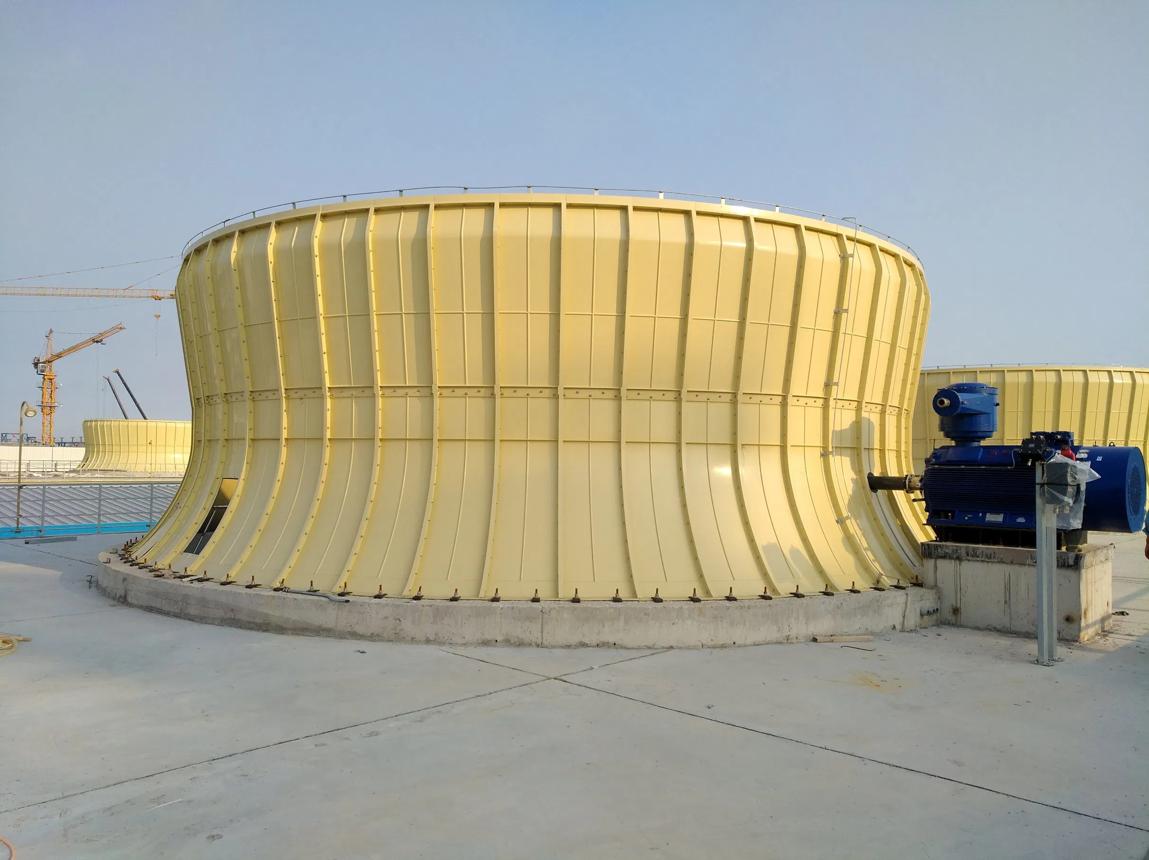
What Is A Cooling Tower Fan Stack?
A cooling tower fan stack is a vertical enclosure installed around the fan at the top of a mechanical draft cooling tower. It is also commonly called a fan cylinder, fan shroud, or fan discharge stack.
Its primary function is to guide air discharged by the fan upward and away from the cooling tower structure. By controlling the direction and velocity of discharged air, the fan stack helps the cooling tower maintain effective ventilation and reduce the possibility of warm, humid exhaust air returning to the air inlet.
What Is the Main Purpose of a Cooling Tower Fan Stack?
A fan stack performs several important functions in a cooling tower system.
1. Directing Airflow
The fan stack provides a defined discharge passage for air moved by the cooling tower fan. It guides the airflow vertically, helping warm and moisture-laden air move away from the tower.
2. Reducing Air Recirculation
Air recirculation occurs when warm exhaust air returns to the cooling tower air inlet. This can increase the entering-air temperature and reduce cooling performance.
A properly designed fan stack helps discharge exhaust air at a suitable height and direction, reducing the risk of recirculation under appropriate installation and site conditions.
3. Improving Fan Operating Conditions
The shape and dimensions of the fan stack influence airflow around the fan. An appropriately designed structure can help reduce unnecessary airflow disturbances and support efficient fan operation.
4. Protecting the Fan Assembly
The stack provides a physical enclosure around the fan area. Depending on its design, it can help limit accidental contact with rotating components and provide a defined mounting structure for associated safety accessories.
Where Is the Cooling Tower Fan Stack Installed?
The fan stack is generally installed at the upper section of a mechanical draft cooling tower.
Its exact position depends on the tower configuration:
Induced draft cooling towers: The fan is located near the top of the tower, and the fan stack guides exhaust air upward.
Forced draft cooling towers: The fan is typically installed near the air inlet, so the airflow arrangement and enclosure design differ.
Industrial mechanical draft towers: Fan stack dimensions are selected according to the fan diameter, airflow requirements, and tower structure.
How Does a Cooling Tower Fan Stack Work?
The working principle of a cooling tower fan stack is closely connected to the operation of the cooling tower fan. The fan generates airflow through the tower, while the stack guides the discharged air toward the atmosphere.
In an induced draft cooling tower, the process generally follows several stages.
Step 1: The Cooling Tower Fan Generates Airflow
The cooling tower fan rotates and creates a pressure difference that draws ambient air into the tower.
The air passes through the air inlet louvers and moves across the heat-transfer section, where it comes into contact with circulating hot water.
Step 2: Heat and Moisture Transfer Occur
As the air moves through the cooling tower fill, a portion of the circulating water evaporates.
This evaporation removes heat from the remaining water, lowering its temperature before it returns to the industrial process.
The air leaving the fill section becomes warmer and more humid.
Step 3: The Fan Moves Warm Air Upward
The fan pulls the warm, moisture-laden air through the upper section of the cooling tower.
The fan stack surrounds the fan discharge area and provides a defined path for the exhaust airflow.
Step 4: The Fan Stack Guides Exhaust Air
The shape of the fan stack helps direct the discharged air upward.
Depending on the design, the stack may feature a straight cylindrical profile, a tapered profile, or a specially engineered aerodynamic shape.
Step 5: Exhaust Air Is Released Into the Atmosphere
The warm, humid air exits through the top opening of the fan stack.
The discharge arrangement helps separate exhaust airflow from the surrounding air inlet area, supporting effective ventilation and reducing the potential for hot-air recirculation.
What Are the Main Components of a Cooling Tower Fan Stack?
A cooling tower fan stack is made up of several structural and functional elements. Their configuration varies according to the tower model, fan diameter, material, and installation requirements.
1. Fan Stack Body
The fan stack body is the main enclosure surrounding the fan.
It provides the airflow passage and maintains the required clearance between the rotating fan blades and the surrounding structure.
Common Structural Designs
The appropriate design depends on the fan configuration, airflow requirements, and tower structure.
2. Mounting Flange
The mounting flange connects the fan stack to the cooling tower structure.
It must provide sufficient strength and dimensional accuracy to support the stack under operating conditions.
Important Flange Considerations
3. Support Structure
Some fan stacks require additional support frames, brackets, or reinforcement components.
These elements help maintain structural stability, particularly for large-diameter stacks exposed to wind loads and vibration.
4. Fan Clearance Area
The space between the fan blades and the inner wall of the stack is an important design consideration.
Insufficient clearance may increase the risk of blade contact, while excessive or poorly designed clearance may affect airflow performance.
The required clearance should follow the fan manufacturer's engineering specifications and the cooling tower design requirements.
5. Safety Accessories
Depending on the installation, the fan stack may be equipped with safety-related accessories, including:
Fan guards
Access platforms
Inspection openings
Maintenance brackets
Protective covers
These components help improve operational safety and maintenance accessibility.
What Materials Are Used for Cooling Tower Fan Stacks?
Material selection is important because cooling tower fan stacks operate in environments with high humidity, water droplets, temperature variations, and potentially corrosive chemicals.
The most common materials include FRP, SMC, galvanized steel, and stainless steel.
FRP Cooling Tower Fan Stack
An FRP Cooling Tower Fan Stack is manufactured using fiberglass reinforced plastic. It is widely used in industrial cooling towers because it combines relatively low weight with good mechanical strength and corrosion resistance.
Advantages of FRP Fan Stacks
Excellent corrosion resistance
FRP materials are suitable for humid environments and many industrial cooling tower applications where conventional metal components may experience corrosion.
Lightweight construction
Compared with many metal structures, FRP fan stacks can be lighter, helping reduce structural loading and simplify transportation and installation.
Good structural strength
Fiberglass reinforcement provides mechanical strength when the material is properly designed and manufactured.
Flexible customization
FRP can be molded into different shapes and dimensions to meet specific cooling tower requirements.
Low maintenance requirements
FRP does not rust like ordinary steel. Appropriate material selection and regular inspection can help extend service life.
SMC FRP Fan Stack
SMC stands for Sheet Molding Compound. It is a composite material made from resin, fiberglass reinforcement, fillers, and other additives.
An SMC FRP fan stack is generally manufactured using a molding process that produces consistent shapes and surface finishes.
Key Features of SMC Fan Stacks
Consistent molded dimensions
Good corrosion resistance
Lightweight structure
Smooth surface finish
Suitable for standardized and customized designs
Convenient modular assembly in suitable configurations
SMC fan stacks can be a practical option for cooling tower projects requiring repeatable production and consistent component quality.
Metal Cooling Tower Fan Stack
Metal fan stacks are traditionally used in some industrial cooling tower designs.
Common Metal Materials
Metal structures can offer good mechanical strength, but their long-term performance depends on material grade, coating quality, environmental conditions, and maintenance.
FRP vs. Metal Cooling Tower Fan Stack: Which Is Better?
Comparison | FRP Fan Stack | Metal Fan Stack |
Weight | Generally lightweight | Depends on metal type |
Corrosion resistance | Generally excellent | Depends on material and coating |
Customization | Flexible molding options | Fabrication-dependent |
Maintenance | Usually relatively low | May require coating inspection |
Structural strength | Depends on composite design | Depends on metal grade and thickness |
Installation | Can be easier due to lower weight | May require heavier lifting equipment |
For humid and corrosive cooling tower environments, FRP is often an attractive choice. Metal may still be suitable where specific structural, temperature, or project requirements favor it.
The final decision should consider operating conditions, structural calculations, installation requirements, and total lifecycle cost.
What Are the Different Types of Cooling Tower Fan Stacks?
Cooling tower fan stacks can be classified according to their shape, material, and construction method.
1. Cylindrical Cooling Tower Fan Stack
A cylindrical fan stack has a relatively uniform diameter from the bottom to the top.
Main Characteristics
Simple structural configuration
Straightforward manufacturing
Convenient installation
Suitable for various standard fan arrangements
It is commonly used where the cooling tower design does not require a specially tapered discharge section.
2. Tapered Cooling Tower Fan Stack
A tapered fan stack has a changing diameter along its height.
Main Characteristics
Aerodynamic profile
Customized inlet and outlet dimensions
Potential to improve discharge flow characteristics
Suitable for selected high-performance fan systems
The taper angle and dimensions should be determined through engineering analysis rather than selected by appearance alone.
3. FRP Cooling Tower Fan Stack
FRP fan stacks are designed for applications where corrosion resistance, lightweight construction, and customization are important.
They can be produced in different diameters, heights, thicknesses, and connection configurations.
4. Modular Cooling Tower Fan Stack
A modular fan stack is manufactured in multiple sections and assembled during installation.
Benefits of Modular Construction
Easier transportation
Flexible manufacturing dimensions
Convenient handling at installation sites
Suitable for large-diameter structures
Potentially easier replacement of individual sections
Modular design is particularly useful for projects with transportation or site-access limitations.
How Does Fan Stack Design Affect Cooling Tower Performance?
The design of a cooling tower fan stack influences airflow behavior and the operating conditions of the fan. Poorly selected dimensions or installation arrangements may create unnecessary resistance, airflow disturbance, or mechanical problems.
Fan Stack Diameter
The diameter must be compatible with the cooling tower fan and the required airflow passage.
Why Is Diameter Important?
If the stack diameter is too small, it may restrict airflow and create additional resistance.
If the diameter is too large or the geometry is poorly matched to the fan, airflow behavior around the discharge section may become less predictable.
The diameter should therefore be selected according to the fan diameter, blade configuration, operating speed, and tower design.
Fan Stack Height
The height of the fan stack affects the position at which exhaust air is released.
How Does Height Influence Airflow?
An appropriately designed stack can help discharge warm, humid air above the tower structure and reduce the potential for exhaust air to return to the air inlet.
However, increasing stack height does not automatically improve cooling performance. Excessive height can increase material requirements, wind loading, and structural costs.
Fan Stack Shape
The internal and external geometry of the stack influences airflow direction and structural behavior.
Aerodynamic Design Considerations
Smooth internal transitions
Appropriate discharge geometry
Consistent cross-sectional dimensions
Adequate fan blade clearance
Structural rigidity
Compatibility with the fan's operating point
A well-designed stack should work together with the fan rather than create additional restrictions.
Surface Quality
The inner surface of the fan stack should be sufficiently smooth and free from major obstructions.
Surface defects, protruding fasteners, or poorly aligned joints may disturb airflow and create localized turbulence.
What Are the Applications of Cooling Tower Fan Stacks?
Cooling tower fan stacks are used in many industries that rely on mechanical draft cooling towers to remove process heat.
Power Generation Industry
Power plants use cooling towers to reject heat from steam condensers and auxiliary cooling systems.
A reliable fan stack supports the airflow arrangement of the cooling tower and contributes to stable operation.
Petrochemical and Chemical Plants
Chemical processing facilities often operate cooling towers under demanding environmental conditions.
FRP fan stacks are commonly considered for these installations because of their corrosion resistance and relatively low weight.
Steel and Metallurgical Industry
Steel mills and metallurgical plants use cooling water for furnaces, casting equipment, rolling systems, and other industrial processes.
Cooling tower fan stacks help guide exhaust airflow in the mechanical draft cooling systems serving these processes.
HVAC and Commercial Buildings
Large commercial buildings, hospitals, shopping centers, and industrial facilities may use cooling towers as part of central air-conditioning systems.
Fan stacks help direct exhaust air away from the cooling tower and surrounding structures.
Data Centers
Data centers require reliable heat rejection to maintain suitable operating temperatures for IT equipment.
Cooling towers may form part of their cooling infrastructure, making fan performance and airflow management important considerations.
Manufacturing Facilities
Factories producing plastics, chemicals, machinery, food products, and other goods often depend on industrial cooling water systems.
A suitable fan stack supports the airflow requirements of these cooling tower installations.
How to Choose the Right Cooling Tower Fan Stack?
Selecting a suitable fan stack requires more than matching the outside diameter of an existing structure. Buyers should consider fan specifications, installation conditions, material properties, and long-term operating requirements.
1. Confirm the Cooling Tower Model
Before selecting a replacement fan stack, identify the cooling tower manufacturer, model, and structural configuration.
Information to Prepare
These details help the supplier evaluate dimensional compatibility.
2. Check Fan Specifications
The fan stack must be compatible with the installed fan.
Important specifications include:
Fan diameter
Blade number
Fan speed
Airflow volume
Motor power
Fan rotation direction
Operating conditions
The fan and stack should be evaluated as parts of the same airflow system.
3. Select the Appropriate Material
Choose a material based on environmental conditions and project requirements.
When Should You Choose FRP?
FRP is worth considering when the cooling tower operates in a humid or corrosive environment and the project requires a lightweight, customizable structure.
When Should You Choose Metal?
Metal may be appropriate when the existing tower design requires a particular metal structure, when specific mechanical requirements apply, or when the project has established metal fabrication standards.
4. Evaluate Structural Requirements
The fan stack must withstand operating loads and environmental forces.
Important Structural Factors
For large industrial fan stacks, structural calculations should be completed by qualified engineers.
5. Consider Transportation and Installation
Large fan stacks can create logistical challenges, especially for international projects.
Buyers should confirm whether the product can be transported as a complete unit or needs to be divided into sections.
A modular FRP fan stack may simplify shipping and on-site assembly for certain large-scale applications.
How to Install a Cooling Tower Fan Stack Correctly?
Correct installation is essential for maintaining structural stability, fan clearance, and airflow performance.
Step 1: Inspect the Installation Area
Before installation, inspect the cooling tower structure and mounting surface.
Check for:
Any structural problems should be addressed before installing the new stack.
Step 2: Verify Dimensions
Confirm the fan stack dimensions against the approved drawings.
Pay particular attention to the diameter, height, flange dimensions, bolt-hole positions, and fan clearance.
Step 3: Position the Fan Stack
Use suitable lifting equipment to move the stack into position.
For large FRP structures, lifting points and handling methods should follow the manufacturer's recommendations to avoid localized damage.
Step 4: Secure the Connections
Align the mounting flange with the supporting structure.
Install the specified bolts and fasteners, and tighten them according to the project requirements.
Avoid excessive tightening that could damage FRP connection areas.
Step 5: Check Fan Clearance
Before operation, verify that the fan blades have adequate clearance from the stack.
The fan should rotate freely without contacting the surrounding structure.
Step 6: Conduct a Trial Run
After installation, inspect the fan assembly and conduct a controlled test run.
Check for:
Follow the cooling tower manufacturer's commissioning procedures before returning the equipment to normal operation.
How to Maintain a Cooling Tower Fan Stack?
Regular inspection helps identify damage before it develops into a more serious structural or operational problem.
Routine Visual Inspection
Inspect the fan stack regularly for cracks, deformation, surface damage, loose bolts, and signs of corrosion.
FRP components should also be checked for visible fiber exposure, delamination, and impact damage.
Check Mounting Connections
Vibration and environmental loading can affect fasteners over time.
Inspect mounting bolts, brackets, and support connections to ensure that they remain secure.
Monitor Fan Vibration
Excessive fan vibration can place additional stress on the fan stack and its supporting structure.
If abnormal vibration occurs, inspect the fan blades, hub, gearbox, motor, and alignment rather than assuming the stack itself is the only problem.
Clean the Internal Surface
Dust, debris, and accumulated deposits may affect airflow or create maintenance problems.
Clean the internal surface using methods and cleaning agents compatible with the stack material.
Inspect After Severe Weather
Strong winds, storms, and other extreme weather events may damage exposed cooling tower structures.
After severe weather, inspect the fan stack, support structure, and mounting connections before restarting the equipment.
Common Cooling Tower Fan Stack Problems and Solutions
Understanding common problems helps maintenance teams improve reliability and avoid unnecessary equipment downtime.
Cracks in the Fan Stack
Possible causes:
Recommended solutions:
Inspect the damaged area and determine whether the problem is superficial or structural. Repair or replace the affected section according to the manufacturer's engineering recommendations.
Excessive Fan Vibration
Possible causes:
Recommended solutions:
Inspect the entire fan assembly, check blade balance, verify alignment, and examine the stack supports and connections.
Airflow Restrictions
Possible causes:
Recommended solutions:
Remove obstructions, correct installation problems, and confirm that the stack dimensions are compatible with the fan design.
Corrosion or Surface Deterioration
Possible causes:
Aggressive operating environment
Incompatible material selection
Damaged protective coatings
Inadequate maintenance
Recommended solutions:
Assess the material condition and determine whether repair, protective treatment, or replacement is required. Consider FRP for suitable corrosive environments.
Loose Mounting Connections
Possible causes:
Recommended solutions:
Inspect the mounting system, replace damaged fasteners, and restore the specified connection arrangement.
Why Choose an FRP Cooling Tower Fan Stack?
An FRP Cooling Tower Fan Stack offers several advantages for industrial cooling tower applications.
Lightweight and Easy to Handle
FRP structures generally weigh less than comparable steel structures, which can simplify transportation and lifting operations.
Excellent Resistance to Moisture
Cooling towers operate in environments with continuous exposure to moisture and water droplets.
FRP does not rust like ordinary carbon steel, making it a practical option for many wet cooling tower environments.
Flexible Manufacturing Dimensions
FRP fan stacks can be customized according to project requirements.
Common customization options include:
Suitable for Replacement Projects
When an existing fan stack becomes damaged or reaches the end of its service life, a custom FRP replacement may help restore the required structural and dimensional configuration.
However, the replacement should be checked against the original fan and tower design to ensure compatibility.
How to Find a Reliable Cooling Tower Fan Stack Manufacturer?
Choosing a qualified manufacturer is important for obtaining a fan stack that meets the project's technical and operational requirements.
Review Manufacturing Experience
Look for manufacturers with experience producing cooling tower components, especially FRP structures and fan-related products.
Relevant experience can help suppliers understand the dimensional and environmental requirements of industrial cooling towers.
Check Material Quality
Ask about the resin system, fiberglass reinforcement, material thickness, and manufacturing process.
For FRP products, consistent material quality and proper curing are important factors affecting long-term performance.
Request Technical Drawings
A reliable supplier should be able to review the project's dimensions and provide technical drawings or dimensional confirmation before production.
Drawings Should Include
Evaluate Customization Capabilities
Different cooling tower brands and models may use different fan stack dimensions.
A manufacturer capable of producing customized sizes and connection configurations can provide more suitable replacement solutions.
Consider Export and Packaging Experience
For international buyers, packaging, shipping dimensions, assembly instructions, and technical communication are also important.
Confirm the shipping arrangement before production, especially when the fan stack is large or divided into multiple sections.
Frequently Asked Questions About Cooling Tower Fan Stacks
What Is the Difference Between a Cooling Tower Fan and a Fan Stack?
A cooling tower fan is a rotating mechanical component that generates airflow. The fan stack is the surrounding structure that guides the air discharged by the fan.
Both components work together to support the ventilation process of a mechanical draft cooling tower.
Does a Cooling Tower Need a Fan Stack?
Many induced draft mechanical cooling towers use a fan stack to guide exhaust air upward and help manage airflow around the fan.
The exact configuration depends on the cooling tower design. Not every cooling tower uses the same type of fan enclosure.
What Is the Best Material for a Cooling Tower Fan Stack?
FRP is a popular choice because of its lightweight construction, corrosion resistance, and customization flexibility.
However, the best material depends on the operating environment, structural requirements, temperature conditions, and project budget.
How Tall Should a Cooling Tower Fan Stack Be?
There is no universal height for every cooling tower fan stack.
The required height depends on the fan diameter, discharge arrangement, tower configuration, site conditions, wind loading, and airflow requirements.
The final dimensions should follow the cooling tower design and engineering calculations.
Can an FRP Cooling Tower Fan Stack Be Customized?
Yes. FRP fan stacks can be manufactured in different diameters, heights, thicknesses, and structural configurations.
Customized designs are useful for new cooling tower projects and replacement applications.
How Often Should a Cooling Tower Fan Stack Be Inspected?
Inspection frequency depends on operating conditions, manufacturer recommendations, and the site's maintenance program.
Regular visual inspections are recommended, with additional checks after severe weather, abnormal vibration, or other unusual operating events.
When Should a Cooling Tower Fan Stack Be Replaced?
Replacement may be necessary when the stack has serious structural cracks, extensive material deterioration, deformation, or damage that cannot be reliably repaired.
A professional assessment should determine whether repair or complete replacement is the safer and more economical option.
Conclusion
A cooling tower fan stack is more than a simple enclosure around a cooling tower fan. It is an important part of the airflow system, helping guide warm exhaust air upward, support fan operation, and reduce the potential for air recirculation.
Selecting the right Cooling Tower Fan Stack requires careful consideration of diameter, height, shape, material, fan clearance, structural strength, and installation conditions. For many industrial applications, an FRP Cooling Tower Fan Stack provides a practical combination of corrosion resistance, lightweight construction, and flexible customization.
Whether you are purchasing a new fan stack or replacing an existing component, working with an experienced cooling tower parts manufacturer can help ensure that the product matches your equipment and operating requirements.


