1. Introduction
Industrial cooling towers play an essential role in many production processes. From power plants and chemical facilities to steel factories and large HVAC systems, they help remove unwanted heat and maintain stable operating temperatures.
But have you ever considered which component keeps the air moving through a cooling tower? The answer is the industrial cooling tower fan.
A cooling tower fan creates the airflow needed for effective heat rejection. It helps air pass through the fill media, supports evaporation, and allows warm water to release heat into the atmosphere. Without sufficient airflow, even a well-designed cooling tower may struggle to achieve its required cooling performance.
However, choosing an industrial cooling tower fan is not as simple as selecting a fan with the largest diameter or highest motor power. You need to consider airflow, static pressure, fan speed, blade material, operating conditions, and compatibility with the existing tower.
In this guide, we explain the main types of industrial cooling tower fans, their functions, materials, specifications, applications, and selection methods. Whether you are building a new cooling tower or replacing an existing fan, this information can help you make a more informed decision.
2. What Is an Industrial Cooling Tower Fan?
An industrial cooling tower fan is a mechanical air-moving device designed to create or maintain airflow through a cooling tower.
Unlike ordinary ventilation fans, cooling tower fans operate as part of a heat rejection system. They must handle the airflow resistance created by fill media, water distribution equipment, drift eliminators, air inlets, and other tower components.
Most mechanical-draft industrial cooling towers use axial fans because these fans can move large volumes of air at relatively low pressure. Centrifugal fans are also used in certain cooling tower configurations where the airflow arrangement or pressure requirements make them suitable.
2.1 How a Cooling Tower Fan Works
The basic working principle is straightforward.
Warm water enters the cooling tower and is distributed over the fill media. At the same time, the fan moves air through the tower. As air contacts the falling water or wetted fill surfaces, a small portion of the water evaporates.
This evaporation removes heat from the remaining water, reducing its temperature.
The fan supports this process by maintaining the airflow required by the cooling tower design.
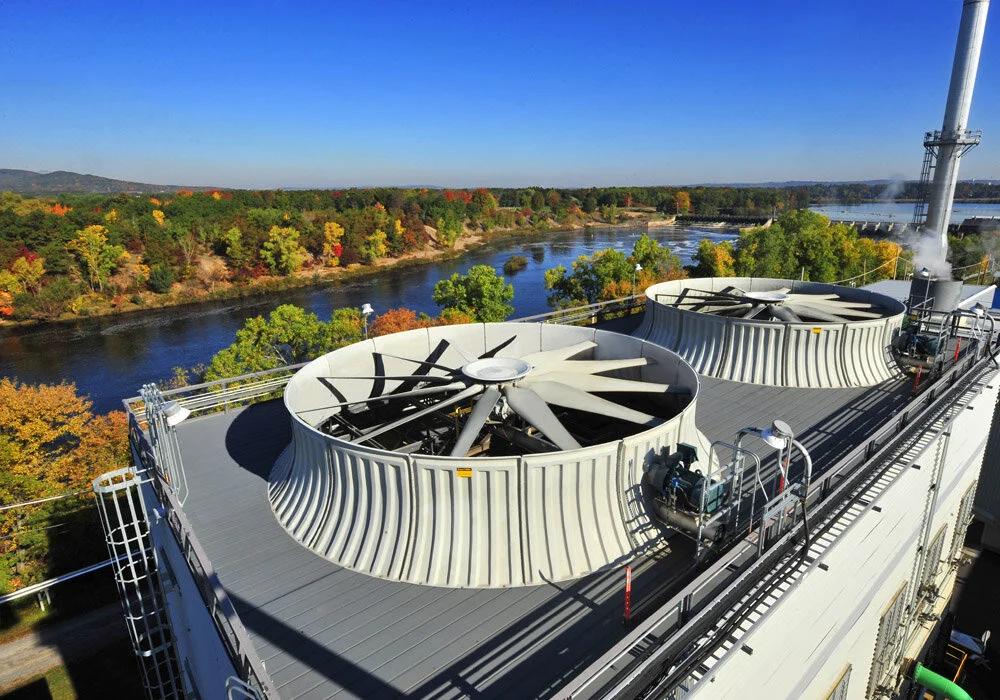
In an induced-draft tower, the fan is generally installed near the top and pulls air upward through the tower. In a forced-draft arrangement, the fan pushes air into the tower, usually near the air inlet.
2.2 The Fan's Role in Heat Rejection
A cooling tower fan directly influences the amount of air passing through the tower. If airflow is too low, the tower may not remove heat effectively under the required operating conditions.
On the other hand, excessive airflow can increase motor power consumption and mechanical loading without producing a proportional improvement in cooling performance.
The objective is to achieve the required airflow at the correct operating point—not simply to maximize fan speed.
3. Main Functions of an Industrial Cooling Tower Fan
A cooling tower fan may look like a simple rotating assembly, but its role in the cooling process is significant.
3.1 Creating Airflow
The primary function is to move air through the cooling tower.
The fan must overcome the resistance created by the tower's internal components and maintain a suitable airflow distribution. Its performance depends on blade geometry, rotational speed, fan diameter, and system resistance.
3.2 Supporting Evaporative Cooling
Evaporation is one of the main mechanisms used in conventional cooling towers.
As air moves through the tower, it helps maintain the conditions needed for heat and mass transfer between water and air. A properly selected fan supports this process by supplying the airflow required by the tower's thermal design.
3.3 Maintaining Stable Cooling Performance
Industrial production processes often require stable cooling-water temperatures.
A properly operating fan helps the cooling tower respond to changing heat loads and ambient conditions. If the fan becomes damaged, unbalanced, or incorrectly adjusted, cooling performance may become less predictable.
For this reason, fan condition should be included in routine cooling tower maintenance.
4. Common Types of Industrial Cooling Tower Fans
Different cooling tower designs require different fan arrangements. Understanding the available types is the first step toward selecting suitable equipment.
4.1 Axial Cooling Tower Fans
<image-placeholder> </image-placeholder>
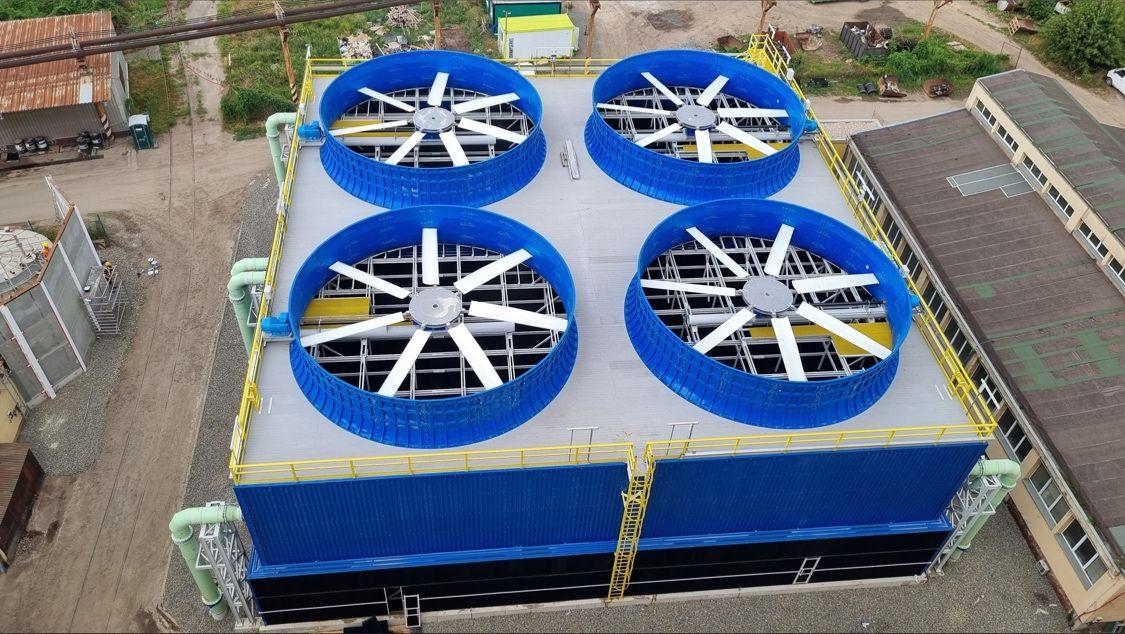
Axial fans move air approximately parallel to the fan shaft. Their blades rotate to create airflow through the fan cylinder.
They are widely used in industrial cooling towers because they can handle large airflow volumes with relatively low pressure requirements.
Common characteristics include:
High airflow capacity.
Relatively compact installation.
Suitable for large fan diameters.
Common use in induced-draft cooling towers.
Availability of different blade materials and configurations.
Axial cooling tower fans are often the first option to evaluate when selecting a fan for a conventional mechanical-draft cooling tower.
4.2 Centrifugal Cooling Tower Fans
Centrifugal fans move air into the fan and discharge it in a direction generally perpendicular to the inlet flow.
They can generate higher pressure than many axial fan arrangements, depending on their design and operating point. This makes them suitable for certain applications with higher airflow resistance or specific ducting requirements.
However, centrifugal fans may require more installation space and a different drive arrangement.
The correct choice depends on the cooling tower design rather than a general assumption that one fan type is always better.
4.3 Induced-Draft and Forced-Draft Fan Arrangements
Cooling tower fans can also be classified according to their location and airflow arrangement.
Induced-draft cooling tower fans are usually installed at the top of the tower. They pull air through the fill and discharge it upward. This arrangement is widely used in industrial cooling towers.
Forced-draft cooling tower fans are typically installed near the air inlet. They push air into the tower and through the internal cooling components.
Each arrangement has different airflow and maintenance considerations. The tower's original design should guide the selection.
5. Cooling Tower Fan Materials
Material selection affects fan weight, strength, corrosion resistance, maintenance requirements, and service life.
Industrial cooling towers often operate in humid environments where airborne contaminants and water chemistry can influence material performance.
5.1 FRP Fan Blades
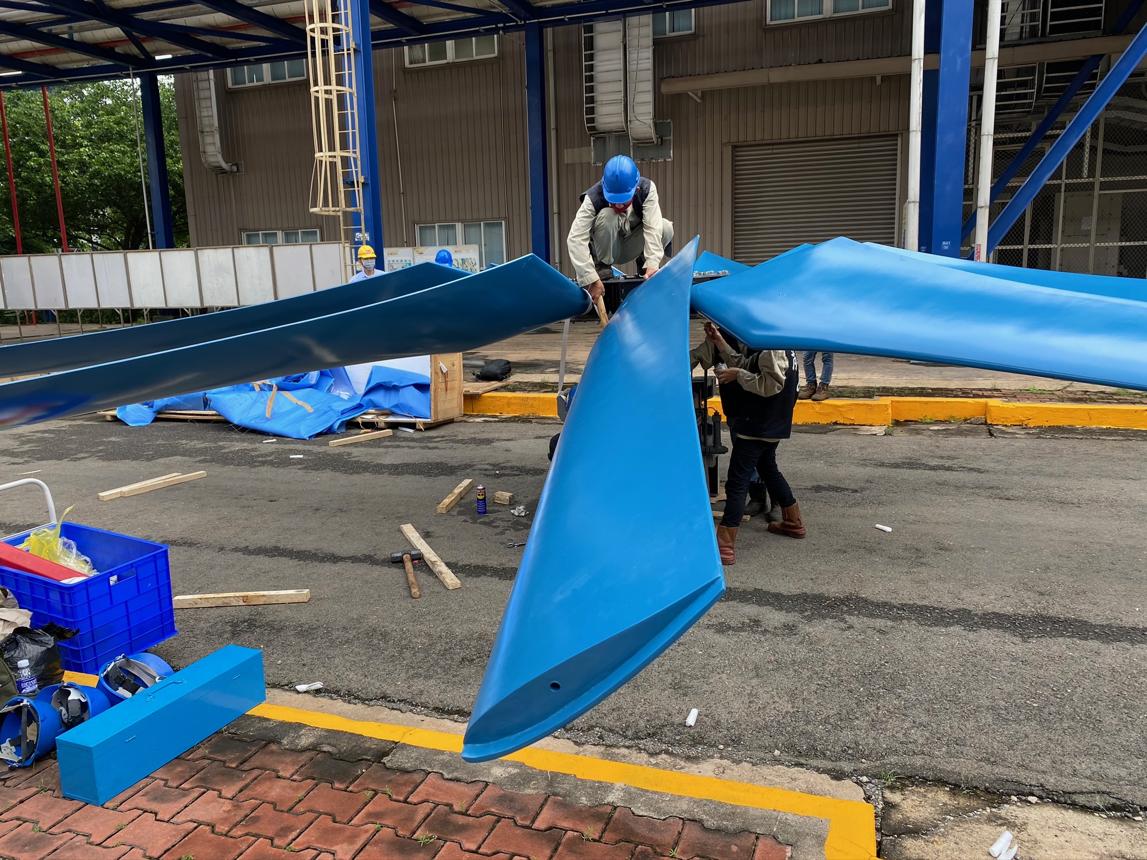
FRP stands for fiber-reinforced plastic. It combines reinforcing fibers with a resin system to produce a lightweight composite material.
FRP cooling tower fan blades are popular in many industrial applications because they offer several useful characteristics:
Relatively low weight.
Good corrosion resistance in suitable environments.
Design flexibility.
Potential for large-diameter blade manufacturing.
Reduced rotating mass compared with some metal alternatives.
However, not all FRP blades have identical properties. Resin selection, fiber reinforcement, manufacturing quality, blade structure, and operating temperature all influence performance.
5.2 Aluminum Alloy Fan Blades
Aluminum alloy blades are another common option.
Their relatively low weight makes them attractive for applications where rotating mass is an important consideration. Aluminum blades can also provide good mechanical performance when the correct alloy and design are selected.
However, the operating environment must be considered carefully. Certain water and chemical conditions can contribute to corrosion, so material compatibility and protective measures may be necessary.
5.3 Stainless Steel Fan Blades
Stainless steel provides high mechanical strength and can offer good corrosion resistance, depending on the selected grade and environment.
It may be suitable for applications requiring specific mechanical properties or resistance to particular operating conditions.
However, stainless steel blades are generally heavier than FRP or aluminum alternatives. The additional rotating mass can influence motor loading, drive requirements, and support structure design.
5.4 How to Compare Different Materials
| Material | Main Advantages | Important Considerations |
| FRP | Lightweight, corrosion resistant in suitable environments, flexible design | Resin quality, reinforcement, temperature limits, structural inspection |
| Aluminum alloy | Lightweight, good mechanical properties | Alloy selection, corrosion exposure, protective requirements |
| Stainless steel | High strength, corrosion resistance depending on grade | Higher weight, grade selection, mechanical loading |
Which material should you choose?
There is no universal answer. Consider the cooling tower's operating environment, fan diameter, mechanical requirements, maintenance strategy, and budget before making a decision.
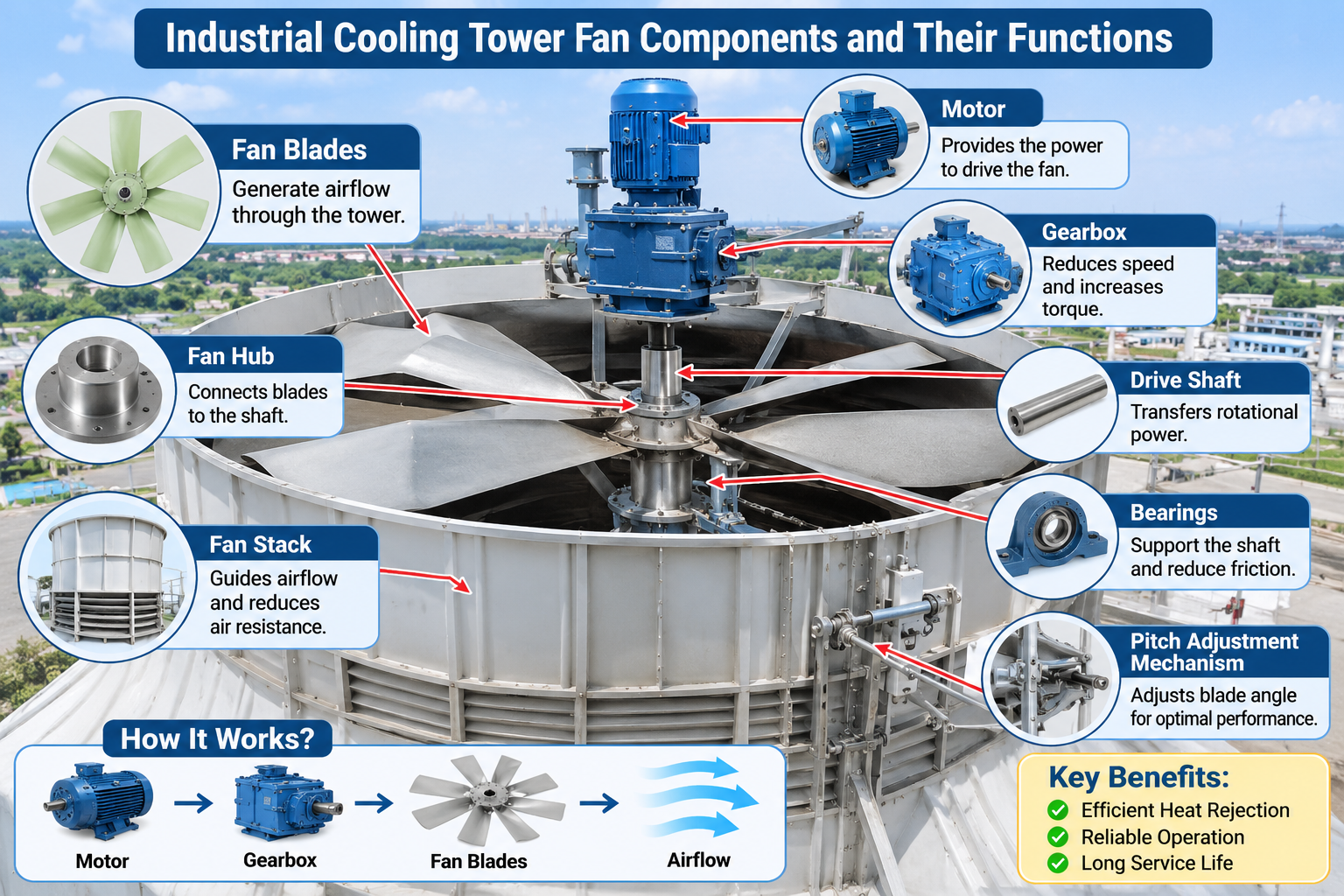
6. Key Components of an Industrial Cooling Tower Fan
A cooling tower fan assembly consists of several components that work together. A failure in one component can affect the performance or safety of the entire system.
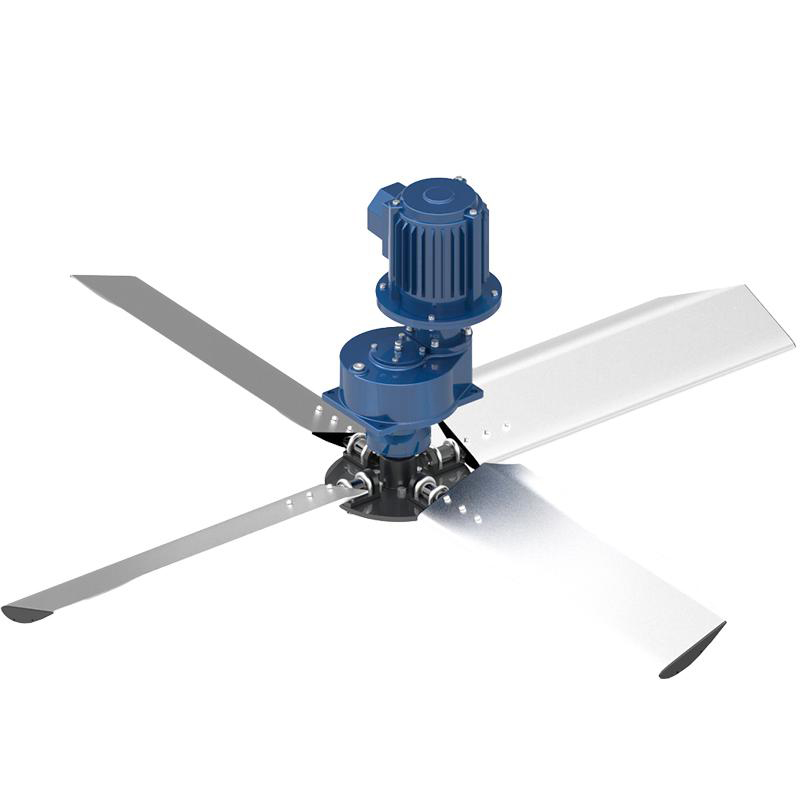
6.1 Fan Blades and Hub
The blades generate airflow, while the hub connects and supports them.
Blade number, profile, pitch angle, and diameter influence aerodynamic performance. The hub must also provide sufficient structural support and maintain secure blade connections.
When replacing blades, compatibility with the original hub is essential.
6.2 Motor and Gearbox
The electric motor supplies mechanical power.
Depending on the design, power may be transferred through a gearbox, belt drive, or direct-drive arrangement.
A gearbox changes rotational speed and transfers torque to the fan. Its ratio, output speed, torque capacity, and mounting arrangement must match the fan system.
Not every cooling tower uses a gearbox, so always confirm the existing configuration.
6.3 Fan Cylinder and Support Structure
The fan cylinder, also called a fan stack in many applications, guides airflow through the fan discharge area.
Its dimensions and geometry influence airflow behavior and must provide suitable clearance for the rotating blades.
The support structure holds the fan assembly in position and must withstand the mechanical loads generated during operation.
7. Important Cooling Tower Fan Specifications
Before purchasing an industrial cooling tower fan, collect the main technical specifications. These details help the supplier evaluate compatibility and select an appropriate design.
7.1 Fan Diameter and Blade Number
Fan diameter is one of the most important dimensions.
It must match the cooling tower's available fan opening and required airflow capacity. Blade number and configuration also influence fan performance.
A larger diameter does not automatically mean better cooling. The fan must be matched to the system's resistance and operating requirements.
7.2 Airflow and Static Pressure
Airflow describes the volume of air moved by the fan over a given period.
Static pressure represents the resistance the fan must overcome to move that air through the system.
Both values are necessary for proper fan selection. A fan may have a high free-air capacity but perform differently when installed in a cooling tower with significant airflow resistance.
7.3 Rotational Speed and Motor Power
Fan speed is usually expressed in revolutions per minute (RPM).
Motor power must be sufficient for the required operating duty while remaining within the limits of the motor, gearbox, and mechanical assembly.
Do not select a replacement motor or fan based only on the original motor's rated power. Confirm the actual operating point and mechanical compatibility.
7.4 Blade Pitch and Clearance
Blade pitch affects the angle at which the blades interact with the air.
Changing the pitch can influence airflow and power demand. However, excessive pitch may overload the motor or cause the fan to operate outside its intended range.
Blade-tip clearance is also important. Insufficient clearance can cause contact between the blade and fan cylinder, while excessive or poorly designed clearance may affect aerodynamic performance.
Follow the fan manufacturer's specifications when adjusting or installing blades.
8. How to Choose the Right Industrial Cooling Tower Fan
Selecting a suitable industrial cooling tower fan requires more than matching the old fan's diameter.
Here is a practical process to follow.
8.1 Identify the Cooling Tower Type
First, identify whether the tower is crossflow or counterflow and whether it uses an induced-draft or forced-draft arrangement.
These configurations influence the airflow path and fan installation requirements.
Also confirm the cooling tower manufacturer, model, and original fan arrangement if this information is available.
8.2 Calculate Airflow Requirements
Determine the airflow required to meet the tower's thermal duty.
Relevant operating information includes:
Circulating water flow rate.
Hot-water inlet temperature.
Required cold-water outlet temperature.
Ambient wet-bulb temperature.
Cooling range and approach.
Process heat load.
The fan selection should be based on the complete cooling tower design and its operating conditions.
If the tower has been modified or its process load has changed, the original fan specification may no longer be appropriate.
8.3 Check Existing Equipment Dimensions
Measure or confirm:
Fan diameter.
Fan cylinder diameter.
Available installation height.
Hub dimensions.
Blade mounting arrangement.
Blade-tip clearance.
Motor and gearbox mounting positions.
Drawings and photographs are useful, but critical dimensions should be verified before manufacturing or ordering replacement equipment.
8.4 Consider Operating Environment
Industrial cooling towers may operate in environments with high humidity, airborne dust, chemical contaminants, or elevated temperatures.
These conditions influence material selection and maintenance requirements.
For example, an FRP fan may be suitable for many corrosive environments, but the resin system must be compatible with the actual exposure conditions.
8.5 Evaluate Energy Efficiency
Energy efficiency should be evaluated at the required operating point.
Consider fan efficiency, motor efficiency, operating speed, airflow resistance, and control strategy.
If the cooling load changes throughout the day or year, a compatible variable-frequency drive may help adjust fan speed to match demand.
However, the motor, drive, fan, and control system must all be suitable for variable-speed operation.
9. Industrial Cooling Tower Fan Applications
Industrial cooling tower fans are used wherever large quantities of heat must be removed from circulating water.
Common applications include:
Power generation: Cooling towers remove heat from condenser cooling-water systems and other plant processes.
Chemical and petrochemical plants: Cooling-water systems support process equipment, condensers, and heat exchangers.
Steel and metal processing: Cooling towers help remove heat from production equipment and industrial circulation systems.
HVAC systems: Large commercial and industrial buildings use cooling towers to reject heat from water-cooled chiller systems.
Manufacturing facilities: Plastic processing, machinery production, food processing, and other industrial operations may require continuous cooling.
Data centers: Cooling towers can form part of larger heat rejection systems, depending on the facility's cooling architecture.
Each application has different cooling loads and operating conditions. Fan selection must reflect the actual system requirements.
10. Common Fan Problems and Solutions
Even a properly selected cooling tower fan needs regular inspection. Understanding common problems can help maintenance teams respond before a minor issue becomes a major failure.
10.1 Excessive Vibration
Excessive vibration may result from:
Fan imbalance.
Loose fasteners.
Damaged blades.
Misalignment.
Bearing deterioration.
Structural problems.
Measure vibration and compare the results with equipment specifications and maintenance limits. Identify the root cause before returning the fan to normal operation.
10.2 Abnormal Noise
Unusual noise may indicate mechanical contact, bearing damage, gearbox problems, or loose components.
Grinding, knocking, and repeated scraping sounds should never be ignored.
Stop the equipment when necessary and investigate the source using the site's safety procedures.
10.3 Blade Damage and Corrosion
Inspect blades for cracks, deformation, erosion, and corrosion.
FRP blades should also be checked for surface deterioration, damage around attachment points, and signs of structural weakness.
Do not attempt to repair structural damage without an approved repair procedure.
10.4 Insufficient Airflow
Low airflow may be caused by an incorrectly adjusted fan, damaged blades, reduced fan speed, or an unsuitable fan operating point.
However, the fan may not be the actual source of the problem.
Blocked air inlets, fouled fill media, poor water distribution, damaged drift eliminators, and air recirculation can also reduce cooling tower performance.
Inspect the complete tower before deciding to replace the fan.
11. Cooling Tower Fan Maintenance Guide
Preventive maintenance helps maintain reliable operation and reduce unexpected downtime.
A practical inspection program should include:
Inspect fan blades for cracks, deformation, and surface damage.
Check blade attachment points and hub fasteners.
Monitor fan and motor vibration.
Check motor temperature and electrical current.
Inspect gearbox oil level and condition where applicable.
Check bearings and lubrication according to manufacturer recommendations.
Inspect the fan cylinder and support structure.
Look for signs of corrosion and loose connections.
Record operating conditions and maintenance findings.
Before performing any maintenance, isolate electrical power and follow the facility's lockout/tagout procedures.
Inspection frequency should depend on operating hours, environmental conditions, equipment criticality, and manufacturer recommendations.
12. Cooling Tower Fan Repair, Replacement, and Upgrading
When a fan develops a problem, the maintenance team must decide whether to repair the existing equipment or replace it.
Repair is often suitable for localized problems, such as replaceable bearings, loose fasteners, or certain approved component repairs.
Replacement may be more appropriate when the fan has extensive structural damage, repeated failures, or components that are no longer available.
Upgrading offers an opportunity to improve performance when the existing fan no longer matches the cooling tower's operating requirements.
Before selecting any option, compare initial costs, future maintenance expenses, downtime, and expected operating performance.
For more serious fan problems, inspect the blades, hub, motor, gearbox, fan cylinder, and supporting structure together. Replacing one component without understanding the underlying problem may lead to another failure.
13. How to Improve Industrial Cooling Tower Fan Efficiency
Improving fan efficiency does not always require purchasing a completely new fan.
Consider these practical measures:
Maintain the correct blade pitch: Incorrect pitch settings can increase power consumption or reduce airflow.
Keep the fan assembly balanced: Imbalance increases vibration and can place additional stress on bearings and supporting components.
Maintain the drive system: Proper alignment, lubrication, and component condition help reduce mechanical losses.
Inspect the fan cylinder: Damage or deformation may affect airflow and mechanical clearance.
Keep the tower's air path clear: Blocked air inlets and fouled internal components increase system resistance.
Consider variable-speed control: Where technically suitable, adjusting fan speed to match changing cooling demand may reduce energy use.
The key is to evaluate the fan and cooling tower as one system. A high-efficiency fan cannot compensate for poor water distribution or severely fouled fill media.
14. How to Select a Reliable Cooling Tower Fan Manufacturer
Choosing a supplier is an important part of any cooling tower fan project.
A reliable manufacturer or supplier should understand both the product and the cooling tower application.
Consider the following points:
Technical experience: Does the supplier understand industrial cooling tower fan requirements?
Product information: Can it provide drawings, dimensions, material details, and relevant performance data?
Customization: Can it evaluate non-standard fan dimensions or replacement requirements?
Quality control: Are inspection procedures and material specifications available?
Compatibility: Can the supplier verify hub, blade, motor, and fan cylinder compatibility?
After-sales support: Can it provide technical assistance and spare-part support?
Avoid choosing a fan based only on a product photograph or a single dimension. Technical compatibility should always be confirmed before ordering.
15. Industrial Cooling Tower Fan Solutions from Power Tower
Power Tower Cooling Technology (Shaoxing) Co.,Ltd provides cooling tower components for industrial cooling applications.
When evaluating a cooling tower fan replacement or upgrade, it is important to understand the existing equipment and the conditions under which it operates.
To help assess a suitable fan solution, prepare the following information:
Cooling tower manufacturer and model.
Existing fan diameter.
Number of blades.
Fan blade material.
Hub dimensions and connection details.
Motor power and rotational speed.
Gearbox specifications, if applicable.
Fan cylinder dimensions.
Required airflow and operating conditions.
Clear photographs of the existing fan, hub, motor nameplate, and installation area can also help with preliminary evaluation.
The objective is to identify a fan configuration that matches the cooling tower's mechanical arrangement and operating requirements.
Visit https://www.coolingtowerpart.com to learn more about cooling tower components and discuss your industrial cooling tower fan requirements.
16. Frequently Asked Questions
16.1 What Type of Fan Is Commonly Used in Industrial Cooling Towers?
Axial fans are commonly used in mechanical-draft industrial cooling towers because they can move large volumes of air at relatively low pressure.
Centrifugal fans are used in certain applications where the airflow arrangement or pressure requirements make them suitable.
16.2 Are FRP Cooling Tower Fans Better Than Aluminum Fans?
Neither material is automatically better for every application.
FRP offers low weight and good corrosion resistance in suitable environments. Aluminum also provides a lightweight design and useful mechanical properties.
The best choice depends on operating conditions, structural requirements, material compatibility, and maintenance considerations.
16.3 How Do I Select the Correct Fan Diameter?
Fan diameter must match the cooling tower's available space, fan cylinder dimensions, and required airflow performance.
You should also check blade clearance, hub dimensions, rotational speed, and system resistance. Do not select a fan based on diameter alone.
16.4 Can I Replace Only the Cooling Tower Fan Blades?
Yes, if the existing hub is suitable and compatible replacement blades are available.
However, blade geometry, weight, pitch, material, attachment design, and balance must be verified. Mixing incompatible blades can create dangerous operating conditions.
16.5 How Often Should an Industrial Cooling Tower Fan Be Inspected?
Inspection frequency depends on operating conditions, equipment design, and manufacturer recommendations.
A regular inspection program should include blades, hub connections, vibration, motor condition, gearbox, fan cylinder, and support structure. More frequent checks may be necessary for critical equipment or demanding environments.
17. Conclusion
An industrial cooling tower fan is an essential part of a mechanical-draft cooling tower. It creates the airflow needed to support evaporation and heat rejection, helping industrial facilities maintain stable cooling-water temperatures.
Choosing the right fan means looking beyond diameter and motor power. You need to consider fan type, blade material, airflow, static pressure, rotational speed, drive configuration, installation dimensions, and operating environment.
For new installations, select a fan based on the cooling tower's complete thermal and mechanical requirements. For replacement projects, verify compatibility with the existing equipment. For older systems, consider whether repair, replacement, or an engineered upgrade offers the best long-term value.
With proper selection and preventive maintenance, your cooling tower fan can operate more reliably and support the performance of the entire cooling system.
Power Tower Cooling Technology (Shaoxing) Co.,Ltd
Website: https://www.coolingtowerpart.com


