Why Are Cooling Tower Fills Important for Industrial Cooling?
Industrial cooling systems are designed to remove large amounts of unwanted heat from manufacturing processes, power generation equipment, HVAC systems, petrochemical facilities, data centers, and other industrial operations. Among the many components inside a cooling tower, cooling tower fills play a particularly important role because they directly influence the contact between circulating water and air.
A cooling tower may have a powerful fan, efficient motor, reliable pump, and properly designed water distribution system, but poor-quality or incorrectly selected fill can still limit overall thermal performance.
So, why are cooling tower fills important for industrial cooling?
The answer lies in their ability to increase the effective contact area between hot water and air, improve heat and mass transfer, optimize tower size, and support stable cooling performance. The right cooling tower filler can also help reduce energy consumption, maintenance requirements, and operating costs when it is matched correctly to the application.
This guide explains how cooling tower fill works, why it matters in industrial applications, which types are available, and how businesses can select and maintain the right fill media.
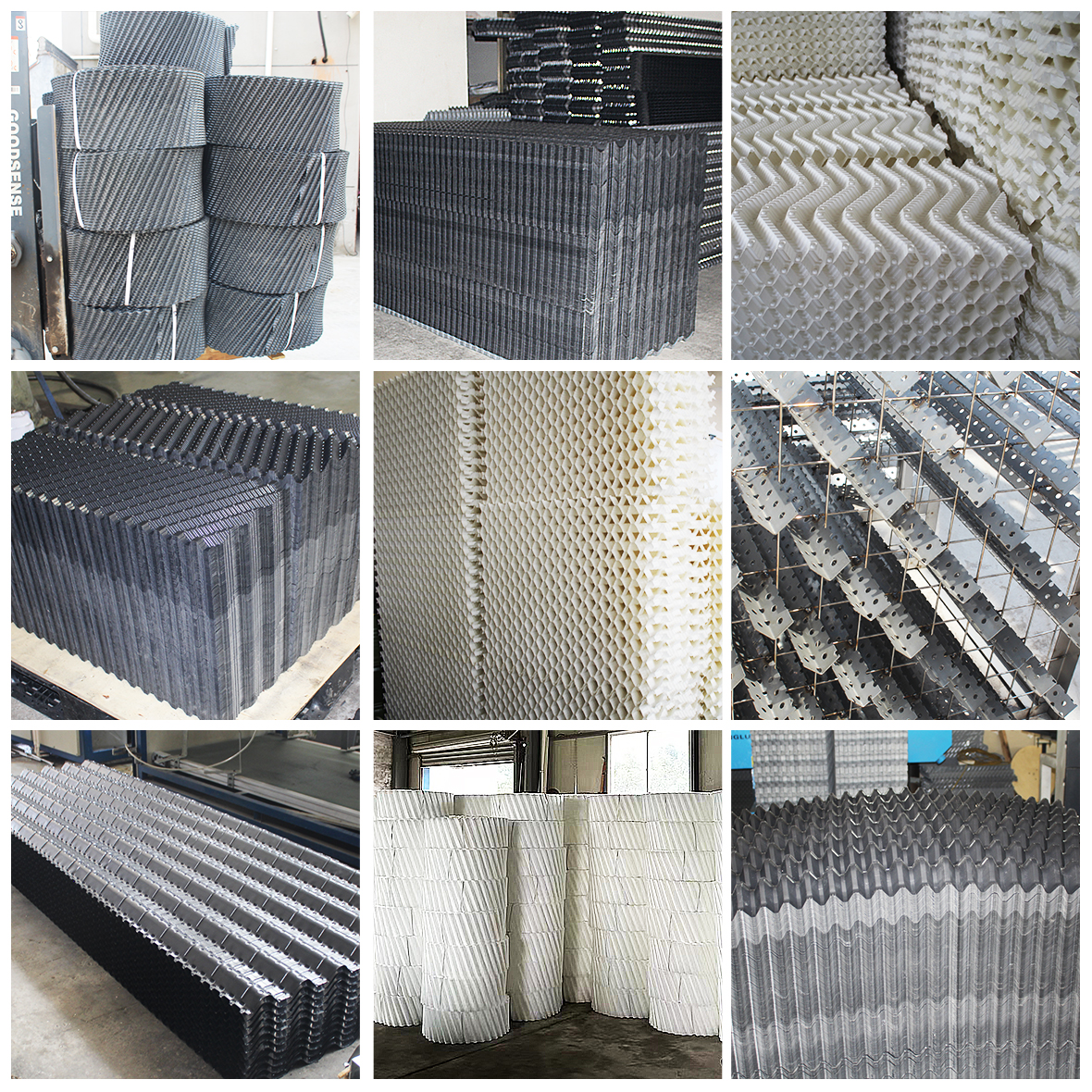
What Is a Cooling Tower Fill?
A cooling tower fill is a structured or splash-type heat-transfer medium installed inside a wet cooling tower.
Its main purpose is to increase the amount of interaction between water and air.
Without fill media, water would simply fall through the tower with relatively limited air-water contact. The cooling process would therefore require a much larger tower volume or significantly higher airflow to achieve the same heat rejection.
How Does Cooling Tower Fill Work?
The basic cooling process can be summarized as:
Hot water → Fill media → Air-water contact → Heat and moisture transfer → Cooled water
Hot water enters the tower through a distribution system and flows across or through the fill. At the same time, air moves through the fill section.
The fill spreads the water into thin films or breaks it into droplets, depending on the design. This creates a much larger effective contact area.
Why Is Contact Area So Important?
Heat transfer depends strongly on the interface between water and air.
A greater effective contact area provides more opportunity for:
Sensible heat transfer
Evaporative cooling
Mass transfer
Water-air interaction
This allows a relatively compact cooling tower to remove substantial quantities of heat.
Why Are Cooling Tower Fills Critical for Industrial Cooling?
Industrial facilities often need to reject large and continuous heat loads.
Examples include:
In these applications, cooling tower performance directly affects production reliability.
How Does Fill Affect Cooling Capacity?
The cooling tower fill determines how effectively water and air interact inside the tower.
A well-designed cooling tower filler can provide:
High effective surface area
Uniform water distribution
Adequate air passage
Long water-air contact time
Consistent wetting
Efficient heat transfer
If the fill is damaged or incorrectly selected, the tower may experience reduced cooling capacity even when the fan and pump are operating normally.
What Happens When Fill Performance Declines?
As fill becomes blocked, scaled, broken, or deformed, several problems can develop:
Heat-transfer area decreases.
Water distribution becomes uneven.
Airflow resistance increases.
Cooling efficiency declines.
Fan power requirements may increase.
Cold-water temperature may rise.
Industrial equipment may operate at higher temperatures.
For this reason, cooling tower fill should be treated as a critical thermal component rather than simply an internal plastic structure.
How Does Cooling Tower Fill Improve Heat Transfer?
The primary function of fill media is to maximize heat and mass transfer within the available tower volume.
How Does Film Fill Increase Surface Area?
Film fill consists of specially formed sheets with patterns, channels, corrugations, or other structures.
Water flows over these surfaces and spreads into relatively thin films.
At the same time, air passes through the channels created by the sheets.
This arrangement produces a large water-air interface.
Why Is Thin Water Film Useful?
A thin water film can improve heat transfer because it creates a relatively large interface between the water and air.
The structure also helps distribute water throughout the fill pack rather than allowing water to fall through a few concentrated paths.
How Does Splash Fill Work in Industrial Towers?
Splash fill uses a different approach.
Instead of creating continuous water films, splash bars or grids repeatedly break falling water into droplets.
When Is Splash Fill Useful?
Splash-type cooling tower fill can be particularly useful when water quality is challenging.
Applications may involve:
The more open structure can make the fill less susceptible to complete blockage than some high-surface-area film designs.
Is Splash Fill Always More Efficient?
Not necessarily.
Film fill can provide a high effective surface area within a compact volume, while splash fill may provide better fouling tolerance in certain operating conditions.
The appropriate choice depends on the cooling tower design, water quality, temperature, airflow, and required thermal performance.
What Types of Cooling Tower Fill Are Commonly Used?
Different industrial cooling systems require different fill materials and configurations.
Common options include:
PVC cooling tower fill
PP cooling tower fill
Film fill
Splash fill
High-temperature fill
Cross-flow fill
Counter-flow fill
What Is PVC Cooling Tower Fill?
PVC cooling tower fill is widely used in commercial and industrial evaporative cooling systems.
Its popularity comes from a combination of:
PVC film fill is commonly selected when water quality and operating temperatures are compatible with the material.
Why Is PP Cooling Tower Fill Used?
Polypropylene, or PP, can be selected for applications requiring different temperature or chemical characteristics.
The choice between PVC and PP should be based on actual operating conditions rather than material price alone.
What Should Engineers Compare?
Before selecting a material, engineers should evaluate:
Maximum water temperature
Continuous operating temperature
Chemical exposure
Water treatment chemicals
Mechanical loading
Fouling conditions
Expected service life
How Does Cooling Tower Fill Affect Energy Efficiency?
Energy consumption is an important consideration for industrial cooling towers because fans and pumps can operate continuously for thousands of hours each year.
Can Efficient Fill Reduce Fan Energy?
Potentially, yes.
The fill creates resistance to airflow, so its design must balance heat-transfer performance with pressure drop.
An efficient cooling tower filler should provide sufficient surface area without creating unnecessarily high airflow resistance.
What Happens When Fill Becomes Fouled?
Scale, algae, sludge, and other deposits can obstruct fill passages.
This may increase air-side resistance and reduce the amount of air moving through the tower.
The fan may then need to work harder or operate for longer periods to achieve the required cooling performance.
Therefore, clean cooling tower fill can be an important factor in maintaining energy-efficient operation.
Can Cooling Tower Fill Reduce Water Consumption?
Evaporative cooling inherently consumes water because evaporation is part of the heat-rejection mechanism.
However, efficient fill can help optimize the cooling process.
How Does Better Fill Performance Support Water Efficiency?
A properly selected fill can improve:
When the cooling tower achieves its design cooling duty efficiently, operators may have more opportunities to optimize water circulation and system operating conditions.
However, total water consumption also depends on:
Evaporation
Blowdown
Drift
Makeup-water quality
Cycles of concentration
Water treatment
Therefore, fill optimization should be combined with proper water-management practices.
Why Does Water Distribution Matter to Cooling Tower Fill?
Even the highest-quality fill cannot perform effectively if water is distributed unevenly.
What Happens When Water Distribution Is Poor?
Poor distribution can create:
The distribution system should therefore deliver water uniformly across the fill.
Which Components Influence Water Distribution?
Important components include:
Cooling tower nozzles
Distribution pipes
Headers
Spray branches
Water pressure
Fill geometry
This means cooling tower fill should always be evaluated together with the water distribution system.
How Does Cooling Tower Fill Influence Tower Size?
One of the less obvious advantages of high-performance fill is its influence on cooling tower compactness.
Can Better Fill Reduce Tower Volume?
A fill with a high effective heat-transfer area can potentially achieve the required thermal performance within a smaller volume.
This can be particularly valuable when:
Plant space is limited
Existing towers need upgrades
Replacement capacity must fit an existing structure
Transportation and installation costs matter
Why Is Compact Design Important?
A smaller effective fill volume can potentially reduce:
However, tower size should always be determined using actual thermal design calculations rather than surface-area claims alone.
Why Is Fill Selection Different for Cross-Flow and Counter-Flow Towers?
Cooling tower configuration strongly influences fill selection.
The two major wet cooling tower arrangements are:
What Is Cross-Flow Cooling Tower Fill?
In a cross-flow tower, air moves horizontally through the fill while water flows downward.
The water distribution system is usually positioned above the fill, allowing water to flow downward through the media.
What Is Counter-Flow Cooling Tower Fill?
In a counter-flow tower, air generally moves upward while water flows downward.
The two streams therefore move in opposite directions.
Why Does Tower Configuration Matter?
Fill geometry must be compatible with the direction of airflow and water flow.
Using an unsuitable fill configuration can result in:
Therefore, buyers should specify the cooling tower configuration when purchasing replacement fill.
How Does Fill Geometry Affect Cooling Tower Performance?
Not all fill sheets are designed the same way.
Geometry determines how water spreads and how air moves through the media.
What Features Matter in Fill Design?
Important design characteristics include:
These variables influence both thermal performance and pressure drop.
Is More Surface Area Always Better?
No.
A very high surface area may look attractive from a theoretical perspective, but if the fill creates excessive airflow resistance or is highly vulnerable to fouling, real-world performance may suffer.
The best cooling tower filler is the one that provides an appropriate balance between:
Heat transfer + airflow + water distribution + fouling resistance + durability.
What Happens When Cooling Tower Fill Becomes Fouled?
Fouling is one of the most common causes of declining cooling tower performance.
What Causes Fill Fouling?
Common causes include:
Mineral scale
Algae
Slime
Dust
Suspended solids
Biological growth
Process contaminants
How Does Fouling Affect Heat Transfer?
Deposits can cover the fill surface and reduce the effective contact area between water and air.
They can also narrow airflow channels.
The resulting performance decline may appear gradually, making it difficult to identify without routine monitoring.
What Are the Warning Signs?
Operators should investigate when they observe:
How Can Industrial Facilities Maintain Cooling Tower Fill?
Regular maintenance helps preserve the designed performance of cooling tower fill.
What Should Routine Inspection Include?
A maintenance program should examine:
Fill condition
Water distribution
Nozzle condition
Drift eliminators
Air inlet louvers
Fan performance
Basin cleanliness
Water chemistry
When Should Cooling Tower Fill Be Cleaned?
Cleaning frequency depends on operating conditions.
A tower operating with clean, properly treated water may require less frequent intervention than a tower exposed to heavy dust, biological growth, or high mineral loading.
When Should Fill Be Replaced?
Replacement may be necessary when fill has:
Become brittle
Collapsed
Permanently deformed
Developed severe scaling
Lost structural integrity
Experienced thermal damage
Become repeatedly blocked
Replacing damaged fill can restore the tower's intended airflow and heat-transfer characteristics.
How Should Industrial Buyers Choose Cooling Tower Fills?
Selecting cooling tower fill should begin with the operating conditions rather than a generic product catalog.
Which Parameters Should Be Evaluated?
Industrial buyers should provide suppliers with information such as:
Cooling tower type
Cross-flow or counter-flow configuration
Circulating water flow
Hot-water temperature
Cold-water temperature
Design wet-bulb temperature
Water quality
Suspended solids
Chemical treatment
Required cooling capacity
Why Is Application-Specific Selection Important?
A fill designed for a clean-water HVAC tower may not be suitable for a heavily contaminated industrial cooling system.
Likewise, a standard PVC filler may not be appropriate for a high-temperature application.
What Should a Professional Supplier Provide?
A reliable cooling tower fills supplier should be able to discuss:
How Can Cooling Tower Fill Replacement Improve Existing Towers?
Replacing old fill does not necessarily mean replacing the entire cooling tower.
What Are the Benefits of Fill Replacement?
A properly planned fill replacement project can help:
Restore cooling capacity
Improve water distribution
Reduce airflow obstruction
Extend tower service life
Improve operating stability
Reduce maintenance problems
This can be particularly useful for older industrial cooling towers whose structural components remain serviceable but whose internal fill has deteriorated.
What Should Be Checked Before Replacement?
Before ordering new fill, measure the existing:
Accurate measurements help prevent compatibility problems during installation.
Why Should Cooling Tower Fill Be Considered Part of a Complete System?
A cooling tower does not operate through the fill alone.
Thermal performance depends on the interaction between multiple components.
Which Components Work Together With Cooling Tower Fill?
A typical system includes:
Cooling tower fill
Fan
Fan motor
Water pump
Nozzles
Drift eliminators
Louvers
Water basin
Gearbox or drive system
Water treatment system
Why Is System Matching Important?
For example, increasing fill surface area without considering fan capacity may increase airflow resistance.
Similarly, installing high-performance fill without improving poor water distribution may not deliver the expected thermal improvement.
The entire system must therefore be evaluated as an integrated cooling process.
What Makes a High-Quality Cooling Tower Filler?
A high-quality cooling tower filler should not be judged only by its appearance or purchase price.
Which Characteristics Matter Most?
Depending on the application, important characteristics can include:
Stable geometry
Consistent sheet thickness
Good bonding quality
Appropriate surface pattern
Suitable temperature resistance
Chemical compatibility
Adequate mechanical strength
Good wetting performance
Appropriate fouling resistance
Why Does Manufacturing Quality Matter?
Small variations in fill geometry can affect installation and water distribution.
Consistent manufacturing helps ensure that fill blocks fit correctly and maintain the intended airflow passages.
For large industrial cooling towers, manufacturing consistency becomes particularly important because thousands of fill sheets may be installed in the same system.
How Does Cooling Tower Fill Support Sustainable Industrial Cooling?
Industrial facilities are increasingly focused on reducing resource consumption without compromising production reliability.
Cooling tower fill can contribute to this objective by improving the efficiency of evaporative heat rejection.
What Sustainability Benefits Can Fill Optimization Provide?
Depending on the application, an optimized fill system can support:
Lower energy consumption
Better water utilization
Longer equipment service life
Reduced maintenance frequency
More stable thermal performance
Improved use of existing tower capacity
The sustainability benefit is strongest when fill optimization is combined with efficient fans, pumps, water treatment, variable-speed control, and regular maintenance.
What Are the Key Takeaways About Cooling Tower Fills?
Cooling tower fills are much more than passive plastic components.
They are the primary heat-transfer media in many wet cooling towers and have a direct influence on how efficiently water and air interact.
The right cooling tower fill can help an industrial cooling system achieve effective heat transfer while maintaining reasonable airflow resistance and water distribution.
The most important considerations include:
Heat-transfer area: More effective contact between water and air improves thermal performance.
Fill material: PVC, PP, and other materials should be selected according to operating conditions.
Fill geometry: Channel structure affects both heat transfer and airflow resistance.
Water quality: Fouling and scaling can significantly reduce performance.
Tower configuration: Cross-flow and counter-flow towers require compatible fill designs.
Maintenance: Cleaning and inspection help preserve long-term performance.
System matching: Fill should be selected together with fans, pumps, nozzles, and drift eliminators.
Conclusion: Why Are Cooling Tower Fills Important for Industrial Cooling?
The importance of cooling tower fills comes down to one fundamental function: creating an efficient environment for water and air to exchange heat and mass.
By increasing the effective contact area, distributing water across the fill surface, and controlling the interaction between airflow and water flow, a well-designed cooling tower filler can significantly influence the thermal performance of an industrial cooling tower.
However, the best fill is not necessarily the one with the highest theoretical surface area or the lowest purchase price. Industrial applications require a balanced approach that considers heat transfer, airflow resistance, water quality, temperature, durability, maintenance, and system compatibility.
For this reason, cooling tower operators should evaluate fill performance as part of the complete cooling system. Proper selection, installation, inspection, cleaning, and timely replacement can help maintain reliable cooling performance and support more efficient industrial operations over the long term.
When the right cooling tower fill is combined with effective water distribution, efficient fans and pumps, proper water treatment, and regular maintenance, it becomes a powerful tool for improving the overall performance of industrial cooling systems.


