When people talk about cooling tower performance, they often mention the fan, motor, pump, or water distribution system first.
But what about the component where the real water-to-air heat exchange happens?
That is where PVC fill for cooling tower comes in.
Cooling tower fill creates a large contact area between circulating water and moving air. Instead of allowing hot water to fall quickly through the tower, the fill spreads the water across structured surfaces, giving evaporation more opportunity to remove heat.
PVC has become one of the most widely used materials for cooling tower fill because it offers a practical combination of thermal performance, relatively low weight, corrosion resistance, manufacturability, and cost.
However, PVC fill is not automatically the right solution for every cooling tower.
Water temperature, water quality, chemical conditions, tower design, airflow, maintenance, and replacement requirements all matter.
So, how does PVC cooling tower fill work? What are its advantages and limitations? And when should you choose PVC instead of another material?
Let's take a closer look.
What Is PVC Fill for Cooling Tower?
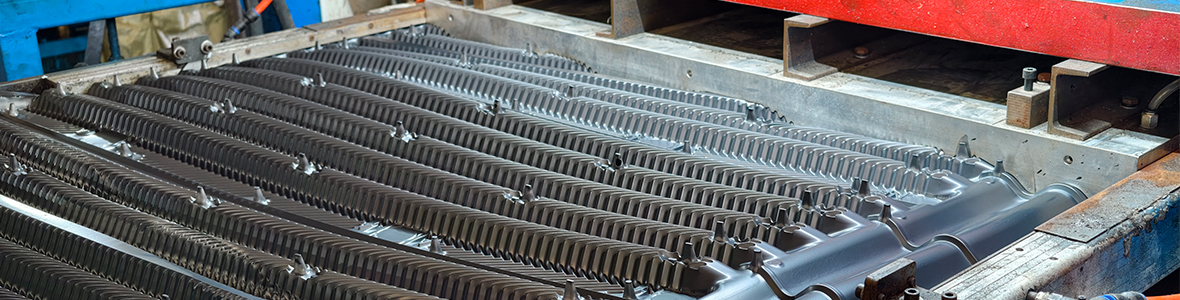
PVC fill for cooling tower is a structured heat-transfer medium made primarily from polyvinyl chloride sheets.
The sheets are formed into specific corrugated, fluted, or otherwise structured patterns and assembled into fill packs or modules. These structures create many small passages through which air and water can interact.
In a typical evaporative cooling tower, hot circulating water enters the upper part of the tower and flows downward across the fill. At the same time, air moves through the fill.
As the water spreads into thin films or droplets, its contact area with the air increases. A portion of the water evaporates, carrying heat away from the remaining water.
That simple principle is the heart of evaporative cooling.
Modern PVC film fill is therefore much more than a collection of plastic sheets. Its geometry determines how water spreads, how air moves, how much surface area is available, and how easily the fill can become fouled.
How PVC Cooling Tower Fill Works
Think of a cooling tower without fill as a person trying to cool down with a quick splash of water.
It works, but not very efficiently.
Now imagine spreading that same water over a large wet surface while continuously moving air across it. The opportunity for evaporation becomes much greater.
PVC cooling tower fill works on essentially this principle.
Increasing Water-Air Contact Area
The first major function of PVC fill is to increase the effective contact area between water and air.
Structured sheets force water to spread over a much larger surface instead of simply falling in streams.
Film fill is particularly effective because water forms thin films along the surfaces of the sheets. This creates a large interface where heat and moisture can move between the water and air.
The exact flute and surface geometry can significantly affect heat-transfer behavior and airflow resistance.
Creating Longer Contact Time
The second function is contact time.
Hot water needs sufficient interaction with moving air for effective evaporative cooling. The fill slows and redistributes the water as it travels through the tower.
More effective contact does not simply mean making the fill as dense as possible.
Too much material can increase airflow resistance, while an unsuitable geometry can create poor water distribution or excessive fouling.
Good fill design is therefore a balancing act between heat transfer, airflow, water distribution, and maintenance.
Improving Water Distribution
Uniform water distribution is another important factor.
If one section of the fill receives too much water while another section stays relatively dry, the entire available fill area is not being used effectively.
A properly selected PVC fill system helps distribute water across the media so that more of the available heat-transfer surface contributes to cooling.
That is one reason why replacement fill should be selected according to the cooling tower's original design rather than simply buying sheets based on length and width.
Main Types of PVC Cooling Tower Fill
PVC cooling tower fill is not a single standardized product.
Different tower configurations and operating conditions require different designs.
PVC Film Fill
PVC film fill is one of the most common choices for cooling towers operating with relatively well-controlled water quality.
Its structured surface encourages water to form thin films while providing passages for air.
Because film fill provides a large effective surface area in a compact volume, it can deliver strong heat-transfer performance when used in suitable applications.
Film fill is particularly common in HVAC systems, commercial cooling towers, and many industrial applications.
Crossflow PVC Fill
Crossflow cooling towers move air horizontally across the fill while water travels downward.
The fill used in these towers must match the crossflow configuration and water-distribution arrangement.
Crossflow PVC fill can be an attractive option for retrofit projects because the tower architecture often provides relatively convenient access to fill sections.
However, dimensions, flute direction, block arrangement, and water distribution must all be checked before replacement.
Counterflow PVC Fill
In a counterflow tower, air generally travels upward while water moves downward.
This creates an opposing air-water flow arrangement that requires a fill geometry designed for counterflow operation.
Counterflow PVC film fill is widely used where compact tower construction and efficient heat transfer are important.
Power Tower supplies PVC counterflow film fill designed around structured corrugations and airflow passages. The geometry influences water distribution, pressure drop, heat-transfer performance, and fouling characteristics.
Special PVC Fill Designs
Not every project uses the same sheet pattern.
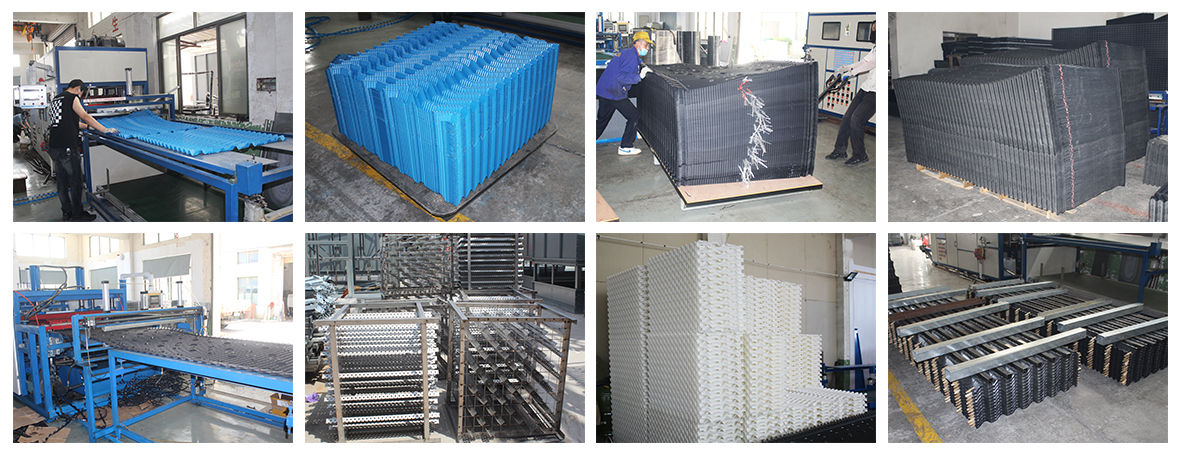
Different flute spacing, sheet thickness, surface structures, block dimensions, and configurations can be selected according to the tower's thermal duty and water conditions.
This is especially important for replacement projects.
A fill that looks almost identical to the original product may still perform differently if its geometry, spacing, or airflow characteristics are not compatible with the tower.
Key Benefits of PVC Fill for Cooling Tower
Why is PVC so widely used?
The answer is not one single advantage. It is the combination.
High Heat Transfer Efficiency
The biggest reason to use PVC film fill is its ability to create a large effective heat-transfer area.
The structured sheets encourage water to spread into thin films, increasing the area available for interaction with air.
When the water distribution system, airflow, and fill design are properly matched, this can provide efficient evaporative cooling in a relatively compact volume.
Lightweight and Easy to Install
PVC fill is considerably lighter than many traditional structural heat-transfer materials.
That matters during both new tower construction and replacement work.
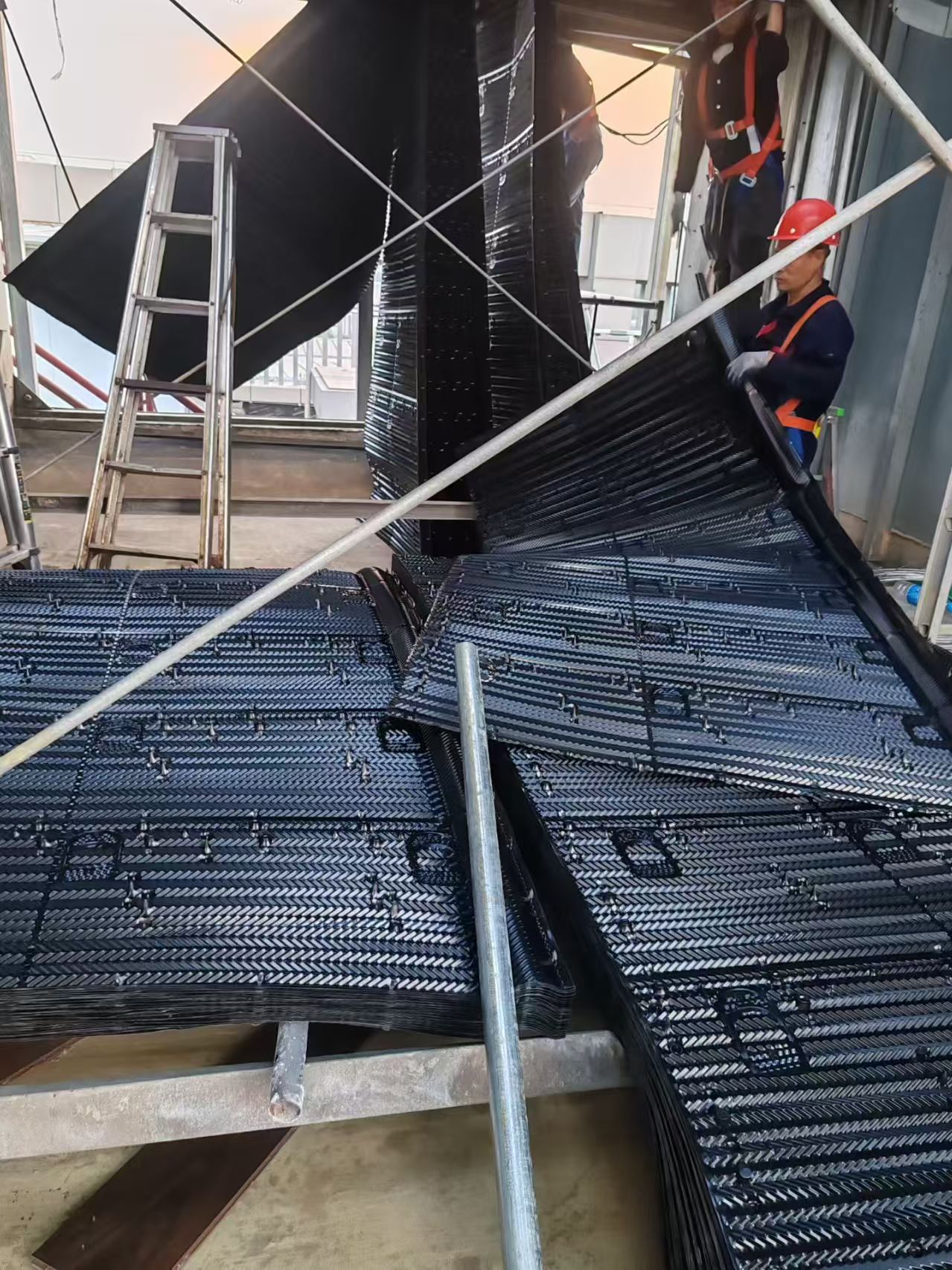
Workers need to move, cut, arrange, and install fill blocks inside confined tower spaces. Lighter components can make handling and installation more manageable.
For retrofit projects, this practical advantage can be just as important as thermal performance.
Good Chemical Resistance
PVC provides useful resistance to moisture and many common cooling-water environments.
It does not rust like ordinary steel, and properly formulated PVC can maintain stable properties across a range of operating conditions.
However, "chemical resistant" does not mean "resistant to everything."
Cooling-water chemistry should always be reviewed before selecting a material.
Cost-Effective Operation
PVC is also popular because it offers a practical balance between performance and cost.
For many standard cooling applications, there is no need to choose a more expensive material if operating temperatures and water chemistry remain within the appropriate range for PVC.
This makes PVC fill an economical option for many commercial and industrial cooling towers.
What Are the Limits of PVC Cooling Tower Fill?
PVC fill has clear advantages, but it is not a universal solution.
Understanding its limitations can prevent expensive mistakes.
Water Temperature Limits
Temperature is one of the first things to check.
The maximum suitable operating temperature depends on the specific PVC formulation, sheet thickness, design, and manufacturer specification.
Many commercial PVC film-fill products are designed for relatively moderate water temperatures. For example, published product data commonly places PVC operating ranges around the 55–60°C area, although specific products and formulations can differ.
If the application involves significantly higher temperatures, PP, CPVC, or another material may need to be considered.
Never select fill based only on the word "PVC." Check the actual product specification.
Water Quality and Clogging
This is perhaps the most important limitation of high-efficiency film fill.
Film fill uses relatively close passages to maximize water-air contact. If the circulating water contains high levels of suspended solids, dirt, biological material, scale, or other contaminants, those passages can gradually become restricted.
Once fouling develops, airflow and water distribution can suffer.
The result?
The same tower may gradually lose cooling performance even though the fan and pump are still running normally.
For heavily contaminated water, open splash-fill designs may sometimes be more appropriate because their larger passages can provide better tolerance to suspended solids.
Chemical Compatibility
Cooling water can contain a complicated mixture of treatment chemicals, dissolved minerals, biological contaminants, and process-related substances.
PVC is resistant to many common conditions, but compatibility must be evaluated against the actual chemistry.
If the tower operates with unusually aggressive chemicals, elevated concentrations, or special process fluids, ask the fill manufacturer for material-compatibility guidance.
UV and Long-Term Exposure
PVC fill can provide a long service life when correctly specified and maintained.
However, prolonged exposure to direct sunlight, excessive heat, mechanical damage, poor water treatment, and harsh operating conditions can affect its service life.
Storage also matters.
PVC fill should not simply be left outdoors under intense sunlight for long periods before installation.
Applications of PVC Fill for Cooling Tower
PVC fill is used across a wide range of cooling applications.
HVAC and Commercial Buildings
Large commercial buildings, hospitals, shopping centers, hotels, and district cooling systems commonly use evaporative cooling towers.
In these applications, water quality is usually manageable, making PVC film fill a practical choice.
The objective is straightforward: reject heat efficiently while keeping equipment size and operating costs under control.
Industrial Process Cooling
Industrial facilities often rely on cooling towers to remove heat from manufacturing processes.
PVC fill may be used in applications involving machinery cooling, process water, refrigeration systems, and other industrial heat-rejection systems.
The exact fill design should be selected according to water quality, temperature, tower configuration, and required thermal performance.
Power and Manufacturing Plants
Manufacturing facilities, metal-processing operations, plastics plants, and other energy-intensive industries can require substantial heat-rejection capacity.
PVC fill can be used where the operating conditions fall within its suitable range.
For more demanding high-temperature or chemically aggressive applications, however, alternative materials may provide a better fit.
Replacement and Retrofit Projects
One of the most important applications for PVC fill is replacement.
Cooling tower fill does not last forever.
Over time, fill can become brittle, clogged, warped, damaged, or structurally weakened.
Replacing old fill with properly designed PVC film fill can restore effective water-air contact and help recover cooling performance.
For retrofit work, accurate measurement is critical. The replacement should match the tower's configuration rather than simply being the cheapest sheet available.

PVC Fill vs PP Fill: Which Should You Choose?
PVC and PP are both widely used for cooling tower fill, but they serve somewhat different operating conditions.
PVC is often selected for standard-temperature applications because of its thermal performance, cost-effectiveness, and ease of forming.
PP generally offers greater temperature resistance and can be attractive for higher-temperature or more chemically demanding environments.
So, which one is better?
There is no universal answer.
The right question is:
Which material matches the actual operating conditions of your cooling tower?
For a conventional HVAC cooling tower with properly treated water, PVC may be a highly practical solution.
For a process cooling application with elevated temperatures or aggressive chemistry, PP or another material may deserve closer consideration.
How to Choose the Right PVC Fill
Buying cooling tower fill is not like buying a standard plastic sheet.
Several technical details should be checked first.
Check the Cooling Tower Type
Start by identifying whether the tower is crossflow or counterflow.
The fill geometry and installation arrangement need to match the airflow and water-flow configuration.
Check Water Quality
Ask:
What is the suspended-solids level?
Is scaling a recurring problem?
Is biological fouling controlled?
What water-treatment program is used?
Has the existing fill experienced clogging?
These answers can determine whether a fine-passage film fill is appropriate.
Check Temperature and Chemistry
Record the hot-water temperature, cold-water temperature, pH, chemical treatment, and any unusual process contaminants.
This information allows the manufacturer to recommend an appropriate material and construction.
Check Fill Dimensions
For replacement projects, measure the existing fill carefully.
Important dimensions may include:
Block length
Block width
Block height
Sheet thickness
Flute spacing
Installation direction
Total fill volume
A good supplier should be able to review these details before production.
Maintenance Tips for PVC Fill
Even high-quality PVC fill needs maintenance.
The first step is maintaining good water treatment.
Proper control of scaling, corrosion, suspended solids, and biological growth can significantly reduce fouling.
Regular inspection is also valuable.
Look for:
Cleaning should be performed using methods compatible with the fill material.
Aggressive mechanical cleaning can damage thin PVC sheets, while inappropriate chemicals may cause material degradation.
The goal is not simply to make the fill look clean.
The goal is to restore water distribution and airflow while protecting the structure.
When Should PVC Fill Be Replaced?
There is no single replacement interval that applies to every cooling tower.
Some fill may operate for many years, while heavily fouled or chemically stressed fill may need replacement much sooner.
Watch for performance-related warning signs.
If the tower's approach temperature is getting worse, airflow is restricted, pressure drop is increasing, or visual inspections reveal serious damage, the fill deserves attention.
Replacement becomes especially important when cleaning can no longer restore the original passage area.
Think of cooling tower fill like the filter in an air-conditioning system. Once it becomes badly damaged or permanently blocked, cleaning alone may no longer solve the problem.
Why Choose Power Tower Cooling Technology?
For buyers looking for PVC fill for cooling tower, Power Tower Cooling Technology (Shaoxing) Co.,Ltd provides cooling tower fill solutions for new towers, replacement projects, and retrofit applications.
The company offers products including PVC film fill, PP fill, counterflow fill, crossflow fill, splash fill, and customized cooling tower fill configurations.
For replacement projects, customization can be particularly useful because cooling towers from different manufacturers may use different fill dimensions and structures.
Rather than choosing fill based only on a product photograph, buyers should provide the tower model, existing fill dimensions, operating temperature, water conditions, and application requirements.
That information makes it easier to select a fill solution that actually fits the equipment.
Frequently Asked Questions
Is PVC fill good for cooling towers?
Yes. PVC fill is widely used in cooling towers because it can provide efficient heat transfer, relatively low weight, good resistance to many common cooling-water conditions, and cost-effective manufacturing.
However, suitability depends on temperature, water quality, chemistry, and tower configuration.
What is PVC film fill used for?
PVC film fill is used to increase the effective water-air contact area inside evaporative cooling towers.
It is commonly used in HVAC, commercial cooling, industrial process cooling, and suitable replacement applications.
How long does PVC cooling tower fill last?
Service life varies considerably.
Water quality, temperature, UV exposure, chemical conditions, cleaning practices, mechanical damage, and operating load can all affect longevity.
A well-maintained installation can last for years, but inspection should determine actual replacement requirements.
Can PVC fill be used in a counterflow cooling tower?
Yes.
PVC counterflow film fill is specifically designed for counterflow cooling tower configurations. However, the fill geometry and dimensions should match the tower design.
Is PVC fill better than PP fill?
Neither material is universally better.
PVC can be a practical choice for many standard cooling applications, while PP may be more suitable where higher temperatures or demanding chemical conditions are involved.
The operating environment should determine the material choice.
Can PVC cooling tower fill be customized?
Yes.
Cooling tower fill can be manufactured in different lengths, widths, thicknesses, flute patterns, and block configurations.
For replacement projects, customization can help match existing tower dimensions and installation requirements.
Final Thoughts
PVC fill for cooling tower is one of those components that can be easy to overlook until something goes wrong.
Yet it plays a central role in the cooling process.
By spreading water, increasing water-air contact, and creating effective evaporation surfaces, PVC fill can help a cooling tower achieve stable and efficient heat rejection.
Its biggest strengths are its practical balance of heat-transfer performance, weight, manufacturability, chemical resistance, and cost.
But PVC is not suitable for every environment.
High temperatures, aggressive chemicals, heavily contaminated water, severe fouling, and poor maintenance can all change the equation.
That is why the best approach is not simply to ask, "What is the cheapest PVC fill?"
Instead, ask:
What fill geometry, material, and specification match this cooling tower and its actual operating conditions?
For new installations and replacement projects, providing accurate tower and operating information to a qualified manufacturer such as Power Tower Cooling Technology (Shaoxing) Co.,Ltd can make the selection process much more reliable.
When the right fill meets the right tower, the result is more than a better-looking fill pack. It is a cooling system that can make much better use of every drop of water and every unit of airflow.


