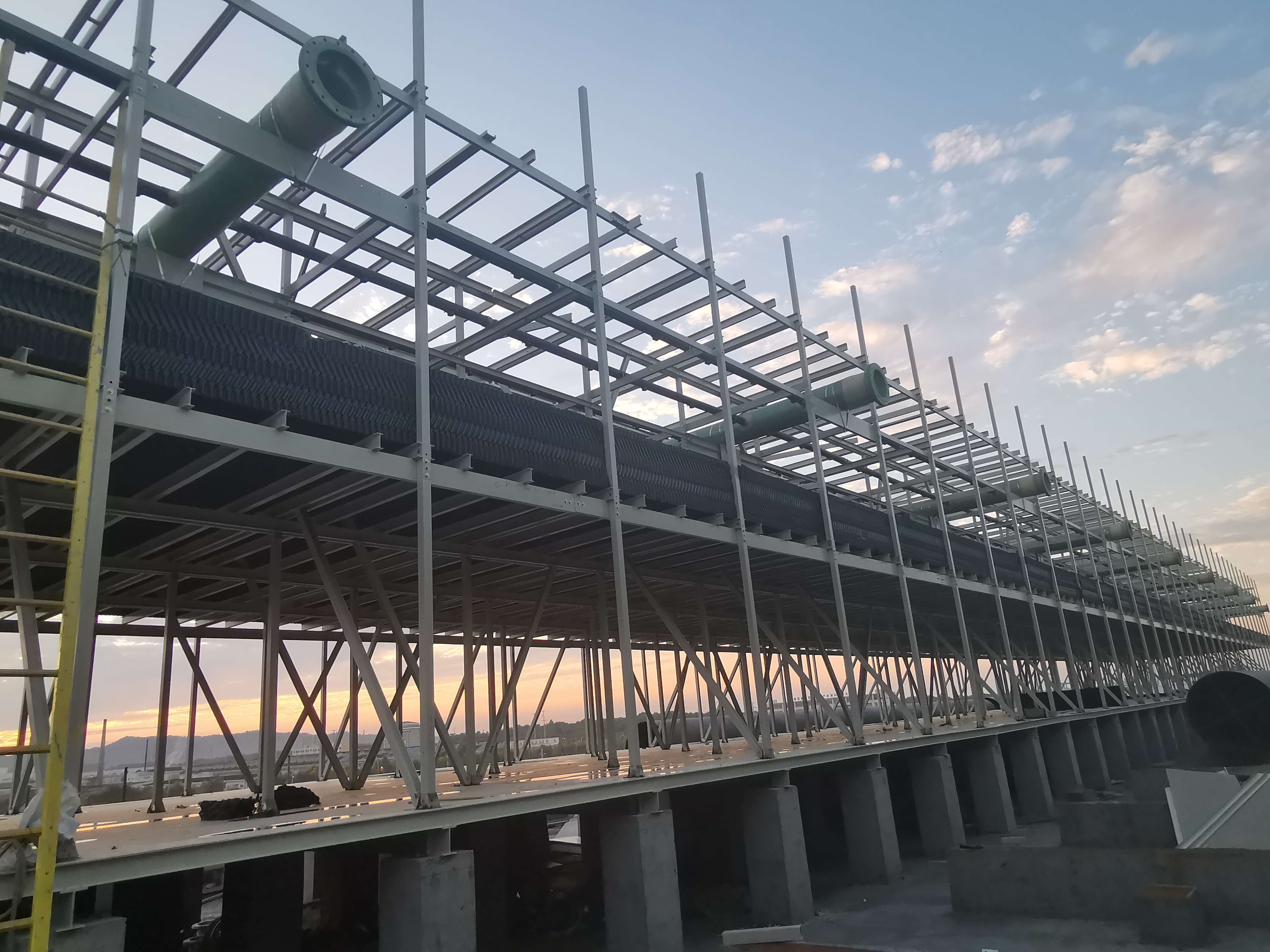
When a cooling tower starts losing performance, the first suspects are often the fan, motor, pump, or water flow.
But there is another component hiding inside the tower that deserves just as much attention: PVC cooling tower fill.
The fill is where water and air get their chance to interact. It spreads circulating water over a large effective surface area, encourages evaporation, and helps the tower reject heat.
So, where should you buy PVC fill for a cooling tower?
That sounds like a simple question, but it is not.
A supplier may offer attractive prices but limited customization. Another may have excellent OEM compatibility but higher procurement costs. A third may specialize in replacement fill for older towers.
In this guide, we compare five major suppliers and manufacturers that buyers may encounter when sourcing PVC cooling tower fill, PVC film fill, cooling tower filler, and replacement fill.
The five companies covered are:
Power Tower Cooling Technology (Shaoxing) Co., Ltd.
Brentwood Industries
SPX Cooling Technologies / Marley
Baltimore Aircoil Company (BAC)
EVAPCO
This is an editorial comparison based on product range, fill technology, replacement capabilities, customization considerations, and relevance to cooling tower projects. It is not an official global market-share ranking.
Why PVC Cooling Tower Fill Matters
Imagine trying to cool a hot glass of water by blowing air over it for a few seconds.
Some heat leaves, but the process is not very efficient.
Now imagine spreading that same water into a thin film across a large structured surface while continuously moving air across it.
That's essentially what cooling tower fill helps accomplish.
PVC film fill creates numerous water-flow passages and surfaces. Hot water is distributed over the fill, while air moves through the structure. The increased contact between water and air supports evaporative heat transfer.
That is why fill selection matters so much.
A poorly selected or heavily fouled fill can restrict airflow, interfere with water distribution, reduce effective heat-transfer area, and ultimately affect tower performance.
The fan can be powerful. The pump can be new. The water flow can look normal.
If the fill is wrong, though, the tower may still struggle.
What Is PVC Cooling Tower Fill?
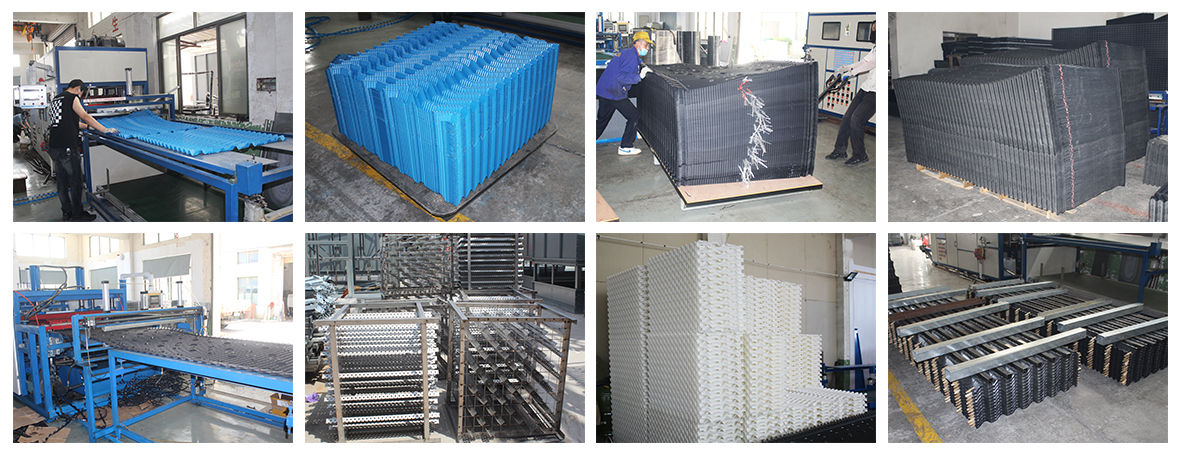
PVC cooling tower fill is heat-transfer media made from polyvinyl chloride sheets.
The sheets are normally thermoformed into structured patterns and assembled into blocks or modules. Depending on the application, the fill can feature cross-fluted, vertical-fluted, herringbone, offset-fluted, or other engineered geometries.
The goal is not simply to create a large plastic surface.
The geometry has a job to do.
It needs to distribute water, provide sufficient air-water contact, maintain suitable airflow passages, and achieve an appropriate balance between heat-transfer performance and pressure drop.
For this reason, two PVC fill products can look similar while performing differently.
How PVC Film Fill Works
In a film-fill cooling tower, water spreads across the structured PVC surfaces and forms relatively thin films.
Air passes through the channels created by the fill geometry.
As the two streams interact, heat moves from the water into the air, while evaporation removes additional heat from the circulating water.
The exact performance depends on much more than the plastic itself.
Water loading, air velocity, fill geometry, sheet spacing, tower configuration, inlet conditions, and water quality all influence the final result.
Why Fill Geometry Matters
This is one of the most overlooked parts of buying cooling tower fill.
A PVC sheet is not just a sheet.
The flute angle, spacing, thickness, surface texture, and block configuration can affect water distribution, air movement, pressure drop, fouling behavior, and thermal performance.
Brentwood, for example, offers different film-fill geometries, including cross-fluted, herringbone, and offset-fluted designs, with different approaches to water distribution and thermal performance.
Likewise, Marley offers multiple PVC fill designs engineered for different cooling tower configurations and fouling conditions.
In other words, fill geometry is part of the engineering—not just the packaging.
How to Evaluate PVC Cooling Tower Fill Suppliers
Before comparing companies, it helps to know what actually matters.
A supplier's logo should not be the only thing on your checklist.
Product Quality
Start with manufacturing consistency.
Look at:
PVC sheet thickness
Forming accuracy
Flute consistency
Block dimensions
Bonding quality
Material uniformity
Packaging
Mechanical strength
Why does this matter?
Because small dimensional errors can become big installation problems.
A block that is slightly too large may not fit properly. A block that is too small may leave unwanted gaps. Inconsistent geometry can also affect water and airflow patterns.
Material and Temperature Resistance
Not every PVC product is designed for exactly the same conditions.
Before ordering, check:
If the application operates outside normal PVC conditions, another material may be more appropriate.
The cheapest fill is not necessarily the cheapest solution if it fails early.
Customization Capability
This becomes especially important for replacement projects.
Older cooling towers may have unusual fill dimensions, discontinued components, modified supports, or previous retrofit work.
A capable supplier should be able to work from information such as:
Existing fill dimensions
Drawings
Photographs
Samples
Tower model
Fill specifications
Customization can turn a difficult replacement into a much simpler project.
Replacement Support
Buying replacement fill is different from buying fill for a new tower.
A new tower is designed around the selected equipment.
A replacement project has to fit into something that already exists.
That means the supplier needs to understand the existing structure, support system, water distribution, access limitations, and installation sequence.
Top 5 PVC Cooling Tower Fill Suppliers Compared
The following five suppliers represent different approaches to cooling tower fill.
The comparison is not intended to declare one company universally superior. Instead, it helps buyers understand what each supplier brings to the table.
1. Power Tower Cooling Technology (Shaoxing) Co., Ltd.

Power Tower Cooling Technology (Shaoxing) Co., Ltd. is a China-based supplier of cooling tower components and fill products.
For buyers specifically searching for PVC cooling tower fill, PVC film fill, replacement fill, and customized cooling tower components, Power Tower is particularly relevant.
Its product range includes PVC film fill, PP fill, counterflow fill, crossflow fill, splash fill, and related cooling tower components.
For sourcing projects, customization can be especially important.
PVC Fill Products and Capabilities
Power Tower's PVC fill solutions can be considered for both new installations and replacement applications.
Common requirements include:
PVC film fill
Counterflow fill
Crossflow fill
Replacement cooling tower fill
Customized fill dimensions
PVC and PP fill options
Splash-fill configurations
The company's cooling tower fill product offering is aimed at practical replacement and sourcing requirements rather than treating every tower as a standard-size project.
Why Buyers Consider Power Tower
One major consideration for buyers sourcing from China is flexibility.
A replacement tower may not use standard dimensions.
Perhaps the original manufacturer has discontinued a particular fill.
Perhaps the tower was modified several years ago.
Or perhaps the existing fill dimensions do not correspond to the current OEM catalog.
In those situations, the ability to discuss dimensions, material, fill configuration, and production requirements directly with the supplier can be useful.
For international buyers, Power Tower's broader cooling tower component range can also make it possible to source multiple tower parts from one supplier.
2. Brentwood Industries
Brentwood Industries is a well-known manufacturer of structured cooling tower fill and related products.
Its cooling tower portfolio includes multiple film-fill designs intended to address different thermal and fouling requirements.
According to Brentwood, its film-fill range includes cross-fluted, herringbone, and offset-fluted designs.
Brentwood Film Fill Options
Different geometries solve different problems.
Cross-fluted designs are engineered to promote lateral water dispersion.
Herringbone designs use surface geometry to help distribute water across the fill area.
Offset-fluted designs combine characteristics of different flow patterns.
This variety can be useful when the buyer's application requires more than a generic film-fill block.
Engineering and Fouling Considerations
One of the interesting aspects of Brentwood's approach is its emphasis on balancing thermal performance with fouling resistance.
That balance matters because the highest theoretical heat-transfer performance is not always the best practical choice.
Imagine buying a sports car and then driving it exclusively on a road covered with mud.
The specifications may look fantastic.
The real-world result may not.
Cooling tower fill works the same way.
If the water contains significant solids or biological material, a very fine film-fill structure may gradually foul.
The supplier therefore needs to understand the actual water conditions, not just the desired cooling capacity.
3. SPX Cooling Technologies / Marley

SPX Cooling Technologies is a major name in cooling tower technology, with Marley being one of its best-known brands.
For buyers who operate Marley cooling towers, OEM familiarity can be particularly relevant.
SPX offers multiple film-fill products for both crossflow and counterflow applications.
Marley PVC Film Fill
Marley's portfolio includes several PVC film-fill designs.
For example, Marley MVC20 is described by SPX as an anti-fouling film fill made from rigid PVC sheets. The product uses structured surfaces designed to maintain thermal performance while allowing substances to migrate through the fill more readily.
Another example is AAFNCS, also a rigid-PVC anti-fouling film-fill design.
For crossflow applications, Marley MBX is a bottom-supported PVC pack fill with integrated louvers and drift eliminators, specifically designed for aftermarket use.
OEM and Aftermarket Applications
OEM compatibility can be valuable.
If a facility has been operating a Marley cooling tower for many years, the owner may want replacement components that are familiar with the original tower configuration.
SPX also offers products designed specifically for upgrading existing equipment.
For example, Marley Flash Fill combines PVC film fill with splash fill in crossflow towers to target improved thermal performance without requiring major structural and mechanical modifications.
That makes the Marley portfolio particularly relevant to buyers who care about compatibility and retrofit options.
4. Baltimore Aircoil Company (BAC)

Baltimore Aircoil Company, commonly known as BAC, is another major evaporative cooling equipment manufacturer.
Its systems are used in commercial, industrial, and process-cooling applications.
BAC Replacement Considerations
For BAC tower owners, one of the most important considerations is equipment compatibility.
Cooling tower fill does not work in isolation.
It interacts with:
Water distribution
Spray nozzles
Air inlets
Drift eliminators
Fans
Basins
Structural supports
Changing the fill can therefore affect other parts of the system.
When purchasing replacement fill for a BAC tower, identify the exact tower model and configuration first.
Don't simply order a block because its dimensions look close.
A technically similar product may still have a different hydraulic or thermal behavior.
5. EVAPCO
EVAPCO is another established manufacturer in evaporative cooling technology.
The company provides cooling equipment and components for a range of applications, including industrial and commercial heat rejection.
EVAPCO Fill and Cooling Systems
One reason to consider an integrated cooling equipment manufacturer is system knowledge.
Fill performance depends on the relationship between the fill, air movement, water distribution, thermal load, and tower design.
When fill replacement forms part of a larger maintenance or modernization project, system-level engineering can be valuable.
For buyers, the key question is not simply whether a supplier sells PVC fill.
It is whether the supplier can provide a fill solution that matches the actual tower.
Quick Comparison of the Top Suppliers
| Supplier | Main Strength | Typical Fill Focus | Suitable Buyer |
| Power Tower | Customization and replacement sourcing | PVC, PP, film and splash fill | Replacement and customized projects |
| Brentwood Industries | Engineered fill technology | Film and other structured fills | Industrial and performance-focused applications |
| SPX / Marley | OEM and aftermarket expertise | PVC film, splash and hybrid fill | Marley towers and retrofit projects |
| BAC | Integrated equipment ecosystem | OEM/replacement solutions | BAC tower owners |
| EVAPCO | System-level evaporative cooling | Engineered fill solutions | EVAPCO and industrial cooling systems |
Again, this table is a descriptive comparison, not a ranking of overall quality.
Different projects can require very different supplier capabilities.
PVC Film Fill vs Splash Fill
This is one of the first choices buyers should make.
Film fill spreads water across structured sheets, creating a large surface area for air-water interaction.
Splash fill breaks water into droplets as it falls through the fill.
Which one should you choose?
It depends heavily on water quality and tower design.
Film fill can provide high thermal performance in a compact space, but its smaller passages can be more vulnerable to fouling.
Splash fill generally provides larger flow paths and can be useful in applications where suspended solids are a concern.
So don't automatically choose film fill just because its theoretical surface area looks impressive.
The operating environment matters more than the brochure.
PVC vs PP Cooling Tower Fill
PVC and PP are both common polymer materials for cooling tower fill.
PVC is widely used because it provides a practical combination of heat-transfer performance, manufacturability, weight, and cost.
PP can become attractive when higher-temperature capability or particular chemical conditions require a different material.
For example, SPX lists several Marley fill products made from rigid PVC and designed around specific thermal and fouling requirements.
The right question isn't:
“Which material is universally better?”
Instead ask:
“Which material is appropriate for this tower's temperature, water chemistry, and operating conditions?”
That small change in thinking can prevent a surprisingly expensive purchasing mistake.
How to Choose the Right PVC Fill Supplier
Choosing a supplier becomes much easier when the purchasing process follows a logical sequence.
Match the Fill to Your Tower Type
First identify whether the tower is:
Crossflow
Counterflow
Forced draft
Induced draft
Mechanical draft
Natural draft
The fill arrangement must match the tower's airflow and water-flow configuration.
Check Water Quality
This is critical.
Find out:
Suspended solids
Turbidity
Scaling tendency
Biological fouling
Chemical treatment
Blowdown practices
A fill designed for clean water may not be the right choice for heavily contaminated process water.
Confirm Fill Dimensions
For replacement projects, measure the existing fill carefully.
Useful information includes:
Fill height
Block length
Block width
Sheet thickness
Flute spacing
Fill volume
Support arrangement
Installation direction
Photos and drawings can also help suppliers understand the application.
Evaluate Technical Support
A good supplier should ask questions.
If the supplier never asks about tower type, water quality, temperature, or fill dimensions and immediately gives you a price, be cautious.
Good sourcing is not just about getting a number.
It is about getting the right number for the right product.
Common Mistakes When Buying PVC Fill
Several purchasing mistakes appear again and again.
Choosing Only by Price
The cheapest fill can become expensive if it has poor dimensional accuracy, low material quality, or a short service life.
Ignoring Water Quality
This is perhaps the most common technical mistake.
A fill that performs beautifully with clean water may struggle badly in a fouling environment.
Ordering the Wrong Dimensions
A few centimeters can matter when the fill must fit into an existing support system.
Always verify measurements before production.
Assuming All PVC Fill Is the Same
It isn't.
PVC is the material.
The fill geometry is the engineering.
Two PVC products can have different flute patterns, sheet thicknesses, surface textures, airflow resistance, and thermal characteristics.
Replacing Fill Without Checking the Tower
Sometimes the fill is not the only problem.
Poor water distribution, damaged nozzles, blocked air inlets, or incorrect operating conditions can also reduce cooling performance.

How Much Does PVC Cooling Tower Fill Cost?
There is no single universal price for PVC cooling tower fill.
The final cost can depend on:
PVC material
Sheet thickness
Fill geometry
Block dimensions
Order quantity
Customization
Bonding method
Packaging
Shipping
Replacement requirements
Installation conditions
A standard high-volume order can have a very different unit cost from a small custom replacement project.
That's why asking for a price without providing specifications can produce misleading comparisons.
If three suppliers quote different prices, first make sure they are actually quoting comparable products.
When Should PVC Cooling Tower Fill Be Replaced?
PVC cooling tower fill does not have one fixed replacement interval.
Service life depends on operating conditions.
Look for signs such as:
Sometimes cleaning can restore performance.
Sometimes it cannot.
Once the fill structure has become seriously damaged or permanently blocked, replacement may be more practical than repeated cleaning.
For an older tower, replacing the fill can also be an opportunity to reconsider the original design.
Perhaps the water quality has changed.
Perhaps the thermal load has increased.
Perhaps the tower is now operating under different conditions.
A replacement project does not always have to be a simple like-for-like purchase.
Frequently Asked Questions
What is the best material for cooling tower fill?
There is no single best material for every cooling tower.
PVC is widely used for many conventional applications because of its balance of performance, cost, weight, and manufacturability.
PP or other materials may be more suitable for particular high-temperature or chemically demanding conditions.
How long does PVC cooling tower fill last?
Service life varies.
Water quality, operating temperature, UV exposure, chemical conditions, mechanical damage, biological growth, and maintenance all influence how long the fill remains effective.
Instead of relying only on a calendar interval, inspect actual fill condition and monitor tower performance.
Can PVC fill replace old splash fill?
In some applications, yes.
Engineered film fill can sometimes replace splash fill and provide different thermal performance characteristics.
However, the tower's airflow, water loading, fouling risk, fill support structure, and thermal requirements must be evaluated first.
Can suppliers customize PVC fill?
Yes, many cooling tower fill manufacturers can produce different dimensions and configurations.
However, customization should be based on accurate tower information.
Provide dimensions, photographs, drawings, existing fill samples, or tower model information whenever possible.
What information should I send to a PVC cooling tower fill supplier?
At minimum, provide:
The more complete the information, the easier it becomes to select the appropriate product.
Final Thoughts
Choosing among the best PVC cooling tower fill suppliers is not simply a matter of finding the biggest company or the lowest quotation.
The right supplier depends on what your cooling tower actually needs.
Power Tower Cooling Technology (Shaoxing) Co., Ltd. is particularly relevant for buyers seeking PVC and PP cooling tower fill, replacement media, customized dimensions, and related cooling tower components.
Brentwood Industries offers a broad range of engineered film-fill designs and focuses on balancing thermal performance with fouling considerations.
SPX Cooling Technologies / Marley provides a wide OEM and aftermarket portfolio, including multiple PVC film-fill designs for crossflow and counterflow towers.
BAC is relevant for customers working with BAC cooling systems and equipment-specific replacement requirements.
EVAPCO brings extensive evaporative cooling and system-level engineering experience.
But here's the most important point:
The best cooling tower fill is the one that fits your tower, water quality, temperature, airflow, thermal load, and maintenance conditions.
Before placing an order, measure the existing fill. Check the water quality. Confirm the tower configuration. Ask about material compatibility. And make sure the supplier understands the application.
A cooling tower fill should do more than simply fit inside the tower.
It should work with the tower.
And that difference can have a major impact on long-term cooling performance.


