Industrial fill for cooling tower systems is a critical component for improving heat transfer between circulating water and air. In industrial cooling towers, the fill provides a large contact area where hot process water can release heat before returning to the process.
The right cooling tower fill can improve thermal performance, support stable operation, and help reduce operating problems. However, industrial applications often have more demanding conditions than commercial HVAC systems. High temperatures, suspended solids, chemicals, oil contamination, and biological growth can all affect fill selection.
This guide explains the main types of industrial cooling tower fill, their applications, benefits, and key factors to consider when selecting replacement fill.
What Is Industrial Fill for a Cooling Tower?
Cooling tower fill, also known as cooling tower packing or fill media, is installed inside the tower between the water distribution system and the air inlet or outlet.
Its primary purpose is to increase the contact area between water and air.
Hot water enters the fill section and spreads over the fill surfaces or breaks into droplets. At the same time, air moves through the fill. A portion of the circulating water evaporates, transferring heat from the water to the air.
This process allows the cooling tower to reduce the temperature of the circulating water.
For industrial cooling towers, fill must be selected according to the tower design and actual operating conditions.
Why Is Cooling Tower Fill Important?
Without an effective fill system, water and air have less opportunity to interact.
A properly designed fill provides:
Greater water-air contact area
Improved heat and mass transfer
Better use of available tower volume
Stable cooling performance
Potentially lower water and energy requirements
More efficient use of existing tower capacity
For industrial facilities, cooling performance can directly affect production equipment and process stability. This makes fill selection an important part of cooling tower design, retrofit, and maintenance.
Main Types of Industrial Cooling Tower Fill
Industrial cooling tower fill is available in several configurations. The most common categories are film fill and splash fill, with different materials and geometries available for each.
1. Film Fill
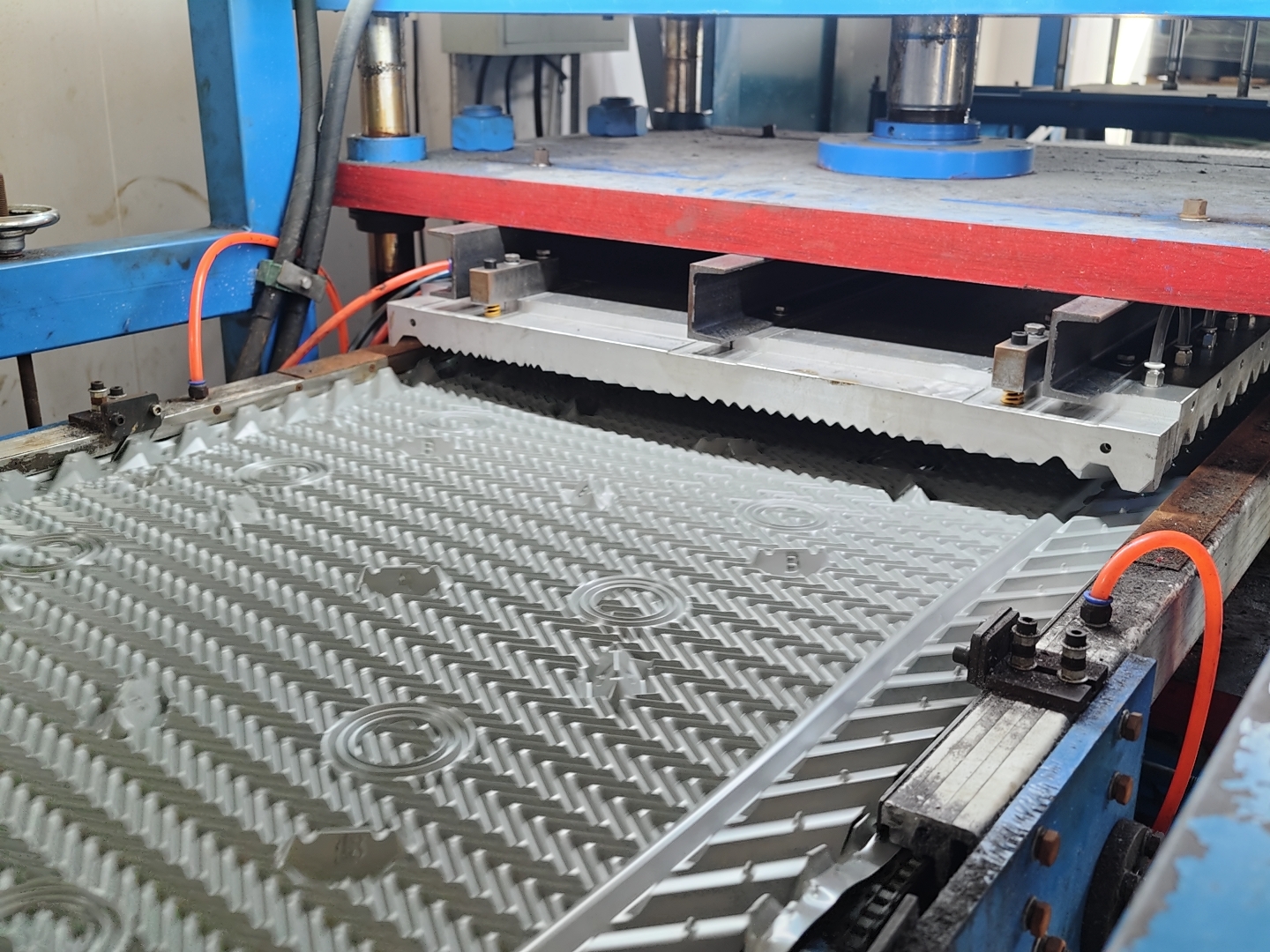
Film fill creates a thin layer of water over a large surface area.
As water flows across the fill, air passes over or through the water film. This creates efficient heat and mass transfer within a relatively compact volume.
Film fill is commonly manufactured from:
Applications of Film Fill
Film fill is widely used in cooling towers handling relatively clean, well-treated water.
Typical applications include:
Film fill can provide high thermal performance when the water quality and operating conditions are suitable.
2. Splash Fill
Splash fill cools water by repeatedly breaking the water stream into smaller droplets.
Instead of relying primarily on a continuous water film, splash bars, grids, or other surfaces cause the water to disperse as it falls through the tower.
Splash fill is often considered for industrial applications where water contains suspended solids or where fouling resistance is an important consideration.
Applications of Splash Fill
Typical applications include:
The open structure of many splash-fill designs can help reduce blockage compared with closely spaced film-fill configurations.
3. Grid Fill
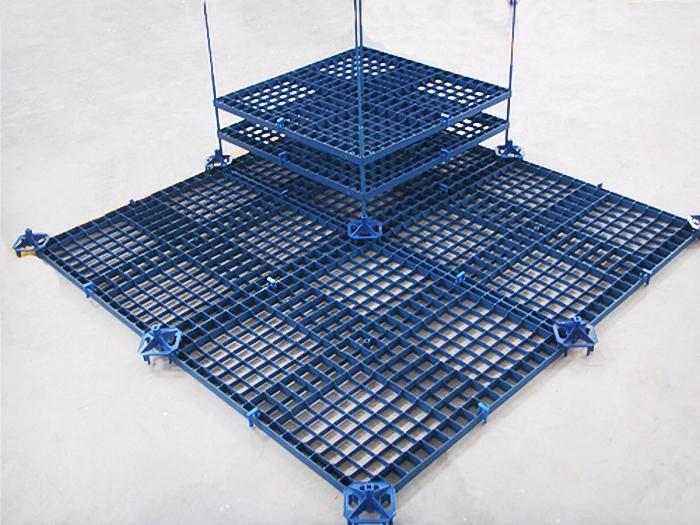
Grid fill uses an open lattice structure to create repeated water breakup and air-water interaction.
It is often selected when a balance between heat-transfer performance and fouling tolerance is required.
Grid fill can be useful for industrial cooling towers where water quality makes narrow passages undesirable.
Cooling Tower Fill Materials
Material selection is just as important as fill geometry.
PVC Cooling Tower Fill
PVC cooling tower fill is widely used in industrial and commercial cooling towers.
Advantages can include:
Good corrosion resistance
Good formability
Competitive cost
Effective heat-transfer surface
Availability in many film-fill configurations
PVC film fill is commonly selected for applications with controlled water chemistry and moderate operating temperatures.
PP Cooling Tower Fill
PP cooling tower fill is another common option, particularly when operating conditions require different material characteristics.
Polypropylene can provide useful temperature and chemical resistance characteristics, depending on the specific grade and application.
PP is commonly considered for:
Higher-temperature applications
Industrial process cooling
Applications requiring specific chemical resistance
Splash-fill configurations
Always verify the manufacturer's temperature and chemical compatibility data before specifying PP fill.
Industrial Applications of Cooling Tower Fill
Industrial fill for cooling towers is used in many sectors where heat must be removed from process water.
Power Plants
Cooling towers are used to reject heat from power-generation systems. Proper fill performance helps maintain the required circulating-water temperature.
Chemical Plants
Chemical processing equipment often requires stable cooling-water conditions. Fill selection should account for water chemistry and possible chemical exposure.
Steel and Metal Processing
Steel mills and metal-processing facilities can produce challenging cooling-water conditions. Suspended solids, scale, and contamination can influence the choice between film and splash fill.
Manufacturing Plants
Industrial cooling towers support processes such as molding, machining, compressors, furnaces, and other heat-generating equipment.
Refineries and Petrochemical Plants
Refineries use cooling-water systems throughout their utility and process operations. Fill must be compatible with operating temperatures and water-treatment conditions.
HVAC and District Cooling
Large commercial and institutional cooling systems also use cooling tower fill. Film fill is commonly used where water quality is appropriately controlled.
Benefits of Industrial Cooling Tower Fill
The right fill configuration can provide several operational benefits.
Improved Heat Transfer
A properly designed fill increases water-air contact and supports evaporation and heat transfer.
Better Cooling Capacity
Efficient fill can help a tower achieve its required cold-water temperature within the available tower volume.
Compact Design
High-performance film fill can provide substantial contact area without requiring excessive fill volume.
Improved Process Stability
Stable cooling-water temperatures can support consistent operation of industrial equipment.
Potential Energy Savings
Better heat-transfer performance can reduce the cooling burden on associated equipment. Actual energy savings depend on the complete cooling tower system.
Retrofit Potential
Replacement fill can sometimes improve the thermal performance of an existing tower without replacing the entire structure.
How to Select Industrial Fill for a Cooling Tower
Choosing industrial cooling tower fill requires consideration of more than the tower's nominal capacity.
1. Identify the Tower Type
Determine whether the tower is:
Crossflow
Counterflow
Induced draft
Forced draft
Mechanical draft
Natural draft
The fill configuration must be compatible with the tower's airflow and water distribution arrangement.
2. Check Water Quality
Water quality is one of the most important selection factors.
Evaluate:
Suspended solids
Hardness
Silica
Biological growth
Oil
pH
Chemical concentration
Corrosion potential
If water contains significant contaminants, an open splash-fill configuration may be more practical than a closely spaced film fill.
3. Check Operating Temperature
Confirm:
Do not select fill based only on normal operating temperature. Short-term temperature peaks can also affect plastic fill.
4. Determine Required Fill Volume
Measure the available fill area and calculate the approximate volume:
Fill Volume = Length × Width × Height
For replacement projects, also measure existing fill blocks, support structures, and installation clearances.
5. Consider Pressure Drop
Fill geometry affects airflow resistance.
A fill with very narrow passages may provide high surface area but can also create greater airflow resistance if the design is not matched to the tower.
The replacement fill should be evaluated as part of the complete fan and airflow system.
Cooling Tower Fill Replacement
Industrial cooling tower fill eventually requires cleaning, repair, or replacement.
Common replacement reasons include:
Before replacing fill, inspect the support structure and water distribution system. A new fill cannot compensate for severely blocked nozzles, poor water distribution, or damaged support members.
For replacement projects, provide the supplier with photos, dimensions, tower model, fill type, and operating conditions whenever possible.
Industrial Cooling Tower Fill Maintenance
Proper maintenance can extend fill service life.
Recommended practices include:
Maintain appropriate water treatment.
Monitor scale formation.
Control biological growth.
Inspect fill periodically.
Check for physical deformation.
Keep spray nozzles clear.
Remove debris from the tower.
Inspect fill supports.
Monitor cooling-water temperatures.
Clean fill using procedures appropriate for its material.
Cleaning methods should be selected carefully because aggressive mechanical or chemical cleaning can damage plastic fill.
Industrial Fill for Cooling Tower: Buyer Checklist
Before purchasing cooling tower fill, confirm the following:
| Item | What to Check |
| Fill type | Film, splash, or grid |
| Material | PVC, PP, or other specified material |
| Tower design | Crossflow or counterflow |
| Dimensions | Length, width, height, thickness |
| Water flow | Design and operating flow rate |
| Water quality | Solids, scale, biological fouling |
| Temperature | Normal and maximum temperature |
| Airflow | Existing tower and fan conditions |
| Quantity | Required fill volume |
| Support | Existing support structure |
| Installation | Block size and arrangement |
| Shipping | Package volume and delivered cost |
This information helps suppliers recommend a suitable industrial cooling tower fill and reduces the risk of ordering incompatible products.
Why Buy Industrial Cooling Tower Fill From a Specialized Supplier?
A specialized cooling tower fill supplier can help buyers select products based on tower geometry and operating conditions rather than simply supplying generic plastic sheets.
For industrial replacement projects, technical support may include:
CoolingTowerPart.com supplies cooling tower fill and replacement parts for industrial and commercial cooling tower applications, including PVC film fill, PP fill, splash fill, and related components.
Frequently Asked Questions
What is the most common industrial cooling tower fill?
Film fill and splash fill are two of the most common types. The appropriate option depends on water quality, tower design, thermal requirements, and fouling conditions.
Is PVC or PP better for cooling tower fill?
Neither material is universally better. PVC is widely used for many film-fill applications, while PP can be suitable for applications requiring particular temperature or chemical-resistance characteristics.
Can industrial cooling tower fill be replaced without replacing the tower?
Yes. In many cases, the fill can be removed and replaced while the tower structure remains in service, provided the support system and other components are suitable for the replacement.
How do I know which cooling tower fill I need?
Start with the tower model, fill dimensions, tower type, water flow, operating temperatures, water quality, and photos of the existing fill. These details allow a supplier to evaluate suitable replacement options.
Does cooling tower fill improve efficiency?
Properly selected fill improves water-air contact and heat transfer. Overall cooling tower efficiency also depends on airflow, water distribution, fan performance, water treatment, and operating conditions.
Conclusion
Industrial fill for cooling tower systems plays a central role in heat transfer and cooling performance. Film fill, splash fill, and grid fill each offer different characteristics, while PVC and PP provide different material options for demanding operating environments.
When selecting industrial cooling tower fill, buyers should evaluate tower design, water quality, operating temperature, fill dimensions, airflow resistance, and maintenance requirements. For replacement projects, accurate measurements and complete operating information are essential.
The right fill can help restore cooling capacity, support reliable process operation, and extend the useful life of an existing cooling tower. For industrial applications, selecting fill based on actual operating conditions—not simply price or nominal tower tonnage—is the key to a successful replacement.
Internal Links for Other CoolingTowerParts
Cooling Tower Fill
Cooling Tower Nozzles
Cooling Tower Drift Eliminators
Cooling Tower Louvers
Cooling Tower Fan Blades
Cooling Tower Motors