Cooling Tower Fan Blade Angle: How Does It Affect Airflow?
Cooling tower fan blade angle is one of the most important factors affecting airflow, cooling efficiency, motor power consumption, and overall cooling tower performance. Although fan diameter, rotational speed, and blade material also influence fan operation, the blade angle determines how effectively the rotating blades interact with the surrounding air.
An appropriately adjusted cooling tower fan blade angle helps generate sufficient airflow, maintain stable fan operation, and achieve the required heat rejection capacity. However, an angle that is too small may result in insufficient airflow, while an excessively large angle can increase motor load, energy consumption, and mechanical stress.
For industrial cooling towers, understanding the relationship between fan blade angle and airflow is essential when selecting replacement fan blades, adjusting existing fan assemblies, or upgrading cooling tower systems.
This article explains how cooling tower fan blade angle works, how it influences airflow, which factors affect angle selection, and how to optimize fan performance for different industrial applications.
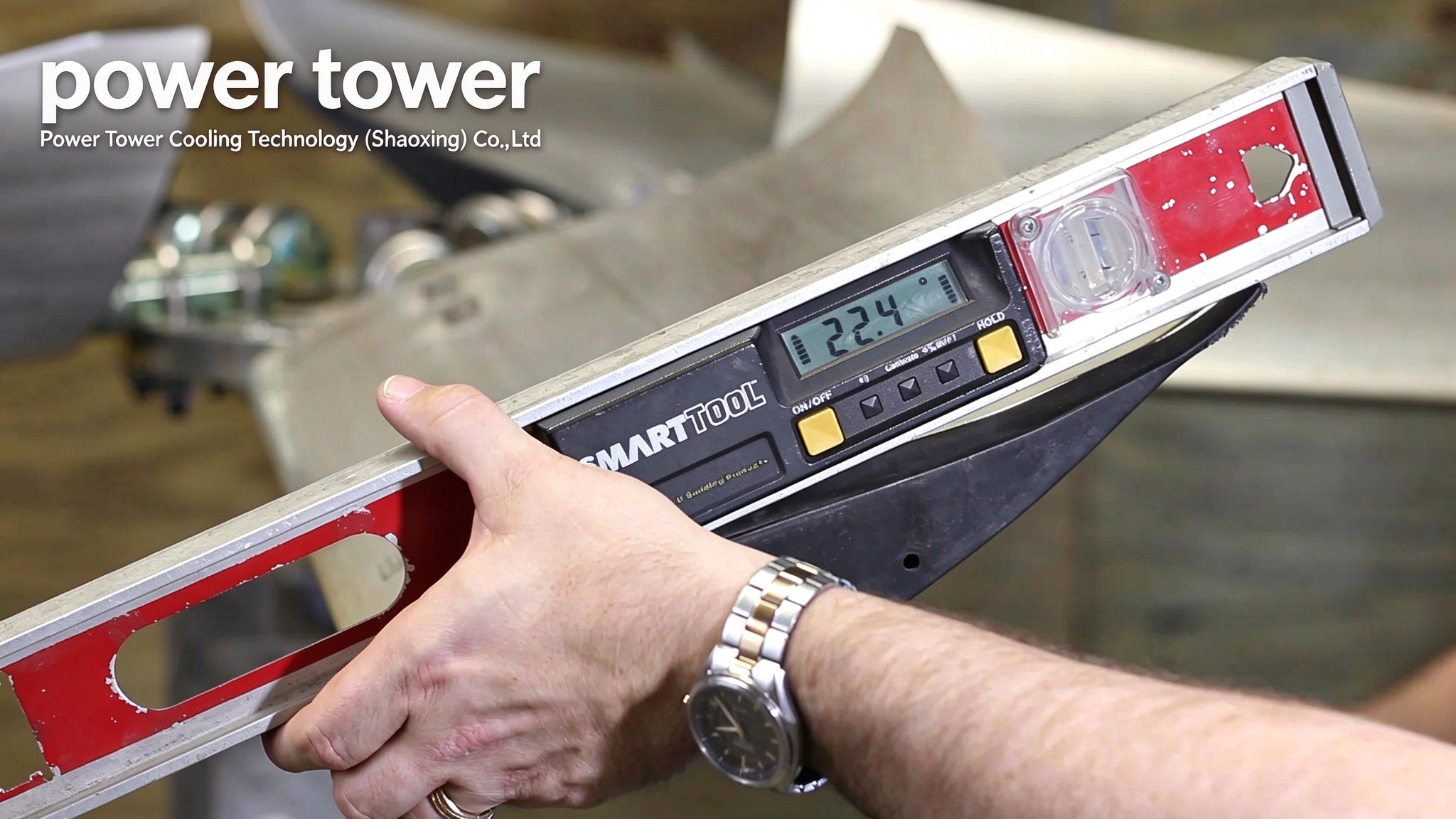
What Is Cooling Tower Fan Blade Angle?
Cooling tower fan blade angle refers to the inclination of a fan blade relative to a defined reference plane, commonly the plane of rotation. It is also frequently called fan blade pitch angle.
When a cooling tower fan rotates, each blade pushes air through the cooling tower. The blade angle determines how the blade interacts with the incoming airflow and influences the aerodynamic force generated during rotation.
A properly selected blade angle allows the fan to deliver the required airflow while maintaining acceptable motor loading.
How Does Fan Blade Angle Work?
Cooling tower fans generally use axial-flow fan technology. The blades rotate around a central hub, moving air along the fan axis.
As the blades rotate, their aerodynamic profiles create a pressure difference that moves air through the cooling tower.
The blade angle influences:
In general, increasing blade pitch within the normal operating range increases aerodynamic loading and may increase airflow and power consumption. However, the actual relationship depends on fan geometry and system resistance.
What Is the Difference Between Blade Angle and Blade Rotation Speed?
Blade angle and rotational speed are two different fan operating parameters.
Parameter | Main function | Effect on performance |
Blade angle | Controls blade aerodynamic loading | Influences airflow and pressure |
Fan speed | Determines blade rotational velocity | Influences airflow, pressure, and power |
Fan diameter | Determines fan size and swept area | Influences airflow capacity |
Blade profile | Determines aerodynamic characteristics | Influences efficiency and resistance |
These parameters work together. Changing one parameter without considering the others may produce unexpected results.
Why Is Blade Angle Important for Industrial Cooling Towers?
Industrial cooling towers require sufficient airflow to support heat and mass transfer.
If the fan blade angle is incorrectly selected, the cooling tower may fail to achieve its design performance.
Common problems include:
High cooling water outlet temperatures.
Insufficient airflow through fill media.
Excessive motor current.
Increased operating noise.
Unstable fan operation.
Higher electricity costs.
Therefore, blade angle optimization is an important part of cooling tower fan selection and maintenance.
How Does Cooling Tower Fan Blade Angle Affect Airflow?
The relationship between fan blade angle and airflow is closely related to aerodynamic loading.
When the blade pitch changes, the angle at which the blade interacts with the air also changes. This affects the pressure generated by the fan and the amount of air moving through the cooling tower.
Small Blade Angles May Reduce Airflow
When the fan blade angle is too small, the blades may not generate enough aerodynamic force to overcome the resistance inside the cooling tower.
As a result, the fan may deliver less airflow than required.
Common Performance Problems
Insufficient air volume.
Reduced heat exchange efficiency.
Increased cooling water outlet temperature.
Inadequate cooling during peak operating periods.
For example, a cooling tower operating under high thermal loads may struggle to maintain the required water temperature if the fan pitch is too low.
However, a smaller blade angle may be appropriate when the cooling tower requires less airflow or when operating under reduced thermal loads.
Increasing Blade Angles Can Improve Airflow
Within the normal operating range, increasing the blade pitch generally increases the aerodynamic loading of the fan.
This can increase the pressure generated by the fan and improve airflow when the system has sufficient motor capacity.
Potential benefits include:
Increased airflow volume.
Improved air movement through fill media.
Better heat rejection under higher loads.
Improved ability to overcome system resistance.
However, the increase in airflow is not unlimited. It depends on the fan performance curve and cooling tower system resistance.
Excessive Blade Angles Can Reduce Overall Efficiency
Although increasing the blade angle may initially improve airflow, excessive pitch can create unnecessary aerodynamic resistance.
The motor may need to provide significantly more power to maintain fan rotation.
What Problems Can Excessive Pitch Cause?
Higher motor current.
Increased electricity consumption.
Excessive aerodynamic loading.
Increased vibration and noise.
Potential motor overload.
Reduced operating reliability.
In some conditions, excessive blade pitch can also move the fan away from its efficient operating range.
Therefore, the goal is not to maximize the blade angle but to identify the correct angle for the required airflow and pressure.
What Is the Relationship Between Cooling Tower Fan Blade Angle and Airflow Volume?
Airflow volume is one of the most important indicators of cooling tower fan performance.
It describes the amount of air moved by the fan over a specific period, usually expressed in cubic meters per hour (m³/h) or cubic meters per second (m³/s).
Blade angle affects airflow by changing the aerodynamic loading of the rotating blades.
Understanding Airflow and Fan Pressure
A cooling tower fan must generate enough pressure to overcome resistance from the fill media, drift eliminators, louvers, and other internal components.
The fan operates at the intersection of its fan performance curve and the cooling tower system resistance curve.
Why Does System Resistance Matter?
Two cooling towers using fans with identical blade angles may achieve different airflow volumes because their internal resistance conditions are different.
For example:
Blocked fill increases airflow resistance.
Dirty drift eliminators restrict air movement.
Poor air inlet conditions affect fan performance.
Incorrect fan cylinder dimensions may create aerodynamic losses.
This means blade angle should always be evaluated together with the actual cooling tower system.
How Does Blade Angle Influence Airflow Distribution?
Fan blade angle does not only affect total airflow volume. It can also influence how air is distributed through the cooling tower.
Uneven blade pitch or unsuitable blade geometry may create an uneven airflow pattern.
This can result in:
Uneven air velocity across the fill section.
Localized cooling performance problems.
Uneven water temperature distribution.
Reduced overall heat transfer efficiency.
A properly designed fan assembly should provide stable and reasonably uniform airflow throughout the cooling tower.
Can Increasing Blade Angle Always Increase Airflow?
No. Increasing blade angle does not guarantee a proportional increase in airflow.
The actual result depends on:
For this reason, engineers should use fan performance data rather than relying on a simple blade-angle adjustment.
How Does Cooling Tower Fan Blade Angle Affect Motor Power Consumption?
Motor power consumption is closely related to fan aerodynamic loading.
When blade pitch increases, the fan may require more torque to overcome the additional aerodynamic resistance.
If the motor is not correctly matched to the fan, excessive pitch can cause overloading.
The Relationship Between Blade Angle and Motor Load
A larger blade angle generally increases aerodynamic loading within the normal operating range.
This may increase:
Motor current.
Required shaft power.
Gearbox loading.
Fan drive torque.
The actual power increase depends on the operating point and system resistance.
Why Should Motor Current Be Monitored?
Motor current provides useful information about the electrical load of the fan system.
When the blade angle is increased, operators should monitor motor current and compare it with the motor nameplate ratings and manufacturer recommendations.
Warning Signs of Excessive Motor Load
Motor current approaches or exceeds its rated limit.
Motor temperature rises abnormally.
Thermal protection frequently activates.
Fan speed becomes unstable.
Unusual vibration or noise develops.
If these symptoms occur, the fan should be evaluated by qualified personnel before continued operation.
How Can the Correct Blade Angle Reduce Energy Consumption?
The objective of blade angle optimization is to achieve the required cooling capacity without unnecessary power consumption.
A suitable blade angle can help the fan operate closer to its intended design point.
For example, if a cooling tower requires a specific airflow volume, using a larger pitch than necessary may increase motor power without providing meaningful additional cooling benefits.
Therefore, fan blade angle should be selected according to actual cooling demand rather than maximum possible airflow.
What Factors Determine the Correct Cooling Tower Fan Blade Angle?
There is no single blade angle suitable for every cooling tower.
The correct setting depends on fan design, operating conditions, and cooling tower performance requirements.
Fan Diameter
Fan diameter influences the swept area and airflow capacity.
Large industrial cooling tower fans may have different blade angle requirements from smaller commercial cooling tower fans.
When selecting a replacement blade, the original fan diameter should be confirmed first.
Fan Rotational Speed
Fan rotational speed directly affects blade tip speed and aerodynamic loading.
Higher rotational speed generally increases airflow and pressure, but also increases power consumption.
Why Must Blade Angle Match Fan Speed?
A blade angle suitable for one rotational speed may create excessive loading at another speed.
Therefore, engineers should consider the rated RPM and actual operating speed when determining the appropriate pitch.
Blade Material and Structure
Different materials have different stiffness, weight, and structural characteristics.
Common cooling tower fan blade materials include:
FRP cooling tower fan blades are widely considered for industrial applications because of their corrosion resistance and lightweight construction.
However, the material itself does not determine the correct pitch angle. Aerodynamic design and structural requirements are more important.
Number of Fan Blades
The number of blades influences the fan's aerodynamic characteristics and load distribution.
Cooling tower fans may use different blade quantities depending on fan diameter, pressure requirements, and manufacturer design.
Changing the number of blades without proper engineering evaluation may affect airflow, power consumption, and vibration.
Cooling Tower Type
Different cooling tower configurations have different airflow requirements.
Counterflow Cooling Towers
Air generally moves upward through the fill section while water flows downward.
The fan must overcome the resistance of the fill and other internal components.
Crossflow Cooling Towers
Air moves horizontally through the fill section while water flows downward.
The fan design must provide sufficient airflow through the cooling tower's crossflow configuration.
The appropriate fan blade angle should be determined according to the specific cooling tower design.
Ambient Temperature and Cooling Load
Cooling tower demand changes with ambient wet-bulb temperature, circulating water temperature, and process heat load.
During periods of high cooling demand, more airflow may be required.
Under lower thermal loads, operating the fan at maximum capacity may waste energy.
This is one reason why adjustable-pitch fans and variable frequency drives are useful in industrial cooling systems.
How to Adjust Cooling Tower Fan Blade Angle Correctly?
Correct blade adjustment can improve cooling tower performance, but improper adjustment may cause motor overload, vibration, and mechanical damage.
Before making changes, operators should obtain the original fan specifications and manufacturer recommendations.
Check the Original Blade Angle
Before adjusting the fan, record the original blade pitch angle.
Check the manufacturer's technical drawings or maintenance documentation whenever available.
What Information Should Be Recorded?
These details provide a reference for evaluating any subsequent adjustment.
Inspect the Fan and Hub Assembly
Before making adjustments, inspect the fan assembly for mechanical problems.
Check:
A damaged or mechanically unstable fan should not be adjusted as a substitute for necessary repairs.
Adjust All Blades Consistently
For adjustable-pitch fan assemblies, all blades should be set according to the manufacturer's specified angle and measurement reference.
Unequal blade angles can create uneven aerodynamic loading and vibration.
Why Is Consistency Important?
If one blade has a different pitch from the others, the fan may generate an unbalanced aerodynamic force during rotation.
This can increase vibration and place additional stress on the fan hub and drive system.
Check Motor Current After Adjustment
After the adjustment has been completed and the fan has been safely returned to service, check motor current under stable operating conditions.
Compare the readings with:
Motor nameplate ratings.
Manufacturer operating limits.
Previous operating records.
Expected fan performance.
If the current is too high, the blade angle or another part of the fan system may require further evaluation.
Verify Cooling Tower Performance
The final step is to evaluate actual cooling tower performance.
Monitor:
Inlet water temperature.
Outlet water temperature.
Circulating water flow rate.
Ambient wet-bulb temperature.
Fan motor current.
Fan vibration.
Airflow, where measurable.
These parameters help determine whether the adjustment improves overall cooling performance.
Important safety note: Fan blade adjustment must be performed by qualified personnel following the manufacturer's procedures. The fan must be isolated from its power source and secured against unexpected starting before mechanical work begins.
What Are the Common Mistakes When Adjusting Cooling Tower Fan Blade Angles?
Incorrect adjustment is a common reason for poor cooling tower fan performance.
Understanding these mistakes can help operators avoid unnecessary maintenance costs and equipment problems.
Setting the Blade Angle Too Large
Some operators assume that increasing the blade angle will always improve cooling capacity.
However, excessive pitch can increase motor loading and power consumption beyond acceptable limits.
The correct setting should be based on fan performance data and actual operating conditions.
Using Different Angles for Individual Blades
All blades in the same fan assembly should follow the specified pitch setting.
Unequal angles may create uneven airflow and aerodynamic imbalance.
Ignoring Motor Power Limitations
A fan blade adjustment should never exceed the allowable operating load of the motor and drive system.
Motor capacity, gearbox limitations, and fan operating speed must all be considered.
Ignoring Cooling Tower Internal Resistance
If fill media or drift eliminators are blocked, airflow may decrease even when the fan blade angle is correct.
Increasing blade pitch to compensate for blocked components may increase motor loading without solving the underlying problem.
Adjusting Blade Angle Without Measuring Performance
Visual estimation alone is not a reliable way to determine whether a fan blade angle is correct.
Operators should use suitable measuring instruments and compare actual operating results with manufacturer specifications.
How Do FRP Cooling Tower Fan Blades Affect Blade Angle Performance?
FRP cooling tower fan blades are commonly used in industrial cooling systems because they offer a combination of low weight, corrosion resistance, and design flexibility.
Their composite construction allows manufacturers to produce customized aerodynamic profiles for different fan applications.
Lightweight Construction
FRP blades are generally lighter than comparable steel blades.
This can reduce rotating mass and centrifugal loading on the fan assembly.
However, aerodynamic loading still determines much of the required motor power.
Aerodynamic Profile Customization
FRP manufacturing allows different blade shapes, widths, thicknesses, and twist distributions.
Manufacturers can optimize these characteristics according to the required airflow and pressure.
Corrosion Resistance
Cooling tower fan blades operate in humid environments where corrosion can affect traditional metal components.
Suitable FRP composite materials provide good resistance to moisture and many industrial environments.
Pitch Stability and Structural Design
FRP blade stiffness and structural design are important for maintaining the intended blade geometry during operation.
Manufacturers should evaluate blade deflection and structural loading at the specified rotational speed.
A blade must maintain adequate mechanical integrity under operating conditions to avoid undesirable changes in aerodynamic performance.
How Does Fan Blade Angle Work with VFD Speed Control?
Variable frequency drives (VFDs) are increasingly used in industrial cooling tower systems to regulate fan speed according to changing cooling requirements.
Combining an appropriately designed blade angle with VFD control can improve operating flexibility and energy efficiency.
Understanding VFD Fan Speed Control
A VFD changes the frequency supplied to the motor, allowing the motor and fan to operate at different speeds.
When cooling demand decreases, the fan can run at a lower speed.
When cooling demand increases, the fan speed can be raised within the approved operating range.
Fan Affinity Laws
For the same fan operating under similar aerodynamic conditions, the fan affinity laws provide useful relationships:
Airflow is approximately proportional to fan speed.
Fan pressure is approximately proportional to fan speed squared.
Fan power is approximately proportional to fan speed cubed.
For example, reducing fan speed to 80% of its original value theoretically reduces fan power to approximately 51.2% under ideal affinity-law conditions.
This illustrates why speed control can provide substantial energy-saving potential.
Why Must Blade Angle and VFD Settings Be Coordinated?
Blade angle and rotational speed both influence fan loading.
If the blade angle is too large, reducing fan speed may not fully resolve all operating problems.
Similarly, an unsuitable blade angle may prevent the fan from achieving the required airflow across its operating range.
A suitable combination should be determined using fan performance curves and actual system requirements.
What Are the Benefits of Combining Adjustable Pitch and VFD Control?
More flexible airflow regulation.
Better adaptation to changing cooling loads.
Potential energy savings.
Improved temperature control.
Reduced unnecessary fan operation.
However, the fan, motor, gearbox, and control system must all be compatible with the intended operating range.
How to Choose the Right Cooling Tower Fan Blade Angle for Replacement Projects?
When replacing existing cooling tower fan blades, matching the original specifications is an important starting point.
However, older fan systems may have experienced changes in operating conditions, internal resistance, or cooling requirements.
Therefore, replacement selection should include a complete technical assessment.
Confirm Original Fan Specifications
Before purchasing replacement fan blades, collect the following information:
Evaluate Existing Fan Performance
Check whether the existing fan meets the required airflow and cooling capacity.
If the cooling tower has insufficient airflow, identify the cause before changing the blade angle.
Possible reasons include:
Damaged blades.
Incorrect pitch.
Blocked fill media.
Dirty drift eliminators.
Low fan speed.
Incorrect fan selection.
Select a Manufacturer with Customization Capabilities
A professional cooling tower fan blade manufacturer should be able to provide blades according to drawings, samples, or original equipment specifications.
Important capabilities include:
FRP blade manufacturing.
Aerodynamic profile design.
Pitch angle customization.
Hub compatibility evaluation.
Dimensional inspection.
Balancing support.
Technical documentation.
Provide Accurate Technical Information
When requesting a quotation, buyers should provide as much technical information as possible.
Information | Why It Matters |
Fan diameter | Determines fan size |
Blade quantity | Confirms assembly configuration |
Blade angle | Helps match original performance |
Fan RPM | Evaluates operating conditions |
Motor power | Checks load compatibility |
Blade material | Determines material requirements |
Hub dimensions | Ensures correct installation |
Cooling tower model | Identifies application requirements |
Providing photographs of the existing fan and hub assembly can also help manufacturers identify the correct replacement configuration.
How to Maintain Cooling Tower Fan Blades for Stable Airflow?
Even correctly designed fan blades require regular inspection to maintain reliable performance.
Maintenance should focus on blade condition, mounting security, pitch consistency, and overall fan operation.
Inspect Blade Surfaces Regularly
Check for:
Any serious structural damage should be evaluated before further operation.
Check Blade Pitch Consistency
For adjustable-pitch fans, periodically verify that all blades remain at the specified angle.
Changes caused by loose fasteners or improper maintenance may affect airflow distribution.
Monitor Fan Vibration
Unexpected vibration can indicate blade imbalance, loose connections, or mechanical problems.
Regular vibration monitoring helps identify potential failures before they become serious.
Check Motor and Gearbox Conditions
Fan performance also depends on the drive system.
Inspect motor current, gearbox lubrication, bearing conditions, and shaft alignment according to the maintenance schedule.
Keep the Cooling Tower Airflow Path Clean
Blocked fill media, dirty drift eliminators, and restricted air inlets can increase system resistance.
Maintaining clean airflow passages helps the fan operate closer to its intended design point.
FAQ About Cooling Tower Fan Blade Angle
What Is the Best Angle for Cooling Tower Fan Blades?
There is no universal best blade angle.
The correct angle depends on fan diameter, blade profile, rotational speed, required airflow, static pressure, and motor capacity.
Always follow the fan manufacturer's specifications.
Does Increasing Fan Blade Angle Increase Airflow?
Generally, increasing blade pitch within the normal operating range increases aerodynamic loading and may increase airflow.
However, excessive pitch can increase motor power consumption and cause overload. Actual airflow depends on system resistance and the fan performance curve.
What Happens If Cooling Tower Fan Blade Angles Are Different?
Unequal blade angles can create uneven aerodynamic forces and airflow distribution.
This may increase vibration, noise, and mechanical loading.
All blades should be adjusted consistently according to manufacturer requirements.
Can Cooling Tower Fan Blade Angle Be Adjusted?
Yes. Some industrial cooling tower fans use adjustable-pitch blade assemblies.
However, not all fan designs allow pitch adjustment. The adjustment method and permitted range depend on the fan structure and manufacturer specifications.
Does Blade Angle Affect Cooling Tower Water Temperature?
Yes. Blade angle can influence airflow, which affects the heat and mass transfer process inside the cooling tower.
Insufficient airflow may reduce heat rejection and increase outlet water temperature.
However, water temperature is also affected by water flow, thermal load, ambient wet-bulb temperature, fill condition, and other operating factors.
Which Is Better: Fixed-Pitch or Adjustable-Pitch Cooling Tower Fan Blades?
Fixed-pitch blades offer a relatively simple structure and consistent operating configuration.
Adjustable-pitch blades provide greater flexibility for optimizing airflow and fan loading.
The best option depends on operating requirements, control strategy, maintenance capabilities, and initial equipment design.
Conclusion: Why Is Cooling Tower Fan Blade Angle Important for Airflow?
Cooling tower fan blade angle has a direct influence on aerodynamic loading, airflow volume, fan pressure, motor power consumption, and cooling tower performance.
A blade angle that is too small may result in insufficient airflow and reduced heat rejection. An excessively large angle may increase motor load, energy consumption, vibration, and operating risks.
For industrial cooling tower applications, the correct blade angle should be selected according to fan diameter, rotational speed, blade geometry, motor capacity, and system resistance.
FRP cooling tower fan blades provide an attractive option for many industrial systems because of their lightweight construction, corrosion resistance, and flexible aerodynamic design.
When purchasing replacement fan blades or optimizing an existing fan assembly, buyers should work with experienced manufacturers who can evaluate blade pitch, hub compatibility, airflow requirements, and structural performance.


