Industrial Cooling Tower Fan Manufacturers For Customized Solutions
Industrial cooling towers play an essential role in maintaining stable operating temperatures across manufacturing plants, power stations, chemical processing facilities, HVAC systems, and other industrial environments. As industrial production becomes more demanding, standard cooling tower fan configurations may no longer satisfy every project's airflow, efficiency, noise, and installation requirements. Customized fan solutions are increasingly important for achieving reliable cooling performance.
Professional industrial cooling tower fan manufacturers provide more than standard fan products. They help customers select suitable fan diameters, blade materials, blade angles, hub structures, drive systems, and aerodynamic configurations according to actual operating conditions. A properly customized cooling tower fan can improve airflow distribution, reduce unnecessary energy consumption, and extend equipment service life.
For cooling tower owners, engineering contractors, distributors, and replacement-part suppliers, choosing an experienced manufacturer is an important step toward building an efficient cooling system.

Why Are Customized Industrial Cooling Tower Fans Important?
Different industrial applications have different cooling requirements. A cooling tower operating in a power plant may require a large airflow volume and continuous operation, while a factory cooling system may need to balance cooling capacity, energy consumption, and operating noise.
Customized cooling tower fans allow manufacturers to adjust important product specifications to match these differences.
Meeting Different Airflow Requirements
Airflow is one of the most important factors affecting cooling tower performance. The fan must move sufficient air through the cooling tower to support heat and mass transfer between water and air.
A fan that cannot provide the required airflow may cause high outlet water temperatures, unstable operation, and reduced cooling efficiency.
Customized Fan Diameter
The fan diameter should match the cooling tower structure and available installation space. Industrial cooling tower fan manufacturers can provide different diameters according to tower dimensions, airflow targets, and operating conditions.
Larger fan diameters may move more air at a given rotational speed, but the final design must also consider blade loading, motor power, structural strength, and tip clearance.
Adjustable Blade Pitch
Blade pitch directly influences airflow, aerodynamic loading, and fan power consumption. Manufacturers can adjust blade angles to achieve a suitable balance between airflow and energy efficiency.
For replacement projects, matching the original fan's operating characteristics is particularly important.
Improving Energy Efficiency
Cooling tower fans are among the major electricity-consuming components in mechanical-draft cooling towers. An unsuitable fan design may increase motor load and operating costs.
Customized fan systems can help improve energy efficiency through:
Optimized blade aerodynamic profiles.
Appropriate blade pitch and fan diameter.
Lightweight, high-strength materials.
Proper fan and motor matching.
Reduced vibration and mechanical losses.
Variable-frequency drive compatibility.
Matching Fan Performance With Motor Power
The fan and motor should be selected as a coordinated system. A fan requiring excessive shaft power may overload the motor, while an incorrectly selected motor may fail to provide sufficient operating capacity.
Experienced manufacturers evaluate fan performance requirements and recommend suitable motor power, rotational speed, and transmission configurations.
What Products Do Industrial Cooling Tower Fan Manufacturers Offer?
Professional manufacturers usually provide several types of cooling tower fan products to meet different industrial applications.
FRP (Fiberglass Reinforced Plastic) cooling tower fans are widely used in industrial cooling systems because of their corrosion resistance, relatively low weight, and good mechanical strength.
FRP fan blades are suitable for environments where moisture, chemical exposure, and long operating hours create challenging conditions.
Advantages of FRP Fan Blades
Good corrosion resistance.
Lightweight construction.
High strength-to-weight ratio.
Flexible aerodynamic design.
Reduced maintenance requirements when properly manufactured.
Suitable for large industrial cooling tower applications.
FRP blades are commonly considered for chemical plants, power stations, steel mills, and large industrial cooling systems.
Aluminum Alloy Cooling Tower Fans
Aluminum alloy fans are another popular option for industrial cooling towers. They combine relatively low weight with good structural strength and can be designed for different airflow requirements.
Where Are Aluminum Cooling Tower Fans Used?
Aluminum fans are suitable for various mechanical-draft cooling towers, especially where customers require durable blades and convenient maintenance.
Manufacturers can customize blade dimensions, profiles, hub connections, and surface treatments according to project specifications.
Adjustable-Pitch Cooling Tower Fans
Adjustable-pitch fans allow the blade angle to be modified to achieve the required aerodynamic performance.
This design is useful when cooling tower operating conditions change or when an existing system needs performance optimization.
Why Is Blade Pitch Adjustment Important?
Blade pitch affects the amount of air moved by the fan and the power required to operate it. Incorrect blade angles may result in excessive motor loading, insufficient airflow, or unnecessary energy consumption.
A suitable pitch setting should be determined through engineering calculations and, where necessary, performance testing.
Cooling Tower Fan Hub Assemblies
The fan hub connects individual blades to the central rotating assembly. It must withstand centrifugal forces, mechanical loading, and continuous operation.
Customized Hub Design
Industrial cooling tower fan manufacturers can customize hub assemblies based on:
Number of fan blades.
Blade mounting dimensions.
Hub diameter and structure.
Shaft connection requirements.
Material selection.
Bolt specifications.
Operating speed and mechanical loading.
A properly designed hub assembly helps maintain blade positioning and stable fan operation.
How Do Manufacturers Customize Cooling Tower Fan Solutions?
Customization involves more than changing the size of a fan. It requires a systematic evaluation of cooling tower structure, operating conditions, airflow requirements, and mechanical compatibility.
Step 1: Evaluate Cooling Tower Operating Conditions
Before manufacturing begins, the supplier should understand the customer's existing cooling tower system.
Important information includes:
Cooling tower type.
Cross-flow or counter-flow configuration.
Existing fan diameter.
Required airflow volume.
Operating temperature.
Ambient environmental conditions.
Motor power and rotational speed.
Continuous or intermittent operating requirements.
Understanding the Application Environment
Industrial environments can expose fan blades to humidity, chemical vapors, dust, temperature fluctuations, and other challenging conditions.
For example, chemical processing facilities may prioritize corrosion resistance, while power plants may require stable operation under continuous high-load conditions.
Understanding these factors helps manufacturers recommend suitable materials and structural designs.
Step 2: Select Suitable Fan Materials
Material selection has a direct influence on fan weight, strength, corrosion resistance, and service life.
Different materials provide different advantages depending on the operating environment.
Material | Main Advantages | Typical Applications |
FRP | Lightweight, corrosion-resistant | Chemical and industrial cooling towers |
Aluminum alloy | Good strength-to-weight ratio | Industrial axial fans |
Stainless steel | High corrosion resistance and strength | Specialized harsh environments |
Carbon steel | Structural strength and fabrication flexibility | Selected heavy-duty applications |
FRP vs. Aluminum Cooling Tower Fan Blades
FRP blades are often preferred when corrosion resistance and lightweight construction are important. Aluminum blades can be attractive when customers require metal construction, good mechanical strength, and specific maintenance characteristics.
The best material depends on temperature, chemical exposure, mechanical loading, and project budget.
Step 3: Optimize Fan Blade Geometry
Fan blade geometry determines how effectively the fan converts rotational energy into airflow.
Important design parameters include blade length, chord width, twist, aerodynamic profile, and pitch angle.
Blade Angle and Airflow Performance
An appropriate blade angle helps generate the required airflow while keeping the motor within its allowable power range.
An excessively large pitch angle may increase aerodynamic resistance and motor load. An insufficient angle may result in inadequate airflow.
Manufacturers should evaluate the fan's complete operating conditions rather than selecting a blade angle based on diameter alone.
Blade Number and Configuration
The number of blades affects airflow characteristics, aerodynamic loading, vibration, and noise.
A customized design should consider the relationship between blade count, rotational speed, fan diameter, and the cooling tower's airflow resistance.
Step 4: Match the Fan With the Drive System
A cooling tower fan cannot operate efficiently without a properly matched drive system.
Depending on the cooling tower design, the fan may be driven by a motor through a gearbox, belt transmission, or another suitable arrangement.
Direct Drive and Gearbox Drive
Direct-drive systems can simplify mechanical transmission and reduce certain maintenance requirements. Gearbox-driven systems provide speed reduction and are widely used in different industrial cooling tower configurations.
The appropriate option depends on fan speed, torque requirements, equipment layout, and operating conditions.
Variable Frequency Drive Compatibility
Variable frequency drives (VFDs) allow operators to adjust motor speed according to cooling demand.
When the fan, motor, and VFD are properly matched, variable-speed operation can help reduce electricity consumption during periods of lower cooling demand.
However, the system should be checked for motor compatibility, minimum operating speed, vibration, and resonance risks.
Step 5: Manufacture and Test the Customized Fan
After confirming the design, manufacturers proceed with material preparation, production, assembly, and quality inspection.
Important Manufacturing Quality Checks
A professional quality-control process should include:
Raw material inspection.
Blade dimension verification.
Surface and appearance inspection.
Blade pitch consistency checks.
Hub connection inspection.
Fan assembly verification.
Static or dynamic balancing as required.
Final dimensional and operational checks.
These procedures help reduce manufacturing defects and improve product reliability.
What Industries Need Customized Cooling Tower Fans?
Industrial cooling tower fan manufacturers serve customers across numerous industries. Each application has different requirements for airflow, corrosion resistance, noise control, and operating stability.
Power Generation Industry
Power stations require reliable cooling systems to support continuous operation.
Cooling tower fans help maintain the airflow required for heat rejection. Large industrial fans must withstand demanding operating conditions and provide consistent performance.
Key Requirements
High airflow capacity.
Continuous operating reliability.
Strong blade and hub structures.
Stable aerodynamic performance.
Compatibility with existing drive systems.
Chemical and Petrochemical Plants
Chemical plants may operate in environments containing corrosive gases, moisture, and chemical contaminants.
FRP cooling tower fan blades are frequently considered for these applications because of their corrosion-resistant characteristics.
Customized Material Selection
Manufacturers should evaluate the actual chemical exposure and operating temperature before recommending a fan material. Not every FRP formulation is suitable for every chemical environment.
Steel and Metallurgical Industries
Steel mills and metallurgical facilities often generate substantial heat during production.
Their cooling towers may require large airflow volumes and reliable equipment capable of handling continuous industrial operation.
Customized fan diameter, blade geometry, and drive-system selection can help meet specific cooling requirements.
HVAC and Commercial Industrial Buildings
Large HVAC cooling towers are commonly installed in shopping centers, office complexes, hospitals, hotels, and industrial buildings.
Their cooling requirements can change throughout the day and across different seasons.
Low-Noise Fan Solutions
Noise reduction is an important consideration for HVAC applications, particularly where cooling towers are installed near occupied buildings.
Manufacturers can optimize blade profiles, operating speeds, and fan configurations to help reduce aerodynamic noise while maintaining the required airflow.
Food and Pharmaceutical Manufacturing
Food processing and pharmaceutical facilities require stable temperature control for different production processes.
Cooling tower fans should be selected according to airflow requirements, environmental conditions, equipment layout, and applicable project standards.
How To Choose Reliable Industrial Cooling Tower Fan Manufacturers?
Selecting the right manufacturer is essential for ensuring product quality, engineering compatibility, and long-term operating performance.
Not all suppliers have the same manufacturing capabilities or customization experience.
Evaluate Manufacturing Experience
An experienced manufacturer should understand cooling tower structures, axial fan aerodynamics, blade manufacturing, and mechanical transmission systems.
Questions To Ask Potential Manufacturers
How many years of cooling tower fan manufacturing experience do you have?
Can you manufacture customized FRP and aluminum fan blades?
Do you provide complete fan hub assemblies?
Can you manufacture replacement fans according to existing drawings?
What quality-control procedures do you follow?
Can you provide technical drawings and product specifications?
The answers can help buyers distinguish specialized manufacturers from general trading companies.
Check Customization Capabilities
A reliable supplier should be able to provide customized solutions rather than simply offering standard products.
Important customization services include:
Customized fan diameter.
Different blade materials.
Adjustable blade pitch.
Customized blade numbers.
Special hub structures.
Replacement fan assemblies.
OEM manufacturing.
Customized packaging and export services.
OEM and Replacement Manufacturing
For international distributors and cooling tower maintenance companies, OEM manufacturing can help provide products under their own brands.
Replacement manufacturing is also important when customers need to replace damaged or outdated fans without changing the entire cooling tower structure.
Review Quality Control and Testing
Product quality directly influences the reliability of cooling tower fan systems.
Buyers should ask manufacturers about their material inspection, blade production, assembly, balancing, and final inspection procedures.
Why Is Fan Balancing Important?
Unbalanced fans can generate excessive vibration during operation. This may increase loads on bearings, gearboxes, motors, and supporting structures.
Proper balancing helps improve operating stability and reduce unnecessary mechanical stress.
Consider Delivery and After-Sales Support
For international projects, manufacturing capability is only one part of supplier evaluation.
Customers should also consider:
A supplier with reliable export experience can make international procurement and project coordination easier.
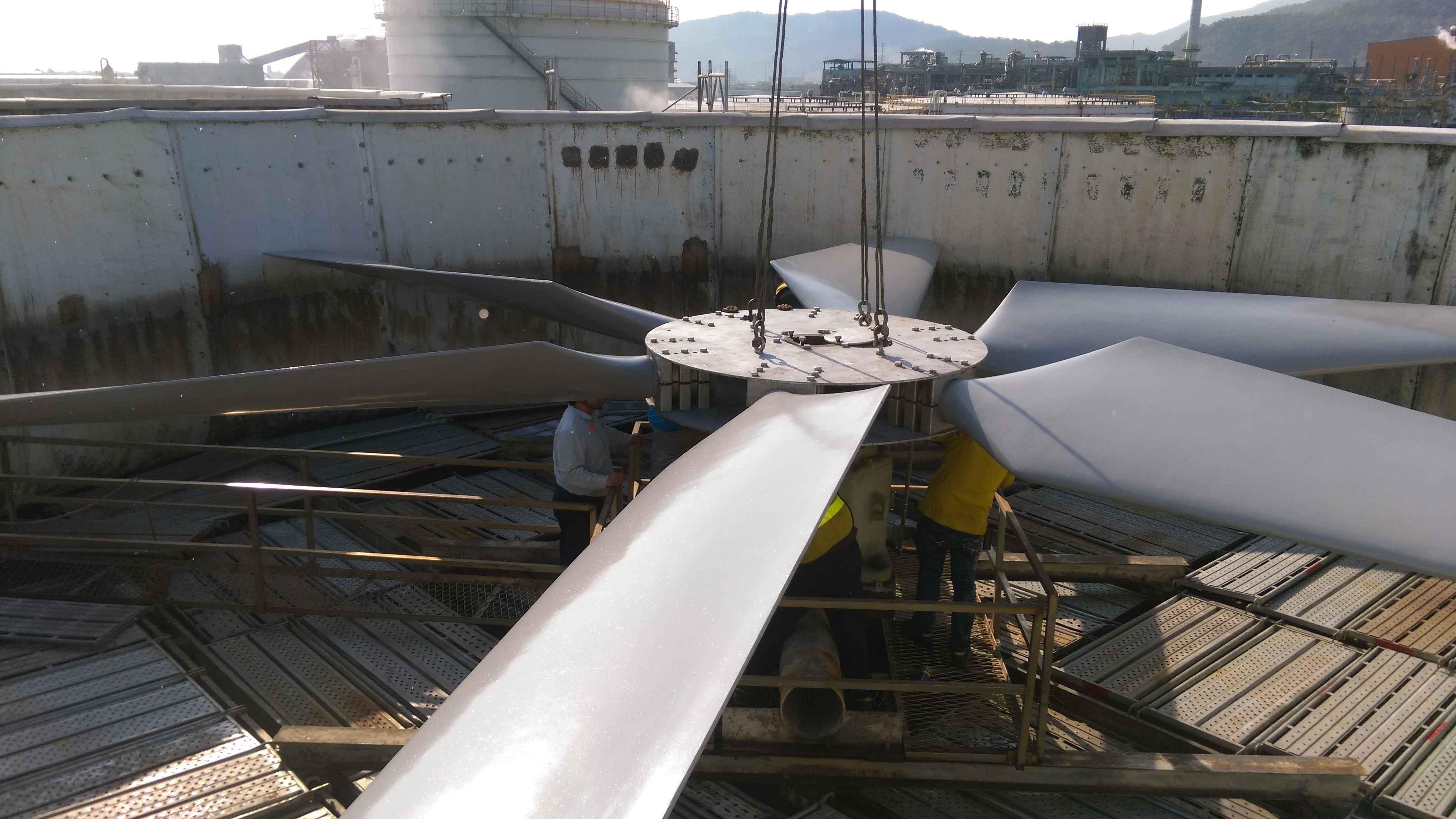
Customized Cooling Tower Fan Replacement: What Should Buyers Consider?
Replacing an existing cooling tower fan is not always as simple as purchasing a product with the same diameter.
Even when two fans have identical external dimensions, their aerodynamic characteristics and power requirements may differ.
Confirm the Original Fan Specifications
Before ordering a replacement fan, customers should collect the following information:
Specification | Information Required |
Fan diameter | Existing fan outside diameter |
Blade quantity | Number of blades |
Blade material | FRP, aluminum alloy, or other |
Blade angle | Existing pitch angle |
Hub diameter | Central hub dimensions |
Motor power | Installed motor rating |
Rotational speed | Operating RPM |
Shaft connection | Relevant mechanical dimensions |
Accurate specifications help manufacturers evaluate whether the replacement fan is mechanically and aerodynamically compatible.
Avoid Replacing Fans Based on Diameter Alone
A common purchasing mistake is selecting a replacement fan based only on its diameter.
The replacement must also be evaluated for airflow, static pressure, shaft power, rotational speed, blade loading, and structural compatibility.
Check Installation Clearance
The fan should have sufficient clearance between the blade tips and surrounding fan cylinder or stack.
Insufficient clearance may increase the risk of mechanical contact, noise, and aerodynamic losses.
Check Structural Compatibility
The hub, blade connections, mounting bolts, and shaft interface must match the cooling tower's mechanical arrangement.
Any structural modification should be evaluated by qualified engineering personnel.
What Are the Latest Trends Among Industrial Cooling Tower Fan Manufacturers?
As industrial facilities focus more on energy efficiency, environmental performance, and equipment reliability, cooling tower fan manufacturing is evolving.
More Efficient Aerodynamic Blade Designs
Modern fan designs increasingly focus on improving aerodynamic efficiency through optimized blade profiles, twist distribution, and pitch configurations.
The objective is to achieve the required airflow with lower power consumption and acceptable noise levels.
Lightweight and Corrosion-Resistant Materials
FRP and other advanced composite materials continue to attract attention in industrial cooling tower applications.
Lightweight blades can help reduce rotating mass and mechanical loading when the entire fan assembly is properly engineered.
Intelligent Fan Speed Control
VFD technology allows cooling tower fans to operate at different speeds based on actual cooling demand.
Combined with temperature sensors and control systems, variable-speed fans can improve operational flexibility and help reduce energy use.
Customized Manufacturing for Global Markets
International buyers increasingly require products that match local cooling tower models, project specifications, and installation conditions.
Manufacturers with flexible production capabilities can serve distributors, EPC contractors, maintenance companies, and industrial end users with more targeted solutions.
Why Work With a Professional Cooling Tower Fan Manufacturer?
Working directly with a specialized manufacturer can offer several advantages compared with purchasing through multiple intermediaries.
Better Product Customization
Direct communication with the manufacturer allows buyers to discuss technical requirements, review drawings, confirm dimensions, and adjust product specifications before production.
More Efficient Technical Communication
Cooling tower fan selection involves several interconnected parameters. Direct technical communication can reduce misunderstandings and help prevent specification errors.
More Flexible OEM and Bulk Orders
Professional manufacturers may support customized production quantities, private labeling, special materials, and project-based orders.
Better Long-Term Spare Parts Support
For cooling tower operators and maintenance contractors, access to compatible replacement blades, hubs, and related components can simplify future maintenance.
FAQ About Industrial Cooling Tower Fan Manufacturers
1. What Products Do Industrial Cooling Tower Fan Manufacturers Produce?
Industrial cooling tower fan manufacturers typically produce FRP fan blades, aluminum alloy fan blades, axial cooling tower fans, adjustable-pitch fans, fan hubs, and complete fan assemblies. Some manufacturers also provide customized replacement components and OEM services.
2. Can Cooling Tower Fan Manufacturers Produce Customized Fan Sizes?
Yes. Professional manufacturers can customize fan diameter, blade length, blade number, hub dimensions, and blade pitch according to customer drawings and project requirements.
However, customized dimensions should be evaluated against the fan's aerodynamic and mechanical operating conditions.
3. Which Material Is Better for Industrial Cooling Tower Fan Blades?
FRP and aluminum alloy are two commonly used materials.
FRP offers corrosion resistance and lightweight construction, while aluminum alloy provides good strength-to-weight characteristics. The final selection depends on the operating environment, temperature, mechanical requirements, and budget.
4. How Can I Find a Reliable Cooling Tower Fan Manufacturer?
Look for manufacturers with cooling tower industry experience, customization capabilities, documented quality-control procedures, technical support, and international delivery experience.
You should also review product specifications and confirm whether the manufacturer can meet your existing cooling tower requirements.
5. Can Manufacturers Supply Replacement Cooling Tower Fans?
Yes. Many specialized manufacturers provide replacement fan blades, hub assemblies, and complete fan systems for different cooling tower models.
Customers should provide original drawings, dimensions, photographs, and operating specifications to ensure compatibility.
6. How Do Cooling Tower Fans Affect Energy Consumption?
Cooling tower fans consume electrical energy to move air through the tower. Fan diameter, blade design, pitch angle, rotational speed, and system resistance all influence power requirements.
An appropriately designed fan can help achieve the required airflow with better energy efficiency.
7. Do Industrial Cooling Tower Fan Manufacturers Provide OEM Services?
Many professional manufacturers offer OEM services, including customized dimensions, materials, product designs, branding, and export packaging.
Buyers should confirm the manufacturer's production capabilities and minimum order requirements before placing an order.
Conclusion: Find the Right Industrial Cooling Tower Fan Manufacturer for Your Project
Choosing the right industrial cooling tower fan manufacturers is essential for achieving reliable airflow, efficient heat rejection, and long-term equipment performance. Customized fan solutions allow industrial users to select suitable materials, blade profiles, fan diameters, hub structures, and drive systems according to their specific operating conditions.
Whether you need FRP cooling tower fan blades, aluminum alloy fans, adjustable-pitch fan assemblies, or complete replacement fan systems, working with an experienced manufacturer can simplify product selection and improve project compatibility.
For distributors, engineering contractors, and industrial end users, the best supplier is not necessarily the one offering the lowest initial price. It is the manufacturer that understands your technical requirements, maintains consistent product quality, provides flexible customization, and delivers dependable technical support.
Looking for customized industrial cooling tower fan solutions? Contact a professional cooling tower fan manufacturer with your fan drawings, dimensions, material requirements, and operating parameters to discuss a suitable solution for your project.


