Cooling Tower Fan Blade Balancing Standards For Industrial Applications
Cooling tower fan blade balancing is an essential part of maintaining reliable industrial cooling systems. In power plants, chemical processing facilities, steel mills, HVAC systems, and other industrial environments, cooling tower fans operate continuously under demanding conditions. Even a small imbalance in the fan assembly can cause excessive vibration, increased mechanical stress, reduced operating efficiency, and premature equipment failure.
For industrial cooling tower operators, following appropriate cooling tower fan blade balancing standards is important for improving equipment reliability and extending service life. Proper balancing helps ensure that fan blades rotate smoothly, distribute centrifugal forces evenly, and work efficiently with the motor, gearbox, shaft, and supporting structure.
However, fan blade balancing is not simply a matter of adjusting blade angles or adding counterweights. It requires attention to blade weight, geometry, installation position, rotational speed, hub condition, and the overall dynamic characteristics of the fan assembly.
This article explains the major balancing principles, relevant industrial standards, inspection procedures, common problems, and practical maintenance recommendations for cooling tower fan blade balancing.
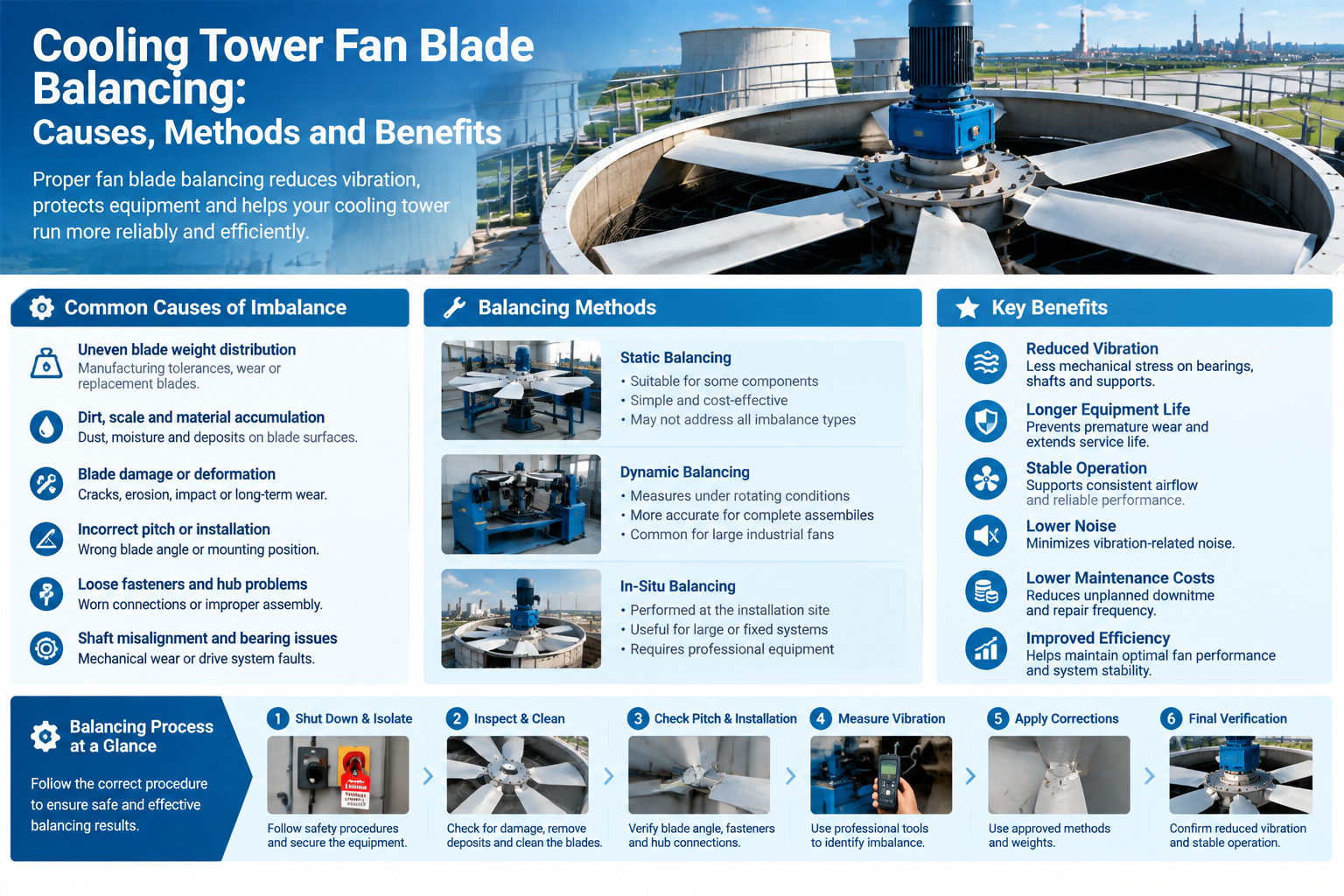
Why Are Cooling Tower Fan Blade Balancing Standards Important?
Cooling tower fans are typically large-diameter rotating components. During operation, their blades generate aerodynamic forces and centrifugal loads. If the rotating assembly is not properly balanced, these forces may create vibration that affects the entire cooling tower structure.
1. Reduce Mechanical Vibration
Unbalanced fan blades generate uneven centrifugal forces during rotation. These forces can transfer to the fan hub, drive shaft, gearbox, motor, and supporting framework.
Excessive vibration may cause:
Following appropriate cooling tower fan blade balancing procedures helps reduce these risks.
2. Improve Cooling Tower Operating Efficiency
An unbalanced fan may consume additional energy because the drive system must operate under unnecessary mechanical stress.
Proper balancing supports smoother rotation and helps the fan maintain stable airflow. This contributes to consistent cooling tower performance and more reliable heat rejection.
3. Extend Fan and Drive System Service Life
Cooling tower fan blades are usually made from FRP, aluminum alloy, or other engineering materials. Continuous vibration can gradually damage blade connections and mounting components.
Correct balancing reduces unnecessary dynamic loads and helps protect expensive components.
4. Improve Industrial Operating Safety
In large industrial cooling towers, fan assemblies can reach considerable rotational speeds. A damaged or improperly secured blade may create serious operational risks.
Balancing inspections should therefore be included in equipment commissioning, maintenance, and post-replacement testing.
What Are The Main Cooling Tower Fan Blade Balancing Standards?
There is no single universal standard that covers every cooling tower fan blade configuration and operating condition. Industrial balancing requirements should be selected according to the fan design, rotor characteristics, operating speed, manufacturer specifications, and applicable project requirements.
Several international standards provide useful technical guidance.
ISO 21940: Mechanical Vibration – Rotor Balancing
ISO 21940 is an important international series covering rotor balancing procedures and requirements.
It provides guidance on balancing quality, balancing methods, and the evaluation of residual unbalance.
ISO 21940-11: Rigid Rotor Balancing
ISO 21940-11 addresses procedures and tolerances for rotors with rigid behavior.
For applicable cooling tower fan assemblies, engineers can use its principles to determine acceptable residual unbalance and establish balancing procedures.
ISO 21940-12: Flexible Rotor Balancing
Some rotating systems exhibit flexible rotor behavior at operating speeds. ISO 21940-12 provides guidance for balancing flexible rotors.
Its applicability should be evaluated based on the actual fan and drive assembly rather than assumed for every cooling tower.
ISO 1940-1: Historical Balancing Quality Guidance
ISO 1940-1 was widely referenced in industrial rotor balancing applications. It has been superseded by the ISO 21940 series.
Older technical documents may still mention ISO 1940-1, so engineers should verify the applicable current edition and contractual requirements before specifying a balancing grade.
ISO 20816: Mechanical Vibration Evaluation
ISO 20816 provides guidance for measuring and evaluating machine vibration.
It is useful when assessing the vibration condition of industrial machinery, including applicable cooling tower drive equipment.
However, vibration acceptance limits depend on machine classification, installation, measurement location, and operating conditions. A rotor balancing tolerance should not be confused with an overall machine vibration limit.
AMCA Standards and Fan Industry Requirements
The Air Movement and Control Association (AMCA) publishes technical standards and guidance for air-moving equipment.
Relevant fan performance, testing, and vibration requirements may be specified depending on the cooling tower fan design and project contract.
Manufacturers and buyers should confirm which AMCA publications apply to their particular equipment.
What Factors Affect Cooling Tower Fan Blade Balancing?
Several factors influence the balancing condition of an industrial cooling tower fan. Understanding these factors helps maintenance teams identify problems before they cause serious mechanical failures.
1. Uneven Fan Blade Weight
Different blade weights can create an uneven mass distribution around the fan hub.
This problem may occur because of:
Manufacturing tolerances.
Differences in blade material thickness.
Uneven resin distribution in FRP blades.
Repair materials added during maintenance.
Moisture absorption or material deterioration.
Why Is Blade Weight Consistency Important?
When blades have different weights, the rotating assembly may develop an uneven centrifugal force.
Manufacturers should control blade production quality and inspect blade weights before final assembly.
2. Incorrect Fan Blade Installation Angle
Blade pitch angle directly affects aerodynamic performance and airflow distribution.
If the blade angles are inconsistent, the fan may produce uneven aerodynamic loading.
How Does Blade Angle Affect Balancing?
Although blade pitch adjustment is not a substitute for mass balancing, inconsistent pitch can contribute to aerodynamic imbalance and unstable operating conditions.
Technicians should measure each blade angle at the same reference position and follow the manufacturer's installation specifications.
3. Damaged or Deformed Fan Blades
Cooling tower fan blades operate in humid environments and may experience exposure to chemicals, ultraviolet radiation, temperature changes, and mechanical impacts.
Common problems include:
Damaged blades should be evaluated and repaired or replaced according to the manufacturer's recommendations before balancing.
4. Improper Fan Hub Assembly
The fan hub connects individual blades to the rotating drive system.
An improperly assembled hub can cause uneven mass distribution, blade positioning errors, and additional vibration.
Important Hub Inspection Points
A high-quality cooling tower fan hub assembly provides a stable foundation for reliable fan operation.
5. Dirt and Material Accumulation
Dust, scale, grease, and other contaminants can accumulate on fan blade surfaces.
Uneven deposits change the mass distribution of the rotating assembly. Regular cleaning is therefore an important part of balancing maintenance.
What Are The Different Methods Of Cooling Tower Fan Blade Balancing?
Industrial cooling tower fans can be balanced using different methods depending on their size, construction, rotational speed, and maintenance requirements.
1. Static Balancing
Static balancing identifies uneven mass distribution when a rotor is stationary or supported in a suitable balancing fixture.
It is generally useful for identifying heavy and light sections of a component.
How Does Static Balancing Work?
Remove the fan assembly or component when required by the procedure.
Install it on an appropriate balancing fixture.
Allow the rotor to settle naturally.
Identify the heavy side.
Apply an approved correction method.
Repeat the measurement until the specified tolerance is achieved.
Static balancing may be suitable for certain individual fan components, but it does not necessarily correct couple unbalance in a large rotating assembly.
2. Dynamic Balancing
Dynamic balancing evaluates rotor unbalance while the component rotates in a balancing machine or an appropriate field-balancing arrangement.
It can identify the magnitude and angular position of correction requirements in one or more balancing planes.
Advantages of Dynamic Balancing
More comprehensive evaluation of rotating mass distribution.
Identification of couple unbalance.
Better control of residual unbalance.
Useful for larger industrial fan assemblies.
Supports more accurate balancing verification.
For large cooling tower fans, the balancing method should be selected according to rotor geometry, support conditions, and manufacturer recommendations.
3. Field Balancing
Field balancing is performed on the installed fan assembly without necessarily removing the complete rotor.
This approach is useful when dismantling the fan would require significant downtime.
When Is Field Balancing Recommended?
Field balancing may be considered when:
A fan develops abnormal vibration during operation.
A replacement fan blade has been installed.
The hub or other rotating components have been repaired.
Vibration measurements indicate residual unbalance.
Removing the complete assembly is difficult.
Before field balancing, technicians must verify mechanical integrity, blade condition, fastener security, and measurement reliability.
How To Perform Cooling Tower Fan Blade Balancing Correctly?
A systematic balancing procedure helps industrial maintenance teams achieve repeatable results.
Step 1: Inspect The Complete Fan Assembly
Before balancing, inspect all major rotating components.
Key Inspection Items
Balancing should not be used to compensate for cracked blades, loose connections, bent shafts, or other mechanical defects.
Step 2: Clean All Fan Blades
Remove dirt, dust, oil, and accumulated deposits from the blade surfaces.
Cleaning is particularly important for cooling towers operating in industrial environments where airborne particles and water treatment chemicals may accumulate.
After cleaning, inspect the blades for cracks, corrosion, and deformation.
Step 3: Check Blade Pitch Angles
Use an appropriate angle-measuring instrument to inspect the pitch of each blade.
All blades should follow the specified installation angle within the manufacturer's permitted tolerance.
Why Should Pitch Angles Be Consistent?
Unequal blade angles can create uneven aerodynamic loading, resulting in airflow instability and vibration.
Technicians should use consistent measurement locations and reference positions.
Step 4: Measure Blade Weight and Position
Record the weight and installation position of each blade when required by the balancing procedure.
For replacement projects, compare the new blades with the original manufacturer's specifications.
Avoid mixing blades with significantly different designs, dimensions, or structural characteristics.
Step 5: Select The Appropriate Balancing Equipment
Depending on the application, balancing equipment may include:
Static balancing fixtures.
Dynamic balancing machines.
Portable vibration analyzers.
Laser tachometers.
Vibration sensors.
Digital measuring instruments.
The equipment should have suitable measurement accuracy and be properly calibrated.
Step 6: Calculate The Required Correction
The balancing technician determines the magnitude and angular position of the required correction based on measured unbalance.
Correction methods may include approved counterweights or manufacturer-authorized material adjustments.
Important Correction Considerations
Use suitable corrosion-resistant materials.
Secure correction weights properly.
Avoid drilling or cutting structural blade sections without approval.
Follow the manufacturer's permitted correction locations.
Maintain sufficient mechanical strength.
Step 7: Conduct A Final Balancing Test
After correction, repeat the balancing measurement.
Record the final residual unbalance and confirm that it meets the specified acceptance criteria.
For installed equipment, conduct an appropriate operational vibration test after ensuring that the fan assembly is safe to operate.
What Is The Relationship Between Fan Blade Balancing And Vibration?
Fan blade balancing and vibration monitoring are closely related, but they are not identical.
Balancing addresses the mass distribution of a rotating assembly. Vibration monitoring evaluates the mechanical response of the operating equipment.
An unbalanced cooling tower fan commonly produces vibration at the rotational frequency, also called 1× running speed.
However, vibration can also be caused by other mechanical problems.
Common Causes Of Cooling Tower Fan Vibration
| Problem | Possible Vibration Characteristics |
| Fan imbalance | Often strong vibration at 1× running speed |
| Shaft misalignment | May produce 1× and 2× components |
| Loose mounting bolts | May create unstable or changing vibration |
| Bearing damage | May generate characteristic bearing frequencies |
| Blade deformation | May produce aerodynamic and mechanical disturbances |
| Structural resonance | May amplify vibration at specific frequencies |
How Can Vibration Monitoring Improve Maintenance?
Industrial operators can establish vibration measurement points on the fan support structure, gearbox, motor, and other appropriate locations.
Regular monitoring helps identify changes in machine condition.
Recommended Monitoring Practices
Establish baseline vibration readings after commissioning.
Use consistent measurement locations.
Record operating speed and load conditions.
Compare results with applicable acceptance criteria.
Investigate sudden vibration increases.
Maintain historical inspection records.
A vibration analyzer can help identify possible causes, but measurements should be interpreted by qualified personnel.
How Often Should Industrial Cooling Tower Fan Blades Be Balanced?
There is no universal balancing interval suitable for every cooling tower.
The inspection frequency depends on operating hours, environmental conditions, fan design, vibration history, and maintenance requirements.
During Initial Installation
New cooling tower fans should be inspected and tested according to the manufacturer's commissioning procedure.
This provides a baseline for future maintenance.
During Routine Maintenance
Industrial maintenance teams should regularly inspect:
Blade surfaces.
Blade mounting bolts.
Fan hub connections.
Pitch angle consistency.
Vibration levels.
Accumulated deposits.
Routine inspection does not always require a complete balancing procedure.
After Fan Blade Replacement
Balancing verification is especially important after replacing individual blades or the complete fan assembly.
New blades should match the original specifications for dimensions, weight, material, and aerodynamic design.
After Mechanical Repair
Balancing should be reconsidered after major repairs involving the fan hub, shaft, blade mounting system, or rotating assembly.
Unexpected vibration following maintenance should be investigated before the equipment returns to normal operation.
What Are The Common Mistakes In Cooling Tower Fan Blade Balancing?
Even experienced maintenance teams can make mistakes when balancing large industrial fans.
1. Using Blade Angle Adjustment To Correct Mass Imbalance
Blade pitch adjustment changes aerodynamic loading, not the actual mass distribution.
Technicians should distinguish between aerodynamic problems and mechanical unbalance.
2. Ignoring The Condition Of The Fan Hub
A damaged or incorrectly assembled hub can create persistent vibration.
Replacing or adjusting blades without inspecting the hub may not solve the underlying problem.
3. Installing Replacement Blades With Different Specifications
Blades with different weights, profiles, materials, or dimensions may affect the balance and aerodynamic performance of the complete fan.
Replacement components should meet the original equipment requirements.
4. Adding Unapproved Counterweights
Incorrectly installed counterweights can become loose during operation and create additional safety hazards.
Only approved correction methods and secure mounting arrangements should be used.
5. Ignoring Other Sources Of Vibration
Not every vibration problem comes from fan imbalance.
Bearing damage, shaft misalignment, structural looseness, and gearbox problems must also be considered during diagnosis.
How Do Manufacturers Ensure Cooling Tower Fan Blade Balancing Quality?
Reliable cooling tower fan blade manufacturers should implement quality control throughout the production and assembly process.
1. Material Quality Control
FRP and aluminum fan blades require appropriate material inspection.
For FRP blades, manufacturers should pay attention to fiber distribution, resin quality, thickness consistency, and structural integrity.
2. Accurate Mold and Blade Geometry
Consistent blade geometry helps maintain aerodynamic performance and reduces manufacturing variation.
Manufacturers should control:
Blade length.
Blade profile.
Root dimensions.
Thickness distribution.
Mounting hole positions.
Overall weight.
3. Individual Blade Inspection
Each blade should be inspected according to the manufacturer's quality control requirements.
Weight and dimensional records can help identify manufacturing differences before final assembly.
4. Complete Fan Assembly Testing
The assembled fan should be inspected to verify blade positioning, pitch angle, mounting security, and balancing requirements.
Why Is Factory Balancing Important?
Factory balancing allows manufacturers to identify and correct unbalance under controlled conditions.
It also helps reduce commissioning difficulties and installation problems for customers.
How To Choose A Reliable Cooling Tower Fan Blade Manufacturer?
Selecting a professional manufacturer is important for industrial cooling tower replacement and new installation projects.
A reliable supplier should offer more than standard fan blades. It should understand fan assembly requirements, balancing procedures, operating conditions, and replacement compatibility.
Evaluate Manufacturing Experience
Look for manufacturers with experience supplying industrial cooling tower fan blades for different applications.
Relevant experience may include power generation, petrochemical plants, steel production, HVAC systems, and large industrial cooling installations.
Check Material and Product Quality
Ask about available materials, including FRP and aluminum alloy.
Review product specifications, manufacturing processes, inspection procedures, and quality documentation.
Confirm Customization Capabilities
Different cooling towers require different fan diameters, blade profiles, hub connections, and installation configurations.
A professional manufacturer should be able to evaluate drawings, dimensions, operating speed, and existing equipment requirements.
Request Balancing and Inspection Documentation
For industrial projects, buyers should confirm whether the manufacturer can provide relevant inspection records, balancing reports, and product quality documentation.
These records help customers evaluate product consistency and installation readiness.
Cooling Tower Fan Blade Balancing For Different Industrial Applications
Different industries have different cooling requirements and operating conditions.
Power Plants
Power plant cooling towers often operate continuously under substantial thermal loads.
Fan reliability is important for maintaining stable cooling capacity and reducing unplanned shutdowns.
Chemical and Petrochemical Facilities
Chemical plants may operate in corrosive environments with demanding operating schedules.
Fan blade material quality, corrosion resistance, and routine vibration monitoring are particularly important.
Steel and Metallurgical Industries
Steel production requires reliable industrial cooling systems to support production equipment.
Large cooling tower fans should be inspected regularly to prevent excessive vibration and mechanical failures.
Commercial HVAC Systems
HVAC cooling towers may experience changing operating loads throughout the year.
Proper fan balancing helps maintain smooth operation, reduce noise, and support long-term equipment reliability.
Conclusion
Cooling tower fan blade balancing standards are essential references for maintaining safe, efficient, and reliable industrial cooling systems.
By understanding ISO 21940 balancing principles, applicable vibration evaluation requirements, and proper maintenance procedures, industrial operators can improve fan reliability and reduce unnecessary mechanical stress.
Successful balancing requires more than correcting uneven blade weight. It also involves inspecting blade geometry, pitch angles, hub connections, shaft alignment, and other rotating components.
For cooling tower fan blade replacement projects, choosing a qualified manufacturer with consistent production quality, reliable assembly procedures, and appropriate balancing capabilities is equally important.
A systematic approach to cooling tower fan blade balancing helps industrial facilities improve operational stability, extend equipment service life, and maintain dependable cooling performance.


