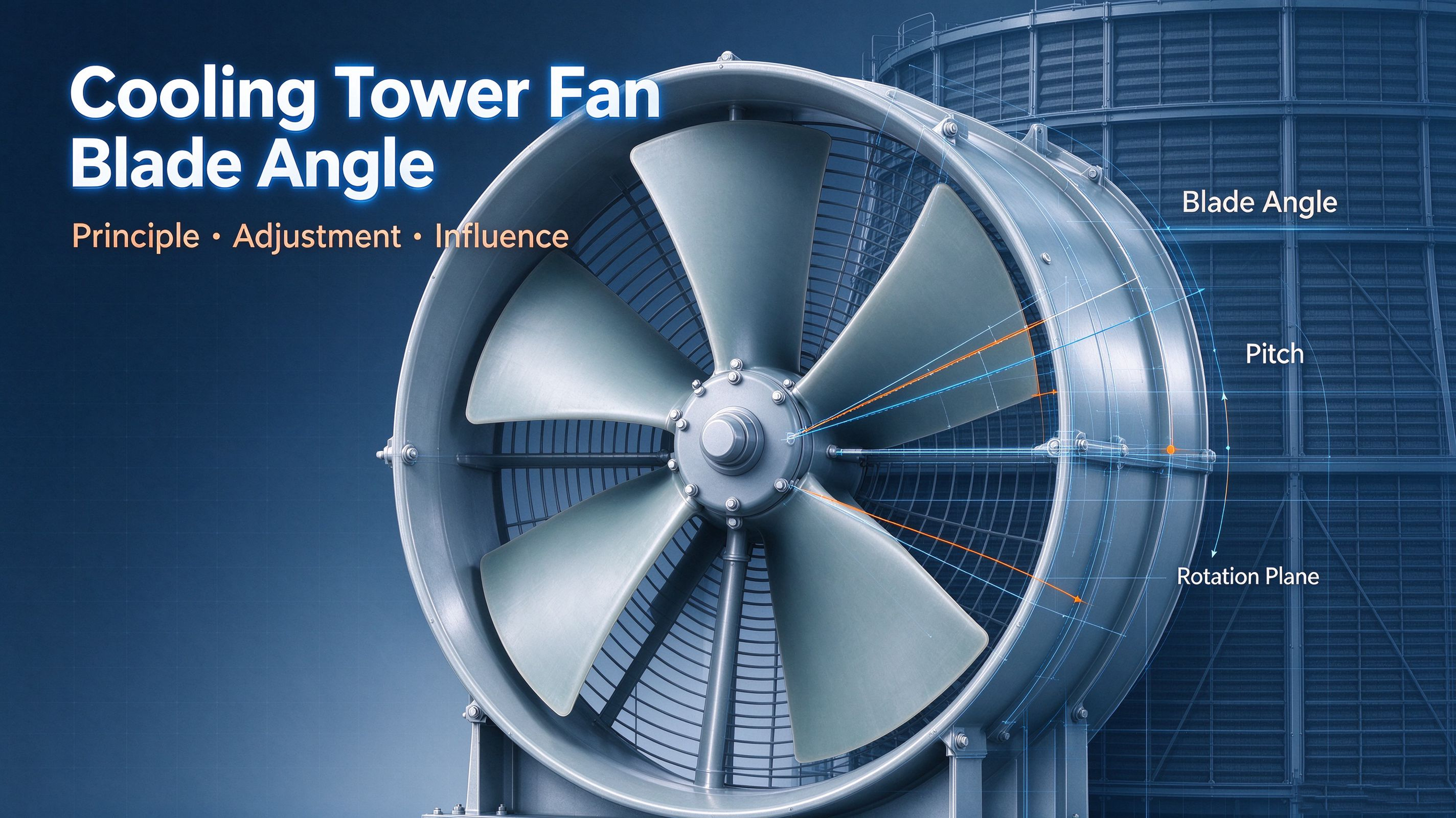
1. Introduction to Cooling Tower Fan Blade Angle
Have you ever noticed that a cooling tower fan can consume a lot of electricity without delivering the cooling performance you expect? Sometimes, the problem is not the fan motor, the cooling tower fill, or the water distribution system. The fan blade angle may also be an important factor.
The blade angle of a cooling tower fan directly affects how the fan moves air through the tower. An angle that is too small may not provide enough airflow, while an angle that is too large can increase motor load, energy consumption, and the risk of mechanical problems.
Finding the right balance is essential. A properly configured fan helps remove heat efficiently, maintains stable operating conditions, and reduces unnecessary energy costs.
Power Tower Cooling Technology (Shaoxing) Co., Ltd., available at www.coolingtowerpart.com, provides cooling tower components and related product solutions for industrial cooling applications. Understanding fan blade angle is a practical starting point for improving cooling tower performance and making informed maintenance decisions.
2. What Is the Blade Angle of a Cooling Tower Fan?
The blade angle, often called the blade pitch angle, describes the orientation of a fan blade relative to a defined reference plane or direction of rotation. It determines how the blade interacts with the surrounding air as the fan spins.
Think of a fan blade as a small rotating wing. Its shape and angle influence how much air it can move and how much resistance it encounters. Change the angle, and you change the way the fan works.
However, blade angle is not a universal number. Different fan manufacturers may define or measure it using different reference points. Always check the manufacturer's drawing or installation manual before measuring or changing the setting.
2.1 Blade Pitch and Blade Installation Angle
Blade pitch is commonly used to describe the geometric angle at which a blade is installed. Depending on the fan design, the specified angle may be measured at a particular radius along the blade rather than at the root or tip.
This distinction matters because a fan blade may be twisted along its length. The angle near the hub can differ from the angle near the blade tip.
When inspecting or adjusting a fan, use the measurement location and reference method specified by the manufacturer. Comparing angles measured at different positions can produce misleading results.
2.2 How Blade Angle Affects Airflow
As a cooling tower fan rotates, its blades accelerate air and create the pressure difference needed to move air through the tower.
Changing blade pitch changes the aerodynamic loading on each blade. Within the fan's intended operating range, increasing pitch often increases airflow and pressure capability. However, it also generally increases the power required to drive the fan.
The result depends on fan speed, blade geometry, air density, system resistance, and the tower's overall design. A larger angle does not automatically mean better cooling.
3. The Working Principle of Fan Blade Angle
A cooling tower rejects heat primarily by transferring heat from circulating water to air, with evaporation providing an important part of the cooling process. The fan supports this process by moving air through the tower.
The blade angle influences the fan's interaction with the air. To understand why adjustment matters, consider three connected factors: airflow, pressure, and power.
3.1 The Relationship Between Blade Angle and Air Volume
In many adjustable-pitch axial fans, increasing blade pitch increases the amount of air the fan can move at a given speed, at least within the intended operating range.
More airflow can improve heat and mass transfer inside the cooling tower. But the increase is not unlimited. As the pitch changes, the fan operating point shifts along the fan and system performance curves.
If the angle is excessive, the fan may draw more power than expected or operate inefficiently. In some cases, airflow gains become smaller than the additional energy cost.
The goal is not to maximize blade angle. It is to achieve the airflow required by the cooling tower while staying within the fan's operating limits.
3.2 The Relationship Between Blade Angle and Fan Load
A fan motor must supply the mechanical power needed to overcome aerodynamic resistance and mechanical losses. Increasing blade pitch often raises aerodynamic torque and motor power demand.
This is why motor current must be checked after any permitted blade adjustment. A fan may appear to move more air while placing excessive load on its motor.
Motor current is a useful operating indicator, but it is not the only criterion. A complete assessment should also consider voltage, power, vibration, rotational speed, airflow, and the manufacturer's limits.
4. Why Is the Correct Blade Angle Important?
The correct blade angle helps a cooling tower operate as a balanced system. Too little airflow may reduce heat rejection, especially during periods of high ambient temperature or heavy process demand. Too much airflow can increase electricity consumption without delivering a proportional improvement in cooling.
An unsuitable setting may also increase motor load, noise, vibration, or mechanical stress. Over time, these conditions can contribute to premature wear of fan blades, hubs, bearings, drive components, and supporting structures.
A suitable setting supports four practical goals:
Reliable cooling: Provide the airflow required for the design duty.
Energy efficiency: Avoid unnecessary fan power consumption.
Mechanical reliability: Keep the fan within its approved operating range.
Stable operation: Reduce the likelihood of overload, excessive vibration, and unplanned downtime.
Remember that fan blade angle is only one part of the cooling tower equation. Fan speed, fill condition, water distribution, recirculation, and air inlet conditions also influence the final result.
5. How Blade Angle Influences Cooling Tower Performance
5.1 Cooling Efficiency and Water Temperature
Cooling tower performance depends on the tower's ability to transfer heat from water to air. If airflow is insufficient, the tower may struggle to achieve the required cold-water temperature.
Adjusting the blade angle on a compatible adjustable-pitch fan may improve airflow and help the tower meet its cooling duty. This can be particularly useful when operating conditions change or when the original fan setting is incorrect.
However, a high outlet-water temperature does not necessarily indicate a fan angle problem. Fouled fill, blocked nozzles, poor water distribution, excessive heat load, and unfavorable wet-bulb temperature can produce similar symptoms.
Before making adjustments, compare actual operating conditions with the tower's design requirements.
5.2 Airflow Distribution and Heat Transfer
A cooling tower needs more than a large volume of air. Air must also pass through the tower in a reasonably uniform way.
An inappropriate fan setting can contribute to poor overall performance if it causes the fan to operate outside its intended range. Yet uneven airflow may also result from damaged fan blades, incorrect rotation, obstructions, poor inlet conditions, or problems with the air distribution system.
The fan should be assessed together with the fill and water distribution system. A correctly pitched fan cannot fully compensate for severely clogged fill or uneven water loading.
5.3 Energy Consumption and Operating Costs
Fan power can represent a significant portion of a cooling tower's operating energy use. If blade pitch is increased unnecessarily, the fan may consume additional electricity without a meaningful improvement in water temperature.
For this reason, the best setting is not always the one that produces maximum airflow. It is the setting that meets the required cooling duty with acceptable power consumption and reliable operation.
When evaluating an adjustment, compare motor current or measured power, cold-water temperature, process heat load, ambient wet-bulb temperature, and fan speed. Where possible, collect readings under comparable conditions before and after the change.
6. Signs That Your Cooling Tower Fan Angle May Be Incorrect
Several symptoms can justify checking the blade angle, although none proves that the angle is the cause.
Possible signs include:
The cooling tower cannot achieve its normal cold-water temperature.
Motor current is unusually high or approaches the rated limit.
Airflow appears weaker than expected.
Fan noise changes after maintenance.
The fan develops unusual vibration.
Energy consumption rises without an obvious increase in cooling demand.
Different blades appear to have inconsistent pitch settings.
Vibration, noise, and high current can indicate serious mechanical or electrical faults. Do not assume that changing the blade angle will solve them. Inspect the fan assembly, drive system, mounting hardware, and motor before deciding on corrective action.
7. Factors to Consider Before Adjusting Blade Angle
7.1 Fan Design and Manufacturer Specifications
Not every cooling tower fan is designed for pitch adjustment. Some use fixed-pitch blades, while others have adjustable hubs that permit changes within a specified range.
Before starting work, identify the fan model, blade type, hub design, rated speed, and permitted pitch range. Check the installation manual for the exact measurement method and required tightening torque.
Never apply an angle setting from a different fan model simply because the blade diameter looks similar. Differences in blade geometry and hub design can significantly affect performance.
7.2 Motor Power and Operating Current
Check the motor nameplate for rated power, voltage, frequency, current, and speed. Confirm that the drive arrangement and protection settings match the approved design.
After an authorized adjustment, verify that the fan operates within the motor and drive limits under actual operating conditions. Do not use a higher current limit as a workaround for excessive fan loading.
7.3 Ambient Conditions and Cooling Load
Cooling towers operate under changing conditions. Seasonal weather, water flow, process heat load, and wet-bulb temperature can all affect the required airflow.
A setting suitable for one operating condition may not provide the best energy performance under another. Where the system supports it, variable-speed control may offer a more flexible way to match fan output to demand.
Any change should remain consistent with the fan manufacturer's limits and the cooling tower's operating requirements.
8. How to Adjust Cooling Tower Fan Blade Angle
Blade adjustment should only be performed on fans designed for it and by trained, authorized personnel. The following is a general workflow, not a substitute for the instructions supplied with a specific fan.
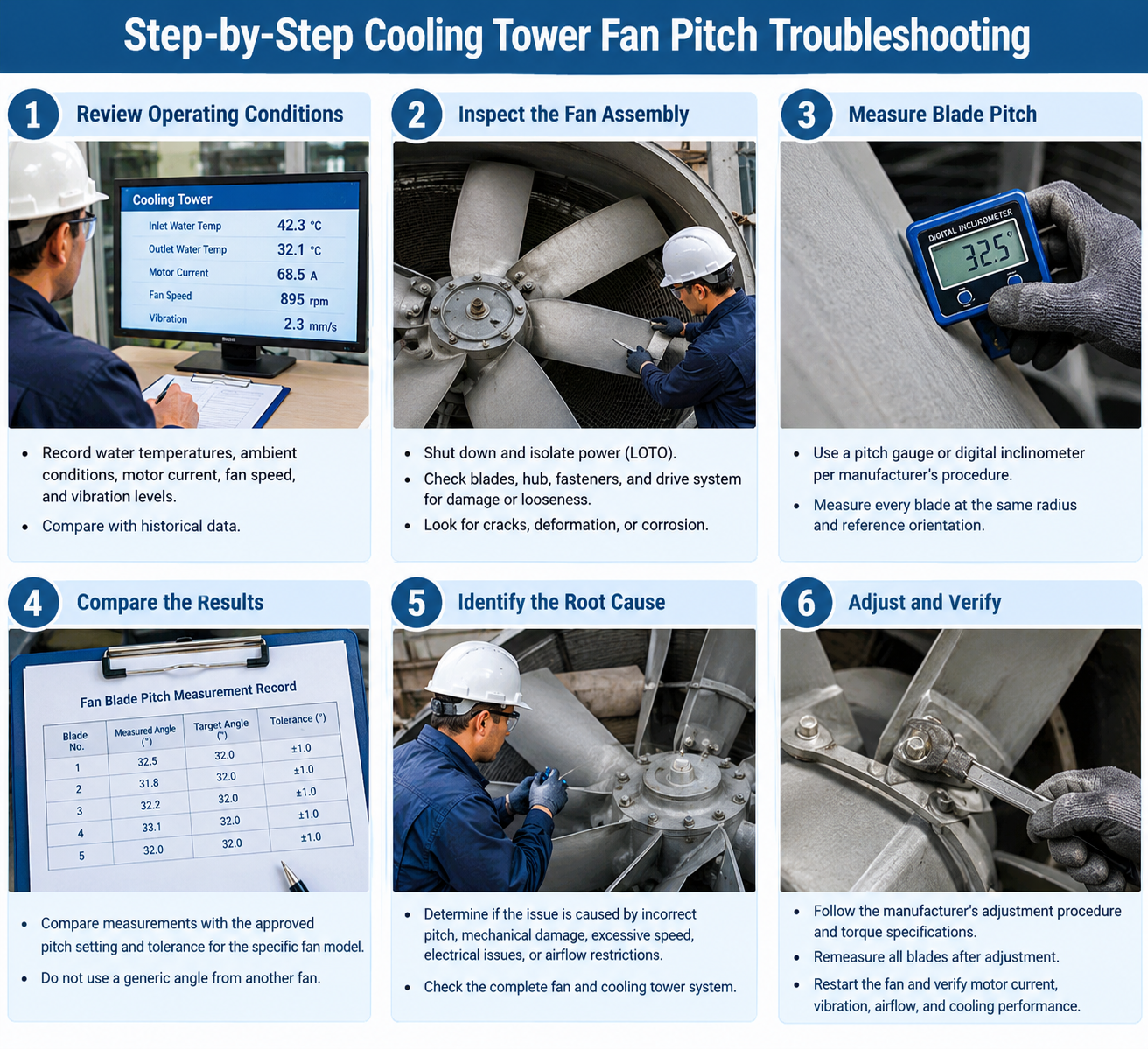
8.1 Step 1: Shut Down and Isolate the Equipment
Stop the fan and follow the site's lockout/tagout procedure. Isolate the electrical supply, prevent automatic or remote restart, and verify that all relevant energy sources are controlled.
Wait until the fan has come to a complete stop. If the equipment has a variable-frequency drive, follow the required electrical isolation and discharge procedures.
Never attempt to measure or adjust blade pitch while the fan is running.
8.2 Step 2: Inspect the Fan Assembly
Before changing the angle, inspect the blades, hub, fasteners, drive components, and support structure.
Look for cracks, deformation, corrosion, loose connections, and signs of blade contact. Check whether the fan has accumulated dirt or deposits that could affect balance.
If any structural damage is found, stop and arrange a suitable repair or replacement. Adjusting the pitch of a damaged blade is not an acceptable repair method.
8.3 Step 3: Measure the Existing Blade Angle
Use the manufacturer's specified measurement tool and reference location. Record the existing angle of each blade before loosening any fasteners.
Documenting the original setting provides a useful baseline and makes it easier to identify inconsistencies. Make sure the fan is measured in the correct position and that the same reference method is used for every blade.
If the manufacturer's method is unclear, obtain technical guidance rather than guessing.
8.4 Step 4: Adjust Each Blade Consistently
For an adjustable-pitch fan, follow the approved procedure to set each blade to the required angle. Make changes gradually and use the specified sequence.
All blades must match the manufacturer's required settings and tolerances. Unequal pitch can create uneven aerodynamic loading and may contribute to vibration, poor performance, and mechanical stress.
Do not exceed the approved adjustment range or choose an angle solely to increase airflow.
8.5 Step 5: Tighten, Verify, and Test
Tighten all fasteners to the specified torque using the recommended tools. Confirm that the blades are secure and that the fan assembly has the required clearances.
Before returning the equipment to service, remove tools and loose materials, reinstall guards, and verify that the work area is clear. Restore power only in accordance with the site's commissioning and safety procedures.
Start the fan under the approved test procedure. Check rotation, vibration, noise, motor current, and operating temperatures. If readings exceed the permitted limits, stop the fan and investigate before continuing operation.
Essential Safety Checks After Adjustment
Confirm that every blade is set to the specified angle.
Verify that fasteners are tightened to the required torque.
Check blade clearance and hub security.
Ensure all guards and safety devices are restored.
Confirm that the motor current remains within its allowable limit.
Check for abnormal vibration, noise, or blade movement.
Record the final settings and test results.
9. Common Mistakes During Blade Angle Adjustment
One common mistake is assuming that a larger blade angle always delivers better cooling. In reality, the additional airflow may come with excessive motor load and higher energy consumption.
Another mistake is setting blades by eye. Small differences can be difficult to see but may create inconsistent loading. Always use the approved measurement method.
Other mistakes include adjusting a fixed-pitch fan, ignoring blade damage, overlooking motor current, failing to tighten fasteners correctly, and restarting equipment before guards are restored.
Finally, changing blade angle without recording operating conditions makes it difficult to determine whether the adjustment actually improved performance. A controlled before-and-after comparison is much more useful than relying on sound or visual impressions alone.
10. Fixed-Pitch vs. Adjustable-Pitch Cooling Tower Fans
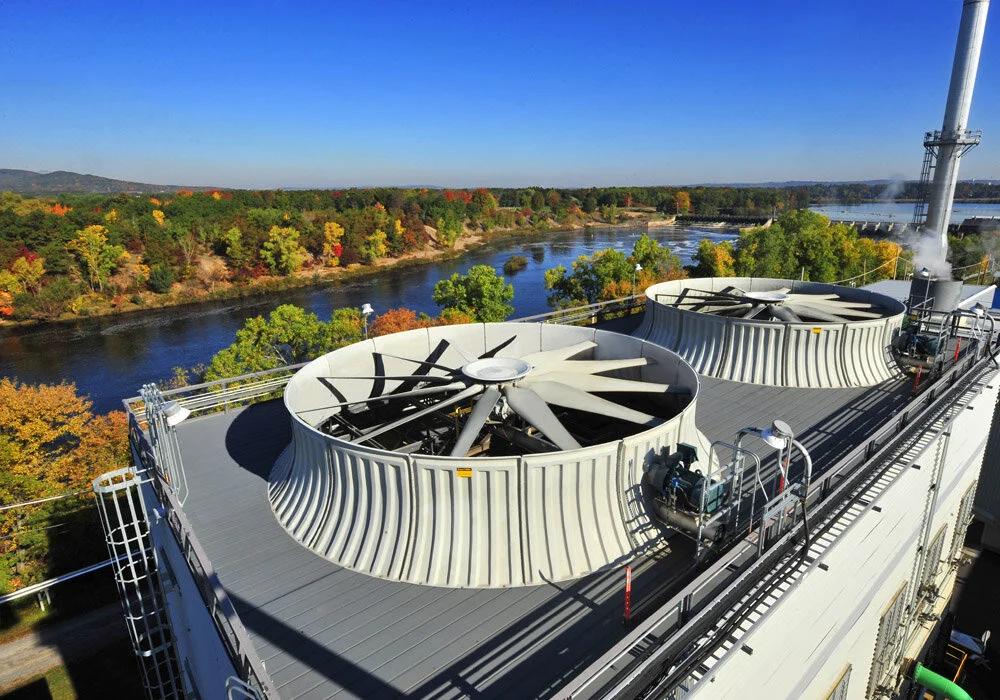
Fixed-pitch fans have blades installed at a predetermined angle. Their design is relatively straightforward, and operators generally control output through the approved drive arrangement or other system-level methods.
Adjustable-pitch fans allow the blade angle to be changed within a specified range. This can provide flexibility during commissioning, replacement, or performance optimization, but adjustment must follow the manufacturer's procedure.
Neither design is automatically superior for every application. The right choice depends on the tower's duty, fan diameter, operating speed, control strategy, maintenance requirements, and expected changes in cooling demand.
When replacing a fan or hub, confirm compatibility with the original equipment. Matching only the outside diameter is not enough; blade profile, hub arrangement, speed rating, motor load, and installation requirements also matter.
11. Cooling Tower Fan Blade Angle and Vibration
Vibration can be a warning sign of uneven loading or a mechanical fault. Incorrect blade pitch may contribute to uneven aerodynamic forces, but it is only one possible cause.
Other causes include blade damage, accumulated deposits, a loose hub, shaft misalignment, worn bearings, an unbalanced fan assembly, and structural resonance.
If vibration appears after pitch adjustment, stop the fan if it exceeds the site's safe operating limits. Recheck the blade settings and fasteners, then inspect the assembly and drive system.
Do not try to correct vibration by randomly changing blade angles. If the cause remains unclear, arrange a qualified vibration assessment and follow the fan manufacturer's recommendations.
12. Seasonal Adjustment and Variable-Speed Operation
Cooling demand changes with weather and process conditions. During hot periods, a cooling tower may need more heat-rejection capacity. During cooler weather or periods of lower load, maximum fan output may not be necessary.
For compatible systems, variable-frequency drives can regulate fan speed to match cooling demand. This approach can reduce energy consumption when full fan speed is unnecessary, provided the motor, drive, fan, and tower are designed for the operating range.
Seasonal changes do not automatically mean that the blade angle should be altered. Blade pitch is often established during commissioning and kept at the approved setting. Any subsequent adjustment should be based on engineering evaluation rather than routine seasonal guesswork.
13. Maintenance Tips for Stable Fan Performance
Good maintenance helps preserve fan efficiency and reduce the risk of unexpected shutdowns. Establish a routine inspection program based on operating hours, site conditions, and manufacturer recommendations.
Inspect blades for cracks, corrosion, deformation, and deposits. Check the hub and fasteners for looseness, and examine the motor, gearbox or belt drive, bearings, guards, and supporting structure as applicable.
Keep the fan clean using an approved method. Deposits can alter blade characteristics and contribute to imbalance. Avoid cleaning methods that damage the blade material or protective coating.
Record vibration, motor current, fan speed, water temperatures, and maintenance activities. Trends are often more informative than individual readings because they can reveal gradual deterioration before a major failure occurs.
14. When Should You Replace Cooling Tower Fan Blades?
Blade replacement may be necessary when inspection identifies cracks, severe corrosion, deformation, material deterioration, or damage that cannot be repaired under the manufacturer's approved procedure.
Repeated vibration, persistent imbalance, and visible damage around blade attachment points also warrant investigation. Do not continue operating a fan with a blade defect that could compromise structural integrity.
Replacement blades should match the fan's approved specifications. Confirm the blade profile, material, dimensions, hub compatibility, pitch range, rotational speed rating, and required operating conditions.
Avoid mixing blades of different designs or weights unless the manufacturer explicitly approves the configuration. After replacement, follow the specified installation, pitch-setting, balancing, and commissioning procedures.
15. How to Choose the Right Cooling Tower Fan Components
Selecting suitable fan components begins with accurate equipment information. Before ordering replacement blades, a hub, or a complete fan assembly, collect the cooling tower model, fan diameter, number of blades, existing blade profile, hub details, motor rating, operating speed, and available installation dimensions.
Photographs and nameplate information can help suppliers understand the application, but they should support rather than replace dimensional and technical verification.
Power Tower Cooling Technology (Shaoxing) Co., Ltd. supplies cooling tower components through www.coolingtowerpart.com. When enquiring about replacement parts, provide as much equipment information as possible so that compatibility can be evaluated more accurately.
A suitable replacement should support the original design requirements, safe mechanical operation, and the intended cooling duty—not simply fit into the available space.
16. Frequently Asked Questions
16.1 What Is the Best Blade Angle for a Cooling Tower Fan?
There is no single best angle for every cooling tower fan. The correct value depends on the fan design, blade geometry, operating speed, hub configuration, motor rating, and required airflow.
Always use the setting specified by the fan manufacturer or confirmed through an appropriate engineering assessment.
16.2 Does Increasing Blade Angle Always Increase Airflow?
No. Increasing pitch often increases airflow and motor load within the intended operating range, but the relationship depends on the fan and system characteristics.
Beyond the appropriate range, extra pitch may increase energy consumption excessively or push the fan beyond its permitted operating conditions.
16.3 Can Different Blade Angles Cause Vibration?
Yes. Inconsistent blade angles can create unequal aerodynamic loading and may contribute to vibration. However, vibration can also result from imbalance, damage, loose fasteners, alignment problems, or structural issues.
Inspect the entire assembly instead of assuming pitch is the only cause.
16.4 Should Blade Angle Be Adjusted While the Fan Is Running?
No. Blade angle must never be adjusted while the fan is running. Stop the equipment, isolate all relevant energy sources, apply lockout/tagout, and verify a safe condition before beginning work.
Only trained, authorized personnel should perform the adjustment according to the manufacturer's procedure.
17. Conclusion
Cooling tower fan blade angle plays an important role in airflow, motor loading, energy consumption, and heat-rejection performance. A suitable setting helps the fan meet the tower's cooling requirements without unnecessary power demand or excessive mechanical stress.
The key is to measure accurately, follow the manufacturer's specifications, adjust only compatible equipment, and verify the results under controlled operating conditions. Increasing blade pitch without considering motor load and system performance can create more problems than it solves.
For cooling tower fan components and replacement-part enquiries, contact Power Tower Cooling Technology (Shaoxing) Co., Ltd. through www.coolingtowerpart.com. With accurate equipment details and the correct technical checks, you can make more informed decisions about cooling tower fan maintenance and performance.v


