How To Choose The Best Cooling Tower Motor Fan for Industrial Applications?
Choosing the best cooling tower motor fan is essential for maintaining reliable cooling performance, improving energy efficiency, and reducing operating costs in industrial facilities. A cooling tower motor fan plays a critical role in moving air through the cooling tower, allowing heat to transfer from circulating water into the atmosphere. Its performance directly affects cooling capacity, airflow distribution, operating stability, and overall system efficiency.
However, selecting a suitable cooling tower motor fan involves more than simply comparing motor power or fan diameter. Different industrial applications require different airflow capacities, operating speeds, motor protection levels, installation configurations, and environmental resistance.
Whether you are replacing an existing cooling tower motor fan, upgrading an industrial cooling system, or purchasing equipment for a new project, understanding the key selection factors can help you make a better investment.
This guide explores how to choose the best cooling tower motor fan for industrial applications, covering motor specifications, fan materials, power requirements, drive systems, installation considerations, and maintenance strategies.
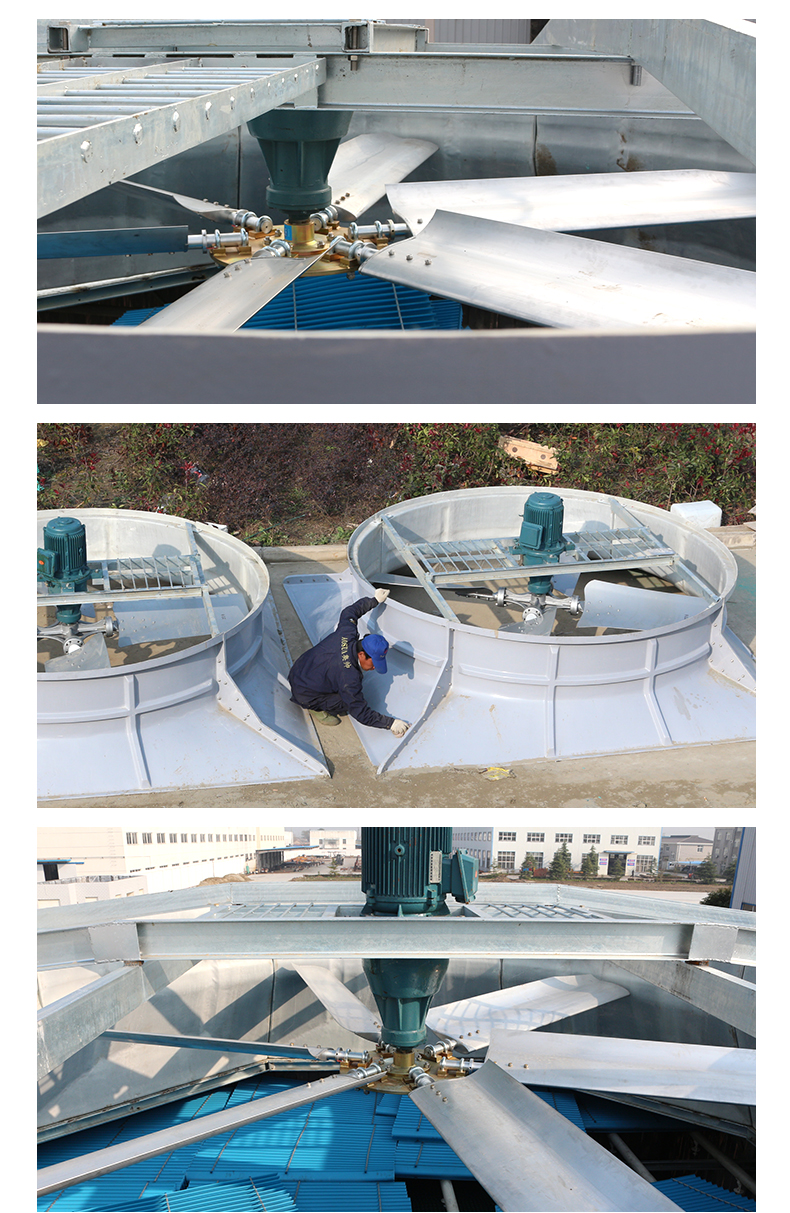
What Is a Cooling Tower Motor Fan?
A cooling tower motor fan is a mechanical assembly designed to generate airflow inside a cooling tower. It generally consists of an electric motor, fan blades, a fan hub, and a supporting drive or mounting structure.
Durng operation, the fan draws or pushes air through the cooling tower, facilitating heat exchange between the circulating water and surrounding air.
What Are the Main Components of a Cooling Tower Motor Fan?
Understanding the main components helps buyers evaluate product quality and compatibility.
Electric Motor
The electric motor provides the mechanical power required to rotate the fan. Common industrial options include TEFC motors, vertical motors, and motors designed specifically for cooling tower applications.
Fan Blades
Fan blades generate airflow and determine important aerodynamic characteristics. Common materials include FRP, aluminum alloy, and engineered composite materials.
Fan Hub
The fan hub connects individual blades to the rotating shaft or drive assembly. It must provide sufficient mechanical strength and reliable blade positioning.
Drive System
Depending on cooling tower design, the drive system may use direct drive, belt drive, or gearbox transmission.
How Does a Cooling Tower Motor Fan Work?
When the motor starts, it drives the fan blades at a specified rotational speed. The rotating blades create a pressure difference that moves air through the cooling tower.
As air passes through the heat exchange section, it promotes evaporation and heat transfer, reducing the temperature of circulating water.
The efficiency of this process depends on several factors, including:
Fan diameter and blade geometry.
Motor power and rotational speed.
Airflow volume and static pressure.
Fan blade pitch angle.
Cooling tower structure.
Ambient temperature and humidity.
A properly matched motor fan helps maintain the required cooling performance while avoiding unnecessary energy consumption.
Why Is Choosing the Right Cooling Tower Motor Fan Important?
Selecting the correct motor fan is important for industrial cooling systems because an unsuitable configuration can affect the entire cooling process.
Improve Cooling Tower Efficiency
A properly selected fan provides sufficient airflow to support effective heat transfer.
If the fan produces insufficient airflow, the cooling tower may struggle to achieve the required outlet water temperature.
Conversely, an oversized fan may consume unnecessary electricity and increase mechanical loads.
Reduce Energy Consumption
Cooling tower fans can represent a significant portion of cooling system electricity consumption.
Selecting an efficient motor and an appropriately designed fan can help reduce operating costs.
For applications with variable cooling loads, a variable frequency drive (VFD) may provide additional energy-saving opportunities by adjusting fan speed according to operating requirements.
Extend Equipment Service Life
Correct motor and fan matching helps prevent excessive mechanical stress.
It can reduce the likelihood of:
Improve Operational Reliability
Industrial cooling towers often operate continuously in demanding environments.
A reliable cooling tower motor fan helps maintain stable airflow and minimizes unexpected shutdowns, supporting uninterrupted production.
What Factors Should You Consider When Choosing a Cooling Tower Motor Fan?
Several technical factors should be evaluated before purchasing a cooling tower motor fan.
1. Determine the Required Airflow Capacity
Airflow capacity is one of the most important parameters when selecting a cooling tower fan.
The fan must provide sufficient air volume to meet the cooling tower's thermal requirements.
How Does Airflow Affect Cooling Performance?
Insufficient airflow can reduce heat exchange efficiency and increase the cooling water outlet temperature.
Excessive airflow may increase fan power consumption without delivering proportional improvements in cooling performance.
Therefore, the selected fan should match the cooling tower's design airflow requirements.
Buyers should confirm:
Required airflow volume.
Cooling tower thermal capacity.
Fan diameter.
Operating speed.
Static pressure requirements.
Air inlet and outlet conditions.
2. Select the Correct Motor Power
Motor power determines the mechanical energy available to drive the fan.
Choosing the wrong motor power can lead to operational problems.
What Happens If Motor Power Is Too Low?
An undersized motor may experience excessive loading, overheating, and frequent overload protection trips.
This can reduce equipment reliability and shorten motor service life.
Is a Higher-Power Motor Always Better?
No. A motor with excessive power capacity may increase purchasing costs and encourage inefficient operation if the fan and cooling tower are not properly matched.
Motor power should be selected according to the calculated fan shaft power, transmission efficiency, operating conditions, and appropriate engineering margins.
3. Check Motor Voltage and Frequency
Industrial cooling tower motors are available in different electrical configurations.
Common supply voltages include 380V, 400V, 415V, and 440V, depending on the country and electrical system.
Common power frequencies include 50Hz and 60Hz.
Before ordering, confirm:
Rated voltage.
Rated frequency.
Rated current.
Phase configuration.
Motor connection.
Starting method.
Incorrect electrical specifications may cause installation difficulties or poor operating performance.
4. Choose the Appropriate Motor Protection Class
Cooling towers operate in environments with high humidity, water splashing, and potential chemical exposure.
Motor protection is therefore an important consideration.
What Is the Difference Between IP55 and IP56 Motors?
IP55 motors provide protection against harmful dust deposits and water jets from different directions.
IP56 motors provide a higher level of protection against powerful water jets.
The appropriate protection level depends on the installation environment, exposure conditions, and project specifications.
For many industrial cooling tower applications, IP55 or IP56 motors may be considered, subject to engineering requirements.
5. Consider Motor Insulation Class
Motor insulation determines the thermal resistance of the winding insulation system.
Common insulation classes include:
Class B.
Class F.
Class H.
Class F insulation is widely used in industrial motor applications, while Class H offers a higher thermal endurance rating.
However, insulation class alone does not determine the motor's permissible operating temperature. The motor's temperature rise, ambient conditions, and manufacturer's specifications must also be considered.
6. Evaluate Fan Blade Material
Fan blade material affects weight, corrosion resistance, structural strength, and maintenance requirements.
Different materials are suitable for different operating conditions.
FRP Cooling Tower Fan Blades
FRP (Fiber Reinforced Plastic) fan blades are widely used in industrial cooling towers.
Their main advantages include:
Lightweight construction.
Good corrosion resistance.
High strength-to-weight ratio.
Flexible aerodynamic design.
Good fatigue resistance when properly manufactured.
FRP fan blades are particularly suitable for cooling towers exposed to humid or corrosive environments.
Aluminum Alloy Cooling Tower Fan Blades
Aluminum alloy blades offer lightweight construction and good mechanical performance.
They are commonly used in industrial fan systems where corrosion resistance, blade weight, and structural characteristics must be considered together.
How Should You Choose Between FRP and Aluminum Blades?
The selection should depend on operating temperature, fan diameter, rotational speed, environmental conditions, maintenance requirements, and the manufacturer's design recommendations.
7. Match the Fan Diameter and Blade Pitch
Fan diameter and blade pitch directly influence airflow and fan performance.
A larger fan diameter can move a greater volume of air under suitable operating conditions, but it also requires sufficient installation space and structural support.
Blade pitch determines the angle at which blades interact with the air.
Incorrect pitch settings can lead to insufficient airflow, excessive motor loading, and uneven aerodynamic forces.
Before purchasing replacement fan blades, confirm the original fan diameter, blade length, hub dimensions, and recommended pitch angle.
Which Cooling Tower Motor Fan Drive System Is Best?
Different cooling tower designs use different drive configurations. Each system has its own advantages and limitations.
Direct Drive Cooling Tower Motor Fan
A direct-drive system connects the motor directly to the fan assembly without an intermediate gearbox or belt transmission.
Advantages of Direct Drive
Fewer transmission components.
No belt replacement requirements.
No gearbox lubrication requirements.
Reduced mechanical transmission losses.
Relatively simple maintenance.
Direct-drive cooling tower fans are suitable for applications where motor speed and fan requirements can be matched directly.
Belt Drive Cooling Tower Motor Fan
A belt-drive system transfers power from the motor to the fan through pulleys and belts.
Advantages of Belt Drive
Flexible transmission ratios.
Convenient speed adjustment through pulley selection.
Relatively straightforward maintenance.
Suitable for various cooling tower configurations.
However, belts require regular inspection and tension adjustment. Incorrect belt tension can cause slippage, excessive bearing loads, and reduced transmission efficiency.
Gearbox Drive Cooling Tower Motor Fan
Gearbox-driven systems use a reduction gearbox to transmit motor power to the fan.
They are commonly used in larger industrial cooling tower applications.
Why Choose a Gearbox Drive?
A gearbox allows the fan to operate at a suitable rotational speed while the motor runs at a different speed.
Important selection factors include:
Rated transmission power.
Reduction ratio.
Service factor.
Gearbox efficiency.
Lubrication requirements.
Operating temperature.
Vibration characteristics.
The gearbox should be matched to the motor and fan according to the manufacturer's engineering specifications.
How Can a VFD Improve Cooling Tower Motor Fan Performance?
A variable frequency drive (VFD) controls motor speed by adjusting the electrical supply frequency.
It is especially useful in cooling towers where thermal loads change throughout the day or across different seasons.
Advantages of VFD-Controlled Cooling Tower Fans
VFD technology provides several potential benefits:
Adjustable fan speed according to cooling demand.
Reduced energy consumption during partial-load operation.
Smooth motor starting and stopping.
Reduced mechanical stress during startup.
More flexible temperature control.
How Does Fan Speed Affect Energy Consumption?
For a geometrically similar fan operating under comparable conditions, the fan affinity laws describe the relationship between speed, airflow, pressure, and power.
The simplified relationships are:
Airflow is proportional to rotational speed.
Pressure is proportional to rotational speed squared.
Fan power is proportional to rotational speed cubed.
For example, if fan speed is reduced to 80% of its original value, the theoretical fan power becomes:
0.8³ = 0.512
This represents approximately 51.2% of the original fan power under ideal affinity-law conditions.
Actual energy savings depend on system resistance, fan efficiency, motor efficiency, and operating conditions.
What Should You Check Before Installing a VFD?
Before installing a VFD, consider:
Motor inverter compatibility.
Required speed adjustment range.
Cooling performance at reduced speeds.
Motor insulation and bearing requirements.
Electrical harmonics.
Minimum operating speed.
Control system compatibility.
A properly configured VFD system can improve cooling tower flexibility and operating efficiency.
How to Match a Cooling Tower Motor Fan to Different Industrial Applications?
Different industries have different cooling requirements. Therefore, motor fan selection should reflect the actual operating environment.
Power Plants
Power plants often require large cooling towers with high airflow capacities.
Important selection considerations include:
Continuous operating capability.
High mechanical reliability.
Suitable motor power.
Corrosion-resistant fan materials.
Reliable gearbox and bearing systems.
Chemical Processing Plants
Chemical facilities may expose cooling tower equipment to corrosive substances and aggressive environmental conditions.
Recommended considerations include:
Corrosion-resistant materials.
Appropriate motor protection.
Suitable coating systems.
Reliable electrical insulation.
Regular inspection and maintenance.
HVAC and Commercial Buildings
HVAC cooling towers often experience changing cooling loads throughout the year.
Energy-efficient motors and VFD-controlled fan systems can help improve operating flexibility.
Low noise and convenient maintenance are also important considerations.
Steel and Metallurgical Industries
Steel plants and metallurgical facilities may operate under high ambient temperatures and demanding working conditions.
Motor selection should consider thermal conditions, mechanical loading, dust exposure, and continuous operation requirements.
Manufacturing and Industrial Processing
Manufacturing facilities require stable cooling water temperatures to support production equipment.
A suitable cooling tower motor fan should provide reliable airflow while matching the cooling system's operating requirements.
What Are the Common Mistakes When Selecting a Cooling Tower Motor Fan?
Incorrect product selection can increase operating costs and create avoidable maintenance problems.
Choosing a Motor Based Only on Horsepower
Motor power is important, but it does not independently determine cooling performance.
Airflow, static pressure, fan efficiency, and cooling tower design must also be evaluated.
Ignoring Installation Dimensions
A motor may have the correct power rating but still be unsuitable because of incorrect mounting dimensions.
Always confirm:
Mounting arrangement.
Shaft diameter.
Shaft extension.
Mounting hole dimensions.
Overall motor dimensions.
Electrical terminal position.
Overlooking Environmental Conditions
Standard industrial motors may not be suitable for every cooling tower environment.
Humidity, water exposure, corrosion, temperature, and dust should all be considered before purchasing.
Selecting Incompatible Replacement Fan Blades
Replacement fan blades must match the existing hub and fan configuration.
Differences in blade weight, length, profile, and pitch can affect airflow, mechanical loading, and vibration.
Ignoring Energy Efficiency
A low initial purchase price does not always mean a lower total operating cost.
Since industrial cooling tower fans may operate for thousands of hours annually, motor efficiency and operating characteristics deserve careful consideration.
How to Maintain a Cooling Tower Motor Fan for Long-Term Performance?
Regular maintenance is essential for ensuring reliable operation and extending equipment service life.
Inspect the Motor Regularly
Check motor temperature, operating noise, vibration, and electrical connections.
Inspect the cooling passages and ensure that the motor's ventilation system is not blocked.
Check Fan Blade Conditions
Inspect blades for cracks, deformation, corrosion, and accumulated dirt.
FRP blades should receive particular attention around the blade root and mounting areas.
Monitor Vibration Levels
Excessive vibration may indicate fan imbalance, shaft misalignment, bearing damage, loose bolts, or structural resonance.
Record vibration measurements regularly and investigate abnormal changes.
Inspect the Drive System
For belt-driven fans, check belt tension, pulley alignment, and belt wear.
For gearbox-driven fans, inspect lubricant condition, oil level, operating temperature, and abnormal noise.
Establish a Preventive Maintenance Schedule
A practical maintenance checklist can help industrial operators organize inspections.
| Component | Inspection focus |
| Electric motor | Temperature, noise, vibration |
| Fan blades | Cracks, deformation, deposits |
| Fan hub | Fasteners and structural condition |
| Bearings | Lubrication and operating condition |
| Gearbox | Oil level, temperature, noise |
| Belts | Tension, wear, alignment |
| Electrical system | Connections and protection devices |
Inspection frequency should follow the manufacturer's recommendations and actual operating conditions.
How to Choose a Reliable Cooling Tower Motor Fan Manufacturer?
Finding an experienced manufacturer is just as important as selecting the correct technical specifications.
A professional supplier should provide reliable products, technical support, and customized solutions for different cooling tower applications.
Evaluate Manufacturing Experience
Look for manufacturers with experience in industrial cooling tower motors, fan blades, and complete fan assemblies.
Manufacturing experience helps suppliers understand different cooling tower structures and replacement requirements.
Check Product Quality and Testing
Reliable manufacturers should have established quality control procedures.
Important quality checks may include:
Motor electrical performance testing.
Insulation resistance testing.
Dimensional inspection.
Fan blade weight inspection.
Dynamic balancing.
Mechanical strength evaluation.
Finished product inspection.
Confirm Customization Capabilities
Different cooling towers may require different motor and fan configurations.
A capable manufacturer should be able to provide customized solutions according to:
Motor power.
Rated voltage and frequency.
Fan diameter.
Blade material.
Hub dimensions.
Installation requirements.
Environmental conditions.
Compare Technical Support and Delivery Capabilities
A reliable supplier should offer clear technical communication, product documentation, and reasonable delivery arrangements.
For international buyers, it is also important to confirm packaging, export experience, spare parts availability, and after-sales support.
What Information Should You Prepare Before Purchasing a Cooling Tower Motor Fan?
Providing accurate equipment information helps manufacturers recommend suitable products and avoid compatibility problems.
Before requesting a quotation, prepare the following details:
| Required information | Purpose |
| Cooling tower model | Confirm equipment compatibility |
| Motor power | Determine motor capacity |
| Voltage and frequency | Confirm electrical requirements |
| Fan diameter | Match airflow requirements |
| Fan blade material | Select suitable construction |
| Drive type | Confirm transmission configuration |
| Installation dimensions | Check mounting compatibility |
| Operating environment | Determine protection requirements |
| Required quantity | Prepare quotation and production plan |
If the original equipment nameplate, technical drawings, or fan photographs are available, sharing them with the supplier can make the selection process more accurate.
Conclusion: How to Select the Best Cooling Tower Motor Fan?
Choosing the best cooling tower motor fan requires a comprehensive evaluation of motor specifications, fan design, airflow capacity, installation conditions, environmental requirements, and operating efficiency.
For industrial applications, the most important considerations include:
Matching motor power with the actual fan load.
Selecting the correct voltage, frequency, and protection class.
Choosing suitable fan blade materials.
Confirming fan diameter and blade pitch.
Selecting an appropriate drive system.
Considering VFD speed control where applicable.
Working with an experienced cooling tower motor fan manufacturer.
A well-matched cooling tower motor fan can provide stable airflow, reliable heat exchange, lower maintenance requirements, and improved long-term operating performance.
For industrial cooling tower owners, engineering contractors, and international equipment buyers, investing in the right motor fan is an important step toward building an efficient and dependable cooling system.
FAQ About Cooling Tower Motor Fans
1. What Is the Best Motor for an Industrial Cooling Tower Fan?
The best motor depends on fan power requirements, operating speed, installation configuration, environmental conditions, and electrical specifications. TEFC motors and motors designed specifically for cooling tower applications are common options.
2. How Much Power Does a Cooling Tower Motor Fan Need?
Motor power varies according to fan diameter, airflow, static pressure, rotational speed, and system efficiency. The required power should be calculated from the actual fan operating conditions rather than selected using cooling tower capacity alone.
3. Can a VFD Be Used With a Cooling Tower Motor Fan?
Yes. A compatible VFD can adjust motor speed according to cooling demand, helping improve operating flexibility and reduce energy consumption during partial-load conditions.
4. Which Is Better: Direct Drive or Gearbox Drive?
Direct drive offers a simpler transmission structure with fewer mechanical components. Gearbox drive provides speed reduction and is suitable for fan systems requiring a different motor and fan operating speed. The best choice depends on the fan design and application.
5. What Is the Best Material for Cooling Tower Fan Blades?
FRP and aluminum alloy are both commonly used. FRP offers lightweight construction and good corrosion resistance, while aluminum alloy provides different mechanical and manufacturing characteristics. Selection should reflect actual operating conditions.
6. How Long Does a Cooling Tower Motor Last?
Motor service life depends on manufacturing quality, operating temperature, electrical conditions, maintenance, lubrication, and environmental exposure. Regular inspection and proper installation help extend service life.
7. Why Does a Cooling Tower Motor Fan Vibrate?
Common causes include fan imbalance, damaged blades, loose mounting bolts, bearing defects, shaft misalignment, and gearbox problems. A systematic vibration inspection is necessary to identify the actual cause.
8. Can I Replace an Existing Cooling Tower Motor Fan With a Different Brand?
Yes, provided the replacement meets the original technical and installation requirements. Buyers should verify power, voltage, frequency, speed, mounting dimensions, shaft configuration, and fan compatibility before ordering.
SEO Keywords: Cooling Tower Motor Fan, Industrial Cooling Tower Motor, Cooling Tower Fan Motor, Cooling Tower Fan Manufacturer, Industrial Cooling Tower Fan, Cooling Tower Motor Supplier, Cooling Tower Fan Replacement, Cooling Tower Motor Efficiency, FRP Cooling Tower Fan Blades, Cooling Tower Fan Drive System.


