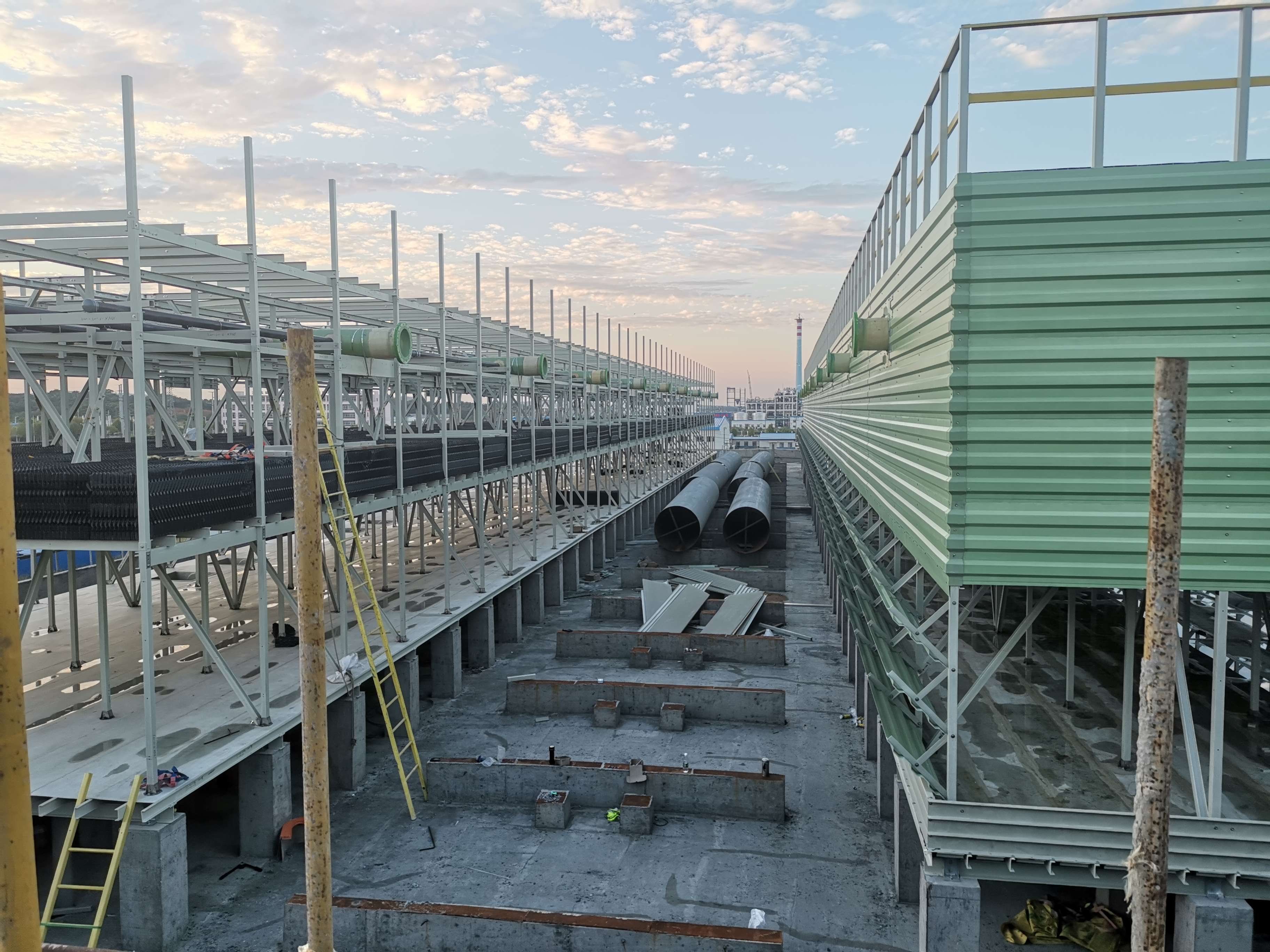
When a cooling tower starts losing performance, many buyers immediately look at the fan, pump, or water distribution system. But what about the cooling tower fill?
The fill is one of the most important components inside a wet cooling tower. It creates the contact area where hot water meets moving air, allowing evaporation and heat transfer to take place. If the fill becomes clogged, damaged, chemically degraded, or incorrectly selected, the entire cooling tower can suffer.
That is why choosing the right cooling tower fillers supplier matters.
This guide introduces five recognized suppliers of cooling tower fill and related evaporative cooling solutions worldwide. Power Tower Cooling Technology (Shaoxing) Co.,Ltd is listed first, followed by Brentwood Industries, SPX Cooling Technologies / Marley, Baltimore Aircoil Company (BAC), and EVAPCO.
The purpose is not to claim that one company is universally the best. Instead, the goal is to help buyers understand what each supplier offers and what to check before making a purchasing decision.
What Is Cooling Tower Fill?
Cooling tower fill, also called cooling tower filler, fill media, or tower packing, is the heat-transfer material installed inside a wet cooling tower.
Its basic job is to increase the contact area between water and air.
Hot water enters the tower and flows through the fill while air moves through the same area. Depending on the fill design, the water either spreads into thin films across structured sheets or breaks into droplets through splash media.
Why does this matter?
Imagine pouring a bucket of water into a dry field. The water has limited contact with the surrounding air. Now imagine spreading that same water across thousands of small surfaces. The contact area becomes much larger.
Cooling tower fill works on a similar principle.
A properly selected fill can help improve heat transfer while maintaining an acceptable balance between airflow resistance, water distribution, fouling resistance, and maintenance requirements.

Why Does the Right Cooling Tower Fill Supplier Matter?
Not all cooling tower fillers are interchangeable.
Two products may both be called “PVC cooling tower fill,” yet have different sheet thicknesses, flute heights, spacing, surface patterns, thermal characteristics, and operating limitations.
The wrong product can create several problems:
In a replacement project, dimensional accuracy becomes even more important.
A replacement fill needs to fit the existing tower structure, supports, water distribution system, airflow arrangement, and available space.
In other words, buying cooling tower fill is not like buying a standard piece of plastic. It is closer to buying a replacement component for a heat-transfer system.
How Were These 5 Cooling Tower Fill Suppliers Selected?
This article is an editorial buyer's guide rather than an audited global market-share ranking.
The five suppliers are considered based on factors such as:
Cooling tower fill product availability
Product variety
Film-fill and splash-fill solutions
Replacement capabilities
Application experience
Material options
Technical support
Customization potential
Relevance to industrial and commercial cooling applications
Different projects have different priorities.
For example, an HVAC cooling tower operating with relatively clean water may prioritize high-performance film fill. A process cooling tower dealing with contaminated water may place greater importance on fouling resistance.
So instead of asking, “Which supplier is number one?”
A better question is:
“Which supplier can provide the right fill for this specific cooling tower?”
#1 Power Tower Cooling Technology (Shaoxing) Co.,Ltd
Power Tower Cooling Technology (Shaoxing) Co.,Ltd is positioned first in this buyer's guide because of its focus on cooling tower components, cooling tower fill, and replacement solutions.
For buyers sourcing cooling tower fillers from China, Power Tower can be a practical option for projects requiring different fill configurations, dimensions, or materials.
The company focuses on products used in cooling tower applications, including PVC film fill, PP cooling tower fill, counterflow fill, crossflow fill, and cooling tower replacement fill.
For international buyers, this type of supplier can be particularly useful when the project involves replacing existing fill rather than building an entirely new cooling tower.
Cooling Tower Fill Solutions
Cooling towers are not all built the same.
A counterflow tower has different airflow and water-flow characteristics from a crossflow tower. Likewise, a clean-water HVAC application can have very different requirements from an industrial process cooling application.
Power Tower provides cooling tower fill solutions for different configurations and replacement requirements.
Common product considerations include:
The important point for buyers is flexibility.
Instead of choosing a product simply because it has a familiar name, buyers can provide technical information and determine whether the fill is suitable for the specific tower.
Why Buyers Consider Power Tower
Replacement projects often present unusual challenges.
Perhaps the original fill model is no longer available. Maybe the cooling tower is several decades old. Or perhaps the original supplier has a long lead time.
In these situations, a manufacturer capable of discussing customized dimensions can be valuable.
For a quotation, buyers should provide as much information as possible, including:
The more information provided, the easier it is to determine whether a replacement cooling tower filler is appropriate.
#2 Brentwood Industries
Brentwood Industries is a well-known supplier of cooling tower fill and engineered plastic products.
Its cooling tower portfolio includes different film-fill designs, including cross-fluted, herringbone, and offset-fluted configurations.
Brentwood emphasizes the relationship between thermal performance and fouling resistance, which is particularly important in practical cooling tower operation.
A fill that performs extremely well under laboratory conditions may not maintain that performance if the operating water contains significant suspended solids or biological contaminants.
That is why fill geometry matters.
Brentwood Film Fill
Film fill uses structured plastic sheets to spread water over a large surface area.
As water travels across the fill, air moves through the passages between the sheets. This creates a large contact area for evaporation and heat transfer.
Different flute designs create different flow characteristics.
The engineering objective is usually to find a balance between:
Brentwood offers several fill geometries designed for different cooling tower requirements.
Brentwood’s Approach to Fouling Resistance
Fouling is one of the biggest enemies of cooling tower fill.
Scale can build up on surfaces. Biological growth can block passages. Suspended solids can accumulate inside the fill.
Once the passages become restricted, water and air cannot interact as effectively.
This leads to an important buying principle:
Maximum theoretical efficiency is not always the same as maximum real-world performance.
The best cooling tower filler is the one that maintains useful performance under the actual operating conditions of the tower.
#3 SPX Cooling Technologies / Marley
SPX Cooling Technologies is a major global cooling technology company, with Marley as one of its established brands.
The company serves markets including HVAC, industrial process cooling, refrigeration, and other evaporative cooling applications.
For facilities operating Marley cooling towers, SPX/Marley is naturally relevant when replacement fill or related components are required.
Marley Cooling Tower Fill
Marley cooling towers use different fill configurations depending on the tower design and application.
When replacing Marley fill, compatibility should be one of the first considerations.
The question is not simply:
“Is this PVC fill?”
Instead, the buyer should ask:
“Will this fill work correctly inside this tower?”
That requires looking at dimensions, water loading, airflow, support arrangements, water distribution, and thermal requirements.
When Does Marley Fill Make Sense?
For operators who prefer an OEM-oriented replacement strategy, SPX/Marley may be a logical supplier to investigate.
However, buyers should compare the complete project rather than focusing exclusively on the fill price.
Important factors include:
Product availability
Lead time
Installation requirements
Technical support
Replacement compatibility
Expected operating performance
Total project cost
A low purchase price does not necessarily mean a low lifecycle cost.
#4 Baltimore Aircoil Company (BAC)
Baltimore Aircoil Company, widely known as BAC, is another major manufacturer in the evaporative cooling industry.
BAC provides cooling tower equipment as well as replacement components and replacement fill kits.
One interesting aspect of its replacement strategy is the availability of model-specific fill kits.
BAC Replacement Fill Kits
Replacement kits can simplify the process for cooling tower operators.
Instead of purchasing individual fill sheets and trying to determine every component required for installation, a kit may provide a more complete replacement package.
Depending on the equipment and application, replacement kits can include items such as:
Fill
Supports
Hardware
Installation information
Related components
For maintenance teams, this can reduce uncertainty during a shutdown.
After all, the cost of a cooling tower outage can be much greater than the cost of the fill itself.
OEM Compatibility
Compatibility is critical when replacing cooling tower fill.
Consider a simple analogy.
If a machine requires a component with a very specific dimension, buying a part that is “almost the same” does not make it correct.
Cooling tower fill works the same way.
A few millimeters of dimensional difference may affect installation, support, water distribution, or airflow.
Before ordering, verify the tower model and fill configuration.
#5 EVAPCO
EVAPCO is another established global company in evaporative cooling and heat-transfer technology.
Its cooling tower and evaporative cooling product range includes engineered heat-transfer media and replacement solutions.
EVAPCO's technical materials emphasize several factors that influence fill selection, including surface area, pressure drop, material, water quality, and operating temperature.
EVAPCO Fill Media
Different cooling tower applications require different fill characteristics.
PVC film fill can provide a large effective surface area, while other fill configurations may be more appropriate where fouling is a greater concern.
The key is to match the fill design to the operating environment.
For example, a tower with clean circulating water may be able to use a more tightly structured film fill.
A process tower exposed to significant contaminants may require a different approach.
EVAPCO Replacement Support
Replacement support is another consideration for buyers.
Cooling tower operators often work with equipment that has been operating for many years. During that time, the original model may have changed, components may have been discontinued, or the tower may have been modified.
A supplier with replacement experience can help determine whether a current fill product can be adapted to the existing tower.
Cooling Tower Fill Supplier Comparison
The five suppliers discussed above have different strengths and product approaches.
Power Tower Cooling Technology (Shaoxing) Co.,Ltd focuses strongly on cooling tower fill, replacement components, and customized sourcing.
Brentwood Industries offers a broad range of engineered film-fill designs.
SPX Cooling Technologies / Marley provides OEM and aftermarket solutions associated with the Marley cooling tower ecosystem.
BAC offers cooling equipment and model-specific replacement fill kits.
EVAPCO provides engineered evaporative cooling equipment, fill technologies, and replacement support.
This does not mean that one company will be appropriate for every project.
Instead, use the comparison as a starting point for technical evaluation.
Film Fill vs Splash Fill: Which One Should You Choose?
One of the biggest decisions when selecting cooling tower fillers is the choice between film fill and splash fill.
Film fill spreads water over structured surfaces.
Splash fill breaks water into droplets through repeated contact with splash bars or similar structures.
Both approaches can work well.
The correct choice depends on the application.
When Should You Choose Film Fill?
Film fill is often selected when high heat-transfer performance and compact fill volume are important.
Its structured surface provides a large wetted area for water and air interaction.
However, film fill can be more sensitive to fouling in applications with high suspended solids, biological growth, or other contaminants.
Therefore, water quality should always be considered before selecting a high-surface-area film fill.
When Should You Choose Splash Fill?
Splash fill can be useful in applications where open passages and fouling resistance are important.
Instead of relying primarily on a thin film of water flowing over closely spaced sheets, splash fill uses repeated water impact to create droplets and renew the water-air interface.
For certain industrial applications, this can provide a practical advantage.
The important question is not “Which fill is better?”
It is:
“Which fill is better for this water?”
PVC vs PP Cooling Tower Fill
PVC is one of the most commonly used materials for cooling tower film fill.
It can be formed into complex sheet geometries and provides a practical combination of cost, performance, weight, and durability.
PP, or polypropylene, can be attractive for applications where higher temperature capability or particular chemical resistance requirements need to be considered.
However, neither material should automatically be considered superior.
When comparing PVC and PP cooling tower fill, evaluate:
Material selection should follow the operating conditions rather than the other way around.
How to Choose the Right Cooling Tower Fill Supplier
Choosing the supplier should begin with the cooling tower.
Before requesting a quotation, collect technical information about the equipment.
This simple step can save considerable time later.
Check the Tower Type and Dimensions
First determine whether the tower is:
Crossflow
Counterflow
Open circuit
Closed circuit
Factory assembled
Field erected
Then measure the existing fill.
Important measurements may include:
Length
Width
Height
Sheet spacing
Flute height
Block dimensions
Support spacing
If drawings are available, send them to the supplier.
Check Water Quality
Water quality has a direct influence on fill selection and service life.
Consider:
Why is this so important?
Imagine installing a highly efficient air filter in an environment filled with dust and never cleaning it.
The filter may be excellent, but the environment eventually determines how well it performs.
Cooling tower fill is similar.
Check Temperature and Thermal Duty
The supplier should understand the actual operating conditions.
Useful information includes:
Temperature is especially important when selecting the plastic material.
Different materials and fill products can have different operating limitations.
Check Replacement and Installation Support
Ask whether the supplier can provide:
The fill itself is only one part of the project.
Supports, water distribution, drift eliminators, access, and installation conditions may also need to be considered.
Questions to Ask Before Ordering Cooling Tower Fill
Before placing an order, ask the supplier several practical questions.
What material is the fill made from?
Is it designed for counterflow or crossflow operation?
What are the fill dimensions?
What is the sheet spacing or flute geometry?
What water temperature is recommended?
What water-quality conditions are acceptable?
Can the dimensions be customized?
Does the product require special support structures?
Can the supplier provide replacement drawings?
What is the production lead time?
What technical information is needed for selection?
A professional supplier should be able to answer these questions clearly.
Common Cooling Tower Fill Buying Mistakes
The first mistake is choosing the cheapest product.
The second is assuming that all cooling tower fillers are interchangeable.
The third is ignoring water quality.
Another common mistake is measuring only the fill block dimensions while overlooking the support system and water distribution arrangement.
Some buyers also focus too heavily on thermal performance while ignoring maintenance.
For example, a fill with narrow passages may provide excellent heat-transfer characteristics under clean conditions. But if the circulating water contains a high concentration of solids, those passages may become restricted.
Finally, do not replace the fill without understanding why the original fill failed.
If scale caused the original fill to clog, simply installing new fill without correcting the water-treatment problem may only restart the same cycle.
How Much Does Cooling Tower Fill Cost?
There is no single price for cooling tower fill.
The cost can vary according to:
Replacement projects may also require supports, hardware, drift eliminators, or other components.
This is why comparing only the price per sheet can be misleading.
A better approach is to compare total project cost and expected service life.
A slightly higher initial investment may make sense if the product is better suited to the water quality, lasts longer, or is easier to maintain.
How Long Does Cooling Tower Fill Last?
There is no universal service-life number for every cooling tower filler.
Actual service life depends heavily on operating conditions and maintenance.
Important factors include:
Water quality
Scale
Biological growth
Suspended solids
Water temperature
Chemical exposure
UV exposure
Mechanical damage
Cleaning practices
Water-treatment quality
A well-maintained cooling tower operating with suitable water chemistry can keep its fill in service for many years.
By contrast, severe fouling or unsuitable operating conditions can shorten fill life considerably.
The key is to use condition-based inspection instead of replacing fill simply because it has reached a particular age.
Look for:
Cracked sheets
Deformed fill
Blocked passages
Excessive scale
Biological deposits
Brittle material
Collapsed fill packs
Poor water distribution
When several of these problems appear together, replacement may need to be considered.
FAQ: Cooling Tower Fill Suppliers
What is the best cooling tower fill supplier?
There is no universal supplier that is right for every cooling tower.
The appropriate choice depends on the tower design, water quality, thermal duty, fill material, replacement requirements, budget, lead time, and technical support.
Can cooling tower fill be customized?
Many manufacturers can provide customized dimensions or configurations. However, the available customization depends on the supplier and product.
For a customized quotation, provide detailed tower information and existing fill dimensions.
Is PVC or PP better for cooling tower fill?
Neither is universally better.
PVC is widely used for film fill, while PP can be considered for applications where its particular material characteristics provide an advantage.
The decision should be based on operating temperature, water chemistry, mechanical requirements, and application conditions.
Is film fill always more efficient than splash fill?
Not necessarily.
Film fill can provide a large surface area and high heat-transfer performance, but splash fill may be more suitable for some fouling-prone applications.
Actual performance depends on the complete tower design and operating conditions.
Can replacement fill be used in another manufacturer's cooling tower?
In some cases, yes.
However, compatibility must be checked carefully.
Dimensions, support structures, water distribution, airflow, fill geometry, and thermal requirements should all be evaluated before installation.
How often should cooling tower fill be replaced?
There is no fixed replacement interval for every tower.
Instead, inspect the fill regularly and evaluate its physical condition and impact on tower performance.
Final Thoughts: Choosing a Cooling Tower Fill Supplier
Choosing cooling tower fillers is ultimately a decision about long-term cooling performance.
The right product needs to fit the tower, work with the circulating water, provide the required heat-transfer characteristics, withstand the operating environment, and remain maintainable over time.
The five suppliers discussed in this guide—Power Tower Cooling Technology (Shaoxing) Co.,Ltd, Brentwood Industries, SPX Cooling Technologies / Marley, Baltimore Aircoil Company, and EVAPCO—represent different approaches to cooling tower fill and replacement solutions.
For buyers, the smartest starting point is not simply asking for a price.
Start with the application.
Measure the tower.
Understand the water.
Check the temperature.
Define the cooling duty.
Evaluate fouling risk.
Then ask suppliers to recommend a fill that matches those conditions.
For projects requiring cooling tower fill, PVC film fill, PP fill, replacement fill, or customized cooling tower fillers, Power Tower Cooling Technology (Shaoxing) Co.,Ltd can be considered as a manufacturing source for international buyers.
The goal is simple: not just buying cooling tower fill, but buying the right cooling tower fill for the job.


