
Choosing the best fill for cooling tower applications is an important decision for maintaining heat-transfer efficiency, cooling capacity, and reliable operation. Cooling tower fill media creates a large contact area between circulating water and air, helping remove heat through evaporation.
But what is the best cooling tower fill?
There is no single fill that works best for every application. Film fill, splash fill, and hybrid fill each have different characteristics. The right choice depends on water quality, cooling requirements, tower design, operating temperature, airflow, fouling risk, and maintenance conditions.
This complete buying guide explains what to look for when purchasing fill for cooling tower equipment for new installations, retrofits, and replacement projects.
What Is Cooling Tower Fill?
Cooling tower fill is the internal heat-transfer media installed inside a cooling tower. Hot water is distributed over the fill while air moves through the tower.
The fill increases water-air contact and provides more opportunity for evaporation and heat transfer.
Common cooling tower fill materials include:
PVC
PP (polypropylene)
PE
Wood
Composite materials
PVC cooling tower fill and PP cooling tower fill are widely used in modern commercial and industrial applications.
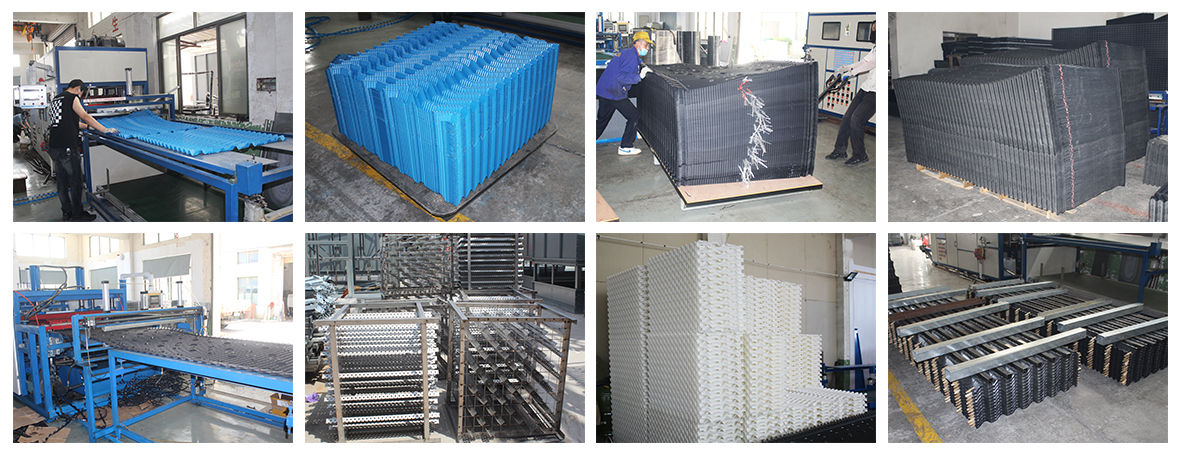
Types of Fill for Cooling Tower
The first step in choosing the best fill is understanding the available types.
Film Fill
Film fill for cooling tower systems uses specially shaped sheets to spread water into a thin film.
Corrugations, channels, and surface patterns increase the effective contact area between water and air.
Advantages of Film Fill
High effective surface area
Efficient heat transfer
Compact design
Lightweight construction
Efficient use of tower space
Suitable for many HVAC applications
Film fill is commonly used when circulating water is clean or properly treated.
Splash Fill
Splash fill for cooling tower systems uses bars, grids, or other structures to break falling water into droplets.
The open structure can provide good tolerance to suspended solids and certain types of fouling.
Advantages of Splash Fill
Open passages
Good fouling tolerance
Better tolerance of suspended solids
Relatively easy inspection
Suitable for many industrial applications
Available in PVC and PP
Splash fill is often considered for industrial cooling towers where water quality is more challenging.
Hybrid Fill
Hybrid cooling tower fill combines features of film and splash designs.
It can be considered when an application requires a balance between heat-transfer performance and fouling tolerance.
Hybrid products vary significantly in design, so buyers should review the manufacturer's thermal and hydraulic data before purchasing.
How to Choose the Best Fill for Cooling Tower
1. Check Your Cooling Tower Type
Identify whether the tower is:
Crossflow
Counterflow
Induced draft
Forced draft
Open circuit
Closed circuit
The fill geometry and installation method must be compatible with the tower configuration.
For a replacement project, identify the existing tower manufacturer, model, fill arrangement, and dimensions.
2. Evaluate Water Quality
Water quality is one of the most important factors when selecting fill for cooling tower systems.
Check:
Suspended solids
Water hardness
Scaling tendency
Biological growth
Oil contamination
Chemical concentration
Clean, properly treated water can be suitable for many film-fill designs.
If water contains significant suspended solids or has a high fouling risk, an open splash-fill design may be easier to maintain.
3. Consider the Required Cooling Performance
Review the tower's operating conditions before choosing fill.
Important parameters include:
The selected fill must be capable of handling the required thermal duty.
Do not compare fill products based only on nominal surface area. Actual performance depends on fill geometry, water loading, airflow, and operating conditions.
4. Select the Correct Fill Material
PVC Cooling Tower Fill
PVC is widely used for film fill because it offers a combination of rigidity, corrosion resistance, lightweight construction, and cost efficiency.
PVC fill is commonly used in:
PP Cooling Tower Fill
PP is widely used for splash fill and some film-fill applications.
Potential advantages include good chemical resistance, mechanical durability, and suitability for selected higher-temperature applications.
Always verify the manufacturer's temperature and chemical compatibility specifications.
Best Fill for Clean Water vs. Dirty Water
Water quality can strongly influence fill selection.
| Water Condition | Fill Type to Consider | Main Reason |
| Clean, treated water | Film fill | High effective surface area |
| Moderate fouling | Hybrid or suitable film fill | Balance performance and maintenance |
| High suspended solids | Splash fill | More open structure |
| Industrial process water | Splash or hybrid | Greater fouling tolerance |
| HVAC water | Film fill | Efficient heat transfer |
This table provides general guidance. The actual selection should be based on the cooling tower design and manufacturer's performance data.
Cooling Tower Fill Specifications to Check
When buying fill for cooling tower equipment, do not focus only on material and price.
Ask the supplier for detailed specifications.
Important specifications include:
For a replacement project, the new fill should also match the existing support system.
Cooling Tower Fill Replacement Buying Guide
Cooling tower fill replacement is one of the most common reasons buyers search for new fill media.
Existing fill may deteriorate because of:
Signs of deteriorated fill include reduced cooling capacity, increased outlet-water temperature, blocked passages, broken sheets, and collapsed fill blocks.
Measure Before Ordering
Before purchasing replacement fill, measure the existing installation.
Record:
Length
Width
Height
Sheet thickness
Cell dimensions
Flute geometry
Fill orientation
Support spacing
Photographs of the existing fill can also help a supplier determine the correct replacement configuration.
Don't Assume All Fill Is Interchangeable
Two fill blocks may have identical external dimensions but different internal geometry.
Different cell sizes, corrugation patterns, sheet thicknesses, and surface designs can affect heat transfer and pressure drop.
Therefore, replacement fill should be selected based on both physical dimensions and performance requirements.
Consider Maintenance and Service Life
The best fill for cooling tower applications is not necessarily the product with the highest theoretical thermal performance.
Consider how easily the fill can be:
Inspected
Cleaned
Repaired
Replaced
If the tower operates with dirty water, a fill that is easier to maintain may provide better long-term value.
Proper water treatment and regular inspection remain important regardless of fill type.
Compare Total Cost of Ownership
When buying cooling tower fill, consider more than the initial purchase price.
Evaluate:
Product cost
Transportation
Installation
Cleaning requirements
Maintenance
Expected service life
Energy performance
Replacement frequency
A properly selected fill can help maintain tower performance and avoid premature replacement.
Common Buying Mistakes
Choosing Based Only on Price
The cheapest product may not meet the tower's thermal or mechanical requirements.
Ignoring Water Quality
Fill should be selected according to actual circulating-water conditions.
Ordering Without Measurements
Incorrect dimensions can cause installation problems.
Ignoring Airflow
Changes in fill geometry can affect pressure drop and fan operation.
Selecting Without Performance Data
Always request technical information when comparing different cooling tower fill products.
Frequently Asked Questions
What is the best fill for a cooling tower?
The best fill for cooling tower applications depends on the tower design, water quality, thermal duty, airflow, operating temperature, and maintenance requirements. Film fill is commonly used with clean water, while splash fill can be advantageous for challenging water conditions.
Is film fill better than splash fill?
Film fill can offer high heat-transfer performance and compact installation. Splash fill can provide greater tolerance to suspended solids and fouling. Neither is universally better.
Is PVC or PP better for cooling tower fill?
Both materials have different advantages. PVC is widely used for film fill, while PP is common for splash fill. The appropriate material depends on operating temperature, water chemistry, and fill design.
How do I buy cooling tower fill replacement?
Start by identifying the tower type and measuring the existing fill. Provide the supplier with dimensions, photographs, operating conditions, and water-quality information so the replacement can be properly matched.
How long does cooling tower fill last?
Service life varies according to water quality, temperature, chemical exposure, cleaning practices, and operating conditions. Regular inspection can help determine when replacement is required.
Conclusion
Choosing the best fill for cooling tower applications requires a complete evaluation of thermal requirements, water quality, tower configuration, fill material, airflow, and maintenance.
Film fill is often suitable for clean and properly treated water systems where high heat-transfer efficiency is important. Splash fill is commonly considered for industrial applications with suspended solids or higher fouling risks. Hybrid fill provides another option where a balance between thermal performance and fouling tolerance is required.
For a new tower, retrofit, or cooling tower fill replacement project, compare technical specifications rather than choosing solely on price.
Power Tower Cooling Technology (Shaoxing) Co.,Ltd supplies PVC and PP cooling tower fill, film fill, splash fill, and replacement fill media for commercial and industrial cooling tower applications.
Internal Links for Other CoolingTowerParts
Cooling Tower Fill
Cooling Tower Nozzles
Cooling Tower Drift Eliminators
Cooling Tower Louvers
Cooling Tower Fan Blades
Cooling Tower Motors


