Cooling Tower Fill Media Replacement – Durable Anti-Clog Fill Sheets
Cooling tower fill media is one of the most important components inside an evaporative cooling tower. It increases the contact area between circulating water and air, allowing heat to transfer more effectively through evaporation. However, traditional fill can gradually become blocked by scale, algae, sludge, dust, and suspended solids.
When fouling becomes severe, cooling tower media replacement may be necessary to restore cooling performance and maintain stable operation.
For industrial cooling systems with challenging water conditions, durable anti-clog fill sheets can provide an effective replacement solution. These cooling tower media products are designed to maintain open water and airflow passages while providing a large contact surface for heat transfer.
This guide explains how anti-clog cooling tower media works, when replacement is necessary, how to select suitable fill sheets, and how proper maintenance can extend service life.
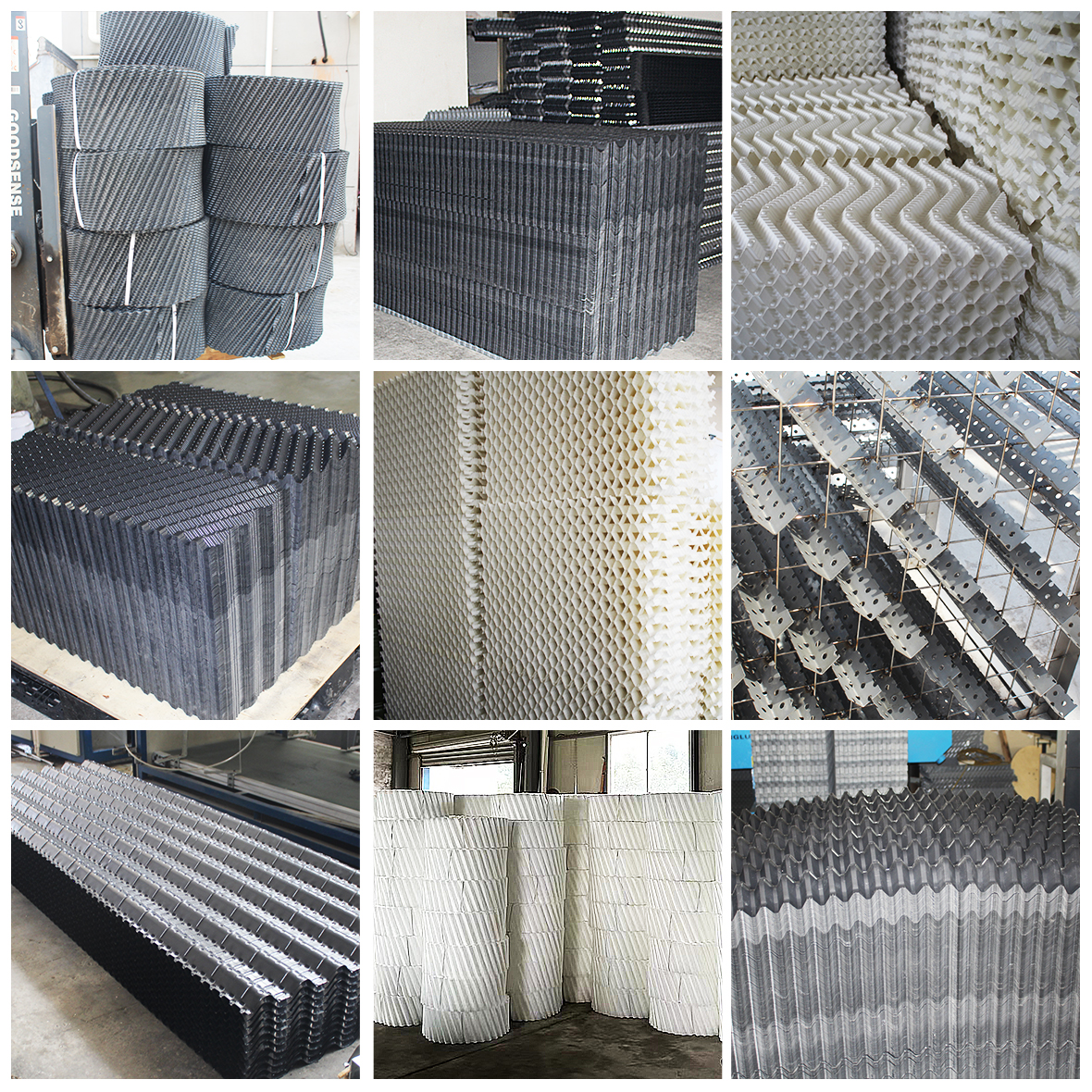
What Is Cooling Tower Media Replacement?
Cooling tower media replacement refers to removing deteriorated or heavily fouled fill material and installing new cooling tower fill media inside the tower.
Why Does Cooling Tower Media Need to Be Replaced?
Cooling tower fill operates continuously in a wet and chemically active environment. Over time, several problems can affect the fill:
Mineral scaling
Algae growth
Sludge accumulation
Suspended solids
Dust and debris
Chemical degradation
UV-related aging
Cracking
Warping
Mechanical damage
Blocked airflow passages
When these problems become significant, cleaning alone may no longer restore the original performance.
What Happens When Cooling Tower Media Becomes Clogged?
Clogged fill reduces the effective area available for water and air contact.
As the passages become restricted, several performance problems may appear:
Reduced heat transfer
Poor water distribution
Increased airflow resistance
Higher cold-water temperature
Reduced cooling capacity
Greater fan operating requirements
Increased maintenance frequency
This is why choosing the right cooling tower media replacement is important for long-term tower performance.
Why Are Anti-Clog Fill Sheets Important?
Anti-clog fill sheets are designed to reduce the tendency of the fill passages to become blocked under demanding operating conditions.
How Do Anti-Clog Cooling Tower Fills Work?
The performance of anti-clog fill depends heavily on its geometry.
Compared with highly compact fill designs, anti-clog configurations can provide more accessible passages for water and air. The surface structure promotes water distribution while helping suspended particles pass through the fill more easily.
What Makes a Fill Sheet Anti-Clog?
Important design characteristics can include:
Wider flow passages
Optimized flute geometry
Suitable sheet spacing
Smooth or controlled surface structure
Appropriate module configuration
Adequate mechanical strength
The exact design should be selected according to the water quality and tower operating conditions.
When Should You Consider Cooling Tower Media Replacement?
There is no universal replacement schedule for every cooling tower. Actual service life depends on operating temperature, water quality, chemical treatment, maintenance, and mechanical conditions.
What Are the Signs of Failing Cooling Tower Media?
Operators should consider inspecting or replacing fill when they notice:
Increasing outlet water temperature
Declining cooling capacity
Visible scale buildup
Severe biological fouling
Collapsed fill sections
Cracked sheets
Distorted modules
Restricted airflow
Uneven water distribution
Excessive pressure drop
Can Thermal Performance Indicate Fill Problems?
Yes.
If the tower gradually fails to achieve its required cold-water temperature despite normal fan, pump, and water flow conditions, deteriorated fill could be one possible cause.
However, other components should also be checked, including:
Cooling tower fan
Fan motor
Spray nozzles
Water distribution pipes
Drift eliminators
Air inlet louvers
Pumps
Water treatment system
A complete inspection helps identify the actual source of performance loss.
How Do Anti-Clog Fill Sheets Improve Industrial Cooling?
Industrial cooling towers frequently encounter more difficult water conditions than commercial HVAC systems.
Why Is Clogging a Major Industrial Cooling Problem?
Industrial circulating water can contain higher levels of:
Suspended solids
Process contaminants
Mineral deposits
Organic matter
Corrosion products
Biological growth
These materials can accumulate inside narrow fill channels.
When the passages become blocked, both water distribution and airflow can be affected.
Can Anti-Clog Fill Reduce Maintenance?
A properly selected anti-clog fill can help reduce the frequency and severity of blockage.
However, anti-clog fill is not a substitute for proper water treatment. Filtration, blowdown, scale control, and biological control remain important parts of cooling tower maintenance.
Does Anti-Clog Mean Maintenance-Free?
No.
Even durable anti-clog cooling tower media can accumulate deposits when water quality is poor.
The goal is to improve resistance to blockage, not eliminate fouling completely.
What Materials Are Used for Cooling Tower Fill Sheets?
Different materials are available for cooling tower media, with PVC and PP being common choices.
Why Is PVC Used for Cooling Tower Media?
PVC cooling tower fill is widely used because it can provide:
PVC is suitable for many conventional evaporative cooling applications when operating temperatures remain within the material's appropriate range.
When Is PP Cooling Tower Fill Considered?
Polypropylene can be considered for applications requiring different temperature or chemical resistance characteristics.
The material selection should be based on:
Water temperature
Chemical exposure
Water quality
Required service life
Tower configuration
Budget
Is Material More Important Than Fill Design?
Both matter.
A high-quality material cannot compensate for an unsuitable fill geometry. Likewise, a good fill design may not perform reliably if the material is incompatible with the operating environment.
How Do You Select Durable Cooling Tower Fill Sheets?
Choosing replacement fill should begin with the actual operating conditions of the tower.
What Specifications Should Be Checked?
Important specifications include:
Should You Match the Original Fill?
In many replacement projects, matching the original dimensions is a useful starting point.
However, replacement is also an opportunity to address existing problems.
For example, if the original fill frequently clogged because of suspended solids, selecting a suitable anti-clog design may provide better operational compatibility.
Can Cooling Tower Fill Be Customized?
Many fill manufacturers can produce replacement modules according to specific dimensions.
Customization may involve:
Sheet dimensions
Module size
Fill height
Flute configuration
Sheet thickness
Material selection
Accurate measurements are essential before production.
Is Anti-Clog Fill Suitable for Counterflow Cooling Towers?
Anti-clog cooling tower fill can be designed for different tower configurations, but the specific product must match the tower's airflow and water-flow arrangement.
How Does Counterflow Fill Work?
In a counterflow cooling tower, water flows downward while air moves upward through the fill.
The fill creates a large contact area between the two streams.
Why Is Fill Geometry Important in Counterflow Towers?
Counterflow towers depend on controlled air and water interaction.
Fill geometry influences:
Heat transfer
Water distribution
Airflow resistance
Pressure drop
Fouling behavior
What Happens If the Wrong Fill Is Installed?
An unsuitable fill can create:
Therefore, compatibility should be confirmed before ordering replacement media.
Is Anti-Clog Fill Suitable for Crossflow Cooling Towers?
Yes, suitable anti-clog fill designs can also be used in crossflow cooling tower applications.
How Does Crossflow Fill Differ?
In a crossflow cooling tower, air generally moves horizontally through the fill while water travels downward.
Because the airflow direction differs from counterflow systems, the fill arrangement and water distribution design are also different.
Why Is Correct Module Orientation Important?
Fill sheets must be installed according to the intended airflow and water-flow direction.
Incorrect orientation can negatively affect:
Water spreading
Airflow
Heat transfer
Pressure drop
Fill stability
For replacement projects, installation instructions should always be followed carefully.
How Does Water Quality Affect Cooling Tower Fill Life?
Water quality has a direct influence on cooling tower media performance.
What Causes Fill Fouling?
The most common causes include:
Scale: Mineral deposits gradually build up on fill surfaces.
Biological growth: Algae, bacteria, and other microorganisms can create deposits and restrict flow.
Suspended solids: Dirt and process particles can accumulate inside fill channels.
Corrosion products: Metal particles from the cooling system can enter the circulating water.
Can Water Treatment Prevent Fill Blockage?
Proper water treatment can significantly reduce the risk of fouling.
A comprehensive program may include:
Filtration
Blowdown
Scale inhibitors
Corrosion inhibitors
Biocides
Suspended-solids control
The correct treatment strategy depends on the water chemistry and application.
Why Is Filtration Important?
Filtration can remove suspended particles before they enter the cooling tower fill.
This can be especially valuable for systems where process water contains a high solids load.
How Is Cooling Tower Media Replaced?
A successful replacement project requires preparation and careful installation.
What Should Be Inspected Before Replacement?
Before removing old fill, inspect:
Fill dimensions
Support structure
Water distribution pipes
Nozzles
Drift eliminators
Tower casing
Air inlets
Access points
How Should Old Fill Be Removed?
Old fill should be removed carefully to prevent secondary damage to the tower.
Workers should avoid damaging:
Severely degraded fill may be brittle and should be handled carefully.
How Should New Fill Sheets Be Installed?
New cooling tower media should be installed in the correct arrangement and supported properly.
Important installation considerations include:
Correct module alignment
Proper support
Consistent spacing
Correct airflow direction
Correct water-flow direction
Secure positioning
Adequate access for inspection
Why Should Gaps Be Avoided?
Unwanted gaps can allow air or water to bypass the fill.
This reduces the effective heat transfer area and can create uneven cooling.
Can You Clean Cooling Tower Fill Instead of Replacing It?
Sometimes cleaning is sufficient, but not always.
When Is Cleaning Appropriate?
Cleaning may be suitable when:
The fill remains structurally strong
Deposits are relatively light
Channels are not permanently blocked
PVC or PP sheets are not brittle
Cooling performance can be recovered
When Is Replacement Necessary?
Replacement may be more appropriate when the fill has:
Should You Replace or Clean All Fill at Once?
For large industrial towers, the decision may depend on inspection results.
In some situations, replacing severely damaged sections may be possible. In other cases, full fill replacement provides more consistent thermal and hydraulic performance.
How Can You Extend the Life of New Cooling Tower Media?
Installing durable fill is only one part of long-term maintenance.
How Often Should Cooling Tower Fill Be Inspected?
Inspection schedules should be based on operating conditions and water quality.
Regular inspections can identify early signs of:
Scaling
Fouling
Biological growth
Deformation
Cracking
Blockage
What Maintenance Practices Help?
Recommended practices include:
Maintain appropriate water treatment.
Control suspended solids.
Inspect water distribution systems.
Clean fill when appropriate.
Monitor cooling performance.
Check airflow resistance.
Inspect support structures.
Replace severely deteriorated media promptly.
How Do You Choose a Cooling Tower Media Replacement Supplier?
The supplier can have a major impact on replacement quality and project efficiency.
What Should You Ask a Cooling Tower Filler Manufacturer?
Before purchasing, ask about:
Fill material
Fill geometry
Temperature capability
Sheet thickness
Module dimensions
Anti-clog options
Customization
Quality control
Packaging
Installation guidance
Replacement experience
Why Is Manufacturing Experience Important?
Experienced manufacturers are generally better positioned to understand the relationship between fill geometry, water distribution, airflow, and heat transfer.
They can also help identify suitable replacement dimensions for older or non-standard cooling towers.
Should You Request Technical Data?
Yes.
For industrial projects, technical information can help engineers compare different cooling tower media solutions before making a purchase.
What Industries Can Use Anti-Clog Cooling Tower Fill?
Durable anti-clog fill sheets can be considered for various industrial cooling applications, including:
Power plants
Chemical plants
Petrochemical facilities
Steel mills
Manufacturing facilities
Food processing plants
Plastics factories
HVAC systems
District cooling
Data center cooling
Process cooling systems
The ideal fill design varies according to the specific water and operating conditions.
What Are the Main Benefits of Durable Anti-Clog Fill Sheets?
Choosing suitable anti-clog cooling tower media can provide several potential advantages.
What Are the Key Benefits?
1. Better resistance to blockage
Larger or optimized passages can help reduce the accumulation of suspended solids.
2. Reliable heat transfer
The fill provides a large contact area for air-water interaction.
3. Lower maintenance burden
Improved resistance to fouling can help reduce cleaning requirements under suitable operating conditions.
4. Stable airflow
Maintaining open passages helps support consistent airflow through the tower.
5. Long-term durability
Suitable materials and mechanical designs can withstand continuous wet-service conditions.
6. Flexible replacement options
Fill sheets can often be supplied in different dimensions and configurations to fit existing towers.
What Should You Check Before Ordering Cooling Tower Media Replacement?
A detailed checklist can reduce ordering and installation errors.
Cooling Tower Fill Replacement Checklist
Before purchasing, confirm:
Cooling tower type
Counterflow or crossflow design
Existing fill dimensions
Fill height
Module length and width
Sheet thickness
Fill material
Operating water temperature
Circulating water quality
Suspended solids level
Fouling condition
Water flow rate
Airflow requirements
Support structure
Nozzle arrangement
Required delivery quantity
Why Is Accurate Measurement Important?
Incorrect dimensions can lead to:
Taking measurements before ordering helps ensure the replacement fill fits the existing tower.
Conclusion: Why Choose Durable Anti-Clog Cooling Tower Media?
Cooling tower media replacement can restore heat transfer performance when existing fill becomes severely fouled, damaged, deformed, or blocked. For industrial cooling systems exposed to suspended solids and difficult water conditions, durable anti-clog fill sheets can provide a practical replacement option.
The right cooling tower filler should match the tower configuration, operating temperature, water quality, airflow, water flow, and installation dimensions. Anti-clog geometry can help maintain open passages, but proper water treatment and regular inspection remain essential.
By combining suitable cooling tower fill sheets, accurate installation, effective water treatment, and preventive maintenance, industrial operators can maintain reliable cooling performance and reduce avoidable downtime.
When planning a cooling tower media replacement project, evaluate both the existing fill condition and the operating environment before selecting a replacement solution. A qualified cooling tower fill manufacturer can also provide technical recommendations and customized fill dimensions for demanding industrial applications.


