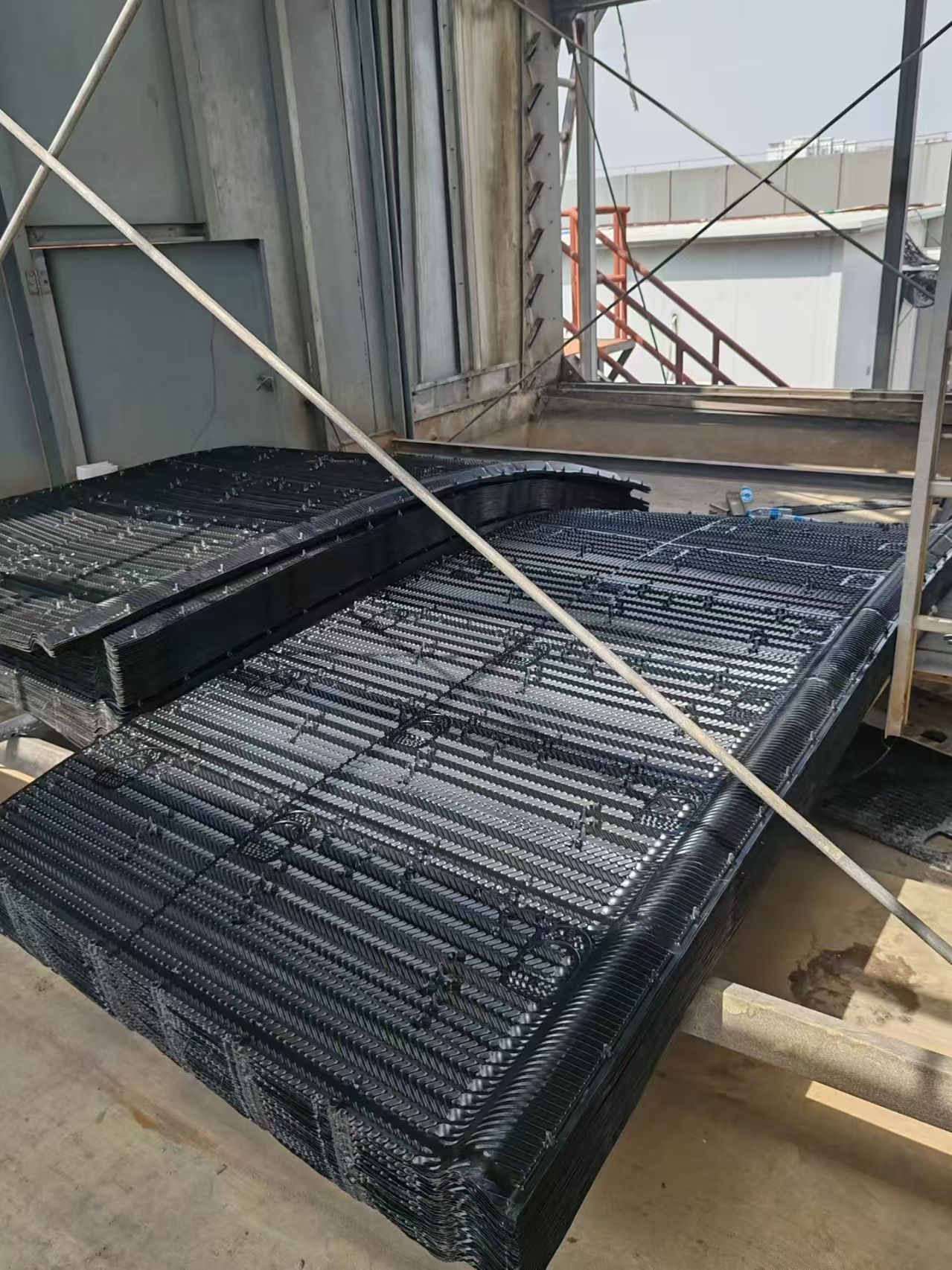
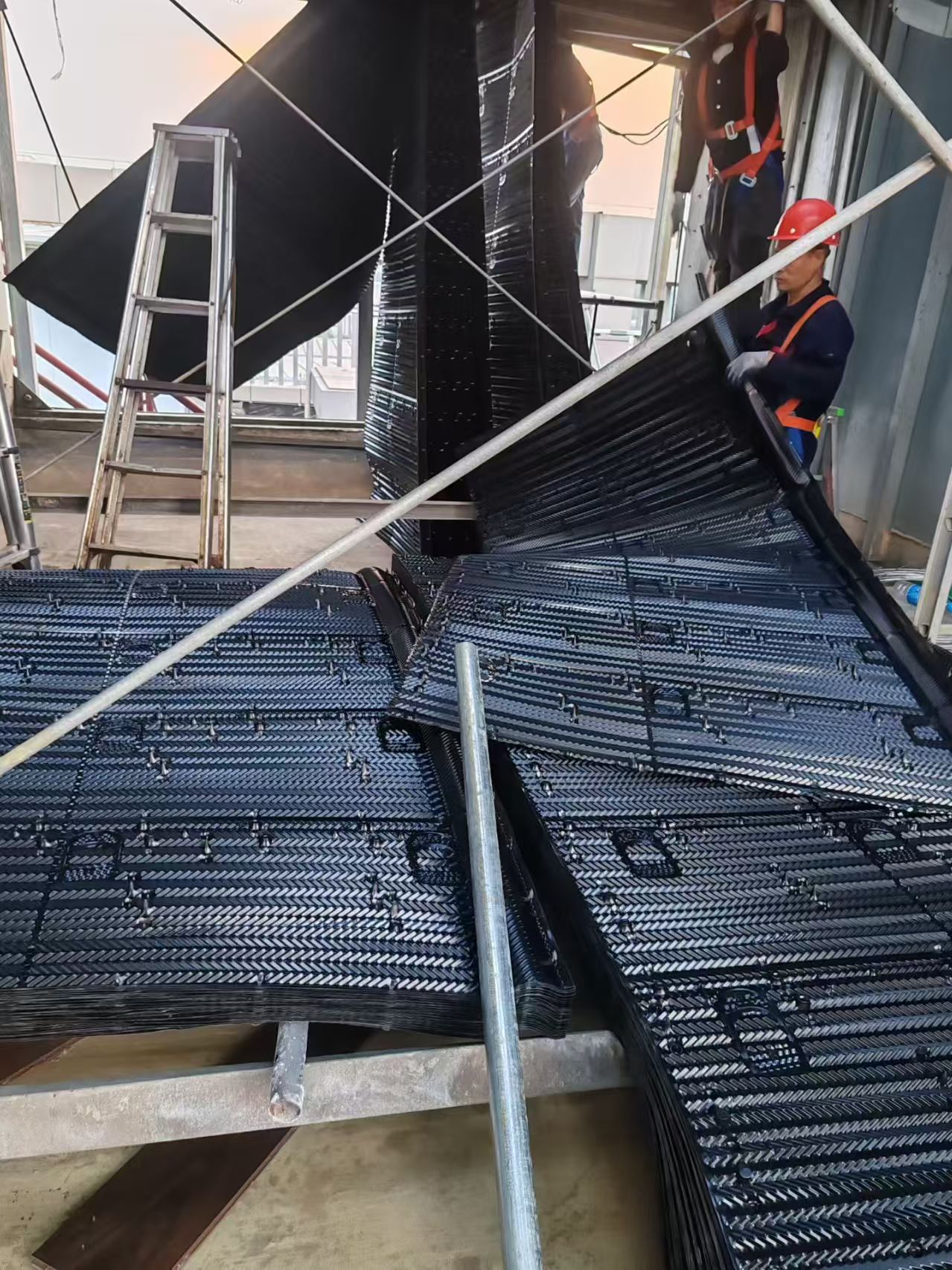
PVC Cooling Tower Fill Replacement for Industrial Cooling Towers
Cooling tower fill plays a critical role in industrial heat rejection. By increasing the contact area between circulating water and air, the fill media improves evaporation and helps cooling towers achieve the required outlet water temperature. However, even high-quality fill eventually becomes damaged, clogged, brittle, or less effective after years of operation.
When this happens, PVC cooling tower fill replacement can restore heat transfer performance and improve the overall efficiency of an industrial cooling system.
For many industrial cooling towers, PVC fill is a practical replacement option because it combines effective heat transfer, lightweight construction, corrosion resistance, and relatively easy installation. Choosing the right cooling tower filler, however, requires more than simply matching dimensions. Fill type, sheet thickness, flute design, water quality, operating temperature, airflow, and tower configuration all need to be considered.
This guide explains when PVC cooling tower fill should be replaced, how to select replacement fill, and how proper installation and maintenance can extend service life.
What Is PVC Cooling Tower Fill?
PVC cooling tower fill is a structured or film-type heat transfer medium commonly installed inside evaporative cooling towers. It consists of specially formed PVC sheets that create numerous thin water films as water flows downward through the fill.
How Does PVC Fill Improve Heat Transfer?
The main purpose of a cooling tower fill is to increase the surface area available for air-water contact.
As warm circulating water enters the fill section, it spreads across the PVC sheets. At the same time, air passes through the channels created by the fill structure. The larger contact area promotes evaporation and sensible heat transfer.
A properly designed PVC cooling tower filler can therefore help:
Increase air-water contact area
Improve evaporation
Enhance heat transfer
Reduce required tower size
Support lower cold-water temperatures
Improve cooling tower thermal performance
Why Is Surface Area Important?
Without fill media, water would pass through the tower in relatively large streams or droplets. The available contact area between water and air would be limited.
PVC fill breaks the water flow into thin films and distributes it across a large surface. This creates much more effective contact between the two fluids.
Why Does PVC Cooling Tower Fill Need to Be Replaced?
Cooling tower fill operates continuously under demanding conditions. Over time, deposits, biological growth, mechanical damage, and high temperatures can reduce its performance.
What Are the Most Common Signs of Damaged Cooling Tower Fill?
Several warning signs indicate that cooling tower fill replacement may be necessary:
Reduced cooling capacity
Higher cold-water temperature
Increased approach temperature
Uneven water distribution
Clogged fill passages
Broken or deformed PVC sheets
Excessive biological growth
Mineral scaling
Increased pressure drop
Restricted airflow
Fill collapse or sagging
A visual inspection can often identify severe damage, but thermal performance should also be evaluated before making a replacement decision.
Can Clogged Fill Reduce Cooling Tower Efficiency?
Yes. Deposits and biological fouling can block the narrow channels within the fill.
When passages become restricted, water distribution and airflow can deteriorate. The tower may require more fan power while providing less cooling capacity.
What Causes PVC Fill Blockage?
Common causes include:
Suspended solids
Dust and dirt
Algae
Sludge
Calcium carbonate scale
Corrosion products
Poor water treatment
Inadequate filtration
Regular water treatment and cleaning can reduce these problems, but heavily damaged or permanently fouled fill may need to be replaced.
When Should You Replace PVC Cooling Tower Fill?
There is no single replacement interval that applies to every cooling tower. Service life depends heavily on water quality, operating temperature, chemical exposure, cleaning practices, and mechanical conditions.
Should You Replace Fill Based Only on Its Age?
Not necessarily.
A cooling tower filler should be evaluated based on its actual operating condition rather than age alone. A relatively old fill system may continue to operate effectively if it has been properly maintained, while a newer installation may deteriorate quickly under severe operating conditions.
Important inspection criteria include:
Physical condition of the PVC sheets
Degree of scaling
Biological fouling
Channel blockage
Fill deformation
Water distribution
Cooling performance
Airflow resistance
What Damage Usually Requires Replacement?
Replacement is generally worth considering when the fill has extensive:
Cleaning may solve surface contamination, but it cannot restore PVC sheets that have become physically degraded.
What Are the Benefits of PVC Cooling Tower Fill Replacement?
Replacing deteriorated fill can provide both thermal and operational benefits.
How Can New Fill Improve Cooling Performance?
New PVC cooling tower fill provides clean, open passages and a properly designed heat transfer surface.
This can improve:
The actual improvement depends on the condition of the existing fill and the design of the replacement system.
Can Replacement Reduce Energy Consumption?
Potentially, yes.
When clogged or damaged fill restricts airflow, cooling tower fans may need to operate under less favorable conditions. Replacing severely fouled fill can restore airflow passages and reduce unnecessary resistance.
However, energy savings depend on the complete tower system, including fan design, motor efficiency, airflow, water flow, and control strategy.
Does New Fill Help Extend Cooling Tower Life?
A replacement fill system can reduce operational problems associated with blocked passages and poor water distribution. It can also help the cooling tower operate closer to its intended design conditions.
However, fill replacement does not eliminate problems caused by deteriorated structural components, fans, motors, pumps, or water distribution systems.
How Do You Choose the Right PVC Cooling Tower Fill Replacement?
Selecting replacement fill requires careful consideration of the tower's operating conditions.
What Fill Type Does the Cooling Tower Require?
The first step is to identify the existing tower configuration.
Common fill arrangements include:
Film fill
Splash fill
Counterflow fill
Crossflow fill
High-temperature fill
Low-clogging fill
For many industrial applications, PVC film fill is used where water quality and operating conditions are suitable.
How Does Counterflow Fill Differ From Crossflow Fill?
In a counterflow cooling tower, air generally moves upward while water flows downward through the fill.
In a crossflow tower, air travels horizontally across the falling water.
Because airflow direction and fill geometry differ, replacement media must be compatible with the tower's internal configuration.
Why Is Fill Geometry Important?
PVC fill geometry controls how water spreads and how air moves through the fill.
Important characteristics include:
Flute angle
Channel dimensions
Sheet spacing
Surface texture
Fill height
Contact area
Airflow resistance
A fill design with high theoretical surface area is not automatically suitable for every industrial cooling tower.
What PVC Fill Specifications Should Be Checked?
Before ordering replacement media, collect the original fill specifications whenever possible.
Which Dimensions Matter Most?
Key dimensions include:
Fill length
Fill width
Fill height
Sheet thickness
Module size
Flute angle
Assembly configuration
Accurate dimensions help prevent installation problems and reduce the need for field modifications.
Does PVC Sheet Thickness Matter?
Yes.
PVC cooling tower fill is available in different thicknesses and constructions. Thickness can affect mechanical strength, weight, durability, and resistance to handling damage.
The appropriate thickness depends on the tower design and operating conditions.
What About Operating Temperature?
Temperature is particularly important when selecting PVC fill.
Standard PVC fill is suitable for many conventional cooling applications, but high-temperature industrial processes may require specially designed materials or alternative fill media.
Always compare the fill's temperature capability with the actual water temperature entering the tower.
How Does Water Quality Affect PVC Cooling Tower Fill Selection?
Water quality is one of the most important factors affecting fill performance and service life.
Is PVC Fill Suitable for Dirty Industrial Water?
It depends on the application.
Film fill creates relatively narrow channels to maximize water-air contact. If circulating water contains high concentrations of suspended solids, these channels can become blocked.
For applications with poor water quality, a low-clogging fill design or splash fill may be more appropriate.
What Water Treatment Practices Help Protect Fill?
A suitable water treatment program may include:
Good water management can significantly reduce fouling and help maintain cooling tower fill performance.
How Is PVC Cooling Tower Fill Replaced?
Proper replacement requires planning and careful installation.
What Should Be Done Before Removing the Old Fill?
Before beginning work, the cooling tower should be inspected and the replacement area measured.
The maintenance team should confirm:
Fill dimensions
Support structure condition
Water distribution system
Spray nozzles
Air inlet condition
Drift eliminators
Structural components
Access and lifting requirements
Why Should the Support Structure Be Inspected?
New fill should not be installed on damaged or weakened supports.
If support beams, grids, or brackets are deteriorated, they should be repaired or replaced before installing the new fill.
How Should Old Cooling Tower Fill Be Removed?
The old fill should be removed carefully to avoid damaging:
Fill supports
Nozzles
Distribution pipes
Tower casing
Structural components
Depending on tower size and fill configuration, removal may involve manual handling or mechanical lifting equipment.
How Should New PVC Fill Be Installed?
The replacement fill should be installed according to the manufacturer's recommended orientation and assembly method.
Key considerations include:
Correct module arrangement
Proper support
Consistent fill spacing
Correct airflow direction
Secure positioning
Proper water distribution
Avoiding excessive compression
Improper installation can reduce the performance of even high-quality fill media.
Can Cooling Tower Fill Be Cleaned Instead of Replaced?
In some cases, yes.
Cleaning is often appropriate when the fill is structurally sound but has accumulated manageable deposits.
When Is Cleaning a Better Option?
Cleaning may be considered when:
PVC sheets remain flexible
Fill passages are still structurally intact
Fouling is relatively light
There is no significant deformation
Cooling performance can be restored through maintenance
When Is Replacement More Practical?
Replacement becomes more appropriate when contamination is combined with physical deterioration.
For example, heavily scaled fill that has also become brittle or distorted may not respond effectively to cleaning.
Should High-Pressure Water Be Used?
Care is required.
Excessive water pressure can damage thin PVC sheets, especially when the material has become brittle with age. Cleaning pressure should therefore be selected according to the fill material and condition.
How Can You Extend the Life of PVC Cooling Tower Fill?
Replacement should ideally be combined with a preventive maintenance strategy.
How Often Should Cooling Tower Fill Be Inspected?
Inspection frequency depends on operating conditions, but regular visual checks can help identify early-stage problems before they become major failures.
Inspect for:
Scale
Algae
Sludge
Cracks
Deformation
Blockage
Uneven water flow
Material deterioration
Can Water Treatment Extend Fill Life?
Yes.
Effective water treatment can reduce the accumulation of mineral deposits and biological fouling. Maintaining appropriate cycles of concentration and controlling suspended solids can also reduce the risk of blockage.
Does Proper Water Distribution Matter?
Absolutely.
Uneven water distribution can cause some areas of the fill to receive excessive water while other sections remain underutilized.
A well-maintained distribution system helps the entire fill surface participate in the cooling process.
How Can You Compare Cooling Tower Fill Replacement Suppliers?
Choosing a reliable supplier is important because fill quality directly affects installation and long-term performance.
What Should You Ask a Cooling Tower Filler Manufacturer?
Before purchasing replacement media, ask the manufacturer or supplier about:
Should You Request a Custom Fill Solution?
Custom sizing can be useful when replacing obsolete or non-standard cooling tower fill.
A supplier may be able to manufacture fill modules according to:
Existing tower dimensions
Original fill specifications
Required fill height
Module size
Water quality
Operating temperature
Crossflow or counterflow configuration
Why Is Accurate Measurement Important?
A small dimensional mismatch can create installation gaps, compression, unsupported sections, or interference with internal tower components.
Accurate measurements before production can therefore save both installation time and cost.
What Industries Use PVC Cooling Tower Fill?
PVC cooling tower fill is used in a wide range of evaporative cooling applications.
Typical industries include:
The correct fill design varies according to the water quality, heat load, temperature, and tower configuration of each application.
What Is the Cost of PVC Cooling Tower Fill Replacement?
The total replacement cost depends on more than the price of the PVC fill itself.
What Factors Affect Replacement Cost?
Major factors include:
For international projects, shipping volume and packaging efficiency can also have a significant effect on the delivered cost.
Should You Choose the Cheapest Cooling Tower Filler?
Purchase price should be evaluated together with service life, thermal performance, compatibility, and installation requirements.
A lower initial price may not provide the lowest overall operating cost if the fill has poor durability or does not match the tower's design.
What Are the Key Factors for Successful PVC Cooling Tower Fill Replacement?
A successful replacement project should consider the entire cooling tower rather than the fill alone.
What Should Be Checked Before Ordering?
Use this checklist:
Cooling tower type
Counterflow or crossflow configuration
Existing fill dimensions
Fill height
Sheet thickness
Operating water temperature
Water quality
Suspended solids
Existing fouling level
Support structure condition
Water distribution system
Nozzle condition
Drift eliminator condition
Required cooling performance
What Should Be Checked After Installation?
After installation, inspect:
Fill alignment
Module stability
Water distribution
Air passages
Support condition
Spray pattern
Leakage
Cooling performance
Monitoring the tower after startup can help identify installation or distribution issues early.
Conclusion: Why Is PVC Cooling Tower Fill Replacement Important?
PVC cooling tower fill replacement is an important maintenance strategy for industrial cooling towers experiencing reduced thermal performance, fouling, blockage, or physical deterioration.
The right PVC cooling tower fill can restore effective water-air contact, improve heat transfer, and help the cooling tower operate closer to its intended performance. However, successful replacement depends on selecting a fill design that matches the tower configuration, water quality, operating temperature, airflow, and physical dimensions.
Instead of choosing replacement media based only on price or appearance, industrial operators should evaluate the complete operating environment. Working with an experienced cooling tower filler manufacturer or supplier can also help ensure accurate sizing, appropriate material selection, and reliable installation.
With proper selection, installation, water treatment, and maintenance, a new cooling tower fill system can provide dependable heat transfer performance and support efficient long-term industrial cooling.