PVC Filler for Cooling Tower | High Heat Transfer Fill Media
Cooling tower performance depends heavily on the quality and design of its fill media. Among the most widely used options, PVC filler for cooling tower applications offers an effective balance of heat transfer performance, durability, chemical resistance, and cost efficiency. Properly designed PVC fill increases the contact area between air and circulating water, helping cooling towers achieve better thermal performance without unnecessarily increasing equipment size or operating costs.
Modern industrial facilities are increasingly looking for high heat transfer fill media that can support stable operation under demanding conditions. PVC cooling tower fill is particularly suitable for HVAC systems, power plants, manufacturing facilities, process cooling systems, and many other applications where reliable heat rejection is essential.
This guide explains how PVC filler works, why it provides efficient heat transfer, how to select the right design, and how proper maintenance can extend its service life.
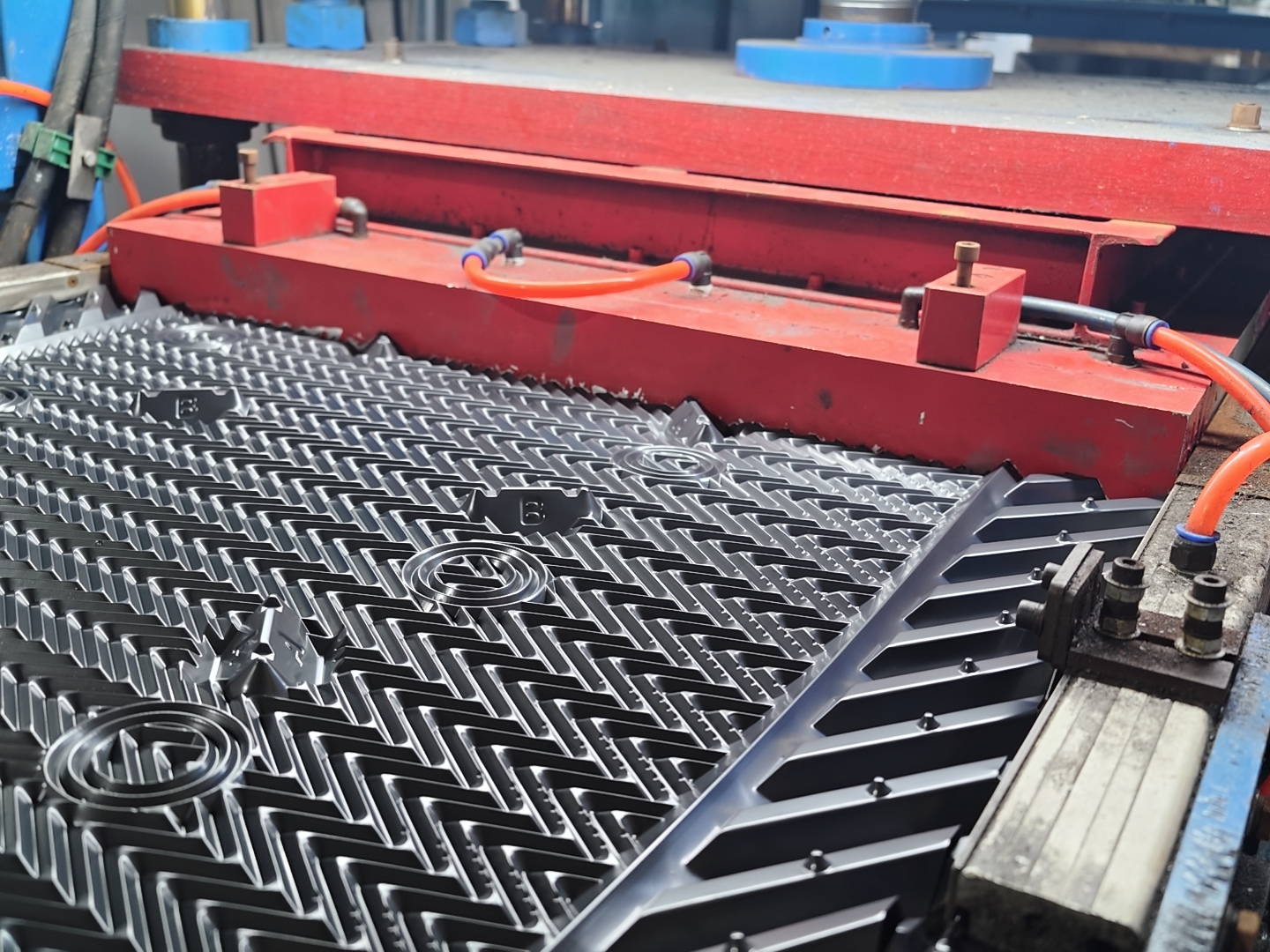
What Is PVC Filler for a Cooling Tower?
PVC filler, also called cooling tower fill, is the internal heat transfer media installed inside a wet cooling tower. Its primary function is to increase the contact area between hot circulating water and moving air.
Instead of allowing water to fall directly through the tower, PVC fill distributes the water across a large surface area. As the water flows over the fill, air passes through or across it. Heat is transferred from the water to the air, while a small portion of the water evaporates and removes additional heat.
How Does PVC Cooling Tower Fill Work?
The heat transfer process can be simplified into three stages:
Water distribution – Hot water is distributed over the upper surface of the fill.
Water spreading – PVC sheets or structured surfaces divide the water into thin films or droplets.
Air-water contact – Air passes through the fill, increasing evaporation and sensible heat transfer.
Why Is Surface Area So Important?
The greater the effective contact area between air and water, the greater the potential for heat transfer.
A well-designed PVC filler for cooling tower creates a large wetted surface while maintaining sufficient airflow. This allows the cooling tower to transfer more heat within a relatively compact space.
Why Choose PVC Filler for Cooling Tower Applications?
PVC has become a popular material for cooling tower fill because it combines thermal performance with practical manufacturing and operating advantages.
What Makes PVC a Good Fill Material?
Several properties make PVC suitable for cooling tower environments:
Good chemical resistance
Lightweight construction
Excellent water distribution characteristics
High effective surface area
Relatively low material cost
Easy fabrication and replacement
Good dimensional stability under normal operating conditions
Compatibility with many industrial water treatment systems
For many applications, PVC provides a practical solution when the goal is to achieve high heat transfer fill media performance while controlling equipment and maintenance costs.
Is PVC Fill Suitable for Industrial Cooling Towers?
Yes. PVC fill is widely used in industrial and commercial wet cooling towers, particularly where water temperatures and operating conditions remain within the recommended range of the selected fill design.
Common applications include:
HVAC cooling towers
Industrial process cooling
Manufacturing plants
Power generation facilities
Chemical processing
Food and beverage plants
Data center cooling systems
Commercial buildings
Air-conditioning systems
How Does PVC Filler Improve Heat Transfer?
The primary advantage of structured PVC fill is its ability to create a large effective heat transfer surface inside the cooling tower.
How Does Film Fill Increase Water-to-Air Contact?
Film-type PVC fill uses closely spaced sheets with specially formed surfaces. Water spreads into a thin film across these surfaces while air moves through the channels.
Why Is Thin Water Film Important?
A thin water film provides a favorable environment for heat and mass transfer because it increases the interface between the water and air.
The process can improve:
The actual performance depends on fill geometry, airflow, water loading, inlet water temperature, ambient conditions, and cooling tower design.
What Is the Role of Fill Flute Design?
The flute or channel geometry controls how water spreads and how air moves through the fill.
Different flute patterns can influence:
Therefore, choosing a high heat transfer fill media should involve more than simply selecting the largest surface area.
What Are the Main Types of PVC Cooling Tower Fill?
PVC cooling tower fill is available in different designs to meet different cooling requirements.
What Is Film-Type PVC Fill?
Film fill is designed to spread water into thin films across a large surface.
It is particularly suitable for relatively clean circulating water and applications where high thermal efficiency is a priority.
What Are the Benefits of Film Fill?
Film fill can provide:
High heat transfer efficiency
Compact tower design
Large effective surface area
Efficient water distribution
Lower required fill volume for certain applications
However, narrow channels may be more sensitive to suspended solids and biological growth.
What Is Splash-Type Fill?
Splash fill breaks falling water into smaller droplets or repeatedly redirects the water through a series of splash bars or grids.
It is often considered when the circulating water contains higher levels of suspended solids or when fouling resistance is more important than maximum compactness.
When Should Splash Fill Be Considered?
Splash fill may be appropriate for:
Poor-quality water
Wastewater cooling
High-fouling environments
Applications with relatively high suspended solids
Systems where easier cleaning is important
How Should You Select PVC Filler for a Cooling Tower?
Choosing the right PVC filler for cooling tower applications requires evaluating both thermal requirements and operating conditions.
What Water Quality Should Be Considered?
Water quality is one of the most important selection factors.
Before choosing fill, evaluate:
Suspended solids
Biological growth
Scaling tendency
Oil contamination
Corrosion products
Water hardness
Chemical treatment
Operating temperature
Why Does Water Quality Affect Fill Selection?
If deposits accumulate inside the fill channels, water and air distribution can become restricted. This reduces heat transfer and increases pressure drop.
A fill that performs extremely well with clean water may not be the best option for a heavily contaminated industrial cooling system.
How Does Operating Temperature Affect PVC Fill?
Temperature resistance should always be checked against the manufacturer's specifications.
Standard PVC fill is suitable for many conventional cooling tower applications, but high-temperature process cooling may require specially selected materials or alternative fill designs.
What Happens When Fill Is Exposed to Excessive Heat?
Excessive temperature can affect:
Sheet rigidity
Dimensional stability
Mechanical strength
Service life
Fill geometry
Therefore, both normal operating temperature and occasional peak temperature should be considered.
How Can You Improve Cooling Tower Heat Transfer with PVC Fill?
Installing high-quality fill is only one part of achieving efficient cooling.
Can Better Water Distribution Improve Performance?
Absolutely. Even a high-performance cooling tower fill cannot compensate for poor water distribution.
A good distribution system should provide relatively uniform water loading across the fill surface.
What Problems Can Uneven Distribution Cause?
Uneven water distribution may result in:
Water distribution nozzles, headers, pipes, and fill should therefore be considered as one integrated system.
Can Airflow Affect PVC Fill Performance?
Yes. Airflow directly influences the air-water contact process.
Insufficient airflow can reduce cooling capacity, while excessive airflow can increase fan energy consumption and pressure drop.
The goal is to achieve an appropriate balance between:
Thermal performance + airflow + pressure drop + fan energy consumption
What Causes PVC Cooling Tower Fill to Fail?
PVC fill can provide long-term service when correctly selected and maintained, but several operating problems can reduce its performance.
Does Scaling Damage Cooling Tower Fill?
Scale can accumulate on PVC fill surfaces and reduce the effective area available for heat transfer.
Heavy scaling can also restrict airflow and water movement.
How Can Scaling Be Controlled?
Effective water treatment should include appropriate control of:
Hardness
Cycles of concentration
pH
Conductivity
Scale-forming minerals
Regular inspection can help identify early deposits before they become severe.
Can Biological Growth Block PVC Fill?
Yes. Algae, bacteria, and other biological deposits can accumulate on wet fill surfaces.
Biofouling can reduce open area and interfere with water distribution.
How Can Biofouling Be Reduced?
A suitable water treatment program combined with routine cleaning and inspection can help minimize biological accumulation.
How Should PVC Filler Be Cleaned?
Cleaning requirements depend on the type of fill and the condition of the circulating water.
What Is the Best Time to Clean Cooling Tower Fill?
Do not wait until severe blockage occurs.
A preventive maintenance schedule should be based on:
Water quality
Operating hours
Seasonal conditions
Differential pressure
Cooling performance
Visual inspection
Fouling history
Should High-Pressure Water Be Used?
High-pressure cleaning may damage or deform some PVC fill designs if performed incorrectly.
Cleaning pressure, nozzle distance, water temperature, and chemical compatibility should be controlled according to the fill manufacturer's recommendations.
How Long Does PVC Cooling Tower Fill Last?
There is no universal service-life number because operating conditions vary significantly.
The life of PVC filler for cooling tower applications depends on:
Water temperature
UV exposure
Water chemistry
Biological control
Cleaning frequency
Mechanical damage
Airborne contaminants
Fill quality
Operating conditions
What Are the Signs That PVC Fill Needs Replacement?
Common warning signs include:
Should You Replace or Clean the Fill?
If the fill is structurally intact but contaminated, cleaning may restore performance.
If the PVC has become brittle, deformed, cracked, or permanently blocked, replacement is usually a more practical solution.
What Should You Look for in a High Heat Transfer Fill Media Supplier?
The supplier can have a major influence on cooling tower performance because fill geometry and material quality directly affect thermal performance.
What Technical Information Should a Supplier Provide?
A reliable supplier should be able to provide information such as:
Fill material
Sheet thickness
Fill dimensions
Flute geometry
Operating temperature range
Application recommendations
Water loading range
Air pressure drop information
Installation guidance
Cleaning recommendations
Why Is Customized Fill Sometimes Necessary?
Different cooling towers have different dimensions and operating conditions.
Customized PVC fill can be designed or supplied according to:
This can be particularly useful when replacing obsolete or non-standard cooling tower fill.
How Does PVC Compare with Other Cooling Tower Fill Materials?
PVC is not the only material used for cooling tower fill. Depending on the application, PP and other materials may also be considered.
PVC vs. PP Cooling Tower Fill
PVC is commonly selected for conventional cooling tower applications because of its combination of cost, processability, and performance.
PP can be attractive for applications requiring higher temperature resistance or specific chemical resistance.
Which Material Should You Choose?
The correct choice depends on the actual operating environment rather than simply the material name.
Consider:
What Makes a High-Quality PVC Cooling Tower Fill?
Not all PVC fill products deliver identical performance.
Does Sheet Thickness Matter?
Yes. Sheet thickness influences mechanical strength, weight, durability, and manufacturing characteristics.
However, thicker does not automatically mean better.
What Else Should Be Evaluated?
A professional evaluation should consider:
Material formulation
Forming quality
Flute consistency
Bonding strength
Block dimensions
Surface characteristics
Thermal design
Installation quality
A well-designed high heat transfer fill media should balance thermal performance with mechanical reliability.
How Can Businesses Reduce Cooling Tower Operating Costs?
Improving fill performance can contribute to overall cooling system efficiency.
Can Efficient Fill Reduce Fan Energy?
Potentially. A fill design that achieves effective heat transfer at an acceptable pressure drop can help optimize the relationship between thermal performance and fan power.
The objective should not simply be the highest possible heat transfer coefficient.
What Is the Real Goal?
The real objective is to achieve the required cooling duty with an efficient combination of:
Fill volume
Airflow
Water flow
Fan power
Pump power
Approach temperature
Maintenance requirements
This system-level approach provides a more realistic method of evaluating cooling tower fill.
What Are the Latest Trends in Cooling Tower Fill Design?
Modern cooling tower systems are increasingly focused on efficiency, maintainability, and longer operating life.
Is High-Performance Fill Becoming More Compact?
Many modern fill designs aim to deliver greater effective heat transfer area within limited tower space.
This is valuable for:
Is Sustainable Cooling Tower Operation Important?
Yes. Efficient cooling towers can help reduce energy and water consumption when the complete system is properly designed and controlled.
Longer-lasting fill can also reduce replacement frequency and material consumption over the life of the cooling tower.
How Do You Choose the Right PVC Filler for Cooling Tower Replacement?
When replacing existing fill, do not select a product based only on dimensions.
What Should Be Checked Before Ordering Replacement Fill?
A useful replacement checklist includes:
Existing fill dimensions
Fill type
Flute design
Sheet thickness
Water temperature
Water quality
Airflow direction
Water loading
Existing support structure
Cooling tower model
Required cooling performance
Installation conditions
Why Is Accurate Measurement Important?
Even small differences in fill dimensions or block arrangement can affect installation and water distribution.
Before purchasing replacement fill, measure the existing installation and confirm the required configuration with the supplier.
Conclusion: Why Is PVC Filler a Popular High Heat Transfer Solution?
PVC filler for cooling tower applications remains a practical and efficient solution for many commercial and industrial cooling systems. Its ability to create a large air-water contact area makes it suitable for applications where efficient heat transfer, compact installation, and cost control are important.
The best high heat transfer fill media is not necessarily the product with the largest surface area. Instead, the right fill should match the cooling tower's water quality, temperature, airflow, water loading, maintenance requirements, and overall thermal design.
By selecting suitable PVC material, optimizing water and air distribution, maintaining proper water treatment, and replacing damaged fill when necessary, cooling tower operators can maintain reliable heat transfer and extend system performance.
For cooling tower manufacturers, contractors, distributors, and replacement projects, selecting the right PVC cooling tower fill from an experienced supplier can be an important step toward improving cooling efficiency and long-term operating reliability.


