How to Choose the Best Cooling Tower Filler for Your Application?
Choosing the right cooling tower filler is one of the most important decisions when designing, upgrading, or replacing a cooling tower. The fill media directly affects how efficiently water and air interact, which in turn influences heat transfer, cooling capacity, pressure drop, water consumption, maintenance requirements, and operating costs.
However, selecting cooling tower fill is not simply a matter of choosing the cheapest product or the material with the highest advertised surface area. Different cooling towers operate under different temperatures, water qualities, airflow conditions, and cooling loads.
So, how do you choose the best cooling tower filler for your application?The answer requires a systematic evaluation of the cooling tower type, operating conditions, water quality, fill material, geometry, thermal performance, fouling risk, and long-term maintenance requirements.
This guide explains the most important factors to consider when selecting cooling tower fill media for HVAC, commercial, and industrial applications.
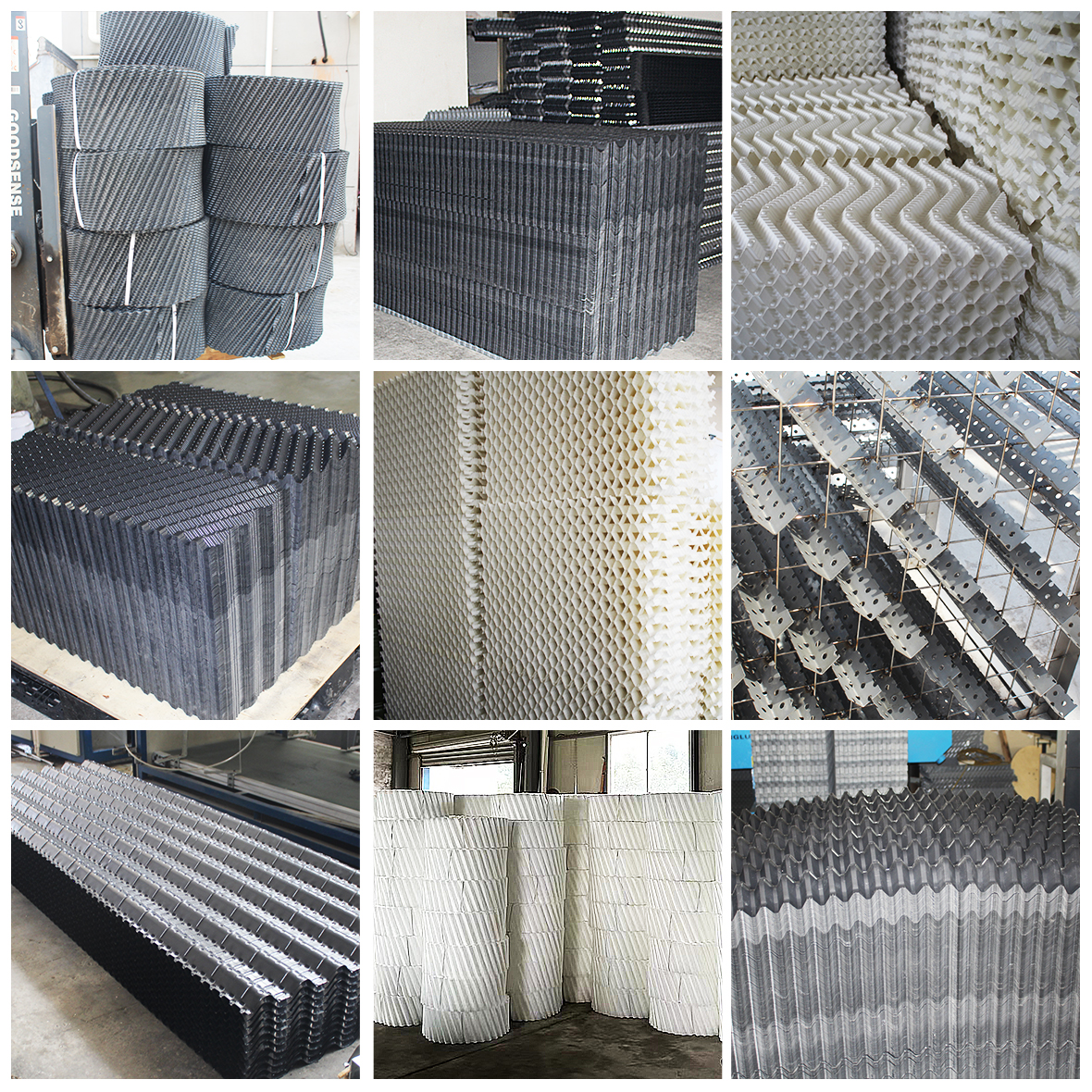
What Is a Cooling Tower Filler and Why Is It Important?
A cooling tower filler, also called cooling tower fill or cooling tower fill media, is the internal material that increases the contact area between circulating water and air.
Warm water flows over or through the fill while air moves through the tower. The increased contact area allows heat to transfer from the water to the air, with evaporation removing a significant portion of the heat.
What Does Cooling Tower Fill Actually Do?
A properly selected cooling tower filler can:
Increase air-water contact area
Improve heat transfer
Extend water-air contact time
Promote more uniform water distribution
Support cooling tower capacity
Improve the efficiency of evaporative cooling
Why Is Fill Sometimes Called the “Heart” of a Cooling Tower?
The fill does not generate cooling by itself. Instead, it creates the physical environment where efficient air-water interaction occurs.
If the fill is incorrectly selected, damaged, blocked, or poorly installed, even efficient fans and pumps may not deliver the expected cooling performance.
What Should You Check Before Choosing Cooling Tower Filler?
Before comparing different products, establish the actual operating conditions of your cooling tower.
What Are the Most Important Technical Parameters?
Start by collecting:
Why Is the Wet-Bulb Temperature Important?
Cooling towers rely on evaporation, so ambient wet-bulb temperature strongly influences achievable cold-water temperature.
A cooling tower operating in a humid climate may have a different design requirement from a tower operating in a dry environment, even when both have the same nominal heat load.
What Is the Cooling Range?
The cooling range is generally the difference between entering hot-water temperature and leaving cold-water temperature.
Cooling Range = Hot-Water Temperature − Cold-Water Temperature
Understanding the required cooling range helps determine whether the selected fill can provide sufficient heat-transfer performance.
How Does Cooling Tower Type Affect Fill Selection?
Not every cooling tower uses the same fill configuration.
The first major question is whether the tower is counterflow or crossflow.
What Is Counterflow Cooling Tower Fill?
In a counterflow cooling tower, water flows downward while air generally moves upward.
What Makes Counterflow Fill Different?
The fill must provide an effective contact surface while allowing air to move upward against the downward water flow.
Counterflow cooling tower fill is commonly designed with:
When Is Counterflow Fill Commonly Used?
It is widely used in:
What Is Crossflow Cooling Tower Fill?
In a crossflow tower, water generally flows vertically downward while air travels horizontally through the fill.
How Does Crossflow Fill Affect Tower Operation?
Crossflow cooling tower filler must be compatible with the tower's water distribution and airflow arrangement.
Important considerations include:
Can Counterflow Fill Be Used in a Crossflow Tower?
Not automatically.
The fill geometry and hydraulic characteristics should match the tower design. A product that fits physically may still produce unsuitable airflow resistance or water distribution.
Which Cooling Tower Fill Material Should You Choose?
Material selection is another critical decision.
The most common thermoplastic materials include:
Why Is PVC Cooling Tower Fill So Popular?
PVC cooling tower fill is widely used because it offers a practical balance between cost, corrosion resistance, processability, and cooling performance.
PVC can be suitable for many:
When Should You Consider PVC Cooling Tower Fill?
PVC is often considered when:
Operating temperatures are within the manufacturer's recommended range
Water chemistry is compatible
Standard industrial or HVAC cooling is required
Cost efficiency is important
What Is the Main Limitation of PVC?
Temperature should be carefully considered. For applications involving elevated water temperatures, another material may be more appropriate.
When Should You Choose PP Cooling Tower Fill?
PP cooling tower fill is another widely used option, particularly where higher temperature resistance or specific chemical compatibility is important.
What Are the Advantages of PP?
PP can offer:
Higher temperature resistance than conventional PVC
Good chemical resistance
Lightweight construction
Good mechanical characteristics
Suitability for certain demanding industrial environments
Is PP Always Better Than PVC?
No.
The appropriate material depends on the operating environment. Choosing PP simply because it has a higher temperature capability can add unnecessary cost if the cooling tower operates comfortably within the suitable range of PVC fill.
How Does Water Temperature Affect Cooling Tower Filler Selection?
Water temperature is one of the first specifications that should be checked.
Why Can High Temperature Damage Cooling Tower Fill?
Thermoplastic materials can lose mechanical stability when exposed to temperatures beyond their recommended operating range.
Potential consequences include:
Should You Consider the Maximum or Normal Temperature?
Both.
A proper selection should consider:
Normal operating temperature
Maximum operating temperature
Temperature fluctuations
Startup conditions
Abnormal process conditions
Why Is a Safety Margin Useful?
Industrial processes can experience temperature spikes. Selecting fill based only on the average operating temperature may leave insufficient margin for unexpected conditions.
How Does Water Quality Influence Fill Selection?
Water quality can determine whether a particular cooling tower fill media will remain effective over time.
What Water Conditions Should Be Evaluated?
Consider:
pH
Hardness
Chlorides
Suspended solids
Silica
Biological activity
Chemical treatment
Process contaminants
Why Is Fouling a Major Concern?
Fouling can reduce the effective surface area of the fill and restrict both water and airflow.
What Can Build Up on Cooling Tower Fill?
Common deposits include:
Scale
Algae
Biofilm
Sediment
Rust
Organic matter
What Happens When Fill Channels Become Blocked?
Blocked channels can cause:
Higher airflow resistance
Poorer water distribution
Reduced heat transfer
Increased fan energy demand
Higher outlet-water temperature
For this reason, a fill designed for the cleanest possible water is not necessarily the best option for every industrial tower.
Should You Choose Film Fill or Splash Fill?
The answer depends heavily on water quality and cooling requirements.
What Is Film Fill?
Film fill uses structured sheets to spread water into relatively thin films.
What Are the Benefits of Film Fill?
Film fill can provide:
When Is Film Fill a Good Choice?
It is commonly considered for relatively clean-water applications where maximizing air-water contact is important.
What Is Splash Fill?
Splash fill uses physical structures to break falling water into droplets and redistribute it repeatedly.
Why Can Splash Fill Be Useful?
Splash fill may be considered for applications where:
Water contains more suspended solids
Fouling resistance is important
Easier passage of contaminants is required
Film-fill channels may be prone to blockage
Is Splash Fill Always More Durable?
Not necessarily.
Durability depends on material quality, water chemistry, operating temperature, structural design, and maintenance.
How Important Is Cooling Tower Fill Surface Area?
Surface area is frequently highlighted in cooling tower fill specifications, but it should not be evaluated independently.
Does Higher Surface Area Always Mean Better Cooling?
No.
A higher nominal surface area does not automatically guarantee higher real-world cooling performance.
What Else Matters?
The actual performance depends on the relationship between:
Surface area
Water distribution
Airflow
Water loading
Film thickness
Fill geometry
Pressure drop
Fouling
What Is Effective Surface Area?
Effective surface area refers to the portion of the fill that actually contributes to useful air-water interaction under operating conditions.
A theoretical surface area is less meaningful if water does not properly wet the fill.
How Does Fill Geometry Affect Cooling Performance?
Fill geometry determines how water and air interact inside the tower.
Which Geometry Factors Should You Compare?
Look at:
Flute angle
Channel size
Sheet spacing
Corrugation pattern
Fill height
Fill depth
Surface texture
Why Does Flute Angle Matter?
The flute angle influences how water spreads and how air moves through the fill.
Different flute configurations can change:
Contact time
Water distribution
Air resistance
Pressure drop
Heat-transfer behavior
Should You Select the Fill With the Smallest Channels?
Not necessarily.
Smaller channels can increase surface area but may also increase the risk of blockage when water contains significant suspended solids or biological matter.
How Should You Consider Pressure Drop?
Cooling tower fill must provide effective heat transfer without creating excessive resistance to airflow.
Why Is Pressure Drop Important?
The cooling tower fan must overcome resistance from:
If fill resistance becomes excessive, fan power requirements can increase.
Is Maximum Surface Area the Only Goal?
No.
A practical cooling tower filler should balance thermal performance and hydraulic performance.
This is especially important for towers where fan energy represents a significant portion of operating costs.
How Do You Choose the Right Fill Thickness?
Cooling tower fill sheets are available in different thicknesses.
Does Thicker Fill Mean Better Quality?
Not necessarily.
Thickness affects:
Mechanical strength
Weight
Material consumption
Cost
Handling
Structural stability
What Should You Evaluate Instead?
Consider the complete specification:
Material
Thickness
Fill geometry
Temperature resistance
Mechanical strength
Water loading
Installation method
Why Is Consistent Thickness Important?
Uneven sheet thickness can affect forming quality and dimensional stability.
For large cooling tower installations, consistent manufacturing quality can be important for maintaining uniform fill structure throughout the tower.
How Should You Select Cooling Tower Fill for Dirty Water?
Applications with poor water quality require special attention.
What Are the Main Risks?
Dirty water can lead to:
Is Film Fill Suitable for Dirty Water?
It depends on the degree and type of contamination.
For relatively clean water, film fill can provide excellent thermal performance. For heavily contaminated water, a more open fill configuration may sometimes be considered.
What Should You Do Before Selecting the Fill?
Analyze:
Suspended solids
Water hardness
Biological contamination
Chemical composition
Existing fouling problems
Can Water Treatment Reduce Fill Fouling?
Yes. Proper water treatment can help control scale, biological growth, and other deposits.
However, water treatment should complement—not replace—appropriate fill selection and routine inspection.
How Do You Choose Cooling Tower Filler for HVAC Applications?
HVAC systems generally have different requirements from heavy industrial process cooling.
What Makes HVAC Fill Selection Different?
HVAC systems often prioritize:
Stable thermal performance
Reasonable operating cost
Low maintenance
Compact design
Reliable water distribution
Is PVC Cooling Tower Fill Common in HVAC?
Yes. PVC fill is widely considered for conventional HVAC cooling tower applications when its temperature and chemical compatibility are suitable.
What Should HVAC Operators Prioritize?
Pay attention to:
How Do You Choose Cooling Tower Fill for Industrial Process Cooling?
Industrial applications often have more complicated requirements.
What Makes Industrial Cooling Different?
Process cooling may involve:
What Should Industrial Buyers Do First?
Build an accurate operating profile before purchasing the fill.
What Information Is Most Useful?
Provide the supplier with:
Why Is Application Data More Important Than a Generic Product Name?
Two cooling towers can both be described as “industrial cooling towers” while having completely different fill requirements.
Application-specific engineering is therefore more useful than selecting a generic product based on its name alone.
How Do You Select Cooling Tower Fill for Replacement Projects?
Replacement projects have a different starting point because the cooling tower already has an existing fill system.
Should Replacement Fill Match the Original Fill?
Whenever possible, the replacement should be compatible with the tower's original design.
Check:
Length
Width
Height
Sheet thickness
Block configuration
Material
Flute pattern
Support structure
Why Is Accurate Measurement Important?
Even a small dimensional mismatch can create:
What Should You Send to a Cooling Tower Fill Supplier?
Ideally provide:
This information allows the supplier to evaluate replacement compatibility more accurately.
What Common Mistakes Should You Avoid When Buying Cooling Tower Filler?
Selecting cooling tower fill based only on price can create long-term problems.
Mistake 1: Choosing Fill Only by Material
PVC and PP are materials, not complete performance specifications.
Mistake 2: Ignoring Water Quality
A fill that works well with clean water may perform poorly in a heavily fouled system.
Mistake 3: Focusing Only on Surface Area
Surface area must be considered together with airflow, water distribution, and pressure drop.
Mistake 4: Ignoring Temperature
Always compare actual operating temperatures with the manufacturer's recommended range.
Mistake 5: Buying Without Checking Dimensions
Replacement fill must physically and hydraulically fit the cooling tower.
Mistake 6: Selecting the Cheapest Supplier
A low purchase price may not represent the lowest total cost.
What Should You Compare Between Suppliers?
Compare:
How Can You Compare Cooling Tower Fill Suppliers?
A qualified cooling tower filler supplier should be able to understand both the product and its application.
What Questions Should You Ask a Supplier?
Ask:
1. What material is used?
Confirm whether the fill is PVC, PP, or another material.
2. What is the recommended operating temperature?
Make sure it matches the actual system.
3. What are the fill dimensions?
Confirm compatibility with the cooling tower.
4. What is the fill geometry?
Ask about flute design, spacing, and surface configuration.
5. What water quality is recommended?
This is particularly important for industrial cooling.
6. Can the supplier customize the fill?
Customized dimensions can be valuable for replacement projects.
Can the Right Cooling Tower Filler Reduce Operating Costs?
The right fill can contribute to efficient cooling tower operation, but it should not be viewed as an independent energy-saving device.
How Can Fill Selection Influence Operating Costs?
Appropriate fill can support:
Efficient heat transfer
Stable water distribution
Reasonable airflow resistance
Lower maintenance frequency
Longer service life
What Other Factors Matter?
Total cooling tower operating cost also depends on:
Fan efficiency
Motor efficiency
Pump efficiency
Water treatment
Blowdown
Drift
Ambient conditions
Cooling load
Therefore, fill selection should be integrated into the overall cooling tower efficiency strategy.
How Can You Build a Practical Cooling Tower Fill Selection Checklist?
Before placing an order, verify the following:
Application
Thermal Conditions
Hot-water temperature
Cold-water temperature
Cooling range
Wet-bulb temperature
Maximum temperature
Hydraulic Conditions
Material
Physical Specifications
Fill length
Fill width
Fill height
Sheet thickness
Flute configuration
Maintenance
Fouling potential
Cleaning method
Inspection access
Replacement requirements
Final Thoughts: How Do You Choose the Best Cooling Tower Filler?
Choosing the right cooling tower filler requires a complete understanding of the cooling tower rather than relying on a single specification.
The most important factors include tower type, operating temperature, water chemistry, water flow, airflow, fill geometry, surface area, pressure drop, fouling risk, material, dimensions, and maintenance requirements.
For conventional applications, PVC cooling tower fill can provide a practical combination of cooling performance, durability, and cost efficiency. For higher-temperature or specialized environments, PP cooling tower fill or other materials may be worth evaluating.
Most importantly, the “best” cooling tower fill is application-dependent. A fill that performs well in an HVAC system may not be appropriate for a high-temperature industrial process.
By collecting accurate operating data and working with an experienced cooling tower fill supplier, buyers can select cooling tower fill media that is compatible with their equipment and designed for reliable long-term operation.


