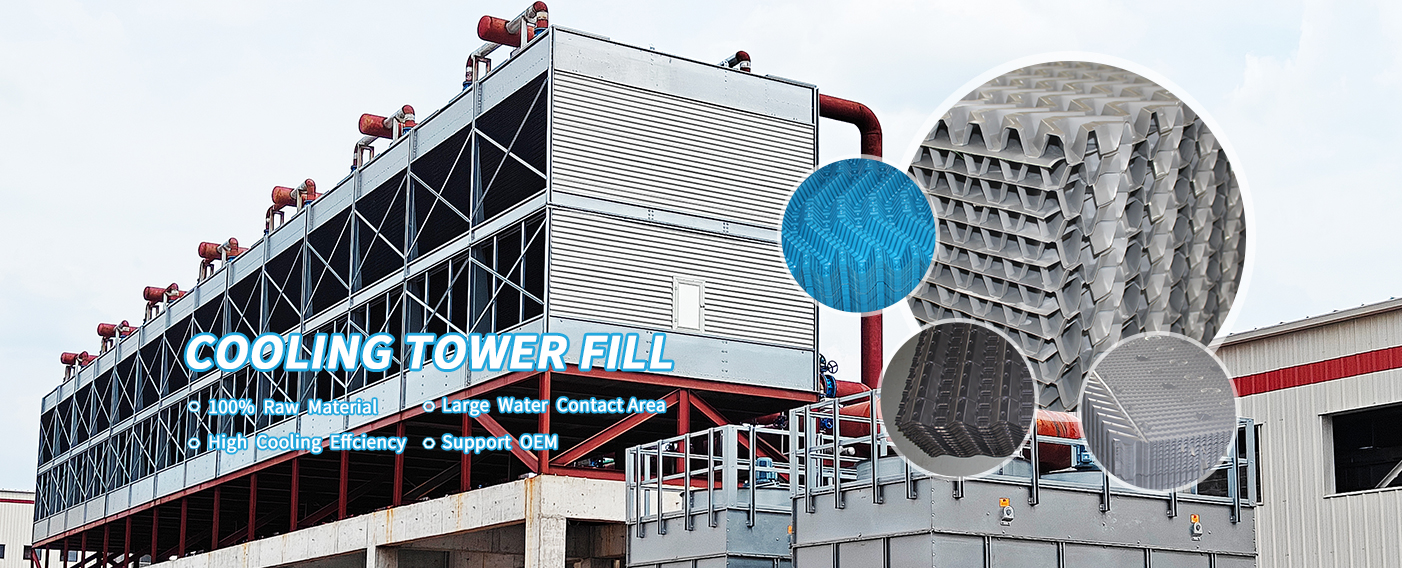
When choosing a film fill cooling tower, many buyers naturally focus on cooling capacity, fill material, dimensions, and price. But there is another factor that deserves just as much attention: water quality.
Why?
Because the water flowing through your cooling tower is not simply a heat-transfer medium. Over time, it can also become a source of scale, suspended solids, biological growth, oil, and other contaminants. These substances can accumulate on cooling tower fill, restrict water and airflow passages, and gradually reduce thermal performance.
This is especially important for film fill. Film fill is designed with closely arranged surfaces and channels that spread water into thin films, creating a large contact area between water and air. This design can provide excellent heat-transfer performance, but it also means that poor water quality may create fouling problems more quickly.
So, when selecting film fill, don't ask only, “Which fill has the highest efficiency?”
Ask a better question:
“Which film fill can maintain good performance under my actual water conditions?”
In this article, we will explain how water quality affects film fill cooling tower selection, including suspended solids, hardness, TDS, pH, biological contamination, material selection, fill geometry, water treatment, and long-term maintenance.
What Is Film Fill in a Cooling Tower?
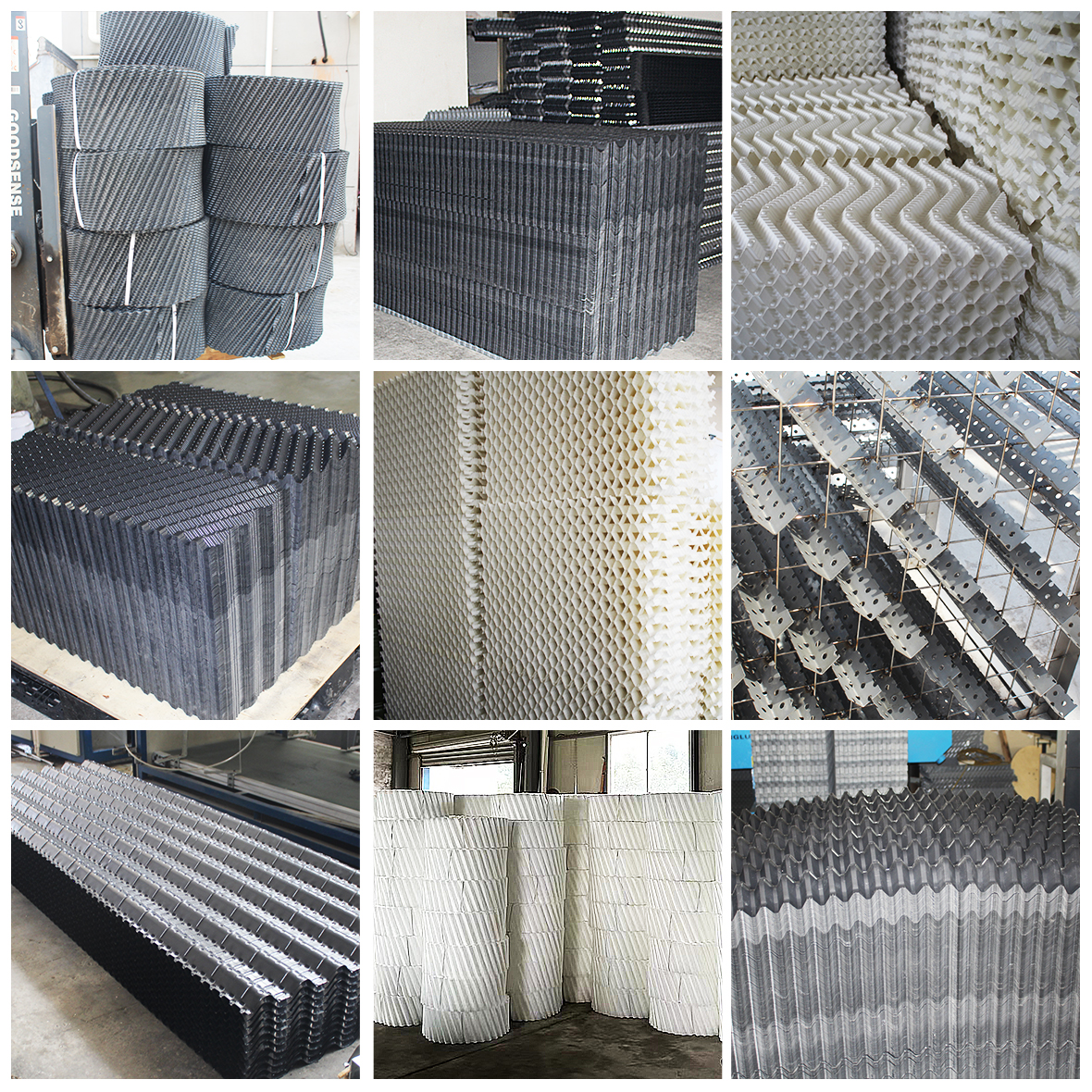
Film fill is a structured heat-transfer medium installed inside an evaporative cooling tower. It is usually made from formed plastic sheets, commonly PVC or other suitable thermoplastics.
The sheets are shaped with corrugations, patterns, or channels that encourage water to spread across a large surface area.
In a counterflow cooling tower, hot water generally flows downward while air moves upward. In a crossflow cooling tower, water travels downward while air moves horizontally through the fill.
In both designs, the objective is the same:
Create extensive contact between water and air so that heat can be transferred and rejected through evaporation.
You can think of film fill as a three-dimensional highway for water and air. Water travels along the surfaces while air passes through the channels. The larger and more effective the contact area, the greater the opportunity for heat and mass transfer.
That is why film fill is widely used when compact design and high thermal performance are important.
How Film Fill Creates More Heat Transfer Area
Imagine pouring a bucket of water onto a flat metal plate.
The water will form a relatively thick layer and quickly run toward the lowest point.
Now imagine spreading the same water across hundreds of structured surfaces. Instead of one thick stream, the water forms thin layers over a much larger area.
That is essentially what film fill does.
The structured sheets distribute the water and create a large water-air interface. At the same time, the internal channels provide paths for airflow.
This combination allows the tower to remove heat efficiently without requiring an unnecessarily large tower footprint.
However, there is an important trade-off.
The more compact the internal passages become, the more important water quality and fouling control can become.
Film Fill vs. Splash Fill
Film fill and splash fill both help a cooling tower transfer heat, but they use different mechanisms.
Film fill spreads water over structured surfaces. Splash fill repeatedly breaks falling water into droplets as it passes through the fill.
Film fill is often attractive for applications where high heat-transfer efficiency and compact construction are important.
Splash fill can be attractive in applications where suspended solids, biological contamination, or other fouling risks are significant.
That does not mean film fill is suitable only for clean water. Rather, it means that water quality should influence the film-fill design you select.
If the water contains a high concentration of solids, selecting a very tight film-fill geometry without considering filtration and cleaning could create operational problems later.
Why Water Quality Matters in Film Fill Cooling Towers
Water quality affects almost every part of a cooling tower's long-term performance.
Poor water quality can contribute to:
Scale formation
Suspended-solid deposits
Biological growth
Slime and biofilm
Oil and grease contamination
Corrosion-related debris
Clogging
Reduced water distribution
Reduced heat-transfer efficiency
Increased maintenance requirements
A new film fill may perform extremely well during its first months of operation. But what happens after months or years of exposure to poorly controlled water?
The answer depends heavily on the water chemistry and treatment program.
This is why water quality should be considered before purchasing the fill, rather than after fouling becomes a problem.
The Main Water Quality Factors to Check
Before selecting film fill for a cooling tower, it is useful to collect actual operating-water data.
Important parameters can include:
Suspended solids
Turbidity
Hardness
Alkalinity
TDS
Conductivity
pH
Water temperature
Biological activity
Oil and grease
Process contaminants
Cycles of concentration
Why measure all these factors?
Because “clean water” and “dirty water” are too vague to support a reliable engineering decision.
Two cooling towers may look similar from the outside while having completely different water conditions inside.
Suspended Solids and Turbidity
Suspended solids are one of the most important concerns when selecting film fill.
Dust, sand, silt, rust particles, process debris, and other solids can enter a cooling tower through makeup water, air exposure, industrial processes, or poor filtration.
Once these particles enter the fill, they can become trapped inside the passages.
The problem can become worse when particles combine with biological growth or mineral deposits.
Think about the inside of a narrow pipe. A little dirt may not seem serious at first. But as more material accumulates, the opening becomes smaller and smaller.
Film-fill passages can experience a similar effect.
Therefore, if your circulating water contains significant suspended solids, consider a film-fill design with greater fouling tolerance and evaluate filtration at the same time.
Hardness and Scale-Forming Minerals
Hard water presents a different challenge: scale.
Calcium and other dissolved minerals can precipitate under certain operating conditions and form deposits on cooling surfaces.
Scale is like putting a blanket over the heat-transfer surface.
The more deposits accumulate, the more difficult it becomes for water and air to interact effectively with the intended fill surface.
Scale can also reduce the available passage area.
For this reason, water hardness should be evaluated together with alkalinity, pH, temperature, conductivity, and cycles of concentration.
A film fill manufacturer can provide the appropriate material and geometry, but no fill can compensate indefinitely for uncontrolled scale formation.
TDS and Conductivity
TDS means total dissolved solids. Conductivity is commonly used as an indicator of dissolved ionic content.
These parameters become especially important in evaporative cooling towers because evaporation removes water but leaves most dissolved substances behind.
As the water becomes more concentrated, the potential for mineral deposition can increase.
This is why cooling towers commonly use blowdown to control concentration.
If your system operates at high cycles of concentration, water chemistry must be carefully managed.
For film fill selection, the important lesson is simple:
High concentration cycles require more attention to scale control and water treatment.
The fill and the treatment program should be designed as one system rather than two separate decisions.
pH and Chemical Conditions
pH affects water chemistry and can influence scaling, corrosion, biological control, and material compatibility.
When choosing film fill, don't look at the material name alone.
For example, simply saying “PVC is chemical resistant” is not enough for every application. The actual compatibility depends on chemical concentration, temperature, exposure time, and the specific material formulation.
The same principle applies to PP and other materials.
Always compare the actual water chemistry and operating temperature with the fill manufacturer's technical specifications.
Biological Contamination
Biological growth can be a major source of cooling tower fouling.
Algae, bacteria, slime, and biofilm can accumulate on film surfaces. Once a biological layer develops, it may also trap suspended solids and minerals.
This creates a snowball effect:
Biological growth → particle trapping → thicker deposits → restricted passages → reduced performance.
Therefore, biological control is not simply a hygiene issue. It is also a thermal-performance issue.
An effective cooling-water management program should address microbial growth while complying with applicable safety and environmental requirements.
Oil, Grease, and Process Contaminants
Industrial cooling towers may face contaminants that are uncommon in ordinary HVAC applications.
For example, process industries can introduce:
Oil
Grease
Organic matter
Wastewater contaminants
Metal particles
Process chemicals
High mineral loads
These contaminants can stick to fill surfaces or encourage additional fouling.
If the cooling tower is connected to an industrial process, tell the fill manufacturer about the process water.
This small detail can make a major difference in material and geometry selection.
How Dirty Water Changes Film Fill Selection
Here is one of the most important principles to remember:
The dirtier the water, the more important fouling resistance becomes.
A common mistake is to choose the film fill with the smallest channels or highest theoretical surface area because it looks more efficient on paper.
But real cooling towers do not operate on paper.
They operate with real water, real dust, real minerals, real biological growth, and real maintenance schedules.
A slightly more open film-fill design may provide more stable performance in a challenging environment than an extremely compact design that becomes fouled quickly.
This is why long-term thermal performance is often more meaningful than initial laboratory performance alone.
Film Fill for Clean Water Applications
If the circulating water is relatively clean, well filtered, and properly treated, conventional high-efficiency film fill can be an excellent choice.
Typical applications may include:
Commercial HVAC systems
Chiller plants
Controlled industrial cooling systems
Manufacturing processes with good water treatment
Closed-loop heat rejection systems with suitable water quality
In these applications, the main goal may be to maximize heat-transfer efficiency within a compact tower volume.
Film Fill for Moderately Fouling Water
What if your water is not perfectly clean but still manageable?
This is where fill geometry becomes particularly important.
A film fill designed with somewhat larger or more fouling-tolerant channels can provide a compromise between heat-transfer performance and maintenance requirements.
The idea is simple:
Don't maximize one specification at the expense of the whole system.
A fill that is slightly less aggressive in terms of surface density but stays cleaner may deliver better real-world results over its service life.
Film Fill for Severely Fouling Water
If the water contains very high levels of suspended solids, oil, biological contamination, or other fouling materials, conventional tightly spaced film fill may require additional protection.
Possible strategies can include:
Better filtration
Improved water treatment
Lower concentration cycles
More frequent cleaning
More open film-fill geometry
Hybrid fill arrangements
Splash fill in particularly challenging conditions
The correct solution depends on the application.
The goal is not simply to find a fill that can survive dirty water. The goal is to design a system where the water quality, treatment program, fill, and maintenance strategy work together.
PVC vs. PP Film Fill for Different Water Conditions
Material selection is another important part of film fill cooling tower design.
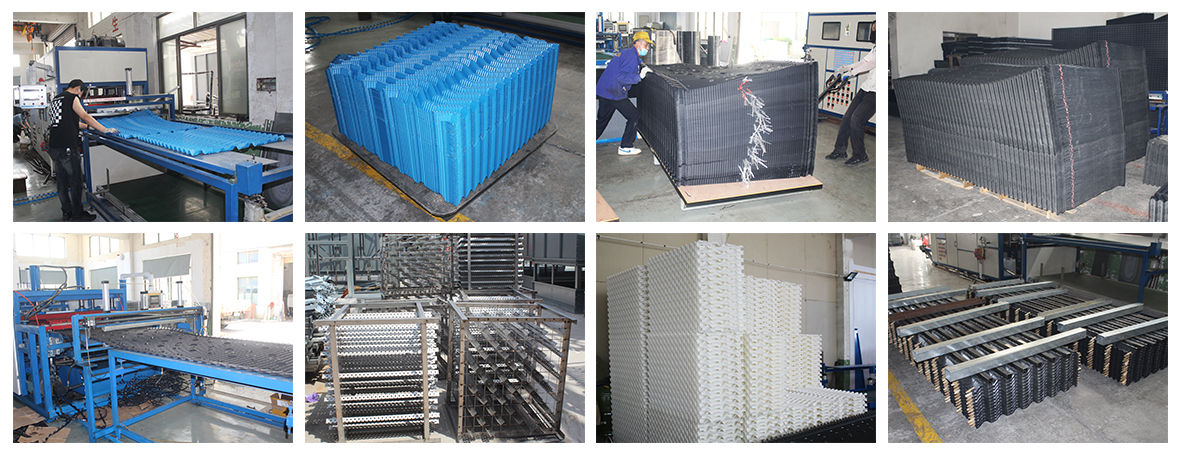
PVC is widely used in cooling tower film fill because it offers a useful combination of processability, weight, durability, and suitability for many standard cooling applications.
PP can also be considered when its temperature characteristics or chemical compatibility are more appropriate for a particular application.
But don't make the decision based on material name alone.
A better approach is to compare:
The selected material should always be checked against the manufacturer's technical limits.
When PVC Film Fill Makes Sense
PVC film fill is a common solution for many standard cooling tower applications.
It can be formed into different corrugated structures for counterflow and crossflow towers, allowing manufacturers to adjust water distribution, airflow paths, and heat-transfer characteristics.
For standard industrial and commercial applications with properly controlled water quality, PVC film fill can provide an effective combination of thermal performance and practical cost.
However, PVC selection should still take into account the actual water temperature and chemical environment.
When PP Film Fill May Be Considered
PP film fill may be considered when an application requires characteristics that make polypropylene more suitable than conventional PVC.
Temperature is one important consideration.
Different PP and PVC formulations have different operating limits, so it is important to avoid using a generic temperature number for every product.
The correct question is:
Which specific material grade and fill construction match my actual operating conditions?
That is the question a professional cooling tower fill manufacturer should help you answer.
Film Fill Channel Design and Fouling Resistance
Material is only half of the story.
The geometry of the film fill can be equally important.
Two products may both be called “PVC film fill,” but they can have completely different:
These differences can affect both thermal performance and fouling behavior.
That is why replacing an existing fill should not be treated as simply buying plastic sheets of the same external dimensions.
The internal structure matters.
Wide-Channel Film Fill
When suspended solids are a concern, wider or more open passages can provide additional fouling tolerance.
The trade-off is straightforward.
More open channels may reduce the risk of blockage, while highly compact structures can provide greater effective surface area.
There is no universal winner.
The right geometry depends on water quality, cooling duty, water loading, air velocity, maintenance practices, and tower design.
High-Efficiency Film Fill
High-efficiency film fill is generally more attractive when water quality is well controlled.
Its structured surfaces create extensive contact between water and air, allowing the tower to achieve strong thermal performance within a relatively compact space.
But remember:
High initial efficiency does not guarantee high long-term efficiency.
If deposits cover the surfaces or block the passages, the effective performance can gradually decline.
That is why water treatment is part of the fill-selection process.
How Water Treatment Supports Film Fill Performance
Choosing the correct fill is only half the job.
The other half is protecting it.
A cooling-water treatment strategy may need to address:
Suspended solids
Scale
Corrosion
Biological growth
Concentration control
Process contamination
Good water management can significantly reduce the conditions that cause film fill fouling.
In other words, don't expect the fill to fight the water by itself.
Give it some help.
Filtration and Side-Stream Treatment
If suspended solids are a major concern, filtration can reduce the amount of particulate matter circulating through the cooling system.
Side-stream filtration is one possible approach. A portion of the circulating water is filtered and returned to the system.
The appropriate filtration method depends on particle size, flow rate, contamination level, and system configuration.
For particularly dirty industrial applications, filtration can be an important part of protecting film fill from premature fouling.
Scale and Corrosion Control
Scale prevention should be matched to the actual makeup-water chemistry and tower operating conditions.
Important factors include:
Water hardness
Alkalinity
pH
Conductivity
Cycles of concentration
Temperature
Treatment chemistry
The objective is to keep the water within a controlled operating range.
Once heavy scale has formed inside film fill, cleaning can become difficult and replacement may eventually be necessary.
Prevention is usually much easier than recovery.
Biological Control
Biological growth can quickly turn a clean film-fill surface into a fouled one.
A proper biological-control program helps limit algae, bacteria, slime, and biofilm.
But chemical treatment should never be viewed in isolation.
The best approach combines:
water treatment + filtration + regular inspection + proper cleaning + correct fill selection.
Together, these measures provide a much stronger defense against fouling.
How to Choose Film Fill Based on Water Quality
So, how should you make the actual purchasing decision?
A simple four-step process can help.
Step 1: Test the Circulating Water
Start with real data.
Check parameters such as:
Suspended solids
Turbidity
Hardness
Alkalinity
TDS
Conductivity
pH
Temperature
Biological activity
Oil and grease
If the tower is already operating, review historical water-quality records whenever possible.
Seasonal changes can also matter.
Water that looks acceptable in winter may behave differently during hot summer operation.
Step 2: Identify the Main Fouling Risk
Next, determine what is most likely to cause trouble.
Is your biggest concern:
Once the main risk is clear, the film-fill selection becomes much more logical.
Step 3: Match Fill Geometry and Material
Now compare the water conditions with the fill design.
Review:
Fill material
Sheet thickness
Flute configuration
Channel size
Pack dimensions
Operating temperature
Chemical compatibility
Tower airflow
Water loading
Don't select a fill based on one number.
A cooling tower is a system, and the fill needs to work within that system.
Step 4: Consider Maintenance Access
Finally, think beyond the first year.
Can operators inspect the fill easily?
Can it be cleaned?
Can damaged sections be replaced?
Is there enough access around the fill packs?
Can the water-treatment program be maintained consistently?
A fill that performs well and is easy to maintain can provide more practical value than one that looks impressive only on a specification sheet.
Common Film Fill Selection Mistakes
Mistake 1: Choosing Only by Price
The cheapest fill is not necessarily the lowest-cost solution.
If it fouls quickly, causes reduced cooling performance, or requires frequent replacement, the total operating cost can become much higher.
Mistake 2: Choosing Only by Cooling Efficiency
Maximum theoretical efficiency is not the same as maximum long-term performance.
Water quality must be part of the decision.
Mistake 3: Ignoring Water Treatment
Even premium film fill cannot indefinitely overcome poor water chemistry.
If the water is uncontrolled, fouling will eventually become a problem.
Mistake 4: Copying Another Tower's Specification
A fill that works well in one tower may not be appropriate for another.
Water quality, water temperature, tower configuration, airflow, and maintenance practices can all be different.
Mistake 5: Ignoring Process Contamination
Industrial cooling towers can receive oil, grease, dust, minerals, and other contaminants from the surrounding process.
Tell your supplier what is actually in the water.
Power Tower Cooling Technology: Film Fill Solutions

Power Tower Cooling Technology (Shaoxing) Co.,Ltd focuses on cooling tower parts and cooling tower fill solutions for industrial and commercial applications.
Its website identifies cooling tower filling as one of its core product categories, alongside cooling tower fans, motors, reducers, drift eliminators, nozzles, and other components. The company also presents OEM/ODM and customized services for cooling tower parts.
For a film-fill project, the most useful approach is not simply to ask for a price.
Instead, provide the manufacturer with technical information such as:
With this information, Power Tower Cooling Technology (Shaoxing) Co.,Ltd can better understand whether a standard film fill or a customized solution is appropriate.
For replacement projects, photos of the existing fill and measurements of the current packs can also be useful.
The manufacturer's website provides cooling tower fill products and other cooling tower components at coolingtowerpart.com.

Final Thoughts
Water quality should be one of the first things you consider when selecting film fill for a cooling tower, not something you worry about after the fill has already been installed.
Clean, well-treated water can support high-efficiency film-fill designs.
Water containing significant suspended solids, scale-forming minerals, biological contaminants, oil, or process pollutants may require a different approach. You may need more fouling-resistant fill geometry, better filtration, stronger water treatment, more frequent cleaning, or even a different type of fill.
So, don't ask only:
“Which film fill is the most efficient?”
Ask:
“Which film fill can maintain useful thermal performance under my actual water conditions?”
That small change in thinking can make a big difference.
The right film fill cooling tower solution is not simply the product with the highest advertised efficiency. It is the combination of appropriate material, suitable geometry, good water quality, effective treatment, and practical maintenance.
When these factors work together, film fill can provide reliable heat-transfer performance and long-term value.
For film fill selection, replacement, or customized cooling tower fill requirements, Power Tower Cooling Technology (Shaoxing) Co.,Ltd can provide cooling tower fill and related components for different applications.
Visit Cooling Tower Parts


