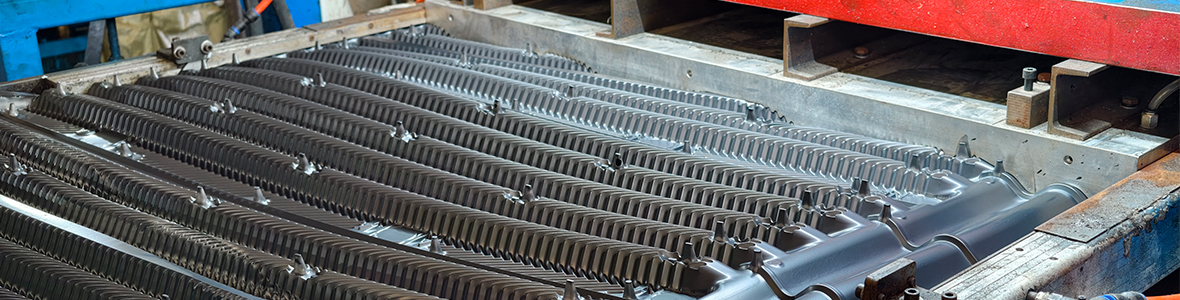
When you look inside a cooling tower, the fill may seem like a simple collection of sheets, blocks, or splash bars. But don't let its appearance fool you. Cooling tower fills material plays a major role in heat transfer, operating reliability, maintenance, and service life.
So, what materials are commonly used for cooling tower fill?
PVC is probably the name you'll encounter most often. PP is another important option, especially when higher temperature resistance is needed. You may also come across 304SS and other stainless-steel materials in specialized cooling applications or tower components. Beyond these, other plastics and engineered materials can be selected for particular operating conditions.
But which one should you choose?
That's where things get interesting.
There isn't one material that wins every application. A material that performs beautifully in a clean-water HVAC tower may be a poor fit for a hot industrial process. Think of it like choosing tires for a vehicle. A racing tire, a winter tire, and an off-road tire are all excellent products—but only when used in the right environment.
In this guide, we'll break down the major cooling tower fill material types, including PVC, PP, 304SS, and other options, so you can make a more informed decision.
Why Cooling Tower Fill Material Matters
Cooling tower fill creates the environment where hot water and air interact.
Hot water enters the tower and flows across or through the fill. At the same time, air passes through the fill. The fill increases the contact area between the two fluids, allowing heat to move from the water into the air.
That sounds simple, right?
In reality, the material must survive a demanding environment.
It may be exposed to:
A suitable material needs to maintain its physical properties under these conditions.
That's why choosing cooling tower fills material shouldn't be treated as a simple purchasing decision. It is part of the tower's overall thermal and mechanical design.
What Is Cooling Tower Fill Material?
Cooling tower fill material is the media installed inside a cooling tower to increase water-to-air contact.
Without fill, water would simply fall through the tower relatively quickly. The available contact area would be much smaller.
Fill changes that.
It spreads water into thin layers or breaks it into droplets, depending on the fill design. This creates more opportunities for heat transfer and evaporation.
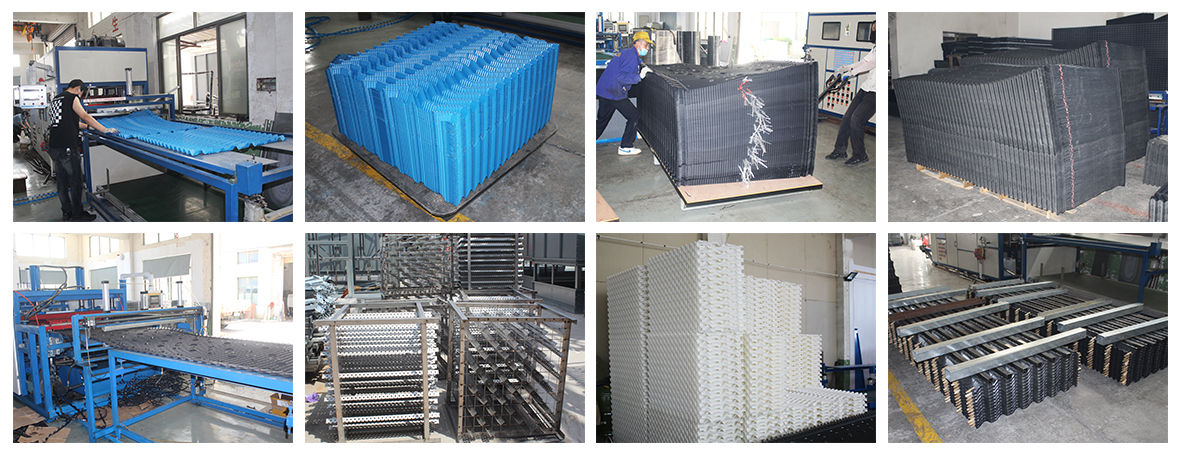
Modern cooling tower fill is often manufactured from lightweight plastics because they provide a useful combination of corrosion resistance, low weight, processability, and cost.
However, plastics aren't the only possibility.
For demanding environments, other materials—including stainless steel—may be considered for particular components or specialized designs.
How Fill Material Supports Heat Transfer
Imagine pouring a glass of water onto a flat floor. The water spreads, but the interaction with surrounding air is limited.
Now imagine that same water flowing through a carefully designed network of surfaces. The water spreads into thinner layers and remains in contact with air for longer.
That's essentially what cooling tower fill is trying to accomplish.
The material itself doesn't create cooling magic. The geometry, surface characteristics, spacing, water distribution, and airflow all work together.
The material simply needs to maintain that geometry and performance under actual operating conditions.
Film Fill vs. Splash Fill
Cooling tower fill can broadly be divided into film fill and splash fill.
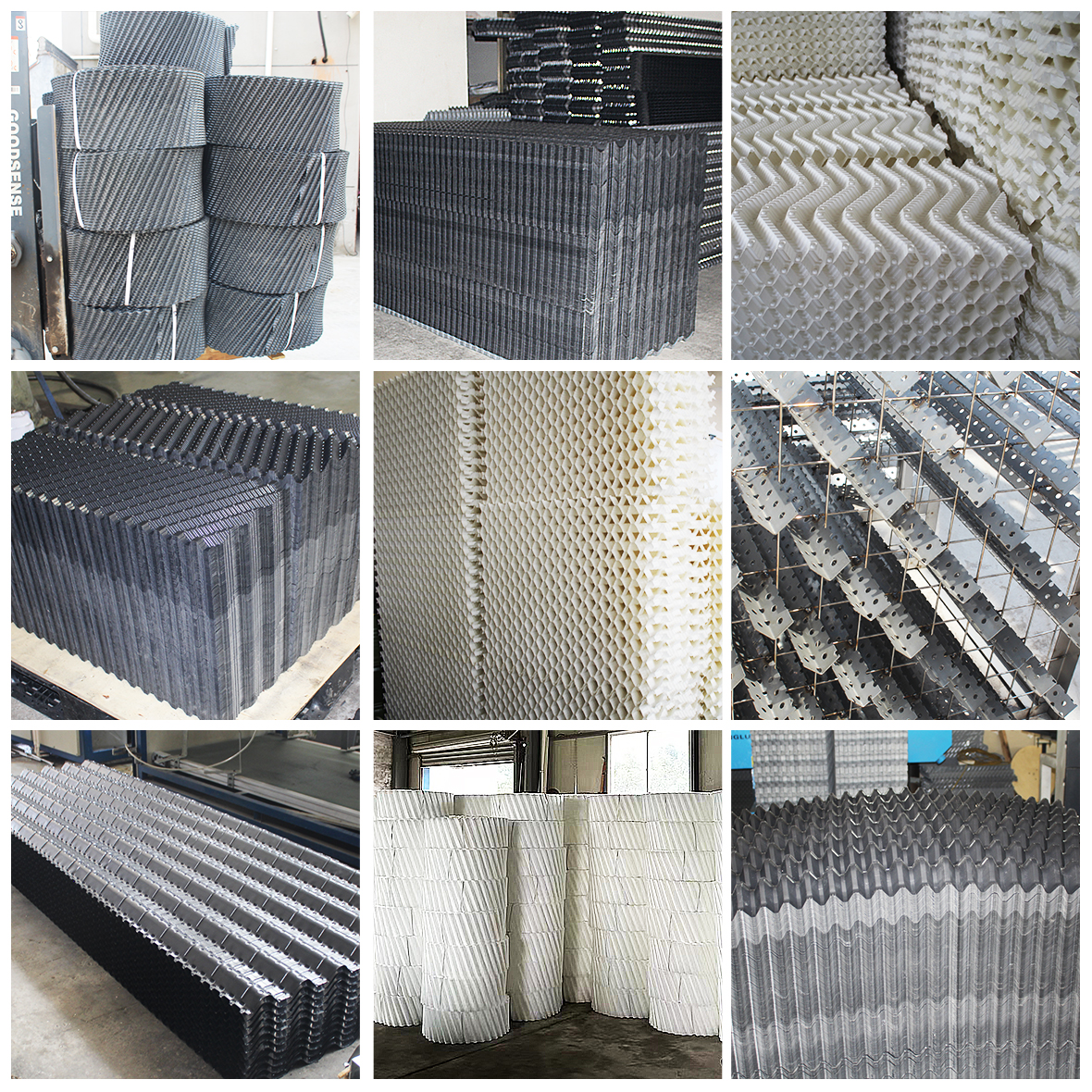
Film fill uses sheets or structured surfaces to spread water into thin films. Because the water forms a large surface area, film fill can provide strong heat-transfer performance in relatively compact spaces.
Splash fill works differently. Water falls through a series of bars or grids and is repeatedly broken into droplets.
This difference matters when selecting material.
Film fill is often used where water quality can be controlled and high surface area is desirable. Splash fill may be considered for applications where larger passages and greater tolerance for suspended solids are important.
So, don't ask only, "Which material is better?"
Ask, "Which material and fill design work best together in my tower?"
Common Cooling Tower Fill Materials
Let's take a closer look at the most relevant materials.
PVC Cooling Tower Fill
PVC, or polyvinyl chloride, is one of the most widely recognized materials for cooling tower fill.
It is commonly used for film-type fill because it can be formed into corrugated or structured sheets with controlled geometry.
PVC offers several practical advantages.
It is relatively lightweight, widely available, economical for many applications, and resistant to many common cooling-water conditions.
For conventional HVAC and industrial cooling systems with appropriate operating temperatures, PVC can be a very practical solution.
Advantages of PVC Fill
Why is PVC so widely used?
First, it provides a good balance between performance and cost.
Second, PVC can be processed into different surface patterns and configurations. This gives manufacturers flexibility when designing fill for specific tower requirements.
Third, PVC has useful corrosion resistance compared with many traditional metallic materials.
And finally, it is relatively easy to handle during installation and replacement.
For many standard applications, that's a pretty attractive package.
Limitations of PVC Fill
PVC isn't perfect.
The biggest consideration is temperature.
Every PVC fill product has a suitable operating range, and actual performance depends on formulation, thickness, geometry, and operating conditions.
If the water temperature is too high, PVC can lose stiffness or deform.
PVC can also be affected by certain chemical environments, particularly when concentrations and temperatures are outside the conditions for which the material was designed.
So, don't select PVC simply because it is common.
Check the actual operating conditions first.
PP Cooling Tower Fill
PP stands for polypropylene.
Like PVC, PP can be manufactured into structured cooling tower fill. But PP becomes especially interesting when operating temperatures or chemical conditions make PVC less attractive.
PP has good chemical resistance and generally offers higher temperature capability than standard PVC products.
This makes it a valuable option for certain industrial cooling applications.
Advantages of PP Fill
PP offers several characteristics that can make it attractive for demanding applications.
These include:
Good temperature resistance
Good chemical resistance
Low water absorption
Lightweight construction
Good dimensional stability under suitable conditions
Suitability for various industrial applications
If you're dealing with a process that pushes temperatures upward, PP deserves serious consideration.
When Should You Choose PP?
PP may be worth considering when:
Water temperature is relatively high
Chemical exposure is demanding
Low moisture absorption is desirable
The application requires a more temperature-resistant plastic
Industrial operating conditions are more severe than typical HVAC conditions
However, higher material capability doesn't automatically mean better tower performance.
If your tower operates at moderate temperatures with well-controlled water, PVC may already meet your requirements.
There's no prize for buying more material capability than you actually need.
304SS Cooling Tower Fill
304SS refers to 304 stainless steel, a widely used stainless-steel grade known for its corrosion resistance and mechanical properties.
But there's an important distinction to make.
304SS is not a typical replacement for PVC or PP in conventional plastic film-fill applications. Instead, stainless steel may be considered in specialized cooling applications or for certain tower components where mechanical strength, temperature capability, or specific corrosion resistance is required.
This distinction is important when someone searches for "304SS cooling tower fill."
The first question should be:
Do you actually need stainless-steel fill, or do you need stainless-steel components supporting the cooling system?
In many conventional towers, plastic fill remains the practical choice.
Benefits of 304SS
Where stainless steel is appropriate, its advantages can include:
Strong mechanical properties
Good resistance to many corrosive environments
High-temperature capability
Good dimensional stability
Long service potential when properly specified and maintained
For specialized industrial environments, these characteristics can be valuable.
Limitations of 304SS
There is a trade-off.
304SS is typically much heavier and more expensive than plastic fill materials.
It also doesn't automatically provide better heat-transfer performance simply because it is metallic.
And corrosion resistance is not absolute.
Certain chemical environments, chloride exposure, temperature conditions, and water chemistry can create corrosion concerns even for stainless steel.
That's why stainless-steel selection should be based on actual water chemistry and application requirements—not simply the assumption that "stainless means corrosion-proof."
HDPE and Other Plastic Materials
PVC and PP aren't the only materials available.
Depending on the application, manufacturers may use other engineered plastics, including HDPE or specialty plastic formulations.
HDPE can offer good toughness and chemical resistance and may be useful in particular cooling applications.
Other engineered materials may be selected when the system has unusual requirements involving temperature, chemical exposure, mechanical strength, or manufacturing constraints.
However, the material name is only part of the story.
Two fills made from the same basic polymer can perform differently because of:
Sheet thickness
Additives
Surface pattern
Corrugation
Manufacturing process
Welding method
Support structure
Installation quality
That's why you should evaluate the complete fill specification rather than looking at the material label alone.
PVC vs. PP vs. 304SS
So how do these materials compare?
| Factor | PVC | PP | 304SS |
| Typical use | Conventional film fill | Industrial/higher-temperature fill | Specialized applications/components |
| Weight | Low | Low | High |
| Temperature capability | Moderate, application dependent | Generally higher | High |
| Chemical resistance | Good in suitable conditions | Very good for many applications | Good, application dependent |
| Corrosion resistance | Good | Good | Good to very good, depending on chemistry |
| Relative cost | Generally economical | Moderate | Generally higher |
| Ease of handling | Easy | Easy | More demanding |
| Typical fill application | Very common | Common in suitable systems | Specialized |
This table is a general guide. The actual suitability of a product depends on its specific design, formulation, manufacturing quality, and operating conditions.
Temperature Resistance
Temperature is often one of the fastest ways to narrow down your options.
If your cooling water operates at moderate temperatures, PVC may be completely adequate.
If temperatures are higher, PP may offer more flexibility.
For extreme or specialized conditions, metallic materials may enter the conversation.
But always check the manufacturer's actual operating-temperature specification.
Why?
Because "maximum temperature" can mean different things depending on whether exposure is continuous, intermittent, or associated with abnormal operating conditions.
Corrosion and Chemical Resistance
Cooling tower water isn't simply water.
It may contain treatment chemicals, dissolved minerals, disinfectants, corrosion inhibitors, and other substances.
PVC and PP generally offer useful resistance to many common chemicals, but compatibility depends on the exact chemical and concentration.
304SS can also perform well in many environments, but it isn't immune to every form of corrosion.
The correct approach is simple:
Match the material to the actual water chemistry.
If you're unsure, provide the manufacturer with a water-analysis report rather than guessing.
Fouling and Clogging Resistance
Here's a common misconception: people sometimes assume a certain material automatically prevents clogging.
It doesn't.
Clogging is strongly influenced by fill geometry and water quality.
A tightly spaced film fill can provide excellent heat transfer but may be more vulnerable to blockage when water contains large amounts of suspended solids.
A more open splash-fill design may be better suited to some dirty-water applications.
In other words, material and geometry must be considered together.
Durability and Service Life
How long will cooling tower fill last?
There's no universal number.
Service life depends on operating temperature, water chemistry, biological growth, mechanical stress, cleaning practices, UV exposure, and installation.
A high-quality PVC fill operating under controlled conditions may provide long service.
A PP fill can also provide long service under suitable conditions.
Stainless steel may offer excellent mechanical durability in appropriate environments.
But poor water treatment can shorten the life of almost any material.
How Water Quality Affects Material Selection
Water quality is one of the most important variables in cooling tower fill selection.
Clean Water Systems
When water is relatively clean and properly treated, film fill can be a strong option.
Its high surface area can help maximize air-water interaction while keeping the tower compact.
PVC film fill is frequently considered for these types of applications.
PP may also be appropriate when temperature or chemical requirements justify it.
Dirty or High-Solids Water
Industrial cooling water can be much more challenging.
If your water contains sediment, suspended solids, algae, oil, or biological deposits, fill selection becomes more complicated.
In these situations, a more open fill configuration may help reduce blockage.
Regular filtration, water treatment, blowdown, and cleaning are also important.
Don't expect a different material alone to solve a water-quality problem.
How to Choose the Right Cooling Tower Fill Material
Now let's turn all of this information into a practical selection process.
Consider Operating Temperature
Start with the water temperature.
Record:
Entering water temperature
Leaving water temperature
Normal operating temperature
Maximum temperature
Possible temperature spikes
Then compare those conditions with the manufacturer's recommended material range.
Consider Water Chemistry
Next, look at the water.
Check:
This information can immediately eliminate some unsuitable materials.
Consider Tower Type
Your tower configuration matters too.
Is it:
The fill must physically and thermally match the tower.
Consider Maintenance and Replacement
Think beyond installation day.
Can your team access the fill?
How often can it be cleaned?
How easy is replacement?
What happens if the fill becomes clogged?
A material that costs slightly more upfront may make financial sense if it reduces downtime or replacement frequency.
Common Mistakes When Selecting Fill Material
One of the biggest mistakes is selecting fill based purely on price.
Another is assuming PVC, PP, or stainless steel is automatically "better."
A third mistake is ignoring water quality.
Buyers sometimes focus heavily on material while overlooking fill thickness, geometry, spacing, water distribution, and airflow.
That's like buying a high-performance engine and then putting the wrong transmission behind it.
The components need to work together.
Before purchasing, ask your supplier:
What material is recommended for my water temperature?
Is the material compatible with my water chemistry?
Is it suitable for film or splash fill?
What tower configuration is it designed for?
What are the fill dimensions?
What cleaning methods are acceptable?
What information is needed to confirm compatibility?
Can replacement fill be manufactured to my existing dimensions?
These questions can save considerable time and money.
Cooling Tower Fill Material from Power Tower Cooling Technology

Power Tower Cooling Technology (Shaoxing) Co.,Ltd provides cooling tower fill and related cooling tower components for different industrial and commercial applications.
When selecting a cooling tower fill material, the company can consider the complete operating environment rather than looking at material type in isolation.
For example, the choice between PVC and PP may depend on operating temperature, while the choice between film fill and splash fill may depend heavily on water quality and suspended solids.
For specialized applications involving stainless steel or other materials, the actual water chemistry, temperature, structural requirements, and system design should be evaluated before specifying the material.
If you're looking for cooling tower fill products, replacement fill, or related cooling tower components, you can visit the company's website for more information:
coolingtowerpart.com
Final Thoughts
There is no universal "best" cooling tower fills material.
PVC remains a practical and widely used choice for many conventional cooling tower applications. PP becomes particularly attractive when higher temperature resistance or demanding chemical conditions are involved. 304SS can have an important role in specialized applications and tower components where mechanical strength and metallic construction are required.
But material selection should never happen in isolation.
The best decision considers:
Water temperature
Water chemistry
Suspended solids
Tower configuration
Fill type
Heat load
Water flow
Maintenance requirements
Expected service life
Total operating cost
So, before you ask, "Should I use PVC, PP, or 304SS?", take one step back.
Ask a more useful question:
"What material will perform reliably under the actual conditions inside my cooling tower?"
Once you answer that, the right material becomes much easier to identify.


