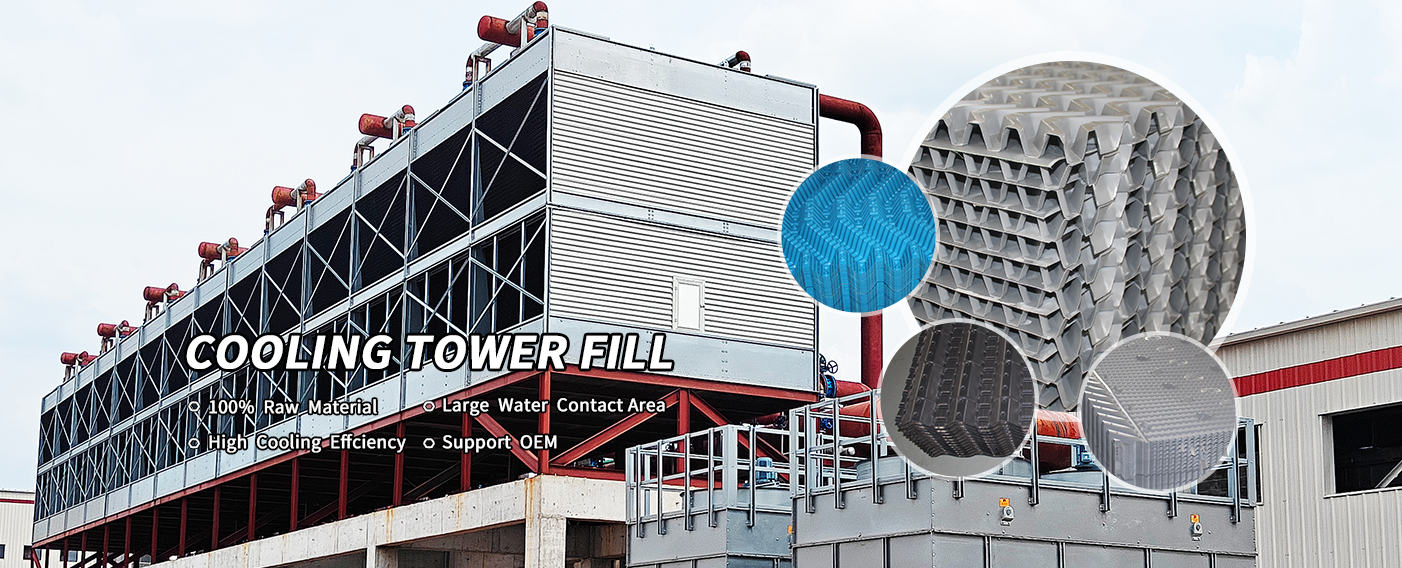
Selecting the right fill for cooling tower replacement projects is more than replacing old sheets with new ones. The cooling tower fill directly affects water-air contact, heat transfer, airflow resistance, maintenance, and overall tower performance.
Whether you are replacing damaged fill during routine maintenance or upgrading an aging industrial cooling tower, the replacement fill should match the tower's design, operating conditions, and water quality.
This guide explains how to select the right cooling tower fill replacement, including film fill, splash fill, PVC fill, and PP fill.
What Is Cooling Tower Fill?
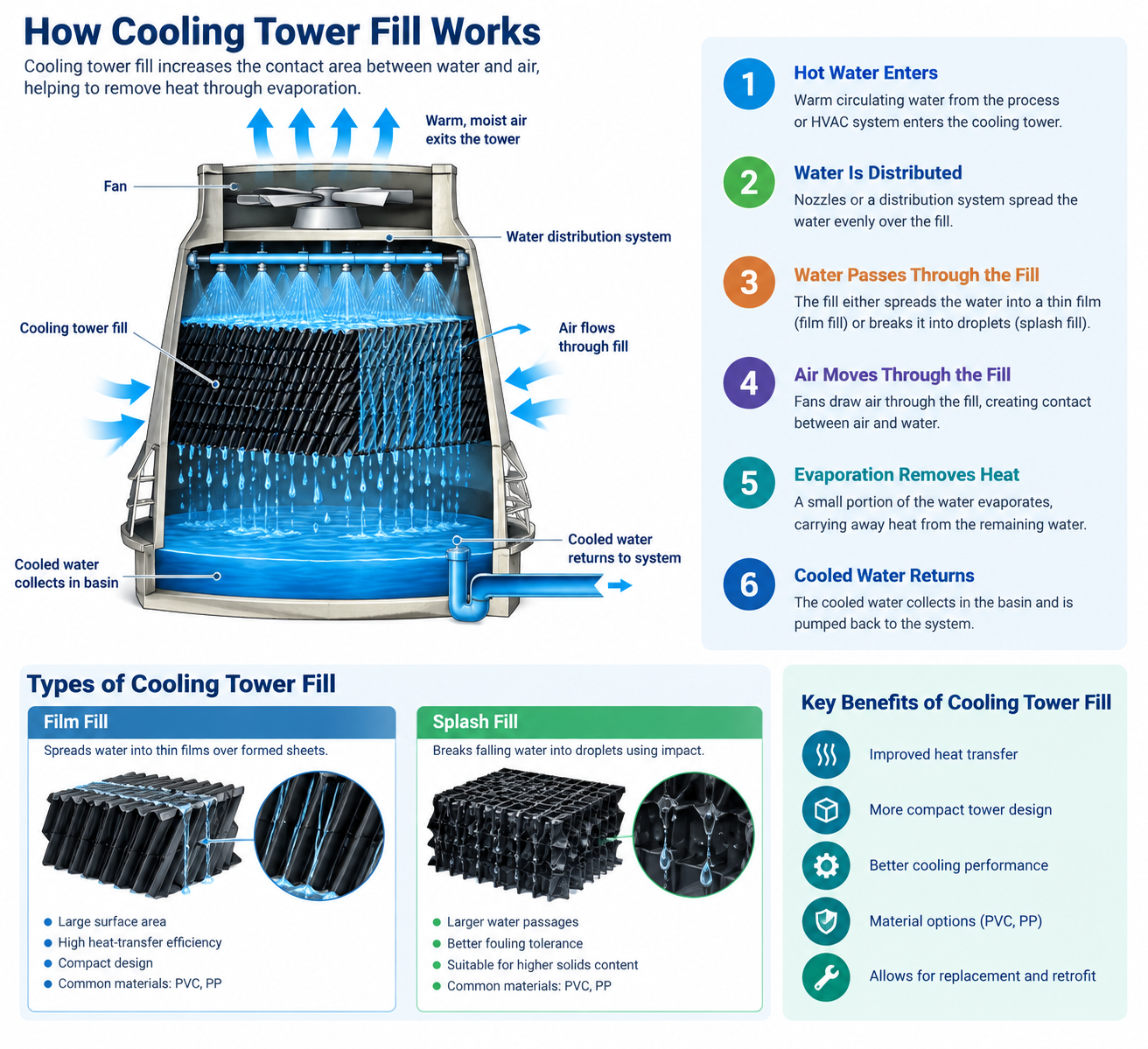
Cooling tower fill, also called fill media, is installed inside a cooling tower to increase the contact area between circulating water and air.
As hot water passes through the fill, the fill spreads the water into thin films or breaks it into smaller streams and droplets. Air moving through the tower contacts the water, allowing heat to transfer from the water to the air.
Common cooling tower fill types include:
PVC film fill
PP film fill
PP splash fill
PVC splash fill
Splash bars
Splash grids
Hybrid fill systems
The correct choice depends on the cooling tower design and operating environment.
Why Is Correct Fill Selection Important?
Choosing unsuitable fill can create several problems.
Fill with the wrong dimensions may not fit the existing supports. Incorrect sheet geometry can change water distribution and airflow resistance. Fill that is unsuitable for the water quality may also foul or deteriorate quickly.
The right cooling tower fill replacement should provide:
For industrial applications, the lowest initial purchase price is not necessarily the lowest total cost.
Step 1: Identify the Cooling Tower Type
Start by identifying the tower configuration.
The two common configurations are:
Crossflow Cooling Tower
In a crossflow tower, air generally moves horizontally through the fill while water flows downward.
Crossflow towers commonly use film or splash fill depending on the tower design and water quality.
Counterflow Cooling Tower
In a counterflow tower, air moves upward while water flows downward.
Counterflow cooling towers commonly use vertically oriented film fill or other fill configurations designed specifically for counterflow operation.
Do not assume that fill designed for one tower configuration will work correctly in another.
Step 2: Check the Existing Fill Dimensions
Before ordering replacement fill, measure the existing installation.
Important dimensions include:
Fill pack length
Fill pack width
Fill pack height
Sheet thickness
Sheet spacing
Corrugation pattern
Support configuration
Number of fill packs
If the original manufacturer information is available, use it together with physical measurements.
For an existing tower, photographs of the fill, support structure, water distribution system, and tower interior can also help a supplier identify a compatible replacement.
Step 3: Choose Film Fill or Splash Fill
One of the most important decisions is choosing between film fill and splash fill.
Film Fill
Film fill spreads water across the surface of specially formed sheets. This creates a large effective surface area for heat and mass transfer.
Advantages include:
PVC and PP are common materials for film fill.
Film fill generally requires reasonably good water quality because scale, sediment, algae, and biological growth can block the passages.
Splash Fill
Splash fill works by repeatedly breaking water into smaller streams or droplets as it falls over splash bars, grids, or other surfaces.
Advantages can include:
Better tolerance of suspended solids
Greater resistance to some fouling conditions
Robust construction
Easier access for certain maintenance applications
Splash fill is often considered for industrial cooling towers with challenging water conditions.
Step 4: Select PVC or PP Fill
Material selection is another important consideration.
PVC Cooling Tower Fill
PVC cooling tower fill is widely used for film-fill applications.
PVC offers good formability, chemical resistance, and cost efficiency for many cooling tower environments.
It is commonly selected for HVAC and industrial cooling tower fill replacement projects where operating conditions are suitable for PVC.
PP Cooling Tower Fill
PP cooling tower fill is commonly used for both film and splash applications.
Polypropylene can provide good resistance to higher operating temperatures and various chemical environments compared with some alternative plastics.
The actual suitability of PVC or PP should be confirmed against the tower's water chemistry and operating temperature.
Step 5: Consider Water Quality
Water quality is one of the most important factors when selecting replacement fill.
Ask:
Does the circulating water contain suspended solids?
Is the tower exposed to heavy biological growth?
Is scale formation a recurring problem?
Is the water treated?
How frequently is the fill cleaned?
For relatively clean water, film fill can provide excellent thermal performance.
For water containing significant solids or debris, splash fill may be more practical because its larger passages are generally less prone to blockage.
However, fill selection should be based on the actual water treatment program and tower operating conditions.
Step 6: Check Operating Temperature
Replacement fill must be suitable for the tower's operating temperature.
Record:
Different plastics and fill designs have different temperature limits.
For higher-temperature industrial applications, PP cooling tower fill may be considered where its material properties are appropriate.
Always confirm the supplier's recommended operating range before ordering.
Step 7: Match Water and Air Flow Requirements
Cooling tower fill does not operate independently.
The fill must work with the tower's existing water distribution and airflow system.
Important operating data includes:
Circulating water flow
Airflow
Heat load
Entering water temperature
Leaving water temperature
Entering air wet-bulb temperature
A fill design that produces excessive airflow resistance can affect fan performance. Conversely, insufficient water wetting can reduce the effective heat-transfer area.
The replacement fill should therefore be evaluated as part of the complete cooling tower system.
Step 8: Inspect the Water Distribution System
Replacing fill without checking the distribution system can leave the original problem unresolved.
Inspect:
If nozzles are blocked or damaged, new fill may not receive uniform water coverage.
For this reason, many cooling tower maintenance projects replace or inspect fill and nozzles at the same time.
Step 9: Consider Fill Fouling and Maintenance
A new fill pack will eventually accumulate deposits if water treatment and cleaning are inadequate.
Before selecting replacement fill, consider the maintenance environment.
For film fill, check the size and geometry of the passages. For splash fill, evaluate the accessibility of splash bars or grids for inspection and cleaning.
A slightly different fill design may sometimes provide better long-term performance if the existing system has a history of severe blockage.
Step 10: Verify Installation Compatibility
Physical compatibility is critical.
Before placing an order, verify:
Fill pack dimensions
Support beam locations
Fill orientation
Water-flow direction
Air-flow direction
Retaining hardware
Spacers
Packing configuration
Access restrictions
For retrofit projects, replacement fill may need to be cut or configured to fit the existing tower structure.
A supplier should receive accurate measurements rather than relying only on the cooling tower brand or model.
Cooling Tower Fill Replacement Checklist
Use the following checklist when purchasing replacement fill:
| Selection Factor | What to Check |
| Tower type | Crossflow or counterflow |
| Fill type | Film or splash |
| Material | PVC or PP |
| Dimensions | Length, width, height |
| Water flow | Design and operating flow |
| Airflow | Existing fan and airflow |
| Water quality | Solids, scale, biological growth |
| Temperature | Normal and maximum temperature |
| Thermal duty | Required cooling performance |
| Installation | Supports and orientation |
| Maintenance | Cleaning and inspection requirements |
Common Mistakes When Replacing Cooling Tower Fill
Choosing Only by Price
Low-cost fill may not provide the required thermal performance or service life.
Matching Dimensions but Ignoring Geometry
Two fill packs with similar dimensions can have different sheet spacing, corrugation patterns, and pressure-drop characteristics.
Ignoring Water Quality
A high-performance film fill may perform poorly if the tower has severe fouling or suspended-solid problems.
Not Checking Airflow
Changing fill geometry can affect airflow resistance and fan operation.
Replacing Fill Without Checking Nozzles
Poor water distribution can reduce the performance of new fill.
How to Buy Cooling Tower Fill Replacement
For a successful replacement project, provide the supplier with as much information as possible.
Useful information includes:
Cooling tower manufacturer and model
Crossflow or counterflow configuration
Existing fill type
Fill dimensions
Fill material
Water temperature
Circulating water flow
Photos of existing fill
Water quality information
Required delivery quantity
This information allows the supplier to recommend a more suitable cooling tower fill replacement instead of simply supplying a generic product.
Frequently Asked Questions
What is the best fill for cooling tower replacement?
There is no single best fill for every tower. Film fill is often selected for high thermal performance, while splash fill can be suitable for applications with more challenging water quality. The choice should match the tower design and operating conditions.
Can PVC fill replace PP fill?
Potentially, but material suitability depends on operating temperature, water chemistry, fill design, and thermal requirements. A direct material substitution should be confirmed before installation.
How do I measure cooling tower fill?
Measure the length, width, and height of the fill pack and record sheet thickness and spacing where possible. Also document the fill orientation and support arrangement.
How often should cooling tower fill be replaced?
There is no fixed replacement interval. Fill should be inspected regularly and replaced when it becomes damaged, deformed, severely fouled, brittle, or unable to provide the required cooling performance.
Can I replace only part of the cooling tower fill?
In some projects, partial replacement is possible. However, the replacement section should be compatible with the existing fill and tower structure, and the effect on water distribution and thermal performance should be evaluated.
Conclusion
Selecting fill for cooling tower replacement projects requires more than matching the old fill's dimensions. Tower type, fill design, material, water quality, operating temperature, water flow, airflow, thermal duty, and installation conditions all need to be considered.
PVC film fill, PP film fill, and splash fill each have different advantages. The right selection can help restore cooling performance while reducing maintenance problems and extending the service life of the cooling tower.
For industrial retrofit projects, work with a cooling tower fill supplier that can review your existing dimensions and operating conditions before recommending a replacement.
Internal Links for Other CoolingTowerParts
Cooling Tower Fill
Cooling Tower Nozzles
Cooling Tower Drift Eliminators
Cooling Tower Louvers
Cooling Tower Fan Blades
Cooling Tower Motors


