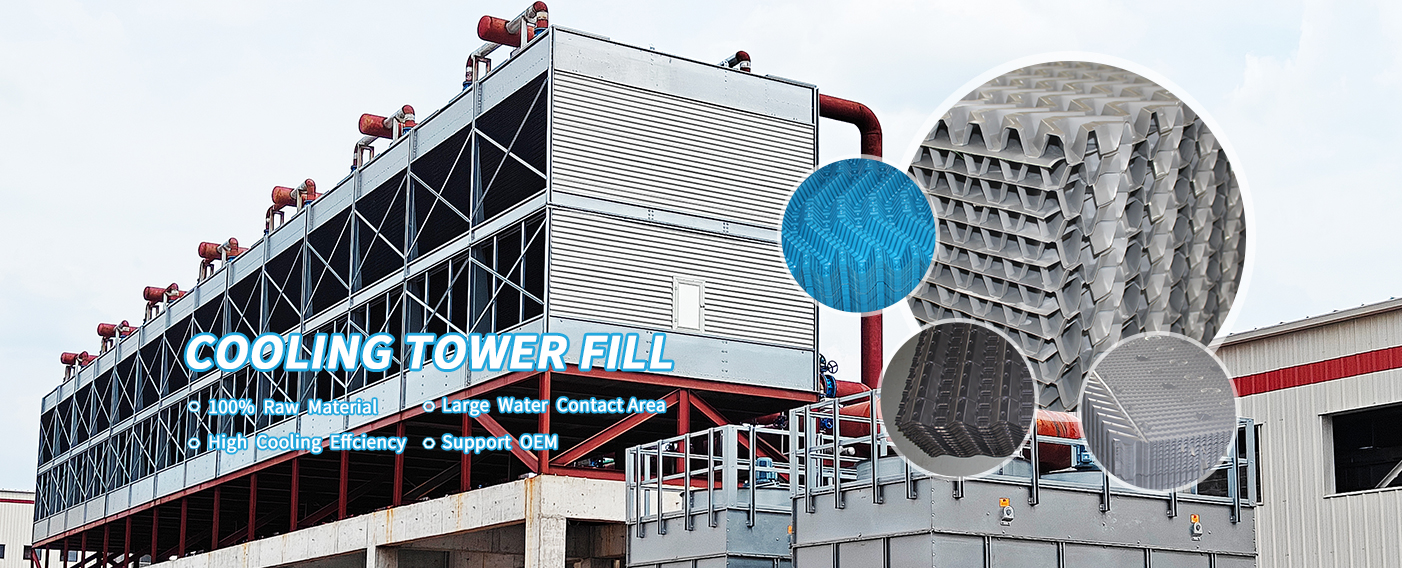
Choosing the right cooling tower fills material can make a surprisingly big difference to cooling performance, maintenance costs, and the service life of your cooling tower.
But here is the tricky part: there is no single fill material that is perfect for every cooling tower.
A fill that works extremely well in a clean-water HVAC system may not be the right choice for an industrial tower handling warm, contaminated, or chemically treated water. The same is true when comparing PVC and PP fills. The material, fill design, water quality, operating temperature, and tower configuration all need to work together.
So, what should you choose?
In this guide, we will look at the most common cooling tower fills materials, compare their characteristics, and explain how to select the right option for your specific tower.
Why Cooling Tower Fill Material Matters
Think of cooling tower fill as the working surface inside the tower.
Hot water enters the tower and needs to release heat to the surrounding air. The fill slows the water down, spreads it over a large surface area, and creates better contact between water and air.
The larger and more effective this contact area is, the more efficiently heat can be transferred.
That means the material used to manufacture the fill needs to withstand continuous exposure to water, heat, chemicals, biological growth, and mechanical stress.
A good fill material should ideally offer:
Good heat-transfer performance
Adequate temperature resistance
Chemical resistance
Low water absorption
Structural stability
Resistance to fouling and degradation
Long service life
Easy maintenance
Reasonable cost
The right balance depends on the operating conditions of your cooling tower.
What Is Cooling Tower Fill Material?
Cooling tower fill material is the media installed inside a cooling tower to increase the contact area between circulating water and air.
Instead of allowing water to simply fall from the distribution system to the basin, fill media breaks the water into thin films, droplets, or flowing layers.
This increases the effective contact area and gives heat more opportunity to move from the water into the air.
Most modern cooling tower fill is made from engineered plastics because plastics can provide a useful combination of low weight, corrosion resistance, manufacturability, and durability.
The most commonly discussed materials include PVC and PP, although other materials can be used for specialized applications.
How Cooling Tower Fill Works
The basic process is straightforward.
Hot water enters the upper section of the tower and is distributed across the fill. As the water travels downward, air moves through the fill.
Heat transfers from the warmer water to the air. A small portion of the water also evaporates, removing additional heat from the circulating water.
You can think of the fill as creating a huge “meeting place” for water and air.
The more effectively that meeting happens, the more heat the tower can reject.
Film Fill vs. Splash Fill
Cooling tower fill generally falls into two major categories: film fill and splash fill.
Film fill uses closely spaced sheets or structured surfaces to spread water into thin films. It can provide a large surface area within a relatively compact volume and is widely used in many industrial and HVAC cooling towers.
Splash fill works differently. Instead of creating a continuous film, it repeatedly breaks the water into droplets as water falls over or through the fill.
Splash fill can be useful when water contains suspended solids or when resistance to fouling is particularly important.
The choice is therefore not simply “which material is strongest?” The fill design and material need to match the water and operating conditions.
Common Cooling Tower Fills Materials
Several materials can be considered for cooling tower fill, but PVC and PP are among the most widely used plastic options.
Each has its own strengths.
PVC Cooling Tower Fill
PVC, or polyvinyl chloride, is a popular material for cooling tower film fill.
One reason is its balance of cost, mechanical performance, chemical resistance, and manufacturing flexibility.
PVC fill can be produced with carefully controlled sheet thickness, surface patterns, spacing, and corrugation. These characteristics influence water distribution and air-water contact.
For many conventional cooling tower applications, PVC provides a practical combination of performance and economy.
However, PVC is not automatically the best choice for every high-temperature application. Operating temperature should always be checked against the actual fill specification.
PP Cooling Tower Fill
PP, or polypropylene, is another important material for cooling tower fill.
One of its major advantages is its ability to handle higher temperatures than many standard PVC fill products.
This can make PP attractive for industrial systems where the circulating water temperature is relatively high.
PP also offers good chemical resistance and low moisture absorption.
If your cooling tower operates under demanding thermal or chemical conditions, PP may be worth considering.
Other Cooling Tower Fill Materials
Other materials may be used for specific applications, including specialty plastics and materials designed for particular industrial environments.
However, material selection should always be based on actual operating conditions rather than simply choosing the most expensive material.
A premium material does not automatically create better cooling if the fill geometry, water distribution, airflow, or tower design is incorrect.
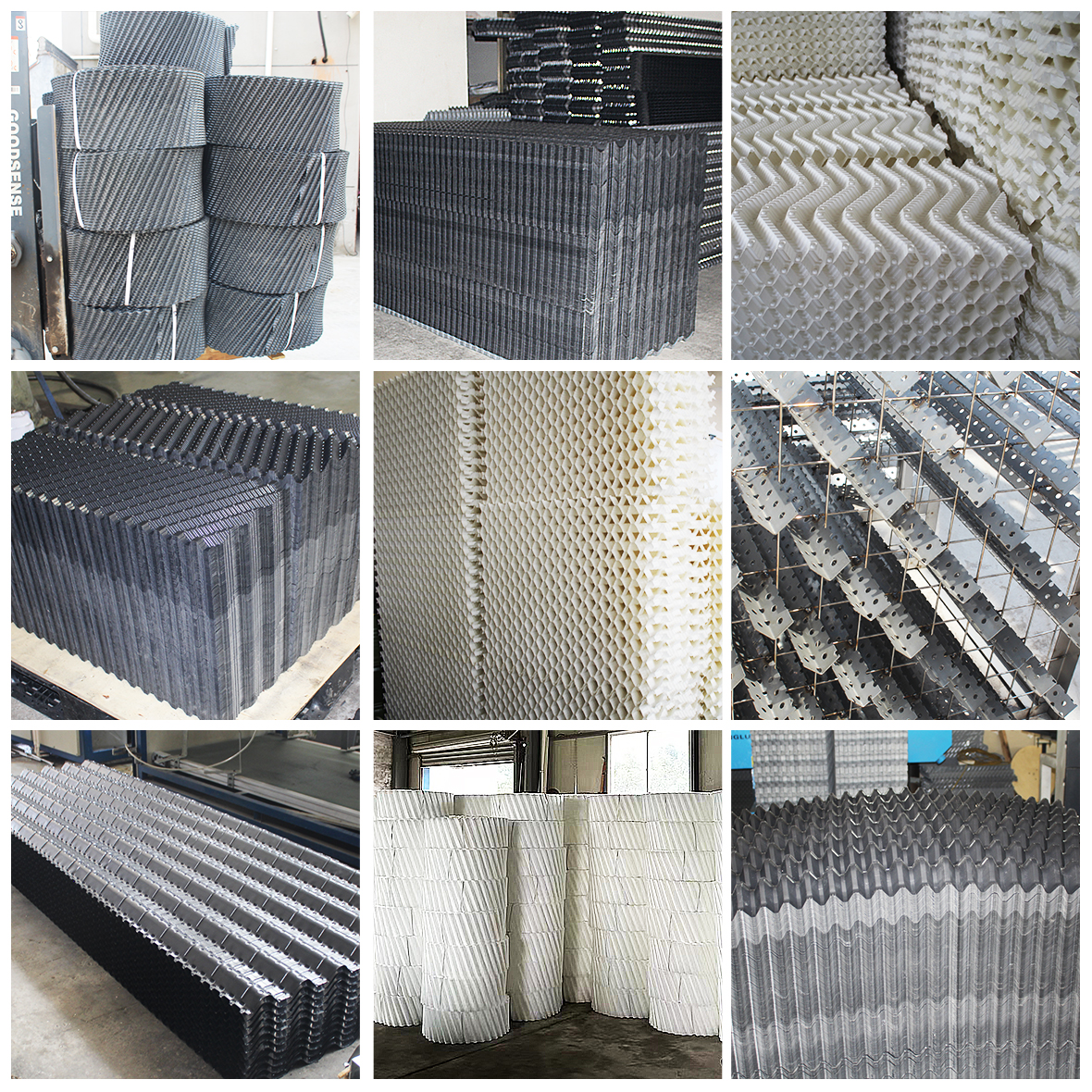
PVC vs. PP Cooling Tower Fill Material
So, PVC or PP?
This is one of the most common questions when selecting cooling tower fills material.
The answer depends heavily on the application.
| Factor | PVC Fill | PP Fill |
| Typical applications | HVAC and general industrial cooling | Industrial and higher-temperature applications |
| Temperature capability | Good for many standard systems | Generally higher temperature capability |
| Chemical resistance | Good | Very good for many applications |
| Weight | Lightweight | Lightweight |
| Cost | Often economical | Can be higher |
| Processing | Widely manufactured | Widely manufactured |
| High-temperature suitability | Application dependent | Often advantageous |
| Water absorption | Low | Very low |
These are general comparisons. The exact performance depends on the specific formulation, thickness, geometry, additives, manufacturing process, and operating conditions.
Temperature Resistance
Temperature is one of the first factors you should check.
Why?
Because cooling tower fill sits in a hot, wet environment continuously. If the material is exposed to temperatures beyond its suitable operating range, it may soften, deform, or lose mechanical stability.
PVC is suitable for many conventional cooling tower systems, but PP can offer an advantage in applications requiring greater temperature resistance.
Don't simply ask your supplier, “Is this material heat resistant?”
Instead, provide the actual:
A good manufacturer can then recommend a suitable material and fill design.
Chemical and Corrosion Resistance
Cooling tower water may contain treatment chemicals, dissolved minerals, suspended solids, and other contaminants.
The fill therefore needs to tolerate the actual chemical environment.
Both PVC and PP can provide good resistance to many common chemicals, but the exact compatibility depends on concentration, temperature, exposure time, and chemical composition.
For industrial systems, this is especially important.
A fill may look perfect during installation but deteriorate prematurely if the material is incompatible with the water chemistry.
Fouling and Clogging Resistance
Material alone does not determine whether fill will clog.
Fill geometry matters enormously.
Closely spaced film fill can provide excellent heat-transfer performance, but if the circulating water contains high levels of suspended solids, biological matter, oil, or other contaminants, narrow passages can become blocked.
Splash fill can be more appropriate for some dirty-water applications because its structure generally provides larger passages.
Therefore, don't look at material in isolation.
Ask a bigger question:
What material and fill design work together for my water quality?
Service Life and Durability
Service life depends on much more than whether the fill is PVC or PP.
Important factors include:
Water temperature
UV exposure
Chemical concentration
Biological growth
Mechanical loading
Cleaning methods
Water quality
Fill thickness
Installation quality
Poor water treatment can shorten the life of even a high-quality fill.
On the other hand, a properly selected fill operating under controlled conditions can remain functional for many years.
How Water Quality Affects Material Selection
Water quality is one of the most overlooked factors in cooling tower fill selection.
Imagine buying an expensive pair of shoes for a hiking trip without checking the terrain. They may be excellent shoes, but the wrong shoes for the wrong environment still create problems.
Cooling tower fill works in much the same way.
Clean Water Applications
For relatively clean water systems, film fill can be an excellent option.
HVAC cooling towers and many closed-loop or well-maintained systems can benefit from the high surface area and efficient water distribution offered by film fill.
PVC film fill is commonly considered for these applications because it can provide good performance at a reasonable cost.
Hard, Dirty, or Contaminated Water
Industrial water can be much more challenging.
If the water contains:
then clogging and fouling become major concerns.
In these conditions, a more open fill design may be preferable.
This is why the question “What is the best cooling tower fills material?” cannot be answered without discussing water quality.
How Operating Temperature Changes Your Choice
Temperature can change the answer significantly.
For a standard HVAC tower with moderate operating temperatures, PVC may provide an efficient and economical solution.
For an industrial tower operating at higher temperatures, PP may be a more suitable option depending on the exact operating conditions.
But don't make the decision based on a generic temperature number from a catalog.
Consider the actual operating environment.
A tower may experience different temperatures during startup, summer operation, peak production, cleaning, and abnormal conditions.
Your fill should be selected with those conditions in mind.
Film Fill or Splash Fill: Which Material Is Better?
This is another area where buyers sometimes compare the wrong things.
Film fill and splash fill are different designs, not simply different materials.
Film fill focuses on creating thin water films and maximizing air-water contact.
Splash fill focuses on repeatedly breaking water into droplets.
If your water is clean and you want high heat-transfer efficiency in a compact tower, film fill may be attractive.
If your water is heavily contaminated or contains suspended solids, splash fill may deserve closer consideration.
The right choice depends on the whole system.
How to Choose the Best Cooling Tower Fills Material
Before ordering replacement fill or specifying fill for a new cooling tower, evaluate several factors.
Consider Tower Type
First identify whether your tower is:
Counterflow
Crossflow
Mechanical draft
Natural draft
Industrial
HVAC
Open circuit
Closed circuit
Different tower configurations use different fill designs.
A fill designed for one tower should not automatically be assumed to fit another.
Consider Heat Load and Water Flow
The cooling tower's heat load and water circulation rate also matter.
You should know:
Required heat rejection
Water flow rate
Entering water temperature
Leaving water temperature
Ambient wet-bulb temperature
Airflow
Existing fill dimensions
These details help determine whether a particular fill can deliver the required thermal performance.
Consider Maintenance Requirements
How often can your team inspect and clean the fill?
This matters more than many buyers realize.
If access is difficult and water quality is poor, choosing a fill that is easier to inspect and maintain may reduce long-term operating problems.
The cheapest fill is not necessarily the lowest-cost solution.
Total cost includes purchase price, cleaning, replacement, downtime, labor, and lost cooling capacity.
Common Mistakes When Choosing Fill Material
One common mistake is choosing fill based only on price.
Another is choosing a material without checking water temperature.
A third mistake is ignoring water quality.
Some buyers also replace old fill with a similar-looking product without checking dimensions, spacing, support requirements, and thermal characteristics.
Here are several questions worth asking before purchasing:
Is the material compatible with my water chemistry?
Can it handle my operating temperature?
Is the fill suitable for my tower design?
Can it handle the expected water flow?
Is the fill appropriate for my water cleanliness?
How easy is it to clean?
What is the expected service life?
Does the manufacturer provide technical support?
A few minutes spent answering these questions can prevent an expensive replacement mistake.
When Should Cooling Tower Fill Be Replaced?
Cooling tower fill does not have one universal replacement interval.
Instead, inspect its actual condition.
Signs that replacement may be necessary include:
If water temperature remains too high even though pumps and fans are operating correctly, degraded fill could be part of the problem.
Regular inspection is therefore essential.
Don't wait until the tower completely loses performance.
Why Manufacturer Quality Matters
Even the right material can perform poorly if the fill is manufactured incorrectly.
Sheet thickness, corrugation, welding or bonding, dimensions, surface pattern, spacing, and packing quality all affect performance.
This is why you should evaluate the manufacturer rather than focusing exclusively on the word “PVC” or “PP.”
A reliable manufacturer should be able to discuss your:
Tower dimensions
Fill type
Water flow
Operating temperatures
Water quality
Replacement requirements
Installation conditions
The goal is not simply to sell you a material.
The goal is to provide a fill solution that works inside your cooling tower.
Cooling Tower Fill Material from Power Tower Cooling Technology

Power Tower Cooling Technology (Shaoxing) Co.,Ltd focuses on cooling tower components and fill solutions for different cooling applications.
When selecting cooling tower fills material, the company can work around application-specific factors such as tower configuration, fill dimensions, water conditions, operating temperature, and replacement requirements.
For buyers comparing PVC and PP options, the important point is to select the material and fill structure together.
You can learn more about cooling tower fill products and related solutions at coolingtowerpart.com.
Cooling Tower Part – Official Website

Final Thoughts
So, what is the best cooling tower fills material for your tower?
There is no universal winner.
PVC can be a practical choice for many conventional cooling applications, especially when operating temperatures and water conditions are within its suitable range.
PP can be attractive when higher temperature resistance and demanding industrial conditions are important.
But the material is only one piece of the puzzle.
The best selection also considers fill type, water quality, temperature, heat load, water flow, tower configuration, maintenance requirements, and expected service life.
In other words, don't ask only, “Which material is the strongest?”
Ask:
“Which cooling tower fill material is best suited to the way my tower actually operates?”
That is the question that leads to better cooling performance, fewer maintenance problems, and a more reliable cooling tower over the long term.


