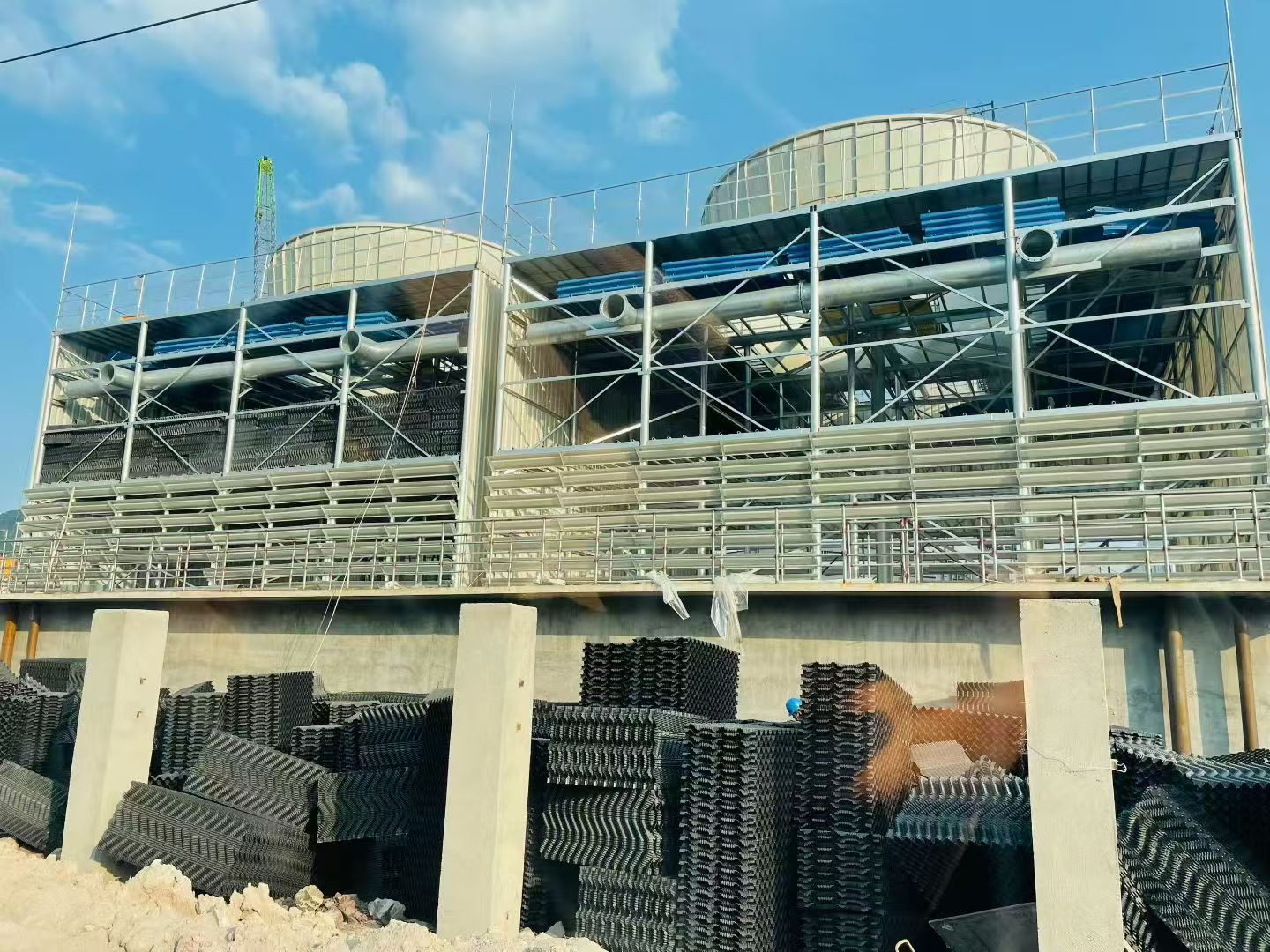
Choosing the right fill for cooling tower systems is one of the most important decisions when designing, upgrading, or replacing cooling tower components. The cooling tower fill increases the contact area between hot process water and air, helping transfer heat more efficiently.
But what type of fill for cooling tower should you choose?
The answer depends on water quality, cooling requirements, tower design, operating temperature, maintenance conditions, and budget. The two main categories are film fill and splash fill, with PVC and PP being common materials.
This guide explains the main cooling tower fill types, their applications, advantages, and key factors to consider before purchasing.
What Is Cooling Tower Fill?
Cooling tower fill is the internal media installed inside a cooling tower to increase the surface area available for heat transfer.
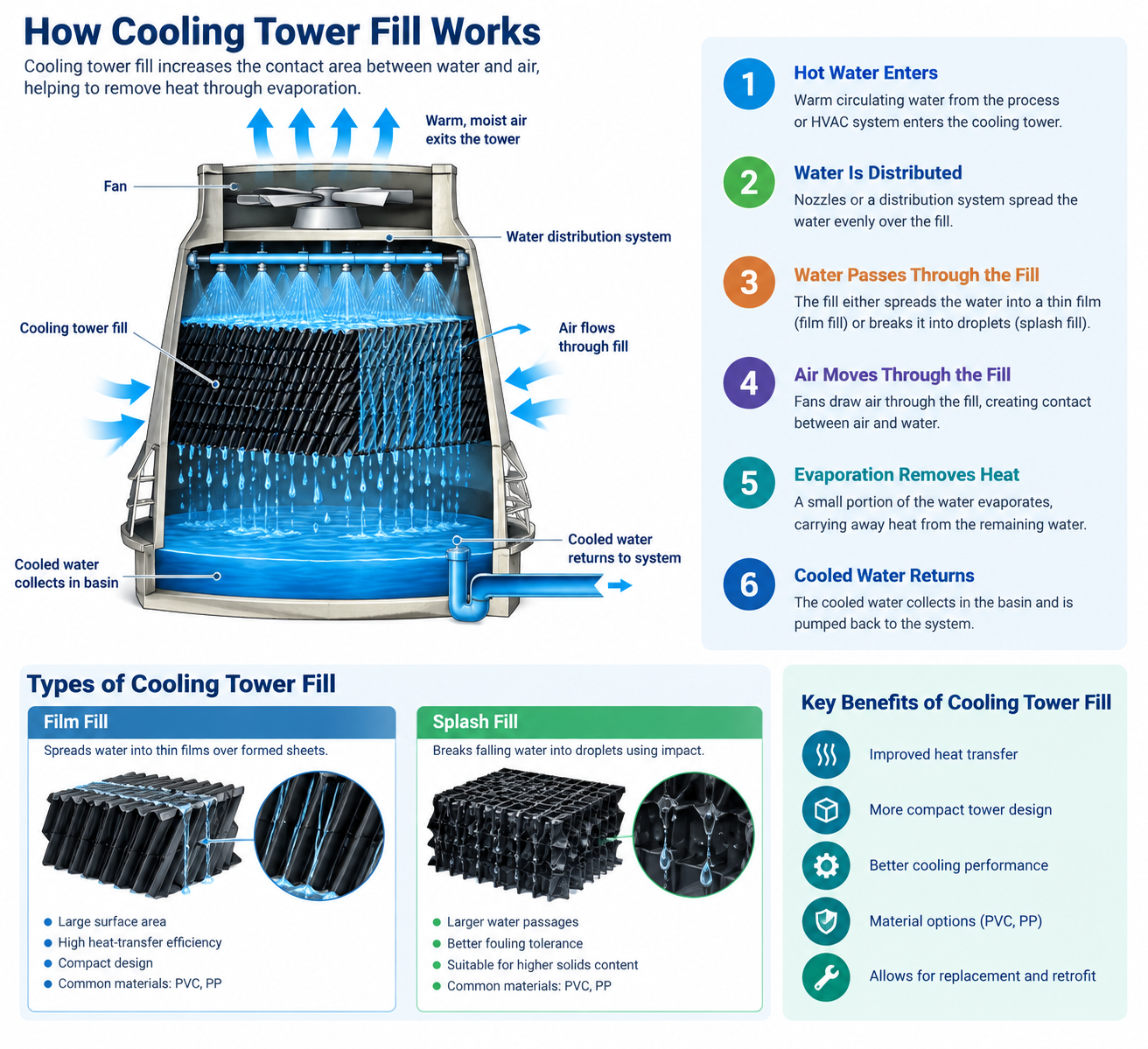
Hot water is distributed over the fill while air moves through the tower. The fill spreads the water into thin films or droplets, increasing contact between water and air. Heat is then transferred from the water to the air through sensible and evaporative cooling.
Without properly designed fill media, the water would have less air contact and the tower would require more space or airflow to achieve the same cooling performance.
What Are the Main Types of Cooling Tower Fill?
The two primary types of cooling tower fill are:
Film fill
Splash fill
There are also hybrid and specialized fill designs for applications where both heat-transfer efficiency and fouling resistance are important.
1. Film Fill
Film fill for cooling towers uses closely spaced sheets with specially designed surfaces. Water flows over the sheets and forms a thin film, creating a large surface area for air-water contact.
Film fill is widely used in industrial and HVAC cooling towers because it can provide high heat-transfer efficiency in a relatively compact volume.
Common materials include:
Advantages of Film Fill
High heat-transfer efficiency
Large surface area
Compact installation
Lower required fill volume for some applications
Suitable for relatively clean circulating water
Available in different flute and sheet configurations
Film fill is often selected when cooling tower efficiency and compact design are major priorities.
Limitations of Film Fill
The narrow passages between film-fill sheets can become blocked by:
Suspended solids
Scale
Biological growth
Dirt
Corrosion products
For this reason, film fill is generally better suited to systems with controlled water quality and effective filtration or water treatment.
2. Splash Fill
Splash fill for cooling towers works differently. Instead of forming a continuous water film, splash bars or grids repeatedly break water into droplets as it falls through the tower.
Common splash-fill designs include:
PP splash bars
PVC splash bars
Grid splash fill
Ladder-type splash fill
Hanging splash fill
Modular splash fill
The repeated splashing increases water-air contact and helps distribute water throughout the fill zone.
Advantages of Splash Fill
Better resistance to fouling
Suitable for dirtier water
Larger openings reduce blockage
Easier cleaning in many applications
Good mechanical durability
Suitable for industrial cooling systems
Splash fill is often considered when circulating water contains a higher concentration of suspended solids or when the tower operates in a challenging environment.
Film Fill vs. Splash Fill: Which Should You Choose?
The right choice depends on the operating conditions rather than simply selecting the fill with the highest theoretical heat-transfer efficiency.
| Factor | Film Fill | Splash Fill |
| Heat-transfer efficiency | High | Moderate to high |
| Water quality requirement | Higher | Lower |
| Fouling resistance | Moderate | High |
| Passage size | Smaller | Larger |
| Cleaning | Requires careful cleaning | Generally easier |
| Suspended solids | Less suitable | More suitable |
| Compact tower design | Excellent | Good |
| Industrial wastewater | Limited applications | Often suitable |
| Maintenance tolerance | Moderate | High |
If your system has clean, well-treated water, film fill can provide efficient heat transfer.
If your system has dirty, contaminated, or high-solids water, splash fill may be more appropriate.
PVC Cooling Tower Fill vs. PP Cooling Tower Fill
Material selection is another important consideration.
PVC Cooling Tower Fill
PVC cooling tower fill is widely used for film-fill applications. PVC offers a practical combination of cost, rigidity, chemical resistance, and processability.
PVC fill is commonly used in:
PVC film fill is particularly common where water quality is controlled and the operating temperature is suitable for the selected product.
PP Cooling Tower Fill
PP cooling tower fill is made from polypropylene and is commonly used for splash fill as well as certain film-fill applications.
PP offers good chemical resistance and can be useful in applications where operating conditions make polypropylene a suitable material choice.
PP splash fill is frequently used for:
Industrial cooling towers
High-fouling applications
Process cooling
Wastewater-related cooling systems
Systems with higher suspended solids
When choosing between PVC and PP, buyers should check the actual operating temperature, chemical environment, water quality, and manufacturer's material specifications.
How to Choose the Right Fill for Cooling Tower Applications
Before purchasing cooling tower fill, consider the following factors.
1. Water Quality
Water quality should be one of the first considerations.
For clean water with effective filtration and chemical treatment, film fill may be suitable.
For water containing significant suspended solids, organic matter, or debris, splash fill can offer better resistance to blockage.
2. Cooling Capacity
The required cooling capacity determines the necessary fill volume, airflow, water loading, and heat-transfer characteristics.
Do not select fill based only on dimensions. The fill should be matched to the tower's thermal design conditions.
3. Operating Temperature
Check the water temperature entering and leaving the tower. Different fill materials and products have different temperature limitations.
The supplier should confirm that the selected fill can operate safely at the actual water temperature.
4. Crossflow or Counterflow Tower
Cooling tower configuration also matters.
Crossflow cooling towers and counterflow cooling towers use different air and water flow arrangements, so the fill geometry and installation method may differ.
Always confirm compatibility with the existing tower before ordering replacement fill.
5. Fouling and Maintenance
If the tower operates with frequent fouling, cleaning requirements should be considered before selecting high-density film fill.
A fill design with larger water passages may be easier to maintain in demanding environments.
6. Replacement Dimensions
For a cooling tower fill replacement project, measure the existing fill carefully.
Important dimensions include:
Fill height
Fill width
Fill length
Sheet thickness
Flute height
Module dimensions
Support spacing
The replacement fill should also be compatible with existing supports, distribution systems, and airflow requirements.
What Is the Best Fill for a Cooling Tower?
There is no universal "best" cooling tower fill.
The best fill for cooling tower applications is the one that matches the tower's thermal requirements and operating environment.
Film fill is commonly selected for efficient heat transfer and compact designs with relatively clean water.
Splash fill is often preferred for applications where fouling, suspended solids, and maintenance are major concerns.
The correct decision should consider the complete operating system rather than fill price alone.
Cooling Tower Fill Replacement: What Buyers Should Check
When replacing old cooling tower fill, buyers should avoid ordering based only on the original product name.
Instead, verify:
For retrofit projects, an experienced cooling tower fill supplier can help determine whether the replacement should use the same design or a compatible alternative.
Why Proper Cooling Tower Fill Matters
Properly selected fill can help a cooling tower maintain effective heat transfer while supporting stable operation.
Incorrect fill selection can contribute to:
Reduced cooling performance
Higher approach temperature
Uneven water distribution
Increased fouling
Higher maintenance requirements
Premature fill damage
The fill should therefore be treated as a critical cooling tower component rather than simply a replacement consumable.
Frequently Asked Questions
What type of fill is used in a cooling tower?
The two main types are film fill and splash fill. Film fill spreads water into thin films, while splash fill breaks water into droplets as it passes through the fill.
Is PVC or PP better for cooling tower fill?
Neither material is universally better. PVC is widely used for film fill, while PP is commonly used for splash fill and selected film-fill applications. The appropriate material depends on temperature, water chemistry, fouling conditions, and tower design.
Which cooling tower fill is best for dirty water?
Splash fill is commonly considered for applications with higher suspended solids or fouling potential because its larger openings are generally less prone to blockage than closely spaced film fill.
Can film fill be used in an industrial cooling tower?
Yes. Film fill is widely used in industrial cooling towers, particularly where circulating water is adequately treated and filtered.
How often should cooling tower fill be replaced?
There is no universal replacement interval. Fill life depends on water quality, temperature, chemical exposure, biological growth, physical damage, and maintenance. Inspection should be based on actual operating conditions.
Conclusion
Choosing what type of fill for cooling tower depends on the specific application.
Film fill provides a large heat-transfer surface and is commonly used where water quality is controlled and compact, efficient designs are required. Splash fill provides larger passages and strong fouling resistance, making it useful for demanding industrial applications.
For a replacement or retrofit project, evaluate fill type, material, water quality, cooling capacity, operating temperature, tower configuration, and dimensions before ordering.
For industrial cooling tower projects, PVC film fill and PP splash fill are two widely used options. Matching the fill design to the actual operating conditions is the key to achieving reliable cooling performance and long service life.
Internal Links for Other CoolingTowerParts
Cooling Tower Fill
Cooling Tower Nozzles
Cooling Tower Drift Eliminators
Cooling Tower Louvers
Cooling Tower Fan Blades
Cooling Tower Motors


