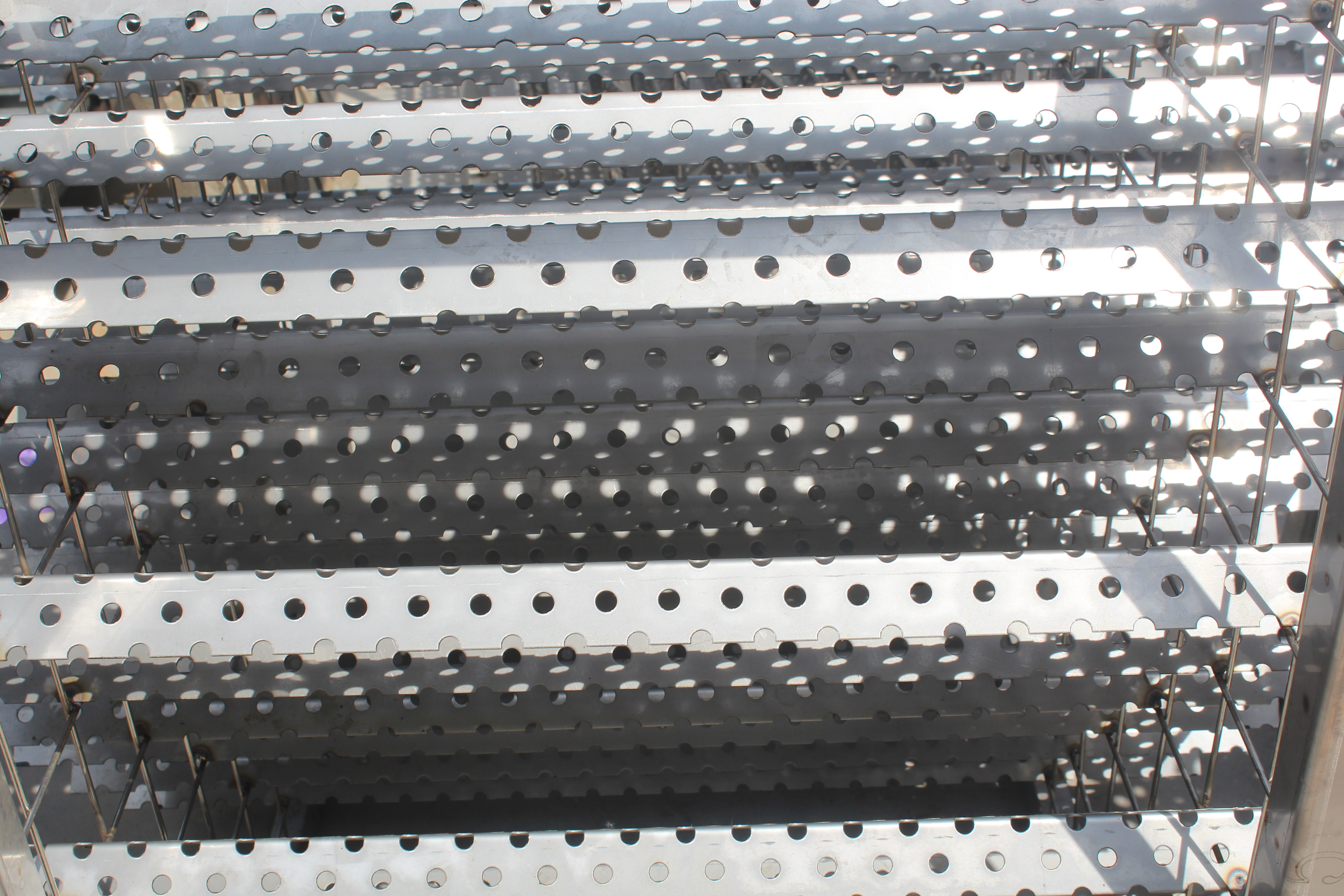
Choosing the right fill for cooling tower applications is critical for thermal performance, maintenance, and service life. Among the most common materials, PVC and PP cooling tower fill are widely used in industrial and HVAC cooling towers.
But which material is better for your cooling tower?
The answer depends on operating temperature, water quality, tower design, chemical exposure, thermal requirements, and maintenance conditions. PVC and PP both offer advantages, but they are not interchangeable in every application.
This guide compares PVC vs. PP fill media to help cooling tower operators, engineers, and buyers select the right solution for new installations and cooling tower fill replacement projects.
What Is Cooling Tower Fill Media?
Cooling tower fill media is installed inside the tower to increase the contact area between hot circulating water and moving air.
As water flows through the fill, it is spread into thin films or broken into smaller streams and droplets. This increases heat and mass transfer and supports evaporative cooling.
Cooling tower fill is commonly available as:
Film fill
Splash fill
Hybrid fill
PVC fill
PP fill
The material and geometry should match the cooling tower's operating conditions.
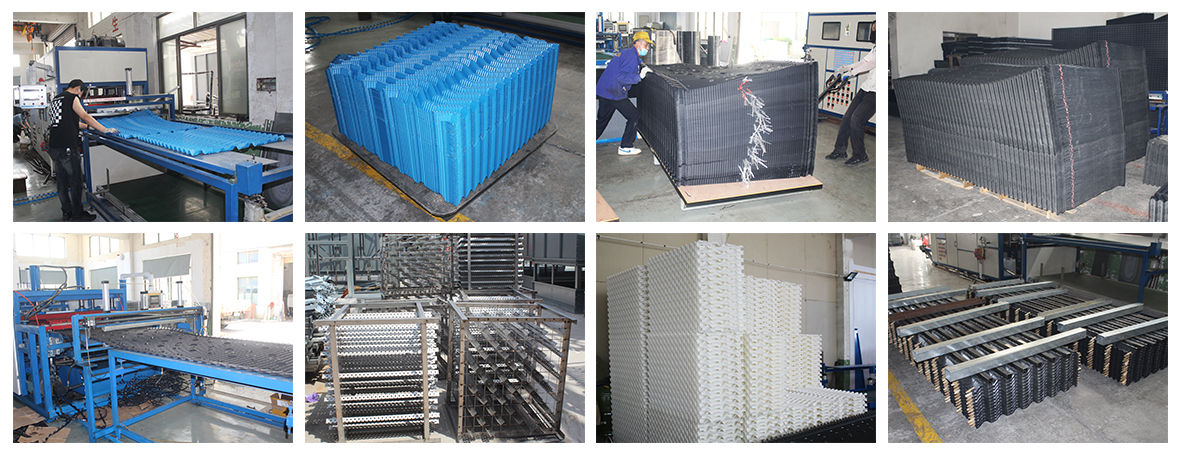
PVC Cooling Tower Fill
PVC cooling tower fill is widely used for film-fill applications because PVC can be manufactured into thin, corrugated sheets with a large effective surface area.
The sheets are assembled into fill packs that create passages for water and air. Water spreads across the sheet surfaces while air moves through the pack.
Advantages of PVC Fill
PVC cooling tower fill offers several benefits:
High effective surface area
Good thermal performance
Lightweight construction
Cost-effective manufacturing
Easy fabrication into complex sheet geometries
Wide availability for replacement projects
PVC film fill is particularly common in applications where the circulating water is relatively clean and the operating temperature is suitable for PVC.
Limitations of PVC Fill
PVC has operating limitations that buyers should consider.
Higher-temperature applications may require a different material or specially designed fill. PVC film fill can also be sensitive to fouling when water contains high levels of suspended solids, scale-forming minerals, or biological growth.
For these applications, water treatment and regular fill inspection become especially important.
PP Cooling Tower Fill
PP cooling tower fill, made from polypropylene, is another widely used option.
Polypropylene can be manufactured into both film and splash-type fill. It is valued particularly for applications requiring higher temperature capability or specific chemical resistance.
Advantages of PP Fill
Key benefits include:
Higher temperature capability than standard PVC in many applications
Good chemical resistance
Good impact resistance
Suitable for film and splash fill designs
Lightweight construction
Good durability in demanding environments
PP splash fill is commonly selected for applications where water quality makes conventional film fill difficult to maintain.
Limitations of PP Fill
PP fill can have a higher initial material cost than conventional PVC fill in some applications.
Material selection should also consider the exact operating temperature, chemical environment, fill geometry, and tower design rather than assuming that PP is always the better option.
PVC vs. PP Cooling Tower Fill: Comparison
The following table provides a practical comparison for buyers.
| Feature | PVC Fill | PP Fill |
| Common applications | Film fill | Film and splash fill |
| Thermal performance | High when properly designed | High when properly designed |
| Temperature capability | Moderate | Generally higher |
| Chemical resistance | Good for many applications | Very good for many applications |
| Impact resistance | Good | Very good |
| Typical cost | Often economical | Often higher |
| Fouling resistance | Depends strongly on geometry | Depends strongly on geometry |
| Typical water quality | Clean to moderately clean | Clean to challenging |
| Replacement availability | Widely available | Widely available |
| Common material use | Corrugated film sheets | Film sheets and splash components |
Actual performance depends on the fill geometry, sheet thickness, surface area, air velocity, water loading, and tower operating conditions.
PVC Film Fill vs. PP Film Fill
If you are comparing PVC film fill vs. PP film fill, material is only one part of the decision.
Both can be manufactured with different corrugation patterns and surface structures. These designs determine how water spreads and how air moves through the fill.
For a replacement project, buyers should compare:
Fill sheet dimensions
Thickness
Corrugation pattern
Flute height
Cell or passage geometry
Fill pack dimensions
Water loading
Airflow requirements
Operating temperature
Chemical environment
A PP fill pack with an unsuitable geometry may perform worse than a properly selected PVC fill.
PVC Splash Fill vs. PP Splash Fill
Splash fill works differently from film fill.
Instead of maintaining a continuous water film across a sheet, splash fill breaks water into smaller streams and droplets as it moves through successive splash surfaces.
PP is commonly used for splash components because of its durability and temperature characteristics.
Splash fill can be useful where water contains suspended solids or where fouling makes narrow film-fill passages difficult to maintain.
Which Is Better: PVC or PP Cooling Tower Fill?
There is no universal answer.
PVC cooling tower fill may be suitable when:
The tower operates within PVC's temperature range
Water quality is reasonably controlled
High-efficiency film fill is required
Cost-effective replacement is important
The existing tower uses PVC film fill
PP cooling tower fill may be suitable when:
Higher operating temperatures are involved
Greater material temperature capability is required
Specific chemical exposure needs to be considered
Splash fill is preferred
The application requires robust fill construction
The correct decision should be based on the complete operating environment rather than material price alone.
How Water Quality Affects Fill Selection
Water quality is one of the most important considerations when choosing cooling tower fill.
Hard water can cause mineral scale. Poor biological control can result in algae and biofilm. Suspended solids can accumulate inside fill passages.
Film fill generally contains relatively narrow air and water passages. Severe fouling can reduce airflow and water distribution.
For applications with difficult water conditions, splash fill for cooling towers may provide greater tolerance to suspended solids and fouling.
However, proper water treatment remains essential regardless of fill material.
Temperature Considerations
Operating temperature should always be checked before purchasing replacement fill.
PVC and PP have different temperature characteristics, and actual allowable operating temperatures depend on the specific formulation, fill construction, and manufacturer.
Do not select PP or PVC solely based on a generic temperature number.
Instead, provide the supplier with:
This information allows the fill supplier to recommend an appropriate material.
Choosing Fill for Cooling Tower Replacement
When replacing existing fill, matching the original dimensions is important, but it is not the only consideration.
Before ordering cooling tower replacement fill, check:
1. Tower Type
Determine whether the tower is crossflow or counterflow.
2. Fill Type
Identify whether the existing media is film fill, splash fill, or another configuration.
3. Material
Confirm whether the existing fill is PVC, PP, or another material.
4. Dimensions
Measure the length, width, height, sheet thickness, and pack configuration.
5. Operating Conditions
Provide water temperature, flow rate, air conditions, and water chemistry.
6. Thermal Requirements
The replacement fill should be capable of meeting the tower's required cooling duty.
7. Installation Requirements
Check fill supports, blocks, spacers, retaining systems, and access conditions before installation.
Can You Replace PVC Fill With PP Fill?
In some cooling tower applications, PVC fill can be replaced with PP fill, but it should not be treated as a direct material swap.
The replacement needs to be evaluated for thermal performance, operating temperature, airflow resistance, water distribution, dimensions, and structural support.
Likewise, replacing PP fill with PVC requires confirmation that PVC is suitable for the operating environment.
A properly engineered replacement should maintain the required cooling tower performance.
Why Proper Fill Maintenance Matters
Even the best PVC or PP cooling tower fill will lose performance if it becomes severely fouled.
Regular maintenance should include:
Inspecting fill for cracks or deformation
Checking for scale buildup
Removing debris where appropriate
Monitoring biological growth
Checking water distribution
Inspecting nozzles
Monitoring cooling-water temperature
Checking airflow and fan performance
Water treatment and routine inspections can extend fill service life and maintain heat-transfer performance.
Buy PVC and PP Cooling Tower Fill
For industrial cooling tower replacement projects, selecting the right PVC or PP fill media requires a combination of material knowledge and application information.
CoolingTowerPart.com supplies PVC cooling tower fill, PP cooling tower fill, film fill, splash fill, and replacement cooling tower fill for a range of industrial applications.
When requesting a quotation, provide the cooling tower model, fill dimensions, existing material, operating temperature, water flow, and photos of the existing fill. This helps ensure the replacement is properly matched to the tower.
Frequently Asked Questions
Is PVC or PP better for cooling tower fill?
Neither material is universally better. PVC is widely used for economical, high-performance film fill, while PP can provide advantages in higher-temperature or demanding applications.
What is the difference between PVC and PP cooling tower fill?
PVC and PP are different thermoplastics with different temperature, chemical, and mechanical characteristics. Both can be manufactured into cooling tower fill, but the appropriate material depends on the application.
Is PP cooling tower fill more expensive than PVC?
PP can have a higher material cost in some applications. However, total project cost should also consider service life, operating conditions, maintenance, and thermal requirements.
Can PP replace PVC cooling tower fill?
Potentially, but the replacement should be checked for thermal performance, dimensions, airflow resistance, water loading, temperature, and structural compatibility.
Which fill is best for dirty cooling water?
Splash fill is often considered for water containing higher levels of suspended solids because its open structure can be more tolerant of fouling than narrow-passage film fill. Water treatment is still important.
Conclusion
PVC and PP are both widely used materials for cooling tower fill media, but they serve different operating requirements.
PVC is a popular choice for film fill where cost-effective thermal performance and controlled water quality are priorities. PP provides useful advantages where higher temperature capability, chemical resistance, or splash-fill construction is required.
For any cooling tower fill replacement, material selection should be based on the tower type, water quality, operating temperature, fill geometry, airflow, water flow, and required cooling performance.
Choosing the right PVC or PP cooling tower fill can help maintain reliable heat transfer, reduce maintenance problems, and extend the useful life of the cooling tower.
Internal Links for Other CoolingTowerParts
Cooling Tower Fill
Cooling Tower Nozzles
Cooling Tower Drift Eliminators
Cooling Tower Louvers
Cooling Tower Fan Blades
Cooling Tower Motors


