Cooling Tower Fan Blade Balancing Methods and Benefits
Cooling tower fan blade balancing is an essential maintenance process for improving equipment stability, reducing vibration, and maintaining reliable airflow in industrial cooling tower systems. Whether a cooling tower is used in power plants, chemical factories, steel production facilities, or commercial HVAC systems, its fan assembly must operate smoothly to achieve the required cooling performance.
During long-term operation, cooling tower fan blades may develop uneven weight distribution, surface contamination, deformation, or installation deviations. These problems can cause fan imbalance, excessive vibration, abnormal noise, and increased mechanical stress on bearings, gearboxes, and motors.
Understanding different cooling tower fan blade balancing methods helps maintenance teams identify problems and select appropriate corrective solutions. Proper balancing also helps extend equipment service life and reduce unexpected maintenance costs.
This article introduces the main balancing methods, common causes of fan imbalance, inspection procedures, technical considerations, and the benefits of maintaining properly balanced cooling tower fan blades.
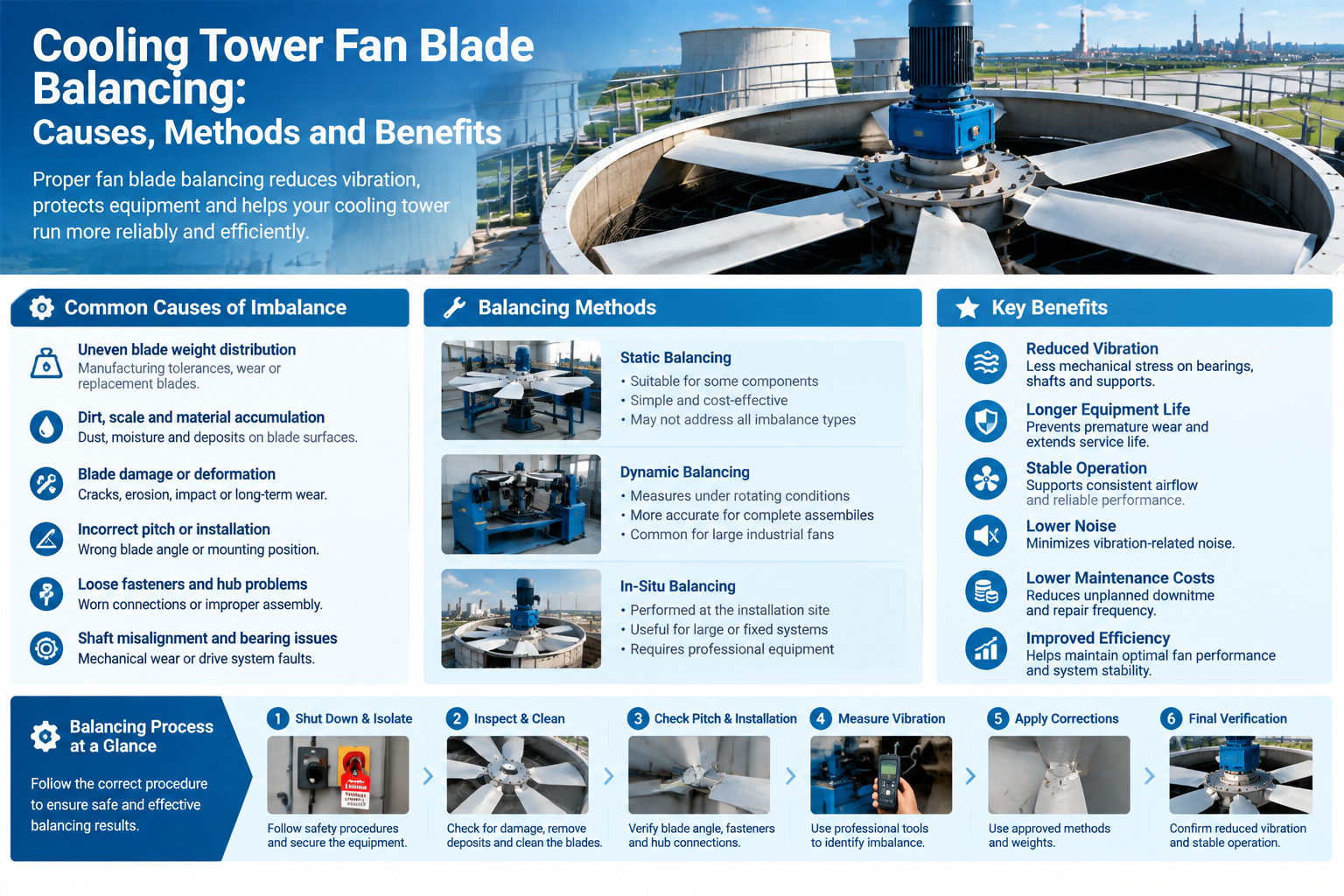
What Is Cooling Tower Fan Blade Balancing?
Cooling tower fan blade balancing is the process of correcting uneven mass distribution in a rotating fan assembly to minimize vibration during operation.
An industrial cooling tower fan typically consists of multiple blades mounted around a central hub. When the fan rotates, every blade generates centrifugal force. If the rotating mass is unevenly distributed, the fan may produce excessive vibration.
Balancing helps distribute the rotating mass more evenly around the rotational axis.
Why Is Fan Blade Balancing Necessary?
Cooling tower fans operate continuously and often run under demanding environmental conditions. Even relatively small mass differences can create noticeable vibration in large-diameter fan assemblies.
Proper balancing helps:
Reduce mechanical vibration.
Improve fan operating stability.
Protect bearings and gearboxes.
Reduce vibration-related noise.
Minimize unnecessary structural stress.
Support reliable airflow.
Reduce avoidable maintenance requirements.
What Happens When Fan Blades Are Unbalanced?
An unbalanced cooling tower fan generates additional centrifugal forces during rotation.
These forces may cause excessive vibration in the fan hub, gearbox, motor, and supporting structure.
If the problem continues, it may contribute to bearing wear, loose connections, fatigue damage, and unexpected equipment shutdowns.
What Causes Cooling Tower Fan Blade Imbalance?
Before choosing a balancing method, it is important to identify the actual cause of the imbalance.
Fan imbalance does not always result from unequal blade weights. Installation errors, material deterioration, contamination, and mechanical defects may also affect rotating performance.
1. Uneven Fan Blade Weight
Unequal blade weight is one of the most common causes of rotating mass imbalance.
Different manufacturing conditions, resin distribution, reinforcement placement, and material thickness can result in weight variations.
Why Is Weight Consistency Important?
When one blade is heavier than the others, the rotating assembly develops an uneven mass distribution.
As the fan rotates, this difference generates centrifugal force that may cause vibration.
Professional cooling tower fan blade manufacturers should maintain consistent material distribution and perform appropriate weight inspections during production.
2. Incorrect Blade Installation
Improper installation may create imbalance even when the fan blades are manufactured correctly.
Common installation problems include:
Incorrect blade positioning.
Uneven blade pitch angles.
Loose mounting bolts.
Incorrect blade spacing.
Improper hub alignment.
Inconsistent mounting dimensions.
How Does Incorrect Pitch Affect Fan Operation?
Blade pitch affects aerodynamic loading and airflow generation.
If the pitch angles differ significantly, individual blades may experience different aerodynamic forces.
This can create uneven operating loads and contribute to vibration, even when the blade weights are similar.
3. Dust and Dirt Accumulation
Cooling tower fans operate in environments containing moisture, dust, and airborne contaminants.
Over time, deposits may accumulate unevenly on blade surfaces.
This changes the mass distribution and may also affect the aerodynamic characteristics of the fan.
Regular cleaning helps prevent excessive contamination and maintains normal blade performance.
4. Blade Damage and Deformation
Long-term operation may cause cracks, erosion, deformation, or material deterioration.
FRP fan blades may also experience delamination or damage near the blade root.
Damaged blades should be inspected carefully because balancing cannot correct structural defects.
5. Fan Hub and Mechanical Problems
The fan hub connects the blades to the rotating drive system.
A damaged hub, bent shaft, worn bearing, or loose connection may produce vibration that resembles blade imbalance.
Therefore, technicians should inspect the complete rotating assembly rather than focusing only on individual blades.
What Are the Main Cooling Tower Fan Blade Balancing Methods?
Different balancing methods are suitable for different fan configurations and operating conditions.
The correct method depends on the fan's diameter, rotational speed, rotor structure, and manufacturer's requirements.
1. Static Balancing
Static balancing is used to identify and correct certain types of mass imbalance in a stationary rotor.
The rotating component is placed on a suitable balancing fixture or support system. Uneven mass distribution creates a gravitational turning effect that can help identify the heavy side.
How Does Static Balancing Work?
The general process includes:
Removing the fan assembly or relevant component when required.
Supporting it on a suitable balancing fixture.
Allowing the rotor to settle naturally.
Identifying the heavy side.
Applying an approved correction method.
Rechecking the balance condition.
Advantages of Static Balancing
Relatively simple procedure.
Suitable for certain single-plane imbalance conditions.
Does not require the fan to operate at full speed.
Useful during manufacturing and assembly inspection.
However, static balancing cannot identify every type of dynamic imbalance.
2. Dynamic Balancing
Dynamic balancing evaluates the rotating assembly under controlled balancing conditions.
It is particularly useful when imbalance exists in more than one plane or when static balancing cannot achieve the required performance.
How Does Dynamic Balancing Work?
Dynamic balancing equipment measures vibration and phase information to identify imbalance magnitude and correction positions.
The technician uses the measurement results to determine where correction mass should be added or removed.
The general procedure includes:
Mounting the rotor on suitable balancing equipment.
Measuring initial vibration.
Identifying imbalance magnitude and phase.
Calculating correction positions.
Applying approved correction measures.
Performing additional measurements.
Benefits of Dynamic Balancing
Dynamic balancing can help achieve more accurate correction for complex rotating assemblies.
It is especially valuable for large industrial fan systems where vibration control is important.
3. Field Balancing
Field balancing is performed on the actual installed fan assembly rather than exclusively on a separate balancing machine.
It can be useful when removing a large cooling tower fan is difficult, expensive, or impractical.
How Is Field Balancing Performed?
Technicians use portable vibration measurement equipment to evaluate the installed fan system.
A typical procedure involves:
Inspecting the fan and surrounding mechanical components.
Measuring baseline vibration under controlled conditions.
Checking operating speed and vibration characteristics.
Identifying the likely imbalance condition.
Calculating suitable correction positions.
Applying approved correction weights.
Repeating measurements to verify the results.
Field balancing requires qualified personnel and suitable equipment.
It should not be used as a substitute for repairing damaged blades, loose connections, or defective bearings.
4. Blade Weight Matching
Blade weight matching is an important step during fan manufacturing, replacement, and assembly.
It involves comparing the weights of individual fan blades and ensuring that differences remain within the manufacturer's specified tolerances.
Why Is Blade Weight Matching Important?
For a multi-blade cooling tower fan, significant weight differences may create uneven rotating mass distribution.
Manufacturers can reduce this risk by using consistent materials, controlled molding processes, and finished-product weight inspections.
However, matching individual blade weights does not automatically guarantee that the complete fan assembly is dynamically balanced.
5. Blade Pitch Angle Adjustment
Blade pitch adjustment focuses on ensuring that all blades are installed at the correct aerodynamic angle.
Although pitch adjustment is not a substitute for mass balancing, it is important for reducing uneven aerodynamic loading.
How Should Blade Pitch Be Adjusted?
Technicians should:
Check the original fan design specifications.
Measure each blade's pitch angle.
Compare measurements across all blades.
Adjust the angles according to manufacturer instructions.
Verify mounting bolt torque.
Recheck operating vibration and airflow.
Incorrect pitch adjustments may increase motor load or reduce cooling tower performance.
Static Balancing vs. Dynamic Balancing: What Is the Difference?
Static and dynamic balancing are both important techniques, but they address different types of rotor imbalance.
Comparison | Static Balancing | Dynamic Balancing |
Main purpose | Corrects certain single-plane imbalances | Corrects rotating imbalance in multiple planes |
Testing condition | Stationary rotor | Controlled rotation |
Equipment | Balancing fixture | Dynamic balancing machine or analyzer |
Measurement | Gravitational turning effect | Vibration and phase measurements |
Application | Suitable simple rotor configurations | More complex rotating assemblies |
Accuracy | Limited by rotor configuration | Suitable for more comprehensive correction |
Which Balancing Method Is Better for Cooling Tower Fans?
There is no single method suitable for every cooling tower fan.
Static balancing may be sufficient for certain configurations, while dynamic balancing or field balancing may be necessary for larger or more complex assemblies.
The selection should follow the fan manufacturer's recommendations and applicable engineering standards.
How to Perform Cooling Tower Fan Blade Balancing Step by Step?
A proper balancing procedure requires careful inspection, accurate measurements, and suitable correction methods.
For industrial cooling tower fans, safety and technical accuracy should always be prioritized.
Step 1: Stop the Fan and Ensure Safety
Before maintenance, shut down the fan and isolate its power supply.
Follow the facility's lockout/tagout procedures to prevent accidental startup.
Important Safety Requirements
Disconnect electrical power.
Apply lockout/tagout procedures.
Confirm that the fan has completely stopped.
Inspect access platforms.
Wear appropriate protective equipment.
Follow the manufacturer's maintenance instructions.
Never attempt to adjust or measure fan blades while the equipment is operating unless using an approved remote monitoring method.
Step 2: Inspect the Fan Blades
Check all blades for cracks, deformation, dirt accumulation, and surface damage.
Pay particular attention to the blade root and mounting areas because these locations experience significant mechanical loads.
Damaged blades should be evaluated before balancing begins.
Step 3: Measure Individual Blade Weight
Use suitable weighing equipment to compare individual blade weights.
Record the results and identify any significant differences.
For new replacement blades, verify that the weights are within the manufacturer's specified tolerances.
Step 4: Check Blade Pitch and Installation Position
Use an appropriate measuring instrument to check blade pitch angles.
Confirm that all blades are installed in the correct positions and follow the original fan specifications.
Step 5: Inspect the Fan Hub and Fasteners
Check the hub for cracks, deformation, and mounting problems.
Inspect bolts and connection points for looseness or damage.
Verify that all fasteners meet the specified torque requirements.
Step 6: Select the Appropriate Balancing Method
Based on the inspection results, determine whether static balancing, dynamic balancing, or field balancing is required.
If vibration is caused by bearing damage, shaft misalignment, or structural resonance, these problems must be addressed separately.
Step 7: Complete Balancing Corrections
Apply approved balancing corrections based on measurement results.
Correction weights must be securely installed in designated or engineered locations.
Do not drill, cut, weld, or attach weights to FRP blades without manufacturer approval.
Step 8: Conduct Final Testing
After maintenance, restore all protective guards and confirm that the fan area is clear.
Restart the fan according to approved operating procedures.
Monitor vibration, motor current, bearing temperature, operating noise, and fan speed.
Record the results to establish a reference for future maintenance.
What Are the Main Benefits of Cooling Tower Fan Blade Balancing?
Proper fan blade balancing offers several benefits for industrial cooling tower systems.
1. Reduces Fan Vibration
The most direct benefit of balancing is reducing vibration caused by uneven rotating mass.
Lower vibration helps protect the fan assembly and supporting mechanical structure.
Protects Related Equipment
Excessive vibration can affect:
Fan bearings.
Gearboxes.
Drive shafts.
Motors.
Fan hubs.
Supporting structures.
Proper balancing helps reduce unnecessary mechanical stress on these components.
2. Extends Equipment Service Life
Unbalanced fan assemblies may expose mechanical components to repeated dynamic loads.
Over time, these loads can contribute to fatigue, wear, and mechanical deterioration.
Balancing helps maintain smoother operation and may reduce vibration-related maintenance requirements.
3. Improves Operating Stability
A properly balanced fan can operate more smoothly under its designed operating conditions.
This helps reduce abnormal noise and unexpected vibration-related interruptions.
4. Supports Consistent Airflow
Cooling tower fan blades generate the airflow required for heat rejection.
Although balancing does not directly increase the fan's aerodynamic capacity, it helps maintain stable rotation and supports consistent operation.
5. Reduces Maintenance Costs
Regular balancing and inspection can help identify developing mechanical problems before they become serious failures.
This may reduce emergency maintenance, equipment downtime, and replacement costs.
6. Improves Workplace Safety
Severe fan vibration can create mechanical risks, particularly in large industrial cooling towers.
Maintaining proper balance and inspecting blade connections help reduce avoidable equipment hazards.
FRP Cooling Tower Fan Blade Balancing: Important Manufacturing Considerations
FRP cooling tower fan blades are widely used in industrial applications because they combine lightweight construction, corrosion resistance, and flexible aerodynamic design.
However, proper balancing begins during the manufacturing process.
1. Consistent Glass Fiber Distribution
Glass fiber reinforcement provides strength and stiffness to FRP fan blades.
Uneven reinforcement distribution may create differences in blade weight and structural characteristics.
Why Is Fiber Placement Important?
Fiber orientation and distribution influence the mechanical properties of composite materials.
Manufacturers should follow controlled reinforcement procedures to improve product consistency.
2. Resin Distribution Control
Resin is another important factor affecting the quality of FRP fan blades.
Uneven resin distribution may result in weight variations, air pockets, or inconsistent material properties.
Controlled resin application and curing help improve manufacturing quality.
3. Accurate Blade Molding
High-quality molds help maintain consistent blade profiles, thickness, and dimensions.
Dimensional consistency is important for both aerodynamic performance and assembly compatibility.
4. Blade Weight Inspection
Manufacturers should compare the finished weights of blades produced for the same fan assembly.
Weight differences should be evaluated according to the applicable product specifications.
5. Structural and Surface Inspection
Before delivery, FRP fan blades should be inspected for:
Surface cracks.
Delamination.
Air bubbles.
Uneven thickness.
Blade deformation.
Mounting hole accuracy.
Blade root defects.
A properly manufactured blade is an important foundation for reliable balancing and long-term operation.
What Tools Are Required for Cooling Tower Fan Blade Balancing?
Professional balancing requires suitable instruments for measuring blade dimensions, rotating mass distribution, and operating vibration.
Electronic Weighing Scales
Electronic scales are used to measure individual blade weights and identify significant differences.
Digital Pitch Angle Gauges
These instruments help technicians measure blade installation angles and compare pitch consistency.
Vibration Analyzers
Portable vibration analyzers are commonly used to measure fan operating vibration.
Common Measurement Parameters
Depending on the application, technicians may measure:
Vibration velocity.
Vibration acceleration.
Vibration displacement.
Frequency.
Phase angle.
Rotational speed.
Dynamic Balancing Machines
These machines are used to evaluate rotating components and calculate suitable balancing corrections.
Torque Wrenches
Torque wrenches help ensure that blade mounting bolts are tightened according to manufacturer requirements.
Common Problems During Cooling Tower Fan Blade Balancing
Even with suitable tools, balancing work may not achieve the expected results if technicians overlook other mechanical problems.
1. Balancing Without Cleaning the Blades
Uneven dust and dirt accumulation can affect mass distribution.
Blades should be cleaned and inspected before balancing.
2. Ignoring Structural Damage
Balancing cannot restore the mechanical strength of cracked or delaminated blades.
Damaged components should be evaluated for repair or replacement.
3. Incorrect Counterweight Installation
Improper counterweight placement may create additional imbalance or introduce a serious safety risk.
Only approved correction procedures should be used.
4. Ignoring Mechanical Alignment
Bent shafts, loose foundations, and bearing defects may cause vibration even when the fan blades are properly balanced.
A complete mechanical inspection is necessary.
5. Failing to Record Test Results
Without vibration measurements before and after maintenance, it is difficult to evaluate the effectiveness of balancing.
Maintenance teams should maintain inspection records and compare results over time.
How Often Should Cooling Tower Fan Blade Balancing Be Performed?
The required balancing frequency depends on operating conditions, fan design, equipment history, and manufacturer recommendations.
Not every cooling tower requires balancing at the same interval.
During Routine Maintenance
Operators should periodically inspect blade condition, mounting bolts, vibration levels, and fan operating conditions.
After Fan Blade Replacement
Whenever fan blades are replaced, the complete assembly should be inspected and its balance verified according to the manufacturer's requirements.
After Major Mechanical Repairs
Balancing verification may be necessary after work involving the fan hub, shaft, gearbox, or rotating assembly.
When Abnormal Vibration Appears
Sudden vibration changes should be investigated immediately.
Continuing to operate a severely vibrating fan may increase mechanical damage and safety risks.
How to Choose a Reliable Cooling Tower Fan Blade Manufacturer?
For cooling tower replacement projects, choosing a professional manufacturer is important for ensuring product compatibility and consistent quality.
A qualified manufacturer should understand FRP materials, aerodynamic design, blade dimensions, and balancing requirements.
Manufacturing Experience
Look for manufacturers with experience producing industrial cooling tower fan blades.
Relevant manufacturing experience helps suppliers understand different fan configurations and replacement requirements.
FRP Material Quality
Check the manufacturer's experience with glass fiber reinforcement, resin selection, molding technology, and curing processes.
Customization Capabilities
A reliable supplier should be able to manufacture replacement blades according to drawings, original samples, and technical specifications.
Quality Inspection Procedures
Ask whether the manufacturer can provide dimensional inspection, weight measurement, structural quality checks, and balancing-related documentation.
Technical Support
Professional technical support helps customers confirm blade specifications, pitch angles, hub connections, and operating requirements before production.
Frequently Asked Questions About Cooling Tower Fan Blade Balancing
1. What Is the Most Common Cooling Tower Fan Balancing Method?
Static balancing, dynamic balancing, and field balancing are commonly used methods.
The correct choice depends on fan configuration, rotor characteristics, operating speed, and manufacturer requirements.
2. Can Unbalanced Fan Blades Damage a Cooling Tower Gearbox?
Yes. Excessive vibration may increase mechanical stress on the gearbox, bearings, shafts, and other connected components.
Proper inspection and balancing help reduce these risks.
3. Do FRP Fan Blades Need Dynamic Balancing?
FRP fan blades require appropriate balance verification, just like other fan blade materials.
Whether dynamic balancing is necessary depends on the complete rotor assembly and the manufacturer's requirements.
4. Does Fan Blade Balancing Improve Cooling Efficiency?
Balancing helps maintain smooth fan operation and stable airflow.
However, actual cooling efficiency also depends on fan design, water distribution, fill condition, ambient temperature, and system operating conditions.
5. Can Fan Blade Balancing Reduce Electricity Consumption?
Balancing can reduce vibration-related mechanical problems, but it does not guarantee a specific reduction in electricity consumption.
Energy consumption depends on fan aerodynamic performance, operating speed, system resistance, and motor efficiency.
6. What Is the Difference Between Fan Blade Balancing and Pitch Adjustment?
Balancing corrects uneven mass distribution in the rotating assembly.
Pitch adjustment changes the blade installation angle to control aerodynamic loading and airflow.
Both are important, but they solve different problems.
Conclusion: Choose the Right Cooling Tower Fan Blade Balancing Method
Cooling tower fan blade balancing is an important part of industrial cooling tower maintenance. By selecting the correct balancing method, identifying the causes of imbalance, and following proper inspection procedures, operators can reduce vibration, protect mechanical components, and maintain reliable fan performance.
Static balancing, dynamic balancing, field balancing, blade weight matching, and pitch angle adjustment all have different applications. The appropriate solution should be selected according to the fan's design and operating requirements.
For FRP cooling tower fan blades, manufacturing consistency, accurate molding, controlled material distribution, and finished-product inspection are equally important. Working with an experienced cooling tower fan blade manufacturer helps ensure that replacement blades meet the required dimensions, material specifications, and balancing requirements.
Whether you are maintaining an existing industrial cooling tower or planning a fan blade replacement project, investing in proper balancing and quality manufacturing can contribute to safer operation, lower maintenance requirements, and more reliable long-term performance.


