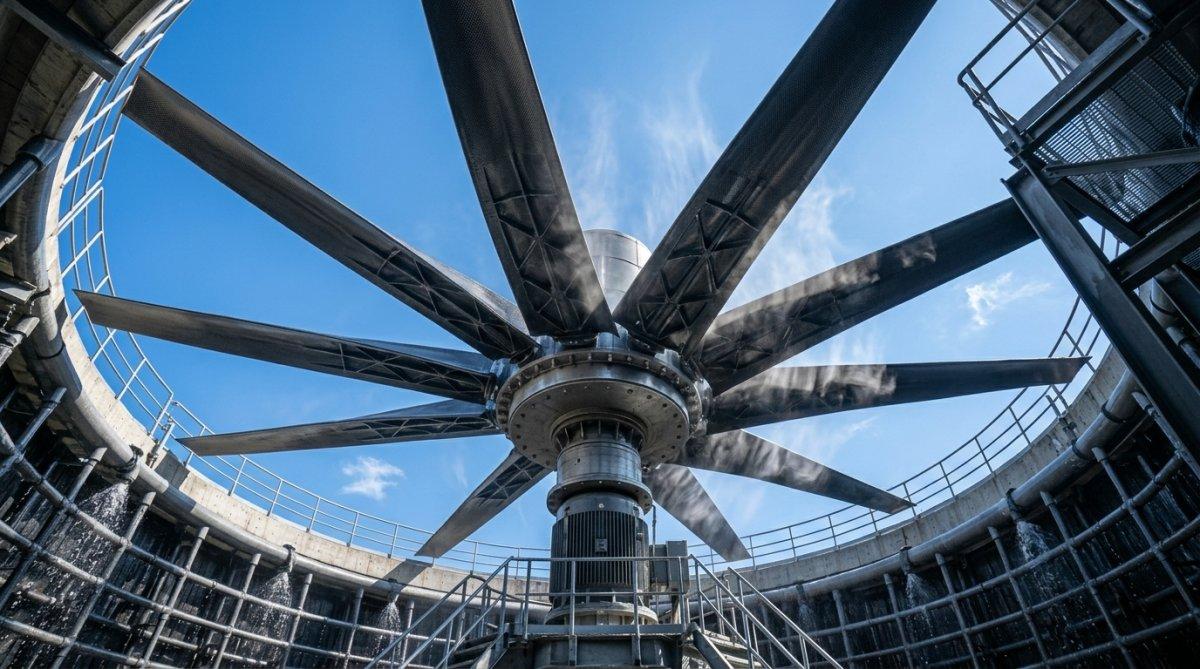
A fan cooling tower is an essential part of many industrial cooling systems. From manufacturing plants and chemical processing facilities to power stations and commercial HVAC systems, cooling towers help remove unwanted heat and maintain stable operating temperatures.
But how does a fan cooling tower actually work? What role does the cooling tower fan play, and how do components such as fill media, drift eliminators, and water distribution systems contribute to cooling efficiency?
Understanding these questions is important when selecting, operating, or maintaining an industrial cooling tower. A properly designed system does more than move air. It combines airflow, water distribution, and evaporation to achieve effective heat rejection while controlling energy consumption.
In this guide, Power Tower Cooling Technology (Shaoxing) Co.,Ltd explains the working principle of fan cooling towers, their main components, different fan types, performance factors, common problems, and maintenance requirements.
1. What Is a Fan Cooling Tower?
A fan cooling tower is a mechanical cooling system that uses an electrically driven fan to move air through a tower and remove heat from circulating water.
Unlike natural draft cooling towers, which depend primarily on natural air movement, mechanical draft cooling towers use fans to generate controlled airflow. This makes them suitable for industrial applications that require consistent and reliable cooling performance.
Fan cooling towers are widely used in:
Industrial manufacturing plants
Chemical and petrochemical facilities
Power generation stations
Steel and metal processing plants
Plastic injection molding factories
Food and beverage production facilities
Commercial air conditioning and HVAC systems
The basic working principle is relatively simple. Hot water enters the cooling tower, spreads across the fill media, and comes into contact with moving air. A small portion of the water evaporates, carrying heat away from the remaining water. The cooled water then collects in the basin and returns to the industrial cooling system.
1.1 Why Do Cooling Towers Need Fans?
Natural air movement is not always sufficient to meet industrial cooling requirements. During hot weather or periods of high production, equipment generates substantial heat, and the cooling system must remove it continuously.
A cooling tower fan helps solve this problem by creating a steady airflow through the tower.
Its main functions include:
Increasing the volume of air passing through the cooling tower.
Improving contact between air and circulating water.
Supporting more stable cooling performance.
Helping control cooling capacity under changing operating conditions.
Improving the effectiveness of heat and mass transfer.
The cooling tower fan is therefore one of the most important components affecting the performance of a mechanical draft cooling tower.
2. How Does a Fan Cooling Tower Work?
The working principle of a fan cooling tower is based mainly on evaporation and heat transfer.
Although different cooling tower designs have different internal configurations, most mechanical draft systems follow a similar cooling process.
2.1 The Basic Cooling Process
The cooling process generally involves six steps.
Step 1: Hot water enters the cooling tower.
Water absorbs heat from industrial equipment, chillers, condensers, or manufacturing processes. Once its temperature increases, a circulation pump sends the hot water to the cooling tower.
Step 2: The water distribution system spreads the water.
Hot water flows through distribution pipes, headers, and spray nozzles. These components distribute water across the cooling tower fill media.
Step 3: The fan generates airflow.
The cooling tower fan pulls or pushes atmospheric air through the tower, depending on the design. The moving air comes into contact with water flowing over the fill.
Step 4: Heat transfer takes place.
As air and water interact, a small portion of the water evaporates. This evaporation absorbs heat from the remaining water, reducing its temperature.
Step 5: Cooled water collects in the basin.
The cooled water falls into the cold-water basin at the bottom of the tower.
Step 6: Water returns to the industrial system.
A circulation pump sends the cooled water back to the equipment that requires cooling. The process then repeats continuously.
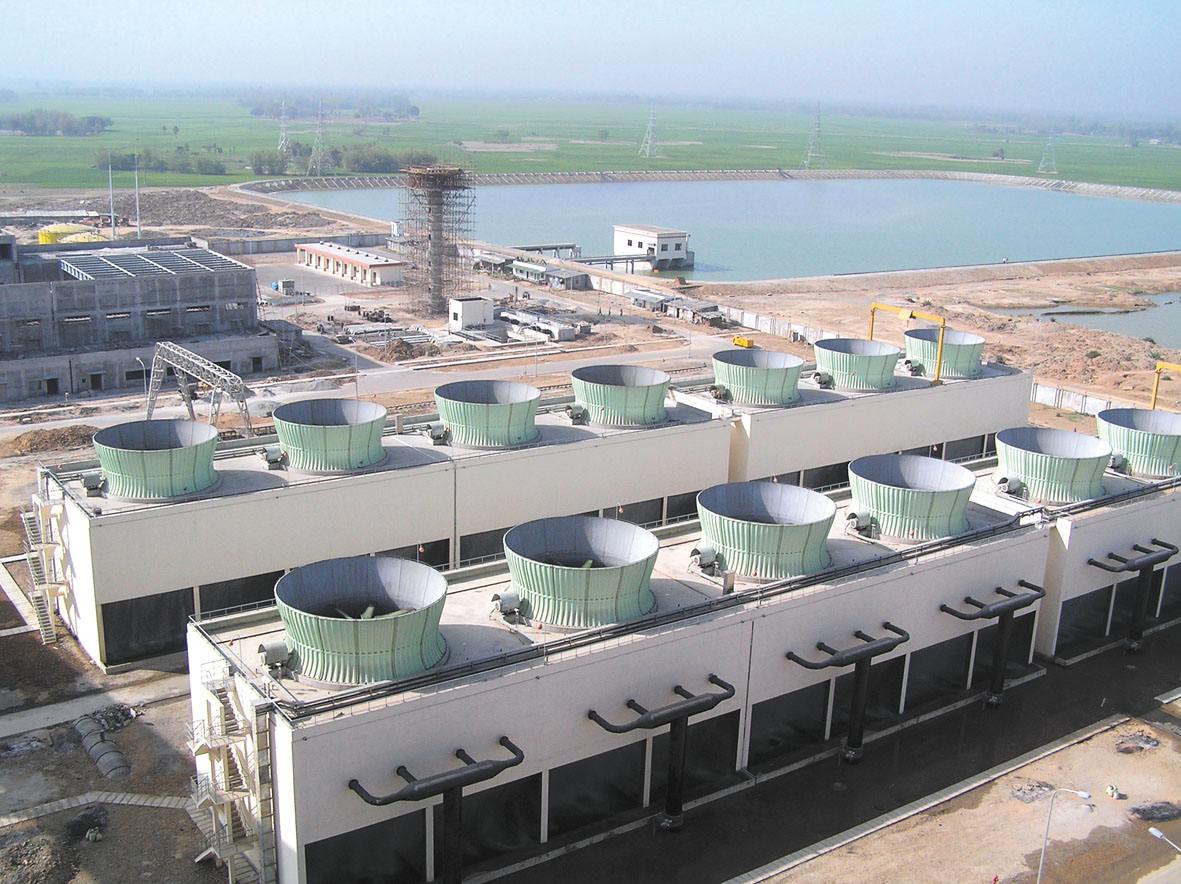
2.2 The Role of Airflow in Heat Transfer
Airflow is essential to cooling tower performance.
When the fan operates, it moves air through the fill section. This airflow helps remove heat and water vapor generated during the cooling process.
Generally, increasing airflow can improve cooling performance when the water distribution and fill system are properly designed.
However, more airflow does not always mean better efficiency. If the fan operates beyond its optimal design point, electricity consumption may increase without delivering a proportional improvement in cooling capacity.
That is why selecting the correct fan diameter, blade angle, rotational speed, and motor power is important.
2.3 How Water and Air Interact
Inside a cooling tower, water and air interact through a combination of heat transfer and mass transfer.
Water flows downward through the fill media, while air moves through the fill section. Depending on the tower configuration, airflow may travel horizontally or vertically.
During this process, heat moves from the water into the air, some water evaporates, and the remaining circulating water becomes cooler.
This process allows cooling towers to achieve water temperatures approaching the entering-air wet-bulb temperature under suitable operating conditions.
3. Main Components of a Fan Cooling Tower
A fan cooling tower is not simply a fan installed on top of a structure. It is an integrated system in which every component contributes to heat rejection.
Understanding the main components helps operators identify performance problems and select suitable replacement parts.
3.1 Cooling Tower Fan and Fan Blades
The cooling tower fan generates the airflow required for heat transfer.
Most large industrial mechanical draft cooling towers use axial fans because they can move large volumes of air at relatively low static pressure.
A typical cooling tower fan assembly consists of:
The blade design determines how effectively the fan converts mechanical power into airflow.
Fan blades may be manufactured from fiberglass-reinforced plastic (FRP), aluminum alloy, or other suitable materials, depending on operating conditions and design requirements.
A properly selected fan helps maintain stable airflow while controlling energy consumption.
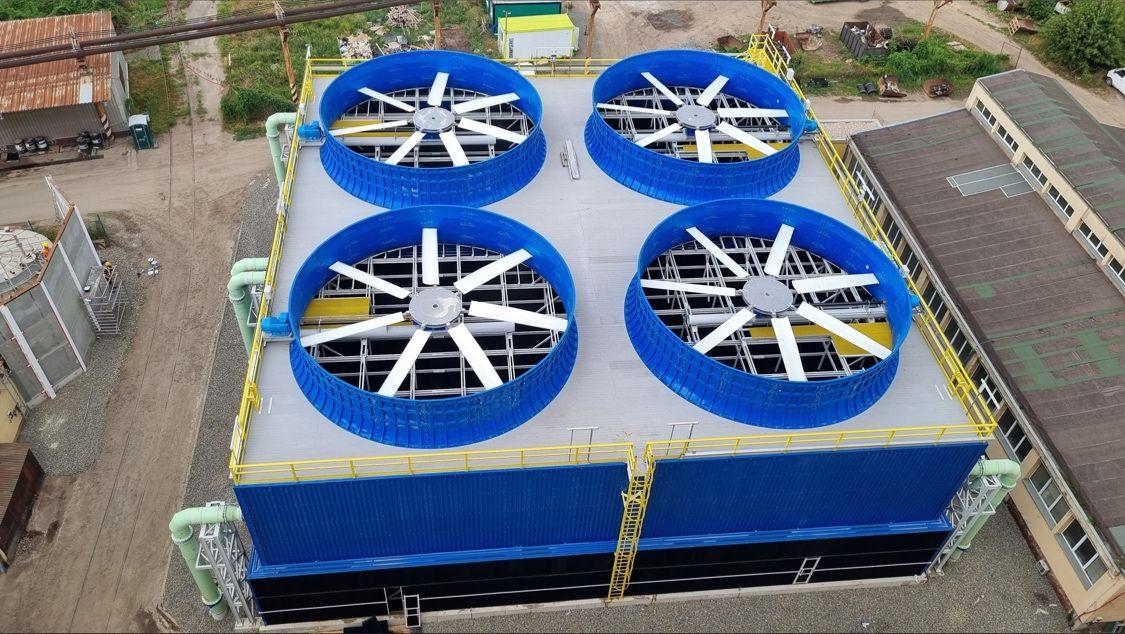
3.2 Cooling Tower Fill Media
Fill media is another critical component of a fan cooling tower.
Its main purpose is to increase the contact area and contact time between water and air. Without fill media, water would fall directly through the tower, providing much less opportunity for heat transfer.
There are two common categories of cooling tower fill.
Film Fill
Film fill spreads water into thin sheets over closely spaced surfaces. It provides a large contact area and is widely used in industrial cooling towers with suitable water quality.
PVC film fill is particularly common because it offers a practical combination of heat transfer performance, chemical resistance, and cost-effectiveness under appropriate operating conditions.
Splash Fill
Splash fill breaks falling water into smaller droplets through repeated impact on splash bars or other fill structures.
It is often selected for applications where water contains more suspended solids or where resistance to clogging is important.
The choice between film fill and splash fill depends on water quality, operating conditions, and tower design.
3.3 Water Distribution System
The water distribution system delivers hot water evenly across the fill section.
It commonly includes distribution pipes, spray nozzles, headers, branch pipes, and valves.
Uniform water distribution is important because dry areas inside the fill reduce the effective heat transfer surface.
If some sections receive too much water while others receive too little, the cooling tower may experience uneven cooling performance.
Regular inspection of nozzles and distribution pipes helps maintain proper water flow.
3.4 Drift Eliminators
Drift eliminators reduce the amount of liquid water droplets carried out of the tower by exhaust air.
They are generally installed above the water distribution and fill sections, depending on the cooling tower configuration.
Their main functions include reducing water loss, limiting visible water drift, and helping protect nearby equipment and structures.
High-quality drift eliminators are particularly important in industrial facilities where water conservation matters.
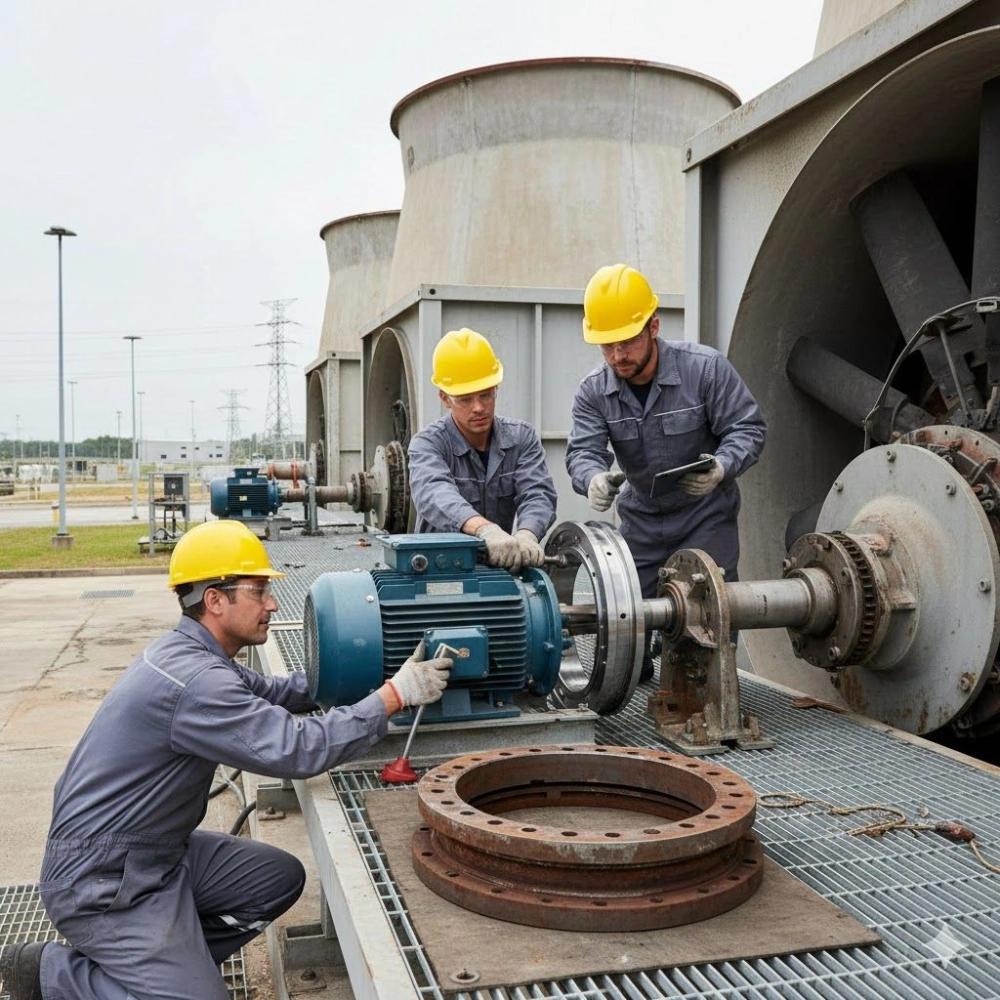
3.5 Fan Motor and Gearbox
The motor provides the mechanical energy needed to rotate the fan.
In some cooling towers, the motor connects directly to the fan through a drive shaft or other transmission arrangement. In other designs, a gearbox reduces the motor speed to the required fan operating speed.
Motor power, rotational speed, electrical efficiency, and protection rating should all be considered during equipment selection.
Regular inspection of the motor, gearbox, bearings, and drive assembly helps prevent unexpected downtime.
3.6 Cooling Tower Structure and Basin
The cooling tower structure supports the internal components and provides the necessary airflow passages.
Common structural materials include FRP, galvanized steel, stainless steel, and concrete.
The cold-water basin collects cooled water before it returns to the industrial circulation system. It should provide sufficient water storage and stable pump suction conditions.
4. Different Types of Fan Cooling Towers
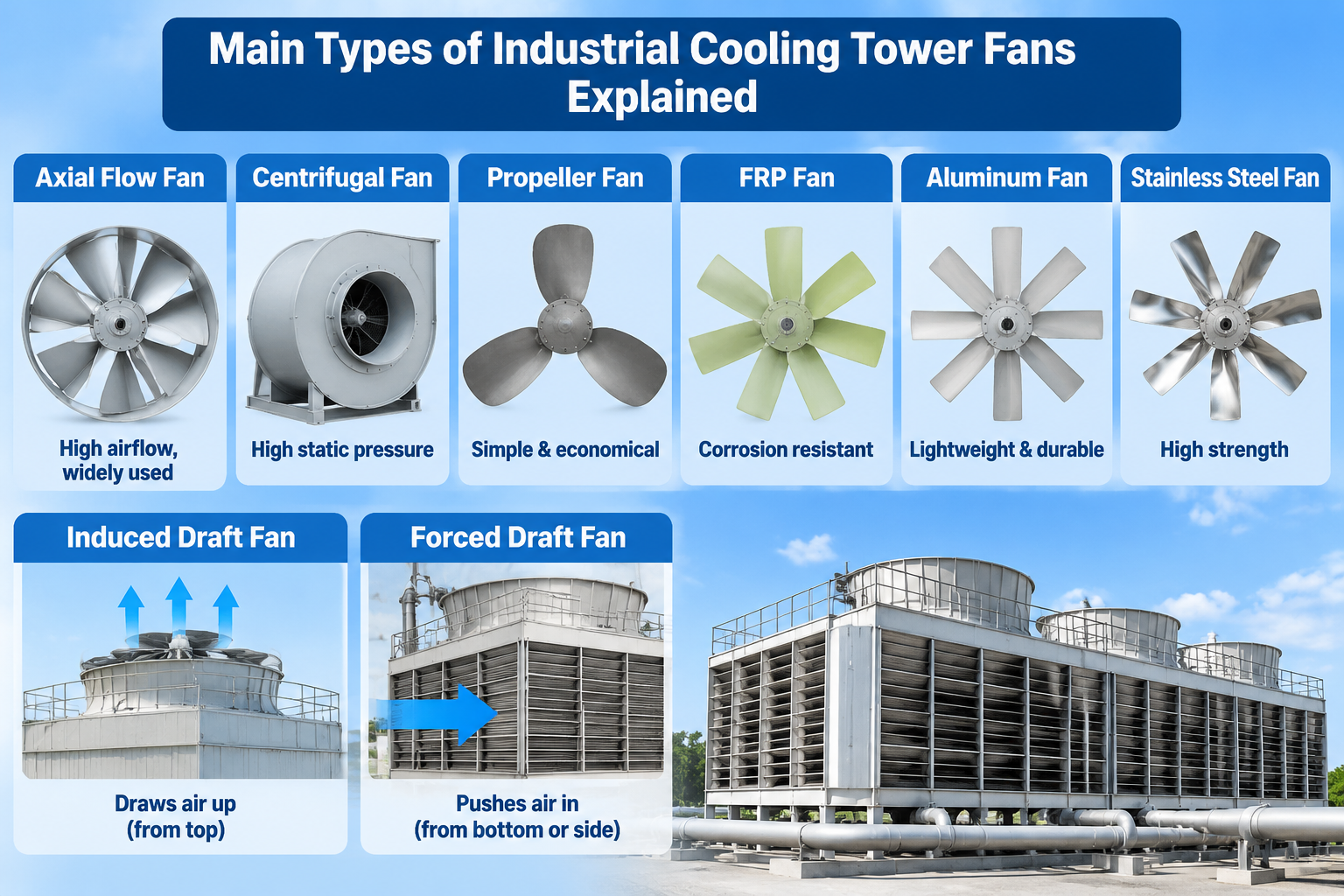
Mechanical draft cooling towers are generally divided into two main categories according to fan location and airflow arrangement.
4.1 Induced Draft Cooling Towers
An induced draft cooling tower places the fan near the top of the tower.
The fan pulls air through the fill section and discharges warm, moisture-rich air into the atmosphere.
This arrangement is widely used in industrial cooling systems.
Its advantages include:
Effective air movement through the tower.
Good control of airflow.
Reduced likelihood of hot, moist exhaust air returning directly to the air inlet.
Suitability for many large industrial applications.
Because the fan is located in the exhaust air stream, its materials and operating conditions must be considered carefully.
4.2 Forced Draft Cooling Towers
A forced draft cooling tower places the fan near the air inlet.
Instead of pulling air through the tower, the fan pushes atmospheric air into the cooling tower. Air then passes through the fill and exits through the discharge section.
Forced draft systems can offer convenient fan and motor access in some configurations.
However, the airflow distribution and exhaust arrangement must be properly designed to avoid recirculation and uneven cooling.
4.3 Axial Flow and Centrifugal Fan Systems
Cooling tower fans can also be classified according to their airflow characteristics.
Axial Fans
Axial fans move air approximately parallel to the fan shaft. They are commonly used in large mechanical draft cooling towers because they can deliver high airflow at relatively low static pressure.
Centrifugal Fans
Centrifugal fans move air through an impeller and discharge it in a direction generally perpendicular to the incoming airflow. They may be suitable for applications requiring higher static pressure, depending on the system design.
For most large industrial cooling tower applications, axial fans are a common choice.
5. How Cooling Tower Fans Generate Airflow
The fan is responsible for moving air through the cooling tower. But how does it actually generate airflow?
5.1 Axial Fan Working Principle
An axial fan works by rotating a series of blades around a central hub.
As the blades rotate, their aerodynamic shape creates a pressure difference that moves air along the fan axis.
This continuous movement draws fresh air into the cooling tower and carries warm, humid air away.
The fan must be selected according to the tower's required airflow and system resistance.
5.2 Fan Blade Angle and Air Volume
Fan blade angle has a direct influence on airflow and power consumption.
A larger blade pitch can increase airflow under suitable operating conditions, but it also increases the aerodynamic load on the fan.
If the blade angle is too large, the motor may consume excessive power or become overloaded.
If the angle is too small, airflow may be insufficient for the required cooling capacity.
Therefore, blade pitch should follow the fan manufacturer's design specifications.
5.3 Fan Speed and Motor Power
Fan speed is another important factor.
For a geometrically similar fan operating under comparable conditions, the fan affinity laws provide useful estimates:
Airflow is approximately proportional to rotational speed.
Pressure is approximately proportional to the square of rotational speed.
Power is approximately proportional to the cube of rotational speed.
For example, increasing fan speed by 10% can theoretically increase airflow by approximately 10%, while power demand may increase by around 33%.
Actual performance depends on the fan system and operating point.
Variable-frequency drives (VFDs) can help manage cooling tower energy consumption by adjusting fan speed according to cooling demand rather than running continuously at maximum speed.
6. The Relationship Between Cooling Tower Fans and Fill Media
A cooling tower fan and fill media work together.
Think of them as two partners in the same process. The fan provides the airflow, while the fill creates the surface area needed for effective water-air contact.
Neither component can deliver optimal performance if the other is incorrectly selected.
6.1 Why Fill Media Is Essential
Fill media slows the movement of water and spreads it over a larger surface.
This increases the opportunity for heat transfer and evaporation.
For industrial cooling towers, the correct fill design can significantly influence cooling capacity, heat transfer efficiency, airflow resistance, water distribution, and operating stability.
Different cooling tower models require different fill dimensions, thicknesses, spacing, and configurations.
6.2 How Airflow Affects Fill Performance
The airflow generated by the fan must pass through the fill section.
If airflow is insufficient, the cooling process may become less effective.
On the other hand, excessive airflow can increase pressure losses, fan power consumption, and water droplet carryover if the system is not properly designed.
The goal is not simply to maximize airflow. It is to achieve the correct balance between air volume, water flow, fill characteristics, and energy consumption.
6.3 Choosing Compatible Fan and Fill Systems
When replacing cooling tower fill, engineers should consider the existing fan system.
Important factors include:
Original cooling tower design.
Fill type and dimensions.
Fill installation height.
Airflow direction.
Water flow rate.
Air pressure drop.
Operating water quality.
For example, replacing an existing fill system with a denser film fill design may change airflow resistance.
If the existing fan cannot operate effectively under the new resistance conditions, cooling performance may be affected.
That is why fill replacement should involve more than simply measuring the old sheets and purchasing new material.
A complete evaluation of the cooling tower's operating conditions helps ensure that the replacement fill is compatible with the existing system.
7. Factors That Affect Fan Cooling Tower Efficiency
Even a well-designed cooling tower may not perform efficiently if operating conditions change.
Several factors determine its actual cooling performance.
7.1 Ambient Wet-Bulb Temperature
Wet-bulb temperature is one of the most important factors affecting cooling tower performance.
It represents the cooling potential of the surrounding air under evaporative conditions.
The lower the wet-bulb temperature, the greater the potential for cooling water.
A cooling tower generally cannot cool water below the entering-air wet-bulb temperature under normal operating conditions.
The difference between the cold-water temperature and the entering-air wet-bulb temperature is called the approach.
7.2 Airflow and Water Flow Rate
The relationship between airflow and water flow rate directly affects heat transfer.
If the water flow rate is too high compared with the available airflow, the tower may struggle to achieve the target outlet temperature.
If airflow is excessive, energy consumption may increase unnecessarily.
Engineers should evaluate the air-to-water ratio based on the required thermal performance.
7.3 Fill Condition and Water Quality
Water quality has a major impact on fill performance.
Mineral deposits, biological growth, suspended solids, and corrosion products can accumulate on fill surfaces.
Over time, these deposits may block passages and restrict airflow.
This can increase pressure drop and reduce effective heat transfer.
Regular water treatment, inspection, and cleaning are essential for maintaining cooling tower performance.
7.4 Fan Blade Design and Installation
Incorrect fan installation can create vibration, noise, and poor airflow.
Common issues include incorrect blade pitch, unbalanced fan blades, improper fan clearance, misaligned drive components, damaged fan blades, and incorrect motor rotation.
Proper installation and commissioning are important for reliable operation.
8. Common Fan Cooling Tower Problems
Cooling tower problems do not always come from the fan itself. Sometimes the cause is related to fill media, water distribution, or operating conditions.
Here are several common issues.
8.1 Insufficient Airflow
Insufficient airflow can lead to higher cold-water temperatures and reduced cooling capacity.
Possible causes include:
The first step is to inspect the fan and measure operating conditions.
Do not immediately replace the fan before checking the entire airflow path.
8.2 Excessive Fan Vibration and Noise
Vibration and unusual noise often indicate mechanical problems.
Possible causes include unbalanced blades, worn bearings, loose connections, shaft misalignment, or gearbox issues.
These problems should be investigated promptly. Ignoring abnormal vibration may result in more serious equipment damage.
8.3 Fan Motor and Gearbox Failure
Cooling tower motors and gearboxes operate under demanding industrial conditions.
High temperatures, moisture, insufficient lubrication, and mechanical overload can shorten their service life.
Routine inspections should include motor current, gearbox oil condition, bearing temperature, and unusual noise.
8.4 Uneven Water Distribution
Uneven water distribution can reduce the effective performance of fill media.
Some areas may become overloaded with water, while other sections remain relatively dry.
Possible causes include clogged nozzles, damaged distribution pipes, blocked water passages, and incorrect operating pressure.
Cleaning and inspecting the water distribution system can help restore uniform flow.
9. How to Maintain a Fan Cooling Tower
Regular maintenance is one of the most effective ways to extend equipment service life and prevent unplanned shutdowns.
A good maintenance program should cover both mechanical and thermal components.
9.1 Regular Fan Inspection
Inspect the fan blades for cracks, corrosion, deformation, and surface damage.
Check blade pitch and confirm that all blades are installed according to the manufacturer's specifications.
Also inspect the fan hub, mounting bolts, and supporting structure.
Any damaged blade should be evaluated before the fan returns to operation.
9.2 Cleaning and Replacing Fill Media
Fill media should be inspected regularly for:
If cleaning cannot restore the original performance, replacement may be necessary.
When selecting replacement fill, confirm the dimensions, material, sheet thickness, flute geometry, and installation arrangement.
For existing cooling towers, compatibility with the original structure is particularly important.
9.3 Checking Motors, Gearboxes, and Bearings
Inspect electrical connections and monitor motor operating current.
For gearbox-driven systems, check oil levels, lubrication condition, seals, and abnormal temperatures.
Bearing noise and vibration should also be monitored.
Follow the manufacturer's maintenance schedule rather than relying only on visible problems.
9.4 Monitoring Cooling Performance
Cooling tower maintenance should include performance monitoring.
Important operating parameters include:
| Parameter | What It Tells You |
| Hot-water temperature | Temperature of water entering the tower |
| Cold-water temperature | Temperature of water leaving the tower |
| Wet-bulb temperature | Environmental cooling potential |
| Approach | Difference between cold-water and wet-bulb temperatures |
| Range | Difference between hot-water and cold-water temperatures |
| Fan motor current | Electrical load of the fan |
| Airflow | Amount of air moving through the tower |
| Water flow rate | Circulating water volume |
By recording these parameters regularly, operators can identify performance changes before they become major problems.
10. How to Choose the Right Fan Cooling Tower
Choosing a suitable fan cooling tower requires more than comparing equipment prices.
You need to consider thermal requirements, operating environments, equipment configuration, and long-term operating costs.
10.1 Determine Cooling Capacity
Start by identifying the amount of heat that needs to be removed.
Important information includes:
Hot-water inlet temperature.
Required cold-water outlet temperature.
Circulating water flow rate.
Local wet-bulb temperature.
Operating hours.
Seasonal variations in cooling demand.
These parameters help determine the required cooling tower capacity.
10.2 Select the Appropriate Fan Type
Choose the fan according to the cooling tower structure and required airflow.
Axial fans are commonly used in large industrial cooling towers because of their high-volume airflow characteristics.
When evaluating fan specifications, consider fan diameter, airflow volume, static pressure, rotational speed, motor power, blade material, noise level, and energy efficiency.
The fan should match the tower's aerodynamic requirements.
10.3 Consider Operating Costs and Maintenance
A lower initial purchase price does not necessarily mean a lower total cost.
Consider electricity consumption, maintenance frequency, spare parts availability, material durability, and expected service life.
For industrial facilities operating continuously, energy efficiency can have a significant effect on total operating expenses.
It is also important to choose a supplier that understands cooling tower structures and replacement requirements.
11. Can Upgrading the Fan Improve Cooling Tower Performance?
Yes. Upgrading the cooling tower fan can improve performance when the existing fan is inefficient, damaged, incorrectly selected, or unable to meet the required operating conditions.
However, a fan upgrade should always begin with a system evaluation.
Installing a larger fan does not automatically guarantee better cooling.
The new fan must be compatible with existing tower dimensions, fan stack geometry, motor capacity, structural loading, fill resistance, required airflow, and the electrical system.
In some cases, improving fill media or correcting water distribution may produce better results than replacing the fan.
A complete cooling tower assessment helps identify the most cost-effective improvement.
12. Why Choose Power Tower Cooling Technology (Shaoxing) Co.,Ltd?
Selecting the right cooling tower components is important for maintaining reliable industrial cooling performance.
Power Tower Cooling Technology (Shaoxing) Co.,Ltd specializes in cooling tower fill products and related cooling tower replacement solutions.
Our product range includes:
PVC cooling tower film fill.
PP cooling tower splash fill.
Crossflow cooling tower fill.
Counterflow cooling tower fill.
Cooling tower drift eliminators.
Cooling tower fill replacement solutions.
We understand that different cooling tower models have different internal structures, operating requirements, and water quality conditions.
When customers need to replace existing fill media, we recommend evaluating the original fill dimensions, material, operating temperature, water flow, and cooling tower configuration.
Why does this matter?
Because the right fill is not simply the product with the lowest price. It must fit the tower, support effective heat transfer, and provide reliable operation under actual working conditions.
Whether you operate an industrial cooling tower, HVAC system, or manufacturing facility, choosing compatible replacement materials can help maintain stable cooling performance.
For more information about our products and cooling tower fill solutions, visit our official website:
https://www.coolingtowerpart.com
13. Frequently Asked Questions About Fan Cooling Towers
13.1 Does a Cooling Tower Need a Fan to Work?
Not every cooling tower needs a mechanical fan.
Natural draft cooling towers use natural air movement to support heat transfer.
However, mechanical draft cooling towers rely on fans to create controlled airflow. They are widely used in industrial applications where predictable cooling performance is important.
13.2 What Type of Fan Is Used in Industrial Cooling Towers?
Axial fans are commonly used in industrial cooling towers because they can move large volumes of air at relatively low pressure.
Centrifugal fans may be used in certain applications that require higher static pressure.
The correct choice depends on the tower design and airflow requirements.
13.3 How Does a Cooling Tower Fan Affect Water Temperature?
The fan influences water temperature by controlling the airflow through the tower.
Proper airflow improves the contact between air and water, supporting heat transfer and evaporation.
However, the final water temperature also depends on wet-bulb temperature, water flow rate, fill performance, and heat load.
13.4 How Often Should Cooling Tower Fans Be Maintained?
Cooling tower fans should be inspected according to operating hours, environmental conditions, and manufacturer recommendations.
Facilities operating continuously may need more frequent inspections.
Routine checks should include blade condition, vibration, mounting hardware, motor operation, and drive components.
13.5 Can Cooling Tower Fill Media Affect Fan Performance?
Yes. Fill media affects airflow resistance inside the cooling tower.
If fill passages become clogged or the replacement fill has unsuitable geometry, pressure drop may increase and airflow may decrease.
Therefore, fill selection should consider both heat transfer performance and airflow resistance.
14. Conclusion
A fan cooling tower is an essential part of many industrial cooling systems. It uses mechanical airflow, water distribution, and fill media to remove unwanted heat from circulating water.
The fan generates airflow, the fill increases air-water contact, and evaporation helps lower the water temperature. All these components work together to achieve effective heat rejection.
However, good cooling performance depends on more than fan capacity alone. Fan selection, blade design, fill quality, water distribution, water treatment, and regular maintenance all play important roles.
If you want to improve your cooling tower's performance, start by evaluating the entire system rather than focusing on a single component.
For cooling tower fill products and replacement solutions, Power Tower Cooling Technology (Shaoxing) Co.,Ltd is ready to support your requirements.
Visit https://www.coolingtowerpart.com to learn more about our cooling tower fill products and industrial cooling solutions.


