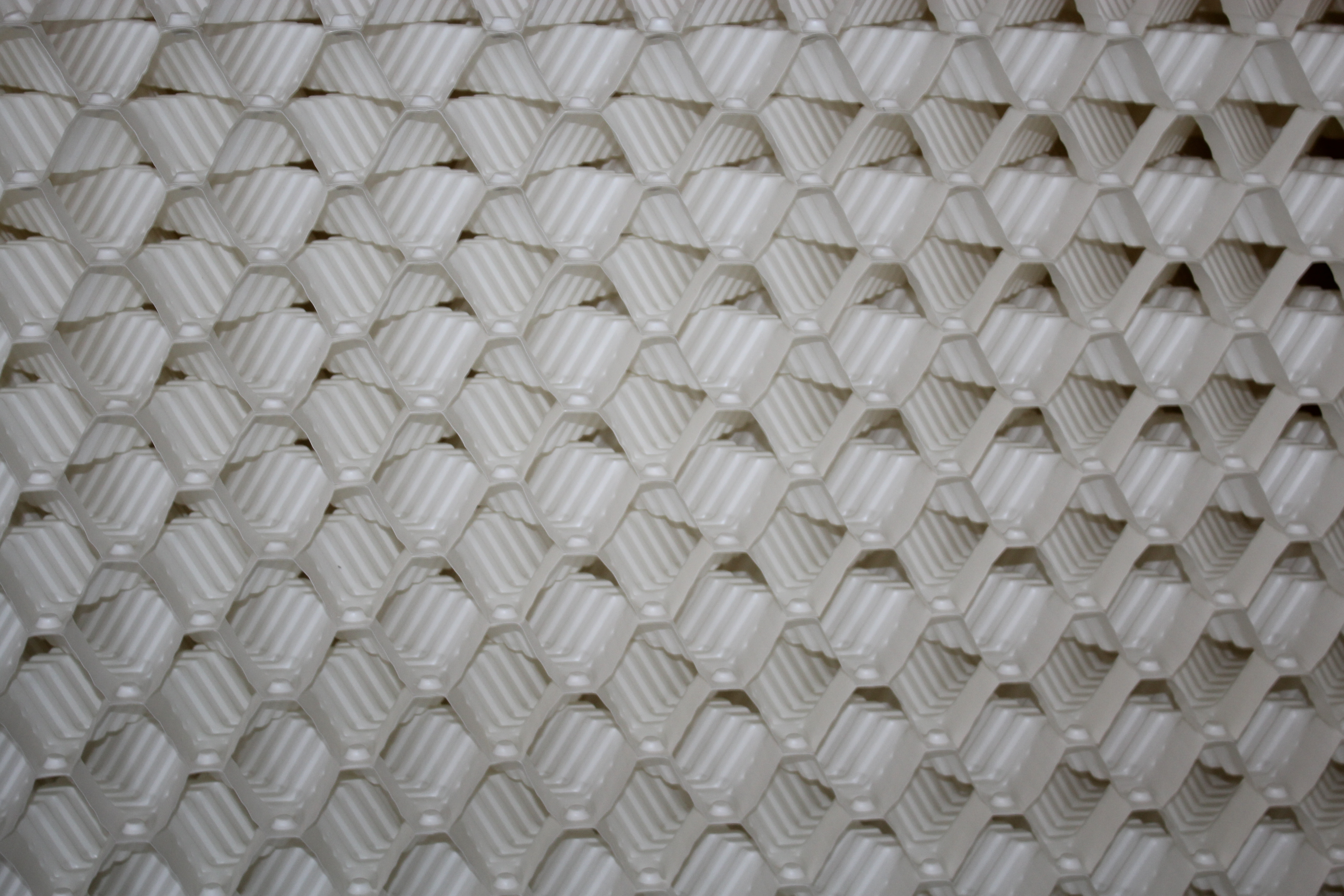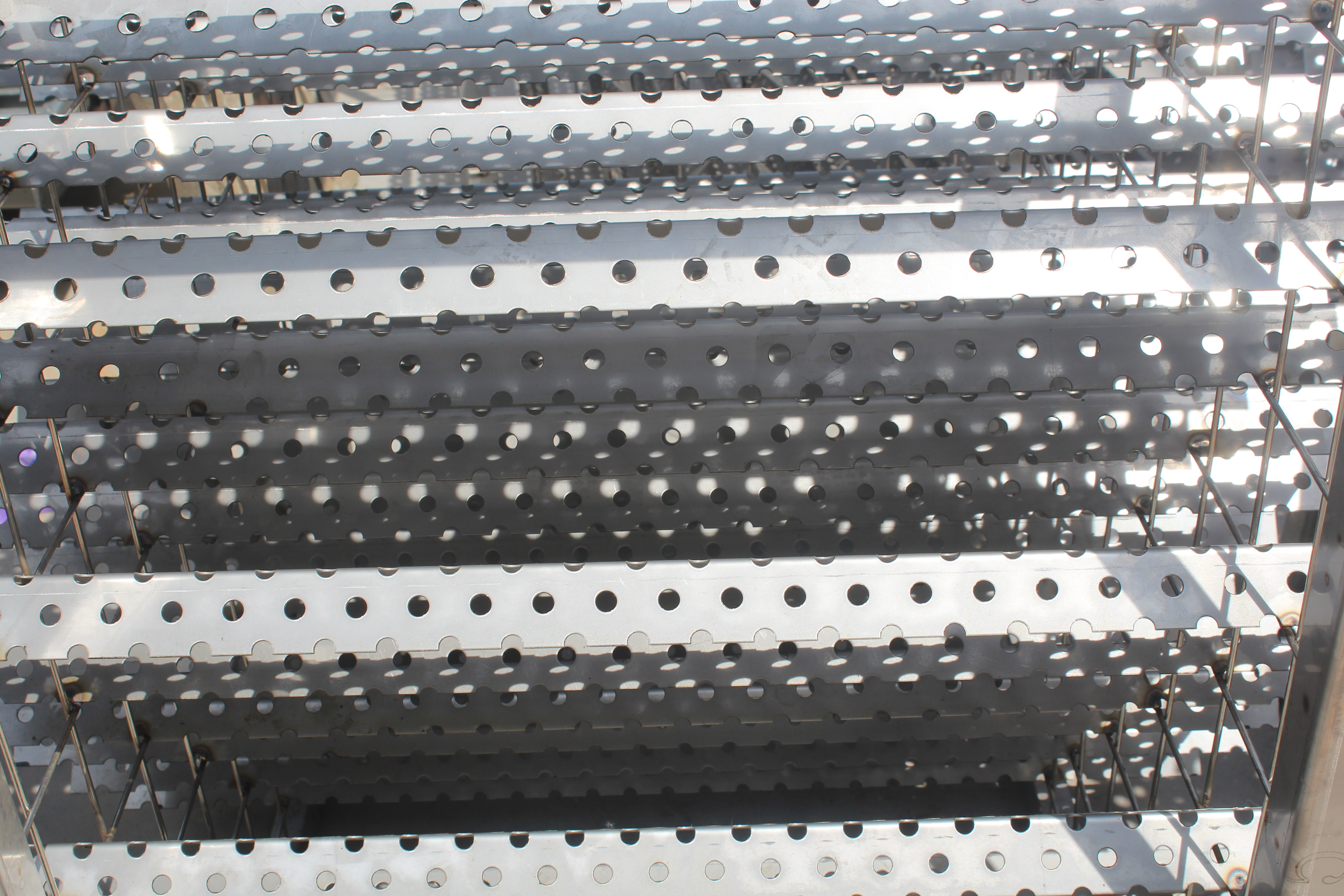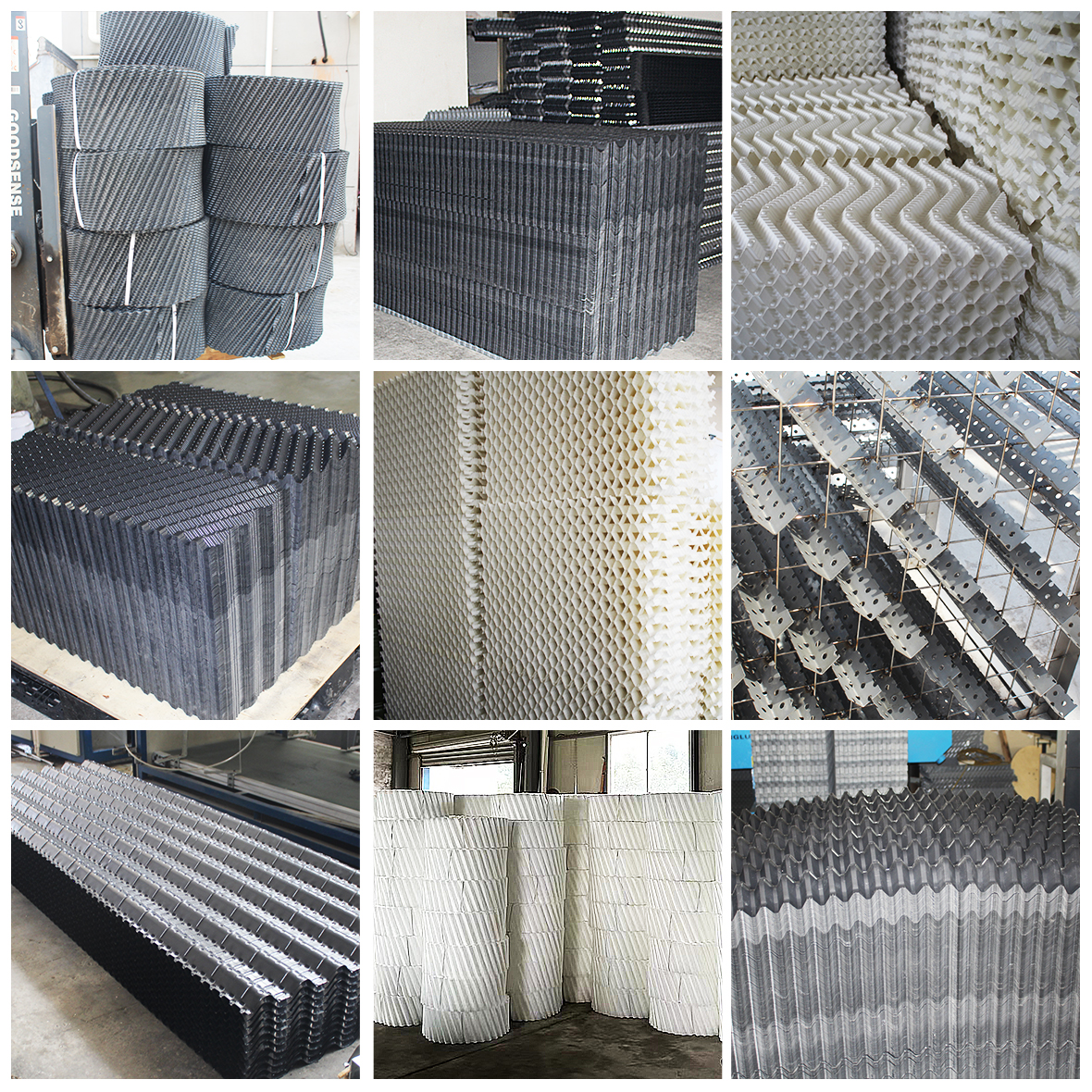
Cooling tower fill is one of the most important components inside an industrial cooling tower. Although fill does not create cooling by itself, it greatly improves heat transfer by increasing the contact area and contact time between hot water and moving air.
For cooling tower operators, selecting the right fill for cooling tower applications can affect thermal performance, water distribution, maintenance requirements, pressure drop, and equipment service life.
This guide explains how cooling tower fill improves heat transfer, how film and splash fills work, and what buyers should consider when selecting replacement fill.
What Is Fill for Cooling Tower?
Cooling tower fill, also called cooling tower fill media, is the material installed inside a cooling tower to increase the interaction between circulating water and air.
Hot process water enters the tower and is distributed over or through the fill. At the same time, air moves through the fill section. The fill creates a large effective surface area where heat can move from the water into the air.
Common cooling tower fill materials include:
PVC cooling tower fill
PP cooling tower fill
Polypropylene splash fill
PVC film fill
PP film fill
Splash bars and splash grids
Hybrid cooling tower fill
The specific design depends on the cooling tower type, water quality, operating temperature, and required thermal performance.
How Does Cooling Tower Fill Improve Heat Transfer?
The basic function of fill is simple: make the water-air contact more effective.
Without fill, water would fall through the tower relatively quickly, providing limited contact with the air. Fill changes this by spreading, breaking up, or redirecting the water as it travels through the tower.
There are several important mechanisms involved.
1. Fill Increases Water-Air Contact Area
The most important advantage of cooling tower fill is its ability to create a large contact area.
In film fill, water spreads into thin layers across the surface of corrugated or specially formed sheets. This creates a much larger water-air interface than a free-falling stream of water.
More contact area allows heat to transfer from the water to the air more effectively.
2. Fill Increases Contact Time
Cooling tower fill also slows down the movement of water.
Instead of falling directly from the distribution system to the cold-water basin, water travels through multiple fill surfaces, channels, or splash stages.
The increased contact time gives the air more opportunity to absorb sensible heat and latent heat from the circulating water.
This is particularly important in applications requiring a significant reduction in water temperature.
3. Fill Breaks Water Into Smaller Streams or Droplets
Different types of fill use different methods to distribute water.
Film fill spreads water into thin films.
Splash fill repeatedly breaks water into smaller streams and droplets as it contacts splash bars or grids.
Smaller water streams and droplets increase the effective surface area available for heat and mass transfer.
4. Fill Promotes Turbulence and Mixing
Good cooling tower fill design encourages interaction between air and water.
Corrugated film fill can change the direction of water and air as they pass through the fill pack. Splash fill creates repeated changes in water direction as water hits successive surfaces.
This movement helps maintain effective air-water contact and supports heat and mass transfer throughout the fill section.
5. Fill Supports Evaporative Cooling
Most industrial cooling towers use evaporative cooling.
As warm water contacts moving air, a small portion of the water evaporates. The energy required for evaporation comes primarily from the circulating water, which lowers its temperature.
Cooling tower fill improves this process by increasing the air-water interface.
The more effectively water contacts unsaturated air, the more efficiently evaporation can occur under suitable operating conditions.
Film Fill vs. Splash Fill for Heat Transfer
Two major categories of cooling tower fill are film fill and splash fill.
| Feature | Film Fill | Splash Fill |
| Main principle | Spreads water into thin films | Breaks water into droplets/streams |
| Surface area | Very high | High |
| Typical application | Cleaner water systems | Dirtier or fouling-prone water |
| Thermal efficiency | High when properly maintained | Good and robust |
| Fouling resistance | Generally lower | Generally higher |
| Common materials | PVC, PP | PP, PVC |
| Maintenance consideration | Requires good water distribution | More tolerant of suspended solids |
Film fill is commonly selected when high thermal performance and compact tower design are priorities.
Splash fill is often considered for applications where water quality, biological growth, or suspended solids make film fill more difficult to maintain.
Why PVC and PP Are Common Fill Materials
PVC and polypropylene (PP) are widely used for cooling tower fill because they provide a combination of thermal performance, chemical resistance, manufacturability, and relatively low weight.
PVC Cooling Tower Fill
PVC film fill is widely used in many industrial and HVAC cooling towers. It can be formed into corrugated sheets that provide a large surface area for water-air contact.
PVC cooling tower fill is often used where good thermal performance and cost-effective replacement are required.
PP Cooling Tower Fill
PP cooling tower fill is known for its resistance to higher temperatures and certain chemical environments. Polypropylene is also commonly used for splash-type fill.
The appropriate material depends on water chemistry, operating temperature, tower design, and application requirements.
Factors That Affect Cooling Tower Fill Heat Transfer
Installing high-quality fill does not automatically guarantee maximum cooling performance. Several operating factors influence heat transfer.
Water Flow Rate
The fill must be designed for the actual circulating water flow.
Too little water may result in poor wetting of the fill. Excessive flow can increase pressure drop, loading, or water carryover depending on the design.
Air Flow Rate
Cooling tower heat transfer also depends heavily on airflow.
Fans, fan blades, gearboxes, motors, louvers, and drift eliminators all influence airflow through the tower.
If airflow is restricted, even properly designed fill may not achieve the expected cooling performance.
Water Distribution
Uniform water distribution is critical.
Nozzles and distribution pipes should deliver water evenly across the fill surface. Dry areas reduce the effective heat-transfer area, while excessive water loading in certain areas can reduce overall performance.
Fill Cleanliness
Dirty or blocked fill can significantly reduce effective heat transfer.
Scale, algae, biological growth, sediment, and debris may restrict airflow and prevent water from spreading properly across the fill.
Regular inspection and appropriate water treatment help maintain thermal performance.
Approach and Range
Two important cooling tower performance terms are range and approach.
Cooling tower fill directly contributes to the tower's ability to achieve the required thermal performance, but the final result also depends on airflow, water flow, ambient conditions, and tower design.
How to Choose Cooling Tower Fill for Heat Transfer
When selecting fill for cooling tower replacement, do not choose based only on sheet dimensions or price.
Consider the following:
Cooling tower type – Crossflow and counterflow towers use different fill configurations.
Original fill design – Check sheet geometry, thickness, spacing, and pack dimensions.
Water quality – High suspended solids or biological loading may favor splash fill.
Operating temperature – Select a material suitable for the water temperature.
Required thermal performance – Match the fill to the tower's design duty.
Airflow and pressure drop – Fill geometry should work with the existing fan system.
Maintenance requirements – Consider cleaning access and fouling resistance.
Replacement compatibility – Confirm dimensions and support requirements before ordering.
For retrofit projects, an OEM-compatible or aftermarket cooling tower fill replacement should be checked against the existing tower configuration rather than selected solely by brand name.
Can Better Cooling Tower Fill Reduce Energy Costs?
Potentially, yes.
Efficient fill can improve heat and mass transfer, helping a cooling tower achieve its required cold-water temperature under appropriate operating conditions. However, actual energy savings depend on the entire cooling tower system.
Clean fill, proper water distribution, efficient fans, correctly sized motors, and good water treatment all contribute to overall system efficiency.
Replacing severely fouled or damaged fill can therefore be an important part of a cooling tower performance improvement project.
Signs That Cooling Tower Fill Needs Replacement
Cooling tower fill may require inspection or replacement when you notice:
Reduced cooling capacity
Higher cold-water temperature
Increased approach
Blocked or collapsed fill packs
Excessive scale or biological growth
Uneven water distribution
Increased airflow resistance
Brittle, cracked, or deformed fill sheets
Physical damage after cleaning
Before replacement, inspect the fill together with the nozzles, water distribution system, drift eliminators, fan, and other cooling tower components.
Cooling Tower Fill Replacement for Industrial Applications
For industrial cooling tower operators, the right cooling tower fill replacement should balance thermal performance, durability, water quality, and installation requirements.
CoolingTowerPart.com supplies cooling tower fill and replacement components for different cooling tower configurations, including PVC film fill, PP fill, splash fill, and other cooling tower fill media.
When requesting a replacement, provide the tower model, fill dimensions, material, operating temperature, water flow, and photos of the existing fill whenever possible. This helps suppliers identify a compatible solution more accurately.
Frequently Asked Questions
What is the main purpose of cooling tower fill?
The main purpose of cooling tower fill is to increase the contact area and contact time between circulating water and air, improving heat and mass transfer.
Does cooling tower fill make water colder?
Fill does not generate cooling itself. It improves the conditions for evaporative heat transfer, allowing the circulating water to release heat more effectively to the air.
Which is better, film fill or splash fill?
The appropriate choice depends on water quality, tower design, thermal requirements, operating temperature, and maintenance conditions. Film fill provides high surface area, while splash fill can offer greater tolerance to fouling and suspended solids.
How often should cooling tower fill be replaced?
There is no universal replacement interval. Fill should be inspected based on operating conditions and replaced when it becomes damaged, severely fouled, brittle, deformed, or unable to provide the required thermal performance.
Can cooling tower fill improve energy efficiency?
Properly selected and maintained fill can support efficient cooling and may reduce the operating burden on fans and other equipment. Actual energy performance depends on the complete cooling tower system.
Conclusion
Cooling tower fill improves heat transfer by increasing water-air contact area, extending contact time, breaking water into thin films or smaller streams, and supporting evaporative cooling.
Film fill is often used when high surface area and compact thermal performance are required, while splash fill can be a practical solution for applications with more challenging water quality.
For a cooling tower retrofit or replacement project, selecting the correct PVC or PP cooling tower fill requires more than matching dimensions. Water quality, airflow, water loading, operating temperature, tower configuration, and thermal duty should all be considered.
Need cooling tower fill replacement? Contact Power Tower Cooling Technology (Shaoxing) Co.,Ltd for compatible film fill, splash fill, PP fill, and PVC cooling tower fill solutions.
Internal Links for Other CoolingTowerParts
Cooling Tower Fill
Cooling Tower Nozzles
Cooling Tower Drift Eliminators
Cooling Tower Louvers
Cooling Tower Fan Blades
Cooling Tower Motors