Automatic Chemical Dosing System for Cooling Tower Water Treatment
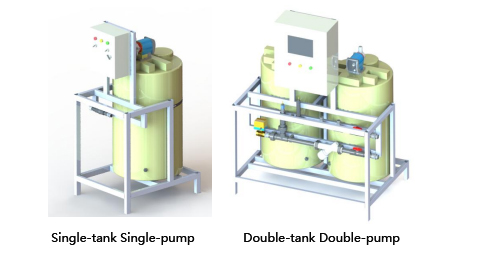 Automatic Chemical Dosing System for Cooling Tower Water Treatment is an integrated chemical metering and control solution designed to automate the dosing of water-treatment chemicals into industrial cooling water systems. The system shown combines chemical storage tanks, metering pumps, dosing pipelines, valves, instruments, and electrical control panels into a compact skid-mounted arrangement.
For cooling towers, maintaining proper water chemistry is essential for controlling scale, corrosion, biological growth, suspended solids, and overall system cleanliness. An automatic dosing system can continuously monitor selected water-quality parameters and regulate chemical injection according to programmed operating conditions.
This type of chemical dosing skid is suitable for industrial cooling towers, HVAC cooling systems, process-water systems, manufacturing plants, chemical facilities, and other applications requiring controlled chemical injection.
Product Overview
Cooling tower water is continuously exposed to evaporation. As water evaporates, dissolved minerals and contaminants can become increasingly concentrated. Without appropriate water treatment, this concentration can contribute to scale formation, corrosion, microbiological growth, and reduced heat-transfer efficiency.
The automatic chemical dosing system shown in the image provides a centralized platform for storing and metering treatment chemicals.
The system can be configured with multiple chemical dosing channels, allowing different chemicals to be independently stored, controlled, and injected into a cooling water circuit.
Typical treatment chemicals may include:
The exact chemicals, dosing rates, pumps, sensors, and control logic should be selected according to the cooling tower water-treatment program.
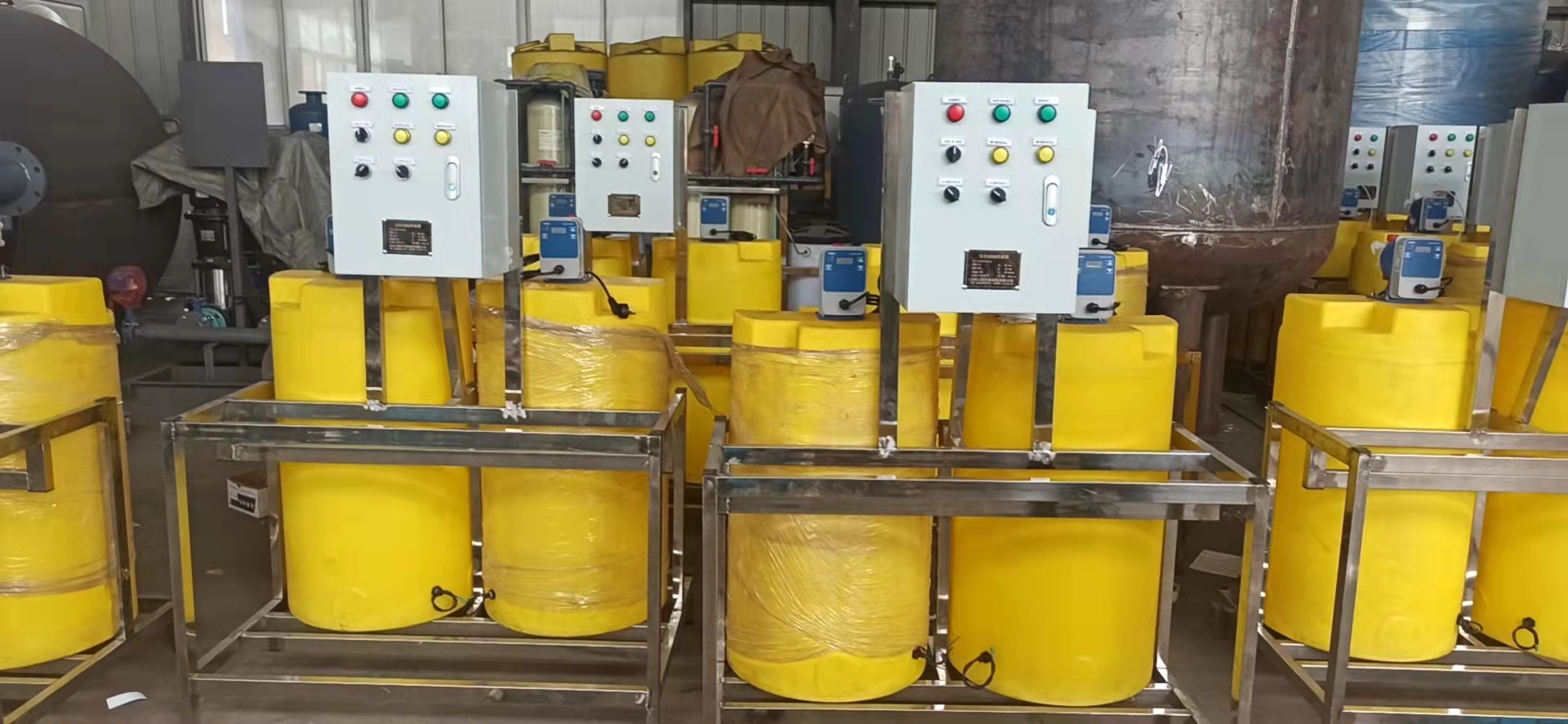
Automatic Cooling Tower Chemical Dosing System
Integrated Chemical Storage and Metering
The visible system uses multiple yellow chemical tanks mounted within metal support frames. Each tank provides a dedicated reservoir for a chemical solution.
Metering pumps and associated piping transfer the chemical solution from the storage tanks into the treatment-water system at a controlled rate.
This integrated arrangement helps simplify installation and provides a centralized location for chemical storage, dosing, and control equipment.
Intelligent Control Panel
The system includes electrical control cabinets equipped with HMI/control interfaces, indicators, switches, and instrumentation.
Depending on the configuration, the controller can be programmed to manage:
Chemical dosing intervals
Pump operation
Dosing rates
Automatic/manual operating modes
Alarm conditions
Water-quality feedback
Chemical replenishment requirements
Interlocking with cooling tower equipment
The control philosophy can be customized according to the application.
Multiple Chemical Dosing Channels
The pictured equipment contains multiple dosing assemblies, making it suitable for applications where more than one water-treatment chemical must be introduced into the cooling system.
Separate dosing channels can provide independent control over different treatment chemicals.
This is particularly useful for industrial cooling tower water treatment, where corrosion control, scale control, and microbiological control may require different chemical products.
Key Features of the Automatic Chemical Dosing System
Multi-Tank Chemical Storage
Multiple chemical tanks allow different treatment chemicals to be stored and dosed independently.
Tank capacity, material, number, and configuration can be customized according to the project requirements.
Precision Chemical Metering
Chemical metering pumps provide controlled chemical injection into the cooling-water circuit.
Pump selection should be based on:
Automated Control
The integrated control cabinet allows the dosing system to operate automatically according to programmed parameters.
Automation can reduce the need for continuous manual chemical dosing and help maintain more consistent treatment conditions.
Compact Skid-Mounted Design
The equipment shown is assembled on structural frames, creating an integrated dosing package that can simplify transportation, installation, piping, and commissioning.
Instrumentation and Monitoring
The system can incorporate sensors and transmitters for monitoring selected water-quality parameters.
Depending on the application, these may include:
Conductivity
pH
ORP
Flow
Pressure
Temperature
Chemical tank level
The actual instrumentation depends on the treatment strategy and control requirements.
Manual and Automatic Operation
A properly configured control system can provide both automatic and manual operating modes.
Manual control can be useful during commissioning, maintenance, troubleshooting, or chemical-system testing.
Cooling Tower Water Treatment Applications
The primary application of this equipment is automatic chemical dosing for cooling tower water treatment.
Industrial Cooling Towers
Industrial cooling towers often operate continuously and require controlled chemical treatment to maintain acceptable water chemistry.
Automatic dosing can help maintain the treatment program while reducing dependence on manual chemical addition.
HVAC Cooling Towers
Commercial and institutional HVAC systems can use chemical dosing equipment to manage cooling-water chemistry and help protect chillers, condensers, piping, and cooling tower components.
Process Cooling Systems
Manufacturing processes may require stable cooling-water quality to maintain heat-transfer performance and protect process equipment.
Chemical and Petrochemical Plants
Industrial facilities with demanding water-treatment requirements can use customized dosing skids for multiple chemical products.
Power and Energy Facilities
Cooling-water treatment systems can be integrated with plant water-management programs where reliable chemical dosing is required.
Manufacturing Facilities
Factories using recirculating cooling water can use automated chemical dosing to support corrosion, scale, and biological-growth control.
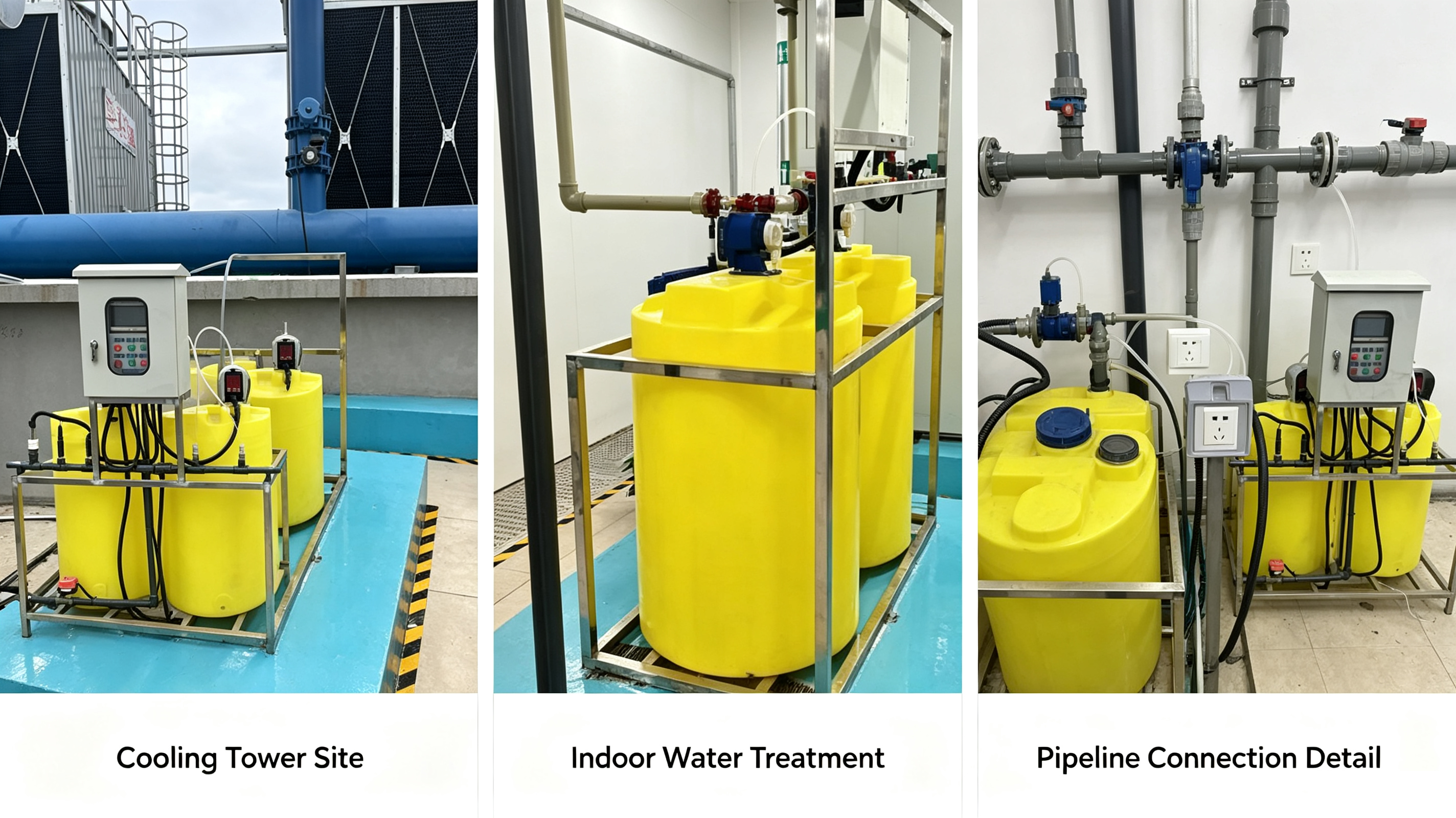
How an Automatic Cooling Tower Chemical Dosing System Works
The operating sequence generally follows several stages.
Step 1: Chemical Storage
Treatment chemicals are prepared at the required concentration and stored in dedicated chemical tanks.
Step 2: Water-Quality Monitoring
Sensors can monitor selected parameters in the cooling-water system.
For example, a conductivity sensor can provide information used for controlling dissolved-solids concentration, while pH or ORP instrumentation can support specific chemical-treatment strategies.
Step 3: Controller Processing
The control panel receives sensor signals and compares measured conditions with programmed setpoints.
Step 4: Chemical Pump Activation
When dosing is required, the controller activates the appropriate metering pump or adjusts its operating condition.
Step 5: Chemical Injection
The metering pump transfers the treatment chemical through the dosing pipeline and injection point into the cooling-water circuit.
Step 6: Continuous Adjustment
The control system can continue monitoring operating conditions and adjust the dosing process according to the configured control strategy.
Automatic Dosing vs. Manual Chemical Addition
Manual chemical addition can be appropriate for small or simple water-treatment systems, but larger industrial cooling systems often benefit from automation.
| Automatic Dosing | Manual Dosing |
| Controlled chemical injection | Operator-dependent |
| Can use sensor feedback | Usually requires manual testing |
| Consistent dosing strategy | Greater variation possible |
| Supports multiple chemicals | More difficult to coordinate |
| Centralized control | More manual intervention |
| Suitable for continuous operation | Better suited to simpler applications |
Automation does not eliminate the need for water-quality testing. Instead, it provides a more controlled way of implementing the selected treatment program.
Cooling Tower Chemicals That Can Be Dosed
The dosing system can potentially be configured for different treatment chemicals, subject to pump, tank, piping, seal, and material compatibility.
Scale Inhibitors
Scale-control chemicals can help manage mineral deposition caused by concentration of dissolved salts in recirculating cooling water.
Corrosion Inhibitors
Corrosion inhibitors are used as part of water-treatment programs designed to protect metal components in cooling-water systems.
Biocides
Biocides can be used to control microbiological growth in accordance with the facility's water-treatment program and applicable regulations.
Dispersants
Dispersants can assist in keeping certain suspended materials dispersed and reducing unwanted deposition.
pH-Control Chemicals
Acidic or alkaline chemicals can be metered when required by the cooling-water treatment strategy.
Chemical selection must always be based on the actual water chemistry, system materials, treatment objectives, and applicable safety requirements.
Product Specifications
The following specifications describe the visible configuration and typical customization options. Final specifications should be confirmed for the particular project.
| Item | Specification / Configuration |
| Product | Automatic Chemical Dosing System |
| Primary application | Cooling tower water treatment |
| System type | Integrated chemical dosing skid |
| Chemical tanks | Multiple tanks |
| Tank material | Project-specific chemical-resistant material |
| Metering equipment | Chemical dosing pumps |
| Control | Electrical control cabinet with HMI/control interface |
| Piping | Chemical-resistant dosing piping |
| Valves | Manual and/or automatic valves |
| Instrumentation | Project-specific sensors and transmitters |
| Dosing control | Automatic / manual |
| Mounting | Skid/frame mounted |
| Chemical quantity | Customizable |
| Tank capacity | Customizable |
| Pump capacity | Customizable |
| Number of dosing channels | Customizable |
| Power supply | Project-specific |
| Control signals | Project-specific |
| Communication | Optional, depending on control system |
| Application | Industrial and commercial water-treatment systems |
Custom Chemical Dosing Skid Configuration
Every cooling tower water-treatment application has different requirements.
The dosing system can therefore be engineered around parameters such as:
Cooling tower circulation flow
Cooling-water volume
Makeup-water flow
Blowdown rate
Chemical concentration
Required dosing rate
Chemical injection pressure
Number of treatment chemicals
Water chemistry
Operating schedule
Required automation level
A customized system can combine storage tanks, metering pumps, sensors, valves, piping, electrical controls, and communication interfaces into one integrated package.
Benefits for Cooling Tower Operators
More Consistent Chemical Dosing
Automated metering helps deliver chemicals according to the programmed treatment strategy instead of relying entirely on manual addition.
Reduced Operator Intervention
A centralized control system can reduce routine manual dosing activities.
Multiple Chemical Management
Independent dosing channels make it easier to manage different treatment products within one integrated system.
Better Process Control
When appropriate sensors are installed, dosing can be linked to measured cooling-water conditions.
Compact Installation
A skid-mounted configuration can reduce the amount of field assembly required.
Easier Maintenance
Centralizing pumps, tanks, piping, instruments, and controls provides a more organized equipment arrangement for inspection and servicing.
Installation Considerations
Before installation, confirm the following:
Chemical compatibility of all wetted materials
Electrical power requirements
Chemical storage requirements
Pump flow and pressure
Injection-point location
Cooling-water flow conditions
Sensor installation locations
Drainage provisions
Ventilation
Chemical containment
Access for maintenance
Required safety equipment
The dosing skid should be installed in accordance with applicable engineering standards, chemical-handling requirements, and the equipment manufacturer's instructions.
Maintenance of an Automatic Chemical Dosing System
Regular inspection helps maintain dosing accuracy and system reliability.
Maintenance activities can include:
Chemical Tanks
Check tank condition, fittings, covers, level indication, and signs of leakage.
Dosing Pumps
Inspect pump operation, tubing or diaphragms where applicable, connections, valves, and dosing performance.
Dosing Lines
Check for blockage, leakage, crystallization, damage, and chemical buildup.
Injection Points
Inspect injection valves and quills for blockage or deterioration.
Sensors
Clean, calibrate, and verify sensors according to the applicable manufacturer's recommendations.
Control Panel
Inspect electrical connections, displays, alarms, switches, and control functions.
Safety Equipment
Check chemical containment, labeling, ventilation, emergency equipment, and access arrangements according to site requirements.
Automatic Chemical Dosing System for Industrial Cooling Towers
An automatic dosing skid can become an important part of a complete cooling tower water-management strategy.
Cooling tower performance depends not only on fan airflow and heat-transfer surfaces but also on maintaining appropriate water quality. Excessive scale, corrosion, biological growth, and solids accumulation can reduce heat-transfer efficiency and increase maintenance requirements.
By combining chemical storage, metering pumps, instrumentation, and automated controls, the dosing system provides a centralized method for implementing a cooling-water treatment program.
Frequently Asked Questions
What is an automatic chemical dosing system?
An automatic chemical dosing system stores, meters, and injects water-treatment chemicals into a process or cooling-water system according to a defined control strategy.
What is this system used for in a cooling tower?
It is used to automatically introduce treatment chemicals into cooling-water systems. Depending on the water-treatment program, chemicals may be used for scale, corrosion, microbiological, dispersion, or pH control.
Can this system dose multiple chemicals?
Yes. The pictured configuration uses multiple chemical storage and dosing assemblies. The number of channels can be customized according to project requirements.
Can the dosing system operate automatically?
Yes. The system can be configured with a PLC/HMI or other control architecture for automatic operation. The actual control method depends on the project.
What sensors can be integrated?
Depending on the application, the system can integrate conductivity, pH, ORP, flow, pressure, temperature, level, or other suitable instruments.
Can the chemical tanks be customized?
Yes. Tank capacity, quantity, material, arrangement, and associated fittings can be customized according to chemical characteristics and project requirements.
How do I select a chemical dosing pump?
Pump selection depends on the required dosing flow, injection pressure, chemical properties, concentration, operating schedule, and control requirements.
Can it be used with an existing cooling tower?
Potentially. The dosing system can be designed as a new installation or integrated into an existing cooling-water treatment system after reviewing the site's hydraulic, electrical, chemical, and control requirements.
Does automatic dosing eliminate water testing?
No. Automation should complement an appropriate water-treatment and monitoring program. Regular testing and calibration remain important for verifying water quality and treatment performance.
What information is needed for a quotation?
Useful project information includes cooling tower capacity, circulating-water flow, makeup-water flow, chemical types, required dosing rates, tank capacities, number of chemicals, electrical requirements, control preferences, and photos or drawings of the existing installation.
Why Choose a Customized Cooling Tower Chemical Dosing System?
A standardized dosing package may not fit every industrial cooling application. Cooling towers vary considerably in capacity, water chemistry, chemical program, operating hours, and automation requirements.
A customized dosing skid allows the equipment to be selected around the actual process.
The result can be a coordinated system incorporating:
Request a Cooling Tower Chemical Dosing System Quote
Looking for an automatic chemical dosing system for a cooling tower?
Provide your cooling tower capacity, water flow, chemical requirements, desired dosing points, tank capacity, and control requirements. Photos of the existing water-treatment system can also help engineers understand the installation environment.
Contact us for a customized cooling tower chemical dosing skid, replacement dosing components, or an integrated water-treatment solution.
Internal Links
For stronger topical authority on CoolingTowerPart.com, link this page to related pages such as:


 Automatic Chemical Dosing System for Cooling Tower Water Treatment is an integrated chemical metering and control solution designed to automate the dosing of water-treatment chemicals into industrial cooling water systems. The system shown combines chemical storage tanks, metering pumps, dosing pipelines, valves, instruments, and electrical control panels into a compact skid-mounted arrangement.


