Industrial Cooling Tower Fan Balancing for Optimal Performance
Industrial cooling tower fan balancing is an essential maintenance procedure for improving equipment reliability, reducing mechanical vibration, and maintaining stable airflow. In industrial cooling systems, cooling tower fans operate continuously under demanding environmental conditions. Even a small imbalance in the fan assembly can lead to excessive vibration, increased bearing loads, abnormal noise, and unnecessary energy consumption.
Proper cooling tower fan balancing helps ensure that fan blades rotate smoothly and distribute centrifugal forces evenly around the rotating assembly. Whether a cooling tower uses FRP fan blades, aluminum fan blades, or large industrial axial fans, accurate balancing is important for achieving reliable long-term performance.
This article explains the importance of industrial cooling tower fan balancing, common causes of fan imbalance, balancing methods, inspection procedures, and practical maintenance recommendations.
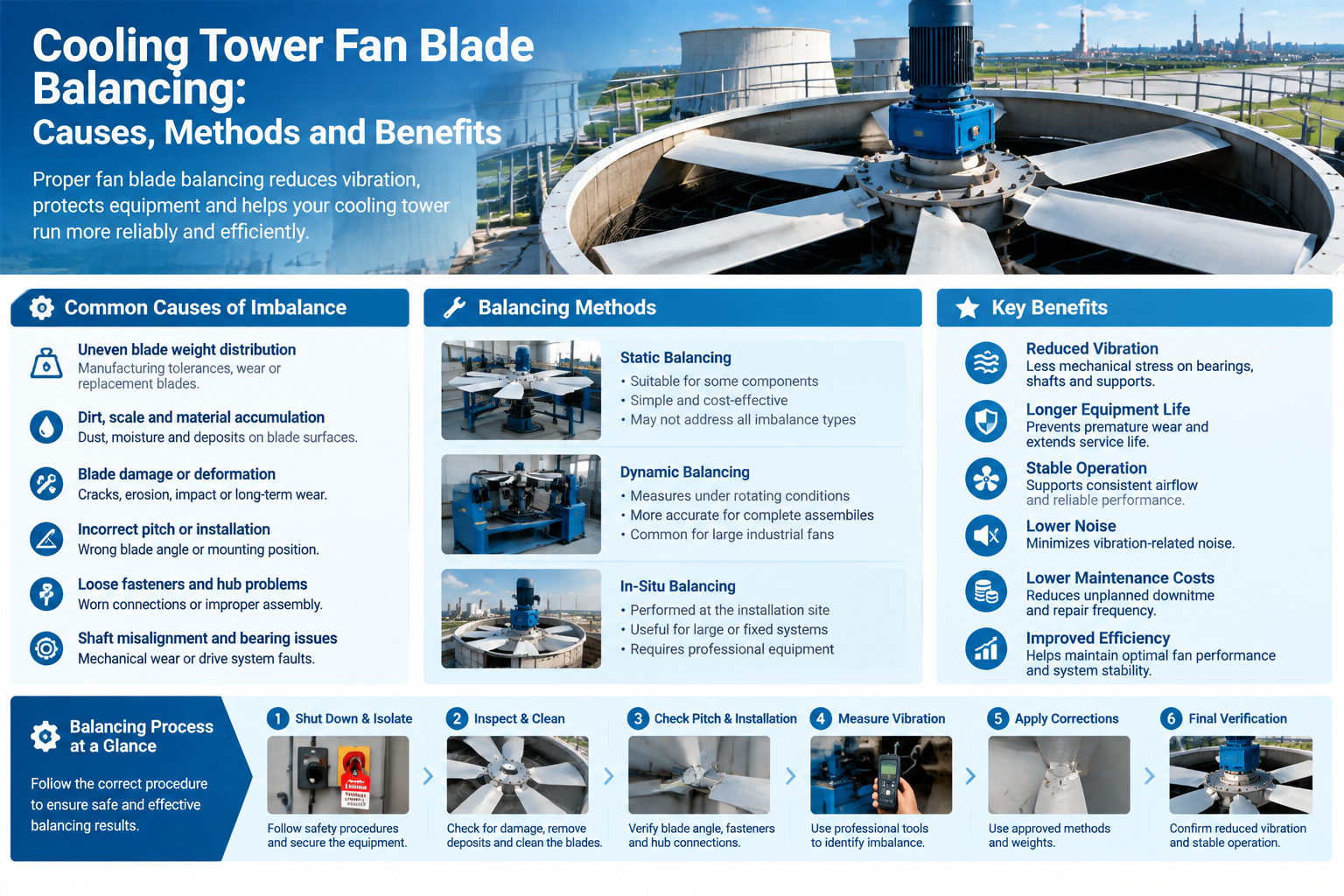
What Is Industrial Cooling Tower Fan Balancing?
Industrial cooling tower fan balancing is the process of correcting uneven mass distribution in a rotating fan assembly. The objective is to minimize unbalanced centrifugal forces during operation and ensure that the fan rotates smoothly.
A cooling tower fan typically consists of several components, including fan blades, a fan hub, a drive shaft, a gearbox or motor, and supporting mechanical structures. If the weight distribution of these rotating components is uneven, vibration can occur when the fan reaches operating speed.
Why Does Fan Balance Matter?
When a cooling tower fan rotates, every blade contributes to the overall rotational balance. Differences in blade weight, installation position, pitch angle, or structural condition can create uneven forces.
Proper balancing provides several benefits:
Reduces mechanical vibration during operation.
Minimizes stress on bearings and gearbox components.
Improves fan operating stability.
Reduces abnormal mechanical noise.
Helps prevent premature equipment failure.
Supports consistent airflow performance.
Reduces unnecessary maintenance costs.
The Relationship Between Imbalance and Vibration
An unbalanced fan produces centrifugal forces that increase with rotational speed. Even a relatively small mass difference can generate significant vibration in large industrial cooling tower fans.
For this reason, fan balancing should be considered an important part of cooling tower installation, commissioning, and preventive maintenance.
Common Causes of Cooling Tower Fan Imbalance
Cooling tower fan imbalance can develop gradually during operation or appear immediately after installation or component replacement.
Identifying the underlying cause is essential before performing any balancing correction.
1. Uneven Fan Blade Weight
Fan blades should have consistent weight and dimensional characteristics. Manufacturing differences, repairs, or accumulated deposits can create mass variations between blades.
Common contributing factors include:
Differences in blade manufacturing tolerances.
Uneven fiberglass resin distribution.
Water accumulation inside damaged blades.
Dirt and mineral deposits on blade surfaces.
Inconsistent replacement blade weights.
How Blade Weight Differences Affect Performance
When one blade is heavier than the others, the rotating assembly experiences an uneven centrifugal force. This force can increase vibration and place additional loads on the fan hub, bearings, and drive system.
For industrial applications, replacement cooling tower fan blades should be checked for weight consistency before installation.
2. Incorrect Fan Blade Installation
Incorrect installation is another common cause of cooling tower fan imbalance.
If blades are installed at different radial positions or with inconsistent mounting conditions, the fan assembly may not rotate evenly.
Potential installation problems include:
Incorrect blade spacing.
Uneven blade mounting angles.
Improper bolt tightening.
Incorrect blade orientation.
Misaligned blade roots.
Importance of Consistent Blade Pitch
Blade pitch determines the angle at which a fan blade moves through the air. If individual blades have different pitch angles, they may generate different aerodynamic forces.
Although pitch differences are primarily an aerodynamic problem rather than a pure mass imbalance, they can contribute to uneven operating loads and vibration.
3. Dirt and Foreign Material Accumulation
Cooling towers operate in environments where dust, airborne particles, mineral deposits, and moisture are common.
Over time, these materials can accumulate on fan blade surfaces.
Uneven deposits change the mass distribution of the rotating assembly, potentially resulting in vibration.
Recommended Cleaning Practices
Inspect fan blade surfaces regularly.
Remove accumulated dirt and mineral deposits.
Check for water retention inside hollow blades.
Clean the fan hub and mounting areas.
Inspect drainage and sealing conditions.
Cleaning should be completed before final balancing measurements are taken.
4. Damaged or Deformed Fan Blades
Mechanical damage can significantly affect fan balance.
FRP fan blades may develop cracks, delamination, or deformation after long-term operation. Aluminum fan blades may experience corrosion, bending, or localized damage.
Damaged blades should be carefully evaluated before attempting any balancing correction.
When Should a Fan Blade Be Replaced?
Consider replacement when a blade has:
Structural cracks or serious delamination.
Permanent deformation.
Significant corrosion or material loss.
Damaged mounting connections.
Internal moisture that cannot be safely removed.
Damage that affects aerodynamic performance.
Balancing weights should never be used to compensate for serious structural damage.
5. Fan Hub and Mechanical Component Problems
The fan hub connects individual blades to the rotating drive assembly. Problems with the hub can affect the overall balance and stability of the fan.
Common issues include loose fasteners, uneven mounting surfaces, corrosion, and mechanical deformation.
A damaged or improperly assembled hub should be repaired or replaced before balancing.
Different Methods of Cooling Tower Fan Balancing
Selecting the appropriate balancing method depends on fan size, operating speed, equipment configuration, and maintenance requirements.
Industrial cooling tower fans generally use static balancing, dynamic balancing, or a combination of both.
1. Static Fan Balancing
Static balancing identifies uneven mass distribution when a fan assembly is stationary or supported on a suitable balancing fixture.
The objective is to identify the heavy side of the rotating component and correct the mass distribution.
Static Balancing Procedure
Remove the fan assembly when required by the equipment design.
Clean the blades, hub, and mounting components.
Install the assembly on an appropriate balancing fixture.
Allow the assembly to settle naturally.
Identify the heavy position.
Apply approved correction methods.
Repeat the test until the required balance condition is achieved.
Static balancing is useful for identifying certain types of mass imbalance, particularly in individual components and smaller fan assemblies.
However, it does not fully evaluate vibration behavior under operating conditions.
2. Dynamic Fan Balancing
Dynamic balancing evaluates the rotating assembly while it operates or on an appropriate balancing machine.
It measures vibration characteristics and helps identify the magnitude and angular position of imbalance.
Dynamic balancing is particularly useful for large industrial cooling tower fans.
How Dynamic Balancing Works
A vibration analyzer or balancing instrument measures vibration signals from suitable sensor locations.
The technician analyzes the collected data to determine the correction weight and its installation position.
Typical procedures include:
Measuring baseline vibration.
Recording fan rotational speed.
Identifying vibration amplitude and phase.
Calculating correction weight.
Installing approved balancing weights.
Performing a verification test.
Advantages of Dynamic Balancing
Helps identify rotational imbalance.
Evaluates the rotating assembly under operating conditions.
Supports accurate correction of vibration problems.
Reduces unnecessary mechanical stress.
Helps improve long-term operating reliability.
3. Single-Plane and Two-Plane Balancing
The balancing method should match the fan's geometry and operating characteristics.
Single-plane balancing
Single-plane balancing corrects imbalance primarily in one correction plane. It may be suitable for relatively narrow rotating components where the dominant imbalance can be addressed in one plane.
Two-plane balancing
Two-plane balancing corrects both static and couple imbalance by using correction weights in two separate planes.
Large industrial cooling tower fans may require two-plane balancing depending on their geometry, rotational speed, and vibration characteristics.
Which Method Is Better?
There is no universal method for every cooling tower fan.
The correct approach should be determined through engineering evaluation, equipment specifications, and applicable balancing standards.
Step-by-Step Industrial Cooling Tower Fan Balancing Procedure
A systematic balancing procedure helps reduce measurement errors and improves the reliability of maintenance results.
Step 1: Perform a Complete Fan Inspection
Before balancing, inspect the entire fan assembly.
Check the following components:
Cooling tower fan blades.
Fan hub assembly.
Blade mounting bolts.
Drive shaft.
Gearbox or motor.
Bearings and supporting structures.
Fan stack and surrounding clearance.
Check for Mechanical Defects
Look for cracks, corrosion, loose connections, blade deformation, and unusual wear.
Any mechanical defect that could affect safe operation should be corrected before balancing begins.
Step 2: Clean the Fan Blades and Hub
Remove dust, dirt, mineral deposits, and other foreign materials from the fan assembly.
Cleaning is important because accumulated material may create an artificial imbalance.
The fan should be dry before final balancing measurements are performed.
Step 3: Verify Blade Pitch and Installation Position
Measure the pitch angle of each fan blade at the specified measurement location.
Confirm that:
All blades follow the manufacturer's installation requirements.
Blade spacing is consistent.
Mounting bolts are correctly tightened.
Blade roots are properly positioned.
The fan hub is installed correctly.
Incorrect pitch settings should be corrected independently of mass balancing.
Step 4: Measure Initial Vibration
Before applying any correction weights, record the initial vibration condition.
Use appropriate vibration sensors and measuring equipment.
Typical measurement locations include:
Record vibration amplitude, frequency, and phase information when available.
Step 5: Calculate and Apply Correction Weights
Based on the balancing analysis, determine the appropriate correction weight and position.
Correction methods may include:
Approved balancing weights.
Manufacturer-approved adjustment components.
Replacement of unsuitable or damaged components.
Correction of uneven material distribution where technically permitted.
Important Installation Considerations
Correction weights must be securely attached using an approved method.
Their material, location, attachment method, and retention system should comply with the fan manufacturer's requirements.
Never install improvised weights that could detach during high-speed operation.
Step 6: Perform a Final Balancing Test
After applying corrections, repeat the measurement process.
Compare the new vibration readings with the initial measurements and the applicable acceptance criteria.
If vibration remains excessive, investigate other potential causes rather than repeatedly adding balancing weights.
Step 7: Record Balancing Results
Maintain a complete record of the balancing process.
Important information includes:
Fan model and identification number.
Fan rotational speed.
Blade configuration.
Initial vibration readings.
Correction weight specifications.
Correction weight locations.
Final vibration readings.
Inspection date and technician information.
These records provide a useful reference for future preventive maintenance.
Important Standards for Industrial Cooling Tower Fan Balancing
Balancing quality should be evaluated according to the relevant equipment requirements and engineering standards.
Several international standards provide useful technical guidance.
ISO 21940 Series
The ISO 21940 series addresses mechanical vibration and rotor balancing.
It provides technical principles and procedures for evaluating rotor balance quality.
ISO 21940-11
ISO 21940-11 covers procedures and tolerances for rotors with rigid behavior.
It is relevant when determining appropriate balance quality requirements for applicable industrial rotating components.
ISO 21940-12
ISO 21940-12 addresses balancing procedures and tolerances for rotors with flexible behavior.
The appropriate standard depends on the characteristics of the rotating assembly.
ISO 20816 Series
The ISO 20816 series provides guidance for evaluating mechanical vibration through measurements on non-rotating parts of machines.
It can help assess the vibration condition of industrial rotating equipment.
However, vibration acceptance limits should be selected according to the relevant machine category, installation conditions, and applicable requirements.
Why Should Manufacturers Follow Balancing Standards?
Following suitable balancing procedures helps manufacturers and maintenance teams:
Establish consistent quality requirements.
Reduce excessive rotating vibration.
Improve equipment reliability.
Support quality control during production.
Provide more reliable commissioning documentation.
A specific balance quality grade should not be assumed to apply to every cooling tower fan. It must be selected according to the rotor characteristics and engineering requirements.
How Cooling Tower Fan Balancing Improves Operating Performance
Proper fan balancing offers several operational advantages beyond reducing vibration.
1. Reduces Mechanical Vibration
Excessive vibration can affect bearings, gearboxes, motors, structural supports, and fan connections.
Accurate balancing helps reduce vibration caused by mass imbalance.
Lower vibration levels can also make it easier to identify other developing mechanical problems.
2. Extends Equipment Service Life
Continuous vibration may accelerate mechanical wear.
It can contribute to:
Bearing fatigue.
Fastener loosening.
Gearbox stress.
Shaft and coupling wear.
Structural fatigue.
By correcting imbalance, maintenance teams can reduce unnecessary mechanical loading and support longer equipment service life.
3. Reduces Operating Noise
An imbalanced cooling tower fan may generate noticeable mechanical noise.
Although aerodynamic noise can also result from blade design, pitch, airflow turbulence, and fan stack conditions, correcting mechanical imbalance can help reduce vibration-related noise.
4. Supports Energy Efficiency
A properly balanced fan operates with reduced imbalance-related mechanical losses.
However, balancing alone does not guarantee significant energy savings.
Overall energy consumption also depends on fan blade design, rotational speed, motor efficiency, airflow resistance, and cooling tower operating conditions.
Combining accurate balancing with correct fan selection and system optimization can improve overall operating efficiency.
5. Improves Cooling Tower Reliability
Industrial cooling towers often operate continuously in power plants, chemical facilities, steel production plants, and HVAC systems.
Unexpected fan failures can interrupt cooling operations and affect production schedules.
Regular balancing inspections help reduce one potential source of mechanical failure.
Cooling Tower Fan Blade Materials and Their Impact on Balancing
Fan blade material affects component weight, structural performance, corrosion resistance, and maintenance requirements.
Different materials require appropriate inspection and balancing considerations.
FRP Cooling Tower Fan Blades
FRP (Fiberglass Reinforced Plastic) fan blades are widely used in industrial cooling tower systems.
They offer several advantages:
Lightweight construction.
Good corrosion resistance.
High design flexibility.
Suitable strength-to-weight ratio.
Adaptability to different fan configurations.
Balancing Considerations for FRP Blades
Manufacturing consistency is important because differences in resin distribution, fiberglass reinforcement, and blade dimensions can influence blade weight.
During maintenance, technicians should inspect FRP blades for cracks, delamination, deformation, and internal moisture.
Aluminum Cooling Tower Fan Blades
Aluminum fan blades are another common option for industrial cooling applications.
Their characteristics include:
Relatively low weight.
Good corrosion resistance when properly specified.
Strong mechanical properties.
Convenient maintenance and replacement options.
Balancing Considerations for Aluminum Blades
Technicians should inspect aluminum blades for bending, corrosion, surface damage, and inconsistent repairs.
Damaged blades should be evaluated before attempting any balance correction.
FRP vs. Aluminum Fan Blades
Comparison | FRP Fan Blades | Aluminum Fan Blades |
Material | Fiberglass composite | Aluminum alloy |
Weight | Generally lightweight | Lightweight |
Corrosion resistance | Generally excellent | Depends on alloy and environment |
Manufacturing | Composite molding | Metal fabrication |
Inspection focus | Cracks and delamination | Corrosion and deformation |
Application | Industrial cooling towers | Industrial cooling towers |
Both materials can provide reliable performance when properly designed, manufactured, installed, and maintained.
The appropriate choice depends on fan diameter, operating speed, environmental conditions, mechanical requirements, and project specifications.
Common Mistakes During Cooling Tower Fan Balancing
Even experienced maintenance teams can make mistakes that reduce balancing accuracy.
Understanding these problems helps improve maintenance quality.
1. Balancing Without Cleaning the Fan
Accumulated dirt and deposits can affect mass distribution.
Performing balancing before cleaning may result in inaccurate measurements.
2. Ignoring Blade Pitch Differences
A fan may have acceptable mass balance but still produce uneven aerodynamic loading because of inconsistent blade pitch.
Both conditions should be checked independently.
3. Using Incorrect Correction Weights
Improperly selected or installed weights may create additional imbalance or introduce safety risks.
Always follow approved engineering procedures.
4. Ignoring Bearing and Gearbox Problems
Not all vibration originates from fan imbalance.
Damaged bearings, misalignment, gearbox defects, loose foundations, and structural resonance may also cause vibration.
Why Is Root-Cause Analysis Important?
Repeatedly correcting the fan balance without identifying the actual source of vibration can increase maintenance costs and fail to resolve the underlying problem.
A comprehensive mechanical inspection should always accompany vibration analysis.
5. Skipping Final Verification
Balancing is not complete until the correction has been verified.
Final measurements should be recorded and compared with the required acceptance criteria.
Preventive Maintenance Tips for Cooling Tower Fan Balancing
Preventive maintenance helps maintain stable fan operation and reduces unexpected equipment downtime.
Daily and Weekly Inspection
Operators should observe the cooling tower fan during normal operation from a safe location.
Check for:
Unusual vibration.
Abnormal operating noise.
Visible blade damage.
Unusual fan movement.
Changes in motor current.
Signs of loose mechanical components.
Monthly Inspection
A more detailed inspection should include:
Fan blade surface condition.
Hub and mounting connections.
Gearbox and motor condition.
Bearing temperature.
Fan stack clearance.
Vibration trends.
Annual or Scheduled Balancing Inspection
The inspection interval should follow manufacturer recommendations, operating conditions, and historical vibration trends.
A balancing inspection may be appropriate after:
Fan blade replacement.
Fan hub replacement.
Major mechanical repair.
Fan drive system maintenance.
Abnormal vibration events.
Significant changes in operating conditions.
Keep a Maintenance History
Historical vibration data can help identify gradual changes in equipment condition.
Comparing measurements over time allows maintenance teams to identify developing problems before they become serious failures.
How to Choose a Reliable Industrial Cooling Tower Fan Manufacturer
Choosing a qualified cooling tower fan manufacturer is important for obtaining reliable fan assemblies and replacement components.
A professional manufacturer should provide products designed for the operating requirements of industrial cooling systems.
Evaluate Product Quality and Manufacturing Capability
Consider the following factors:
Experience in industrial cooling tower fan production.
FRP and aluminum fan blade manufacturing capabilities.
Fan hub design and production quality.
Dimensional and weight consistency.
Material quality control.
Product inspection procedures.
Technical support and replacement services.
Check Customization Capabilities
Different cooling tower models require different fan configurations.
A reliable manufacturer should be able to evaluate project requirements and provide suitable customized solutions.
Important Technical Information
Before purchasing a replacement fan assembly, provide:
Accurate technical information helps ensure that the replacement fan matches the existing cooling tower system.
Why Is Fan Hub Quality Important?
The fan hub is a critical component connecting the blades to the rotating drive system.
A properly designed hub provides reliable blade positioning and secure mechanical connections.
Its structural strength, dimensional accuracy, and assembly quality directly affect the reliability of the fan system.
Applications of Industrial Cooling Tower Fan Balancing
Industrial cooling tower fan balancing is important across various industries where reliable heat rejection is required.
Power Generation Plants
Power plants use large cooling tower systems to remove heat from circulating cooling water.
Proper fan balancing helps maintain stable operation and reduces unnecessary mechanical stress on large rotating assemblies.
Chemical and Petrochemical Facilities
Chemical facilities often operate cooling towers under demanding environmental conditions.
Regular fan inspection and balancing help maintain equipment reliability and support continuous production.
Steel and Metallurgical Plants
Steel production requires reliable cooling for various industrial processes.
Properly maintained cooling tower fans help maintain consistent cooling performance and reduce unexpected equipment interruptions.
Commercial HVAC Systems
Large HVAC cooling towers depend on stable fan operation to maintain heat rejection capacity.
Balancing helps reduce vibration and noise while supporting reliable system operation.
FAQ About Industrial Cooling Tower Fan Balancing
1. Why Is Cooling Tower Fan Balancing Necessary?
Cooling tower fan balancing is necessary to minimize vibration caused by uneven mass distribution. It helps reduce mechanical stress, protect bearings and gearboxes, and improve equipment reliability.
2. How Often Should an Industrial Cooling Tower Fan Be Balanced?
There is no universal balancing interval for every cooling tower fan.
Inspection frequency should depend on manufacturer recommendations, operating hours, vibration history, environmental conditions, and maintenance requirements.
Balancing should also be considered after major fan repairs or blade replacement.
3. What Causes Excessive Vibration in Cooling Tower Fans?
Common causes include:
Uneven fan blade weight.
Incorrect blade pitch.
Loose mounting bolts.
Damaged fan blades.
Fan hub defects.
Shaft misalignment.
Bearing damage.
Gearbox problems.
Structural resonance.
Accurate diagnosis is required before selecting a corrective action.
4. Is Dynamic Balancing Better Than Static Balancing?
Dynamic balancing provides additional information about rotating behavior and can address imbalance in multiple correction planes.
Static balancing is useful for certain components and configurations.
The appropriate method depends on fan geometry, rotational speed, and engineering requirements.
5. Can Fan Imbalance Increase Energy Consumption?
Yes. Fan imbalance can increase mechanical losses and vibration-related loading. However, the actual energy impact depends on the equipment and operating conditions.
Other factors, such as blade pitch, airflow resistance, and motor efficiency, also influence power consumption.
6. Can FRP Cooling Tower Fan Blades Be Balanced?
Yes. FRP cooling tower fan blades can be balanced using suitable procedures and equipment.
Before balancing, technicians should inspect the blades for structural damage, weight differences, deformation, and moisture accumulation.
7. What Is the Difference Between Fan Balancing and Fan Alignment?
Fan balancing corrects uneven mass distribution in rotating components.
Fan alignment ensures that connected mechanical components, such as shafts and couplings, are positioned correctly relative to each other.
Both procedures are important for reliable industrial fan operation.
Conclusion
Industrial cooling tower fan balancing is an essential part of maintaining reliable cooling tower performance. Proper balancing reduces vibration, minimizes mechanical stress, improves operating stability, and helps extend the service life of important rotating components.
However, effective balancing requires more than simply adding correction weights. Technicians must inspect fan blades, verify blade pitch, check hub connections, evaluate mechanical alignment, and identify other potential sources of vibration.
Selecting high-quality FRP cooling tower fan blades, precision-engineered fan hubs, and reliable replacement components also contributes to long-term equipment performance.
For industrial facilities seeking stable airflow and dependable cooling capacity, combining professional fan balancing with regular preventive maintenance is an effective strategy for improving cooling tower reliability and operational efficiency.


