Why Is Choosing the Right Cooling Tower Fan Replacement System Important?
A cooling tower fan replacement system plays a critical role in maintaining airflow, heat rejection, and overall cooling tower performance. When an existing fan system becomes inefficient, damaged, or outdated, replacing it with a properly designed solution can improve operating reliability, reduce energy consumption, and extend equipment service life.
However, selecting a replacement system involves more than simply purchasing a new fan. Industrial cooling tower fans operate under demanding conditions, including high humidity, temperature fluctuations, vibration, and continuous operation. Every component must work together to deliver stable airflow and mechanical performance.
A suitable cooling tower fan replacement system should match the original tower configuration while meeting current operating requirements.
What Problems Can a Poor Replacement System Cause?
Choosing an unsuitable replacement fan system may result in several operational problems:
Insufficient airflow and reduced cooling capacity.
Excessive motor power consumption.
Increased vibration and mechanical noise.
Improper fan blade pitch and aerodynamic performance.
Premature gearbox or bearing failure.
Difficult installation and unexpected maintenance costs.
These problems can affect the entire cooling process. Therefore, evaluating technical specifications before purchasing a replacement system is essential.
When Should You Consider Cooling Tower Fan System Replacement?
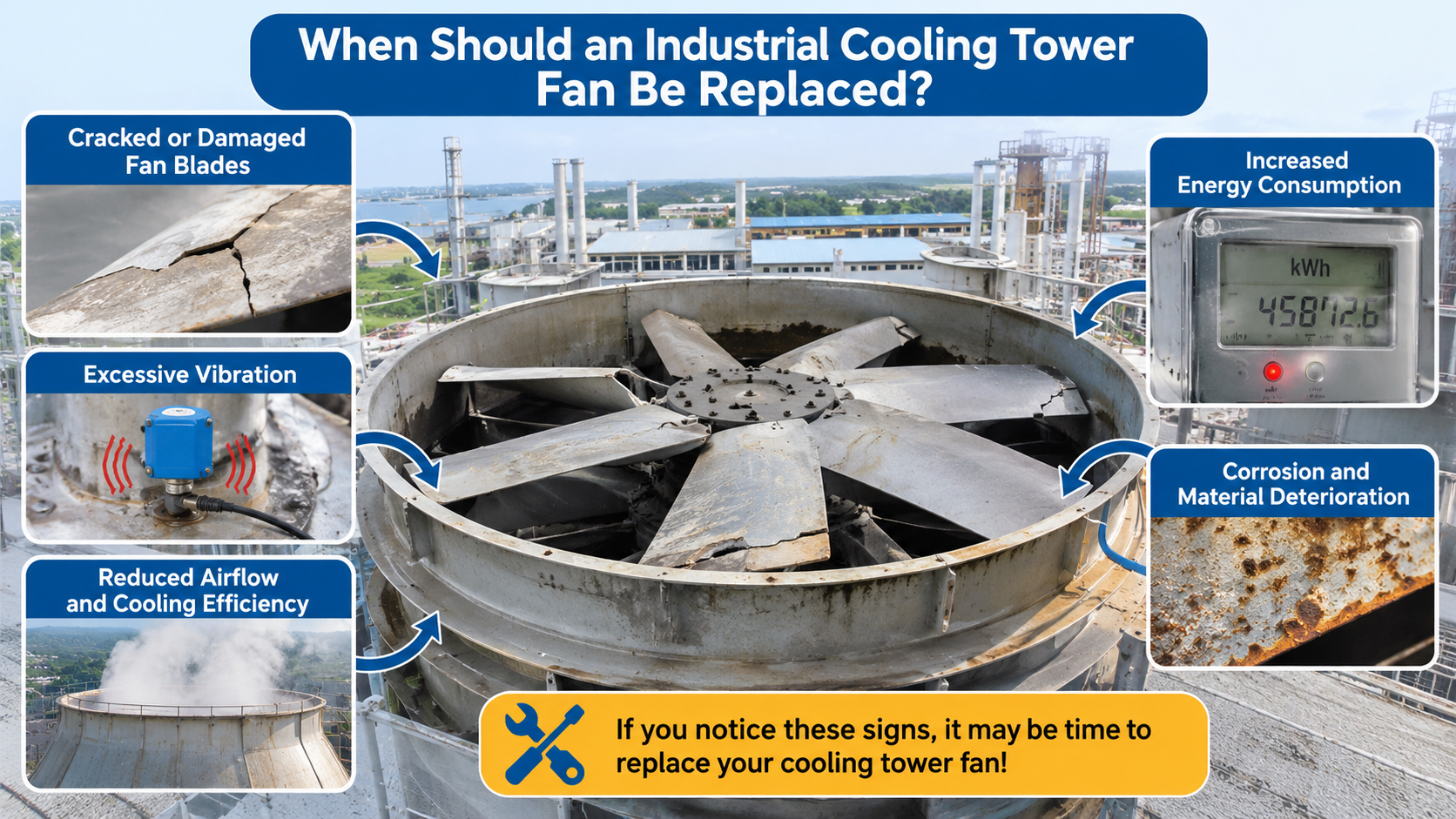
Several warning signs indicate that an existing fan system may require replacement.
Reduced Airflow Performance
If the cooling tower cannot maintain the required outlet water temperature, the fan may no longer provide sufficient airflow. Damaged blades, incorrect blade angles, and aerodynamic deterioration can all contribute to reduced performance.
Excessive Vibration and Noise
Unusual vibration may indicate blade imbalance, damaged fan hubs, loose connections, worn bearings, or gearbox problems. If repeated repairs fail to resolve these issues, replacing the affected fan system may be a more practical solution.
Increasing Energy Consumption
An aging fan system may consume more electricity while delivering less airflow. Upgrading to an efficient fan design can help reduce unnecessary energy consumption.
Structural Damage and Material Aging
Corrosion, fiberglass deterioration, blade deformation, and connection fatigue can weaken the fan assembly. Replacement becomes particularly important when structural damage affects safe operation.
Which Factors Should You Evaluate Before Choosing a Replacement System?
Selecting the correct cooling tower fan replacement system requires a detailed understanding of the existing equipment and operating conditions.
1. Identify the Cooling Tower Type
The first step is identifying the cooling tower configuration because different tower designs require different fan arrangements.
Counterflow Cooling Towers
In counterflow cooling towers, air moves vertically upward against the downward flow of water. Axial fans are commonly installed at the top of the tower to draw air through the fill section.
The replacement system must provide sufficient airflow while maintaining compatibility with the existing fan stack and supporting structure.
Crossflow Cooling Towers
Crossflow cooling towers allow air to move horizontally through the fill media while water flows vertically downward.
Their fan systems may have different installation dimensions and airflow requirements compared with counterflow designs.
Induced-Draft and Forced-Draft Systems
Induced-draft cooling towers generally install fans at the air discharge section, while forced-draft systems use fans to push air into the tower.
Understanding the airflow arrangement helps determine the appropriate fan configuration, motor position, and replacement components.
2. Calculate the Required Airflow Capacity
Airflow capacity is one of the most important parameters when selecting a cooling tower fan replacement system.
The fan must move enough air through the tower to support the required heat transfer process.
Factors affecting airflow requirements include:
Cooling tower thermal capacity.
Water circulation rate.
Entering and leaving water temperatures.
Ambient wet-bulb temperature.
Tower fill characteristics.
Air resistance and system pressure losses.
Why Is Airflow Matching Important?
A replacement fan with insufficient airflow may reduce cooling efficiency and increase water outlet temperatures.
An oversized fan may consume unnecessary power, increase mechanical loading, and create operating problems.
The objective is to select a fan that meets the required airflow at the actual system resistance rather than simply choosing the largest available model.
3. Check Fan Diameter and Installation Dimensions
Fan dimensions directly affect installation compatibility and aerodynamic performance.
Before ordering a replacement system, measure the following:
Existing fan diameter.
Fan stack inside diameter.
Hub mounting dimensions.
Shaft or gearbox connection dimensions.
Blade clearance.
Overall installation height.
Mounting bolt patterns.
Why Should Fan Stack Dimensions Be Checked?
The fan stack helps guide airflow and reduce unnecessary turbulence.
If the replacement fan diameter does not match the stack configuration, airflow efficiency may decrease. Insufficient blade-tip clearance can also create mechanical risks.
A properly matched fan and stack combination helps maintain stable airflow distribution.
4. Evaluate Fan Blade Materials
Fan blade material influences weight, corrosion resistance, mechanical strength, and service life.
Different industrial environments require different material selections.
FRP Cooling Tower Fan Blades
Fiber Reinforced Plastic (FRP) blades are widely used in industrial cooling tower applications.
Their main advantages include:
Lightweight construction.
Good corrosion resistance.
High strength-to-weight ratio.
Flexible aerodynamic design.
Reduced rotating mass.
Suitability for humid industrial environments.
FRP blades are particularly useful in cooling towers exposed to moisture and corrosive operating conditions.
Aluminum Cooling Tower Fan Blades
Aluminum blades offer a combination of mechanical strength and relatively low weight.
Their advantages include:
Good structural rigidity.
Relatively easy maintenance.
Established industrial applications.
Convenient manufacturing and replacement options.
However, material selection should consider corrosion exposure, protective coatings, and the specific operating environment.
How Should You Compare Different Blade Materials?
Evaluation factor | FRP blades | Aluminum blades |
Weight | Generally lightweight | Lightweight |
Corrosion resistance | Generally excellent | Depends on alloy and protection |
Structural strength | High | High |
Maintenance | Relatively low | Requires corrosion inspection |
Customization | Flexible design options | Established fabrication options |
The best choice depends on operating conditions, fan dimensions, mechanical loading, and total lifecycle cost.
How Do You Select the Main Components of a Replacement Fan System?
A cooling tower fan replacement project should evaluate the complete rotating assembly rather than focusing exclusively on the fan blades.
1. Cooling Tower Fan Blades
Fan blades directly influence airflow volume, aerodynamic efficiency, and power requirements.
When replacing blades, consider:
Blade length and profile.
Blade angle and pitch adjustment range.
Material and structural strength.
Number of blades.
Rotational speed.
Aerodynamic characteristics.
Why Is Blade Pitch Important?
Blade pitch determines the angle at which the fan blades interact with incoming air.
An incorrect pitch setting can increase motor load without providing the expected airflow improvement.
Replacement blades should be installed and adjusted according to the manufacturer's engineering specifications.
2. Cooling Tower Fan Hub Assembly
The fan hub connects individual blades to the rotating shaft or gearbox output assembly.
A properly designed hub ensures that rotational forces are distributed safely across the blade mounting points.
Important Hub Selection Factors
Hub diameter and configuration.
Blade mounting structure.
Material strength.
Bolt arrangement.
Shaft connection dimensions.
Compatibility with existing fan blades.
For replacement projects, confirming the hub interface is essential to avoiding unnecessary installation modifications.
3. Cooling Tower Fan Gearbox
The gearbox transfers motor power to the fan while adjusting rotational speed according to the system design.
An unsuitable gearbox can affect fan speed, torque transmission, and overall operating reliability.
What Should You Check When Replacing a Gearbox?
Gear ratio: The replacement gearbox must provide the required output speed.
Rated power: Its power capacity should be suitable for the motor and fan load.
Output shaft: Shaft dimensions and connection arrangements must match the fan hub.
Lubrication: The gearbox should have an appropriate lubrication system for continuous industrial operation.
Operating environment: Temperature, moisture, vibration, and maintenance accessibility should be considered.
4. Cooling Tower Fan Motor
The motor provides the driving force for the cooling tower fan.
When choosing a replacement motor, evaluate the following parameters:
Should You Upgrade to a Higher-Efficiency Motor?
A high-efficiency motor can reduce electricity consumption, particularly in cooling towers operating for extended periods.
However, motor replacement should consider the actual fan power requirement, starting torque, gearbox capacity, and electrical system compatibility.
Installing a motor with excessive power does not automatically improve cooling tower efficiency.
How Do You Match Fan Performance With Existing Operating Conditions?
A replacement cooling tower fan must operate within the performance requirements of the complete cooling system.
Understand the Fan Performance Curve
A fan performance curve describes the relationship between airflow, pressure, rotational speed, and power consumption.
When selecting a replacement fan, engineers should compare the proposed fan performance with the existing system requirements.
Airflow and Static Pressure
The replacement fan should deliver the required airflow against the resistance created by the cooling tower structure, fill media, drift eliminators, and other internal components.
Fan Speed and Power Consumption
Fan rotational speed affects airflow and power requirements.
For geometrically similar operating conditions, the fan affinity laws provide useful engineering relationships:
\[ Q \propto N \]
\[ P \propto N^3 \]
Where:
For example, increasing fan speed by 10% can theoretically increase airflow by approximately 10%, while power demand may increase by approximately 33.1%.
These relationships are approximate and assume similar aerodynamic conditions. Actual performance depends on system resistance and fan characteristics.
Consider Seasonal Operating Conditions
Cooling tower operating requirements often change throughout the year.
During periods of lower ambient temperatures, the required cooling capacity may decrease. Variable frequency drives (VFDs) can help regulate fan speed according to actual cooling demand.
A replacement fan system designed for variable-speed operation may provide additional energy-saving opportunities.
What Replacement Options Are Available for Industrial Cooling Towers?
Not every cooling tower requires a complete fan system replacement. The appropriate solution depends on the condition of the existing equipment.
Option 1: Replace Individual Fan Components
If the gearbox, motor, and hub remain in good condition, replacing only damaged or outdated fan blades may be sufficient.
This approach can reduce initial investment and minimize installation work.
Suitable applications:
Damaged or cracked fan blades.
Corroded aluminum blades.
Outdated blade profiles.
Uneven blade performance.
Localized mechanical damage.
Option 2: Replace the Complete Fan Assembly
A complete fan assembly replacement generally includes the fan blades and hub.
This solution is appropriate when the existing rotating assembly has significant damage or when an upgraded aerodynamic design is required.
Main advantages:
Improved component compatibility.
Easier performance optimization.
Reduced uncertainty from mixing old and new components.
Opportunity to upgrade blade materials and design.
Option 3: Upgrade the Entire Fan Drive System
A complete fan drive upgrade may involve replacing the fan, hub, gearbox, motor, and associated drive components.
This option is suitable for aging cooling towers with multiple mechanical problems.
It also provides an opportunity to improve energy efficiency, operating stability, and maintenance accessibility.
How Can You Reduce the Cost of Cooling Tower Fan System Replacement?
Replacement costs involve more than the purchase price of a new fan. Installation, transportation, downtime, maintenance, and electricity consumption should all be considered.
Compare Initial Cost With Long-Term Operating Cost
A low-priced replacement fan may not provide the best economic value if it consumes excessive electricity or requires frequent maintenance.
Consider the following cost factors:
Cost factor | What to evaluate |
Equipment price | Fan, hub, motor and gearbox |
Installation | Labor and lifting equipment |
Energy consumption | Annual electricity usage |
Maintenance | Inspection and replacement frequency |
Downtime | Production interruption |
Transportation | Packaging and delivery expenses |
Improve Energy Efficiency Through Proper Fan Selection
The fan is one of the major electricity-consuming components in many mechanical-draft cooling towers.
Selecting an efficient fan profile and matching its operating point to the system can reduce unnecessary energy consumption.
Avoid Excessive Fan Speed
Operating a fan faster than necessary can increase power consumption and mechanical stress.
Where appropriate, VFD control can help maintain the required cooling performance while adjusting energy use to changing operating conditions.
Maintain Correct Blade Pitch
Incorrect blade pitch can create excessive motor loading or insufficient airflow.
Proper adjustment helps balance cooling capacity, energy consumption, and mechanical reliability.
Plan Replacement During Scheduled Maintenance
Replacing the fan system during a planned maintenance shutdown can reduce unexpected production interruptions.
Preparing installation drawings, equipment dimensions, lifting arrangements, and replacement components in advance can also improve project efficiency.
What Are the Most Common Mistakes When Choosing a Replacement Fan System?
Even experienced industrial buyers can encounter problems when selecting replacement equipment.
Choosing a Fan Based Only on Diameter
Two fans with identical diameters may have different aerodynamic profiles, airflow capacities, and power requirements.
Diameter alone is not sufficient to determine whether a replacement fan is suitable.
Better Selection Method
Compare fan performance curves, rotational speed, static pressure, blade geometry, and motor power before making a decision.
Ignoring Existing Gearbox Compatibility
A replacement fan may have different hub mounting dimensions or shaft connection requirements.
Ignoring these differences can result in expensive modifications during installation.
Overlooking Environmental Conditions
Cooling towers may operate in environments containing chemicals, salt, moisture, and industrial contaminants.
Selecting unsuitable materials can accelerate corrosion and reduce component service life.
Replacing Components Without Checking the Entire System
Installing new blades without inspecting the gearbox, motor, hub, and supporting structure may leave existing mechanical problems unresolved.
A complete equipment inspection should be performed before finalizing the replacement plan.
How to Choose a Reliable Cooling Tower Fan Replacement System Manufacturer?
Working with an experienced manufacturer can make the replacement process more efficient and reduce technical risks.
A qualified supplier should provide more than standard replacement products. Technical support, dimensional verification, material selection, and customization are also important.
Evaluate Manufacturing Experience
Look for manufacturers with experience producing industrial cooling tower fans and related components.
Relevant manufacturing capabilities may include:
Check Customization Capabilities
Many existing cooling towers use non-standard dimensions or equipment configurations.
A reliable manufacturer should be able to evaluate drawings, samples, and original equipment specifications.
What Information Should You Provide?
To obtain an accurate replacement recommendation, prepare the following information:
Cooling tower manufacturer and model.
Cooling tower type.
Existing fan diameter.
Fan blade quantity and dimensions.
Motor power and rotational speed.
Gearbox model and reduction ratio.
Fan hub dimensions.
Required airflow or cooling capacity.
Operating environment.
Equipment drawings or photographs.
Providing detailed information helps manufacturers evaluate compatibility and recommend suitable replacement configurations.
Verify Quality Control and Technical Support
Before placing an order, ask about material inspection, dimensional verification, dynamic balancing, manufacturing procedures, and product testing.
For FRP fan blades, particular attention should be paid to structural consistency, blade weight variation, and manufacturing quality.
For complete fan assemblies, balancing and mechanical compatibility are especially important.
Compare After-Sales Service
A dependable supplier should provide installation guidance, technical documentation, maintenance recommendations, and assistance with replacement questions.
These services are particularly valuable for overseas industrial buyers who need technical support after delivery.
What Is the Recommended Process for Replacing a Cooling Tower Fan System?
A systematic replacement procedure helps reduce installation errors and improve equipment reliability.
Step 1: Inspect the Existing Cooling Tower
Record the equipment configuration, operating conditions, and mechanical problems.
Inspect the fan blades, hub, gearbox, motor, fan stack, and supporting structure.
Step 2: Collect Technical Specifications
Measure critical dimensions and obtain the original equipment documentation whenever possible.
Confirm fan diameter, shaft connections, motor specifications, blade pitch, and mounting arrangements.
Step 3: Evaluate Replacement Solutions
Compare different fan materials, aerodynamic designs, and component configurations.
Determine whether individual component replacement or a complete fan system upgrade is more appropriate.
Step 4: Confirm Engineering Compatibility
Before manufacturing or purchasing, verify the proposed replacement system against the existing equipment.
Review the fan performance curve, mechanical interfaces, structural loads, motor power, and operating speed.
Step 5: Complete Installation and Balancing
During installation, follow approved lifting and mechanical procedures.
Check blade pitch, fastener torque, shaft alignment, and clearances. Perform the required balancing and vibration checks according to the manufacturer's specifications.
Step 6: Conduct Trial Operation
After installation, inspect the fan during initial operation.
Monitor:
The replacement system should operate within the approved equipment limits before being returned to normal service.
How Can Regular Maintenance Extend the Life of a Replacement Fan System?
Installing a new cooling tower fan system is only the beginning. Regular maintenance is necessary to maintain reliable operation.
Inspect Fan Blades Regularly
Check for cracks, deformation, surface deterioration, and loose mounting connections.
FRP blades should receive particular attention around blade roots and mounting areas.
Monitor Vibration Levels
Unexpected vibration can indicate imbalance, loose fasteners, misalignment, or bearing problems.
Establishing a vibration monitoring routine helps identify developing mechanical issues.
Maintain the Gearbox and Motor
Check lubrication levels, operating temperatures, unusual noise, and visible leakage.
Follow the manufacturer's recommended maintenance intervals.
Check Blade Pitch and Fasteners
Verify that blade angles remain consistent and mounting connections are secure.
Any adjustment should follow the approved technical specifications.
Keep the Fan Stack and Airflow Path Clean
Dust, debris, and accumulated deposits can affect airflow and increase system resistance.
Regular cleaning helps maintain stable operating conditions.
Frequently Asked Questions About Cooling Tower Fan System Replacement
1. How Often Should a Cooling Tower Fan System Be Replaced?
There is no universal replacement interval. Service life depends on material quality, operating hours, environmental conditions, maintenance practices, and mechanical loading.
Regular inspection is more reliable than replacing equipment based only on age.
2. Can I Replace Only the Cooling Tower Fan Blades?
Yes. If the existing hub, gearbox, motor, and supporting structure remain in good condition, replacing only the blades may be a practical solution.
However, new blades must be compatible with the existing hub and fan operating requirements.
3. Is FRP Better Than Aluminum for Cooling Tower Fan Replacement?
FRP offers excellent corrosion resistance and a favorable strength-to-weight ratio, making it suitable for many humid industrial environments.
Aluminum offers good structural rigidity and established manufacturing options.
The best material depends on operating conditions, structural requirements, and maintenance expectations.
4. Can a New Fan System Reduce Electricity Consumption?
Yes. A properly selected replacement system can reduce unnecessary power consumption through improved aerodynamic performance, appropriate fan speed, and better component matching.
Actual savings depend on the original system condition and operating requirements.
5. Should I Replace the Motor and Gearbox Together With the Fan?
Not necessarily. If the existing motor and gearbox are in good condition and compatible with the new fan, they may be retained.
However, if their power capacity, speed, or mechanical condition is unsuitable, upgrading the complete drive system may provide better long-term reliability.
6. What Is the Most Important Information for Ordering a Replacement Fan?
Fan diameter, blade quantity, motor power, rotational speed, gearbox specifications, hub dimensions, and cooling tower configuration are among the most important details.
Original equipment drawings and photographs can also help manufacturers confirm compatibility.
7. How Long Does Cooling Tower Fan Replacement Take?
The replacement period depends on equipment size, installation accessibility, component availability, and whether the project involves individual blades or the complete drive system.
Proper planning and prefabrication can help minimize shutdown time.
Conclusion: Choose a Replacement System Based on Total Performance
Choosing the right cooling tower fan replacement system requires careful consideration of airflow capacity, fan dimensions, blade materials, hub compatibility, gearbox specifications, and motor performance.
Rather than focusing only on the initial equipment price, industrial buyers should evaluate energy consumption, installation requirements, maintenance costs, and expected service life.
A properly engineered replacement solution can improve cooling tower efficiency, reduce mechanical problems, and support more reliable industrial operation.
For cooling tower owners, maintenance contractors, and equipment distributors, working with an experienced manufacturer is an effective way to obtain compatible replacement components and customized fan system solutions.
Looking for a reliable cooling tower fan system replacement supplier? Choose a manufacturer that can provide FRP fan blades, aluminum blades, fan hubs, gearboxes, and customized complete fan assemblies based on your existing cooling tower specifications.


