Cooling Tower Fan Blade Materials: FRP vs Aluminum
Cooling tower fan blades play a critical role in maintaining efficient airflow, heat transfer, and stable operation in industrial cooling systems. Among the different materials available, Fiber Reinforced Plastic (FRP) and aluminum are two common choices for cooling tower fan blade manufacturing.
Both materials offer specific advantages in terms of weight, mechanical strength, corrosion resistance, manufacturing flexibility, and maintenance requirements. However, selecting the wrong material may lead to increased operating costs, premature component damage, or reduced fan performance.
For industrial cooling tower operators, equipment manufacturers, and purchasing managers, understanding the differences between FRP and aluminum cooling tower fan blades is essential when selecting new equipment or replacing existing components.
This article compares FRP and aluminum fan blades from material properties and aerodynamic design to manufacturing processes, operating performance, and long-term maintenance. It also explains how to select the most suitable cooling tower fan blade material for different industrial applications.

1. Why Does Cooling Tower Fan Blade Material Matter?
Cooling tower fans operate continuously in environments characterized by high humidity, water exposure, temperature fluctuations, and sometimes corrosive chemicals.
The fan blades must maintain stable aerodynamic performance while withstanding centrifugal forces, bending loads, vibration, and environmental exposure.
Material selection directly influences several important performance factors.
1.1 Weight and Mechanical Loading
The weight of a cooling tower fan blade affects the rotating mass of the fan assembly.
Lightweight blades can help reduce certain mechanical loads on the fan drive system, depending on the overall design.
Why Is Blade Weight Important?
A heavy fan blade may increase the demands placed on the hub, shaft, gearbox, and supporting structure.
For large industrial cooling towers, reducing unnecessary rotating mass can be beneficial for equipment design and maintenance.
FRP generally offers greater weight-reduction potential than conventional aluminum blade designs, although actual weight depends on blade dimensions and structural construction.
1.2 Corrosion Resistance
Cooling tower environments contain moisture and may expose fan blades to chemicals, airborne contaminants, and water-treatment substances.
Material corrosion resistance is therefore an important consideration.
FRP can provide excellent corrosion resistance when the fiber, resin, and surface protection are properly selected.
Aluminum naturally forms a protective oxide layer but may suffer corrosion under certain chemical and chloride exposure conditions.
Both materials require selection according to the actual operating environment.
1.3 Aerodynamic Performance
The material itself does not determine fan efficiency. Blade geometry, airfoil profile, pitch angle, surface quality, and operating speed are equally important.
However, material properties influence how manufacturers design the blade structure and maintain its aerodynamic shape under operating loads.
2. What Are FRP Cooling Tower Fan Blades?
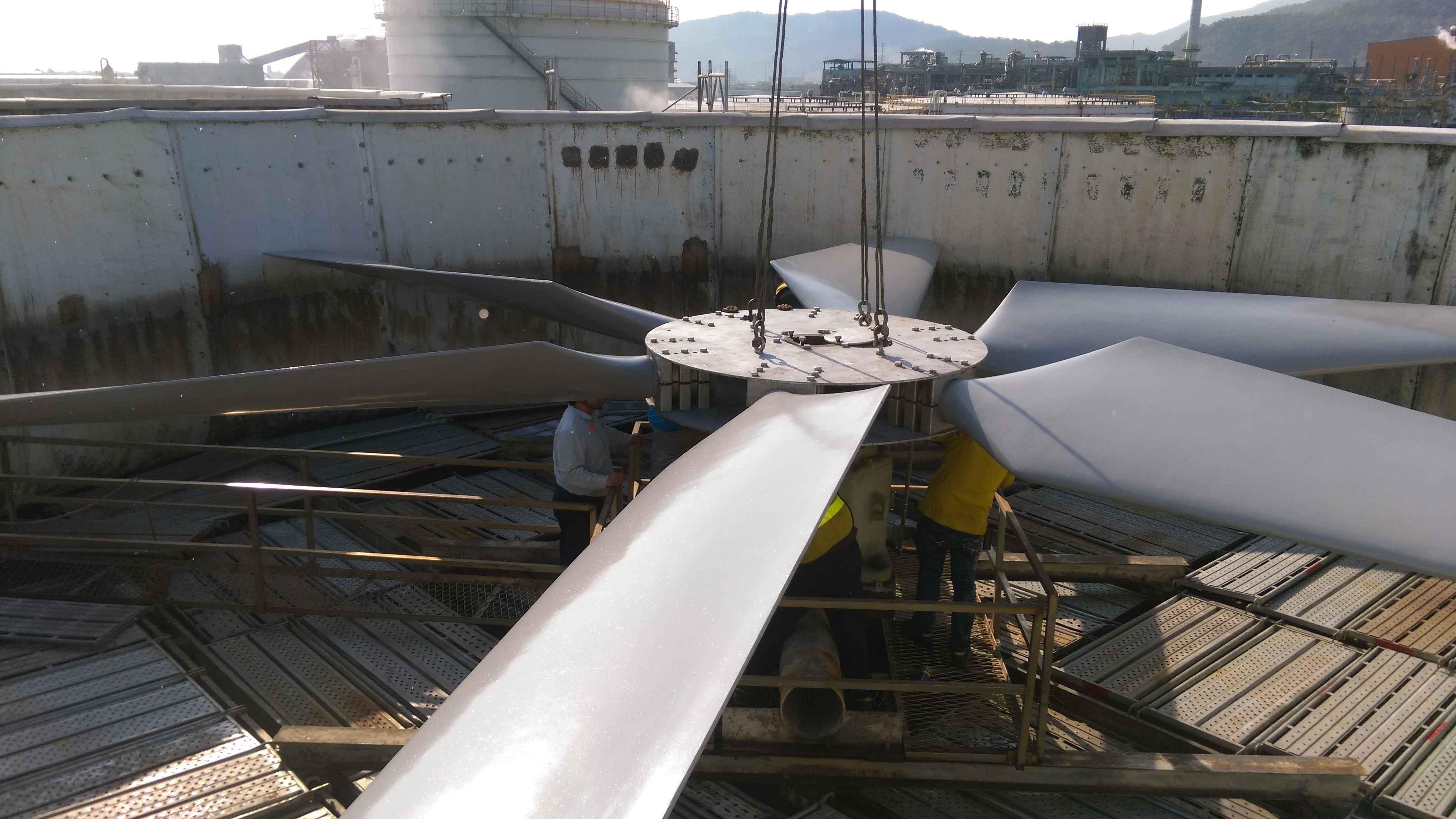
FRP stands for Fiber Reinforced Plastic. It is a composite material made by combining reinforcing fibers with a polymer resin matrix.
In cooling tower fan manufacturing, fiberglass is commonly used as the reinforcing material, while polyester or vinyl ester resin may be selected according to the required mechanical and environmental properties.
FRP cooling tower fan blades are widely used in industrial applications where lightweight construction, corrosion resistance, and customized aerodynamic designs are important.
2.1 Main Components of FRP Fan Blades
An FRP cooling tower fan blade typically consists of several material and structural elements.
Fiberglass Reinforcement
Fiberglass provides structural strength and helps the blade resist bending and mechanical loads.
Different fiber arrangements can be used to achieve specific strength and stiffness requirements.
Resin Matrix
The resin binds the reinforcing fibers together and transfers loads between them.
Common resin options include:
The appropriate resin depends on temperature, moisture, and chemical exposure.
Protective Surface Layer
A protective gel coat or suitable surface coating may be applied to improve surface quality and environmental resistance.
The coating system should be compatible with the operating conditions.
2.2 Advantages of FRP Cooling Tower Fan Blades
Excellent Corrosion Resistance
FRP does not undergo electrochemical corrosion in the same way as aluminum or steel.
When properly designed, it performs well in humid cooling tower environments and many chemically demanding industrial applications.
Lightweight Structural Design
FRP has a relatively low density, allowing manufacturers to develop lightweight fan blades with suitable structural reinforcement.
This can reduce rotating mass and help lower certain mechanical loads.
Flexible Aerodynamic Design
FRP manufacturing allows manufacturers to produce different blade profiles, lengths, thickness distributions, and structural configurations.
This flexibility is particularly useful for custom cooling tower fan blade replacement projects.
Good Fatigue Performance
A properly engineered FRP blade can withstand repeated operating loads.
Its fatigue performance depends on fiber orientation, resin properties, laminate structure, manufacturing quality, and operating conditions.
2.3 Limitations of FRP Fan Blades
Although FRP offers many advantages, it also has certain limitations.
Manufacturing quality is highly dependent on process control.
Impact damage may cause hidden internal defects.
Delamination can occur under unsuitable loading or poor manufacturing conditions.
Repair procedures may require specialized materials and technical expertise.
Resin properties must be suitable for the operating temperature.
Why Is Manufacturing Quality Important?
Poor resin distribution, air pockets, incorrect fiber orientation, or insufficient curing can reduce the mechanical reliability of an FRP blade.
Therefore, buyers should evaluate the manufacturer's production process and quality inspection capabilities rather than focusing only on the material name.
3. What Are Aluminum Cooling Tower Fan Blades?
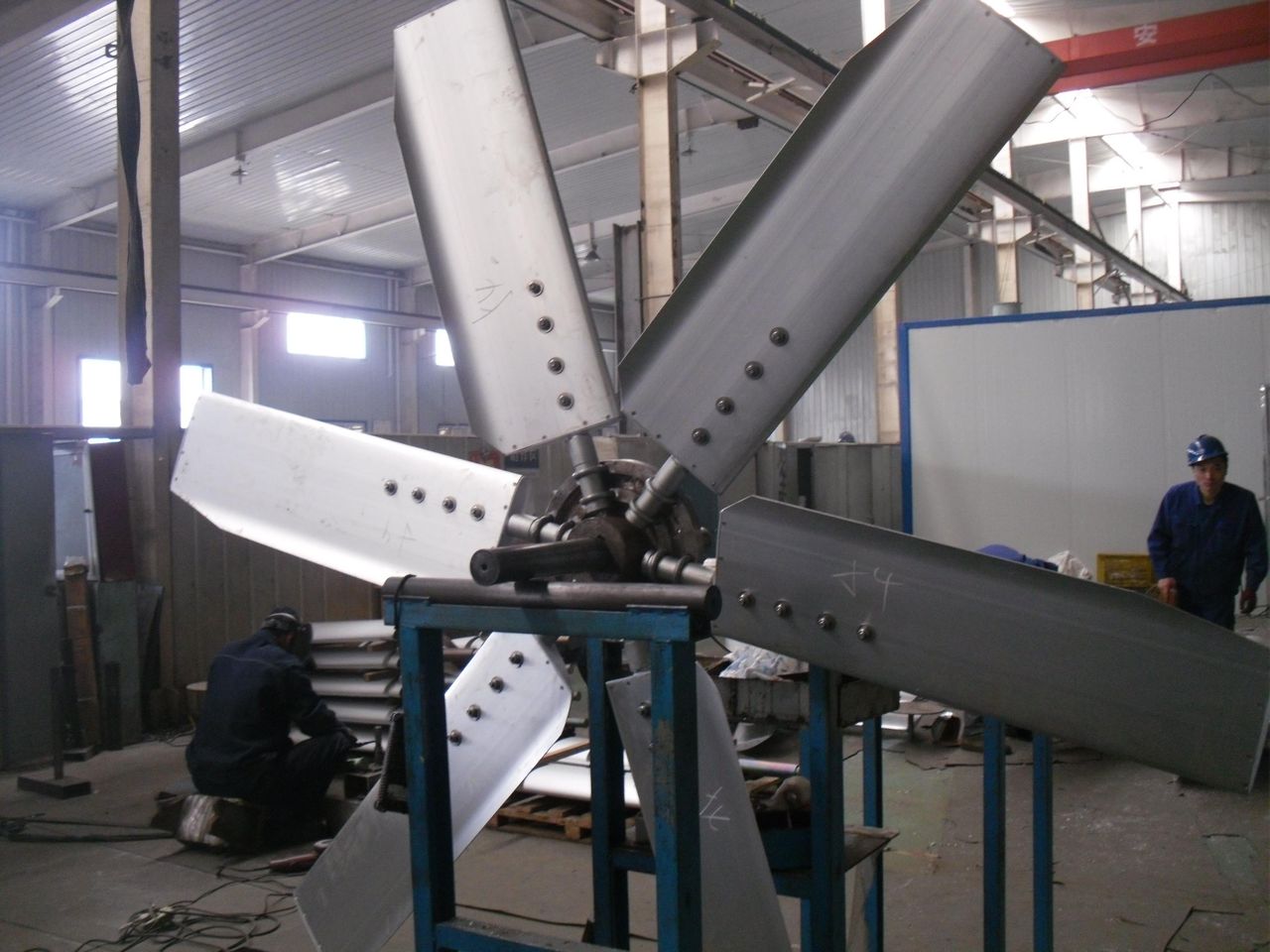
Aluminum cooling tower fan blades are manufactured using aluminum alloys selected for their strength, weight, and processing characteristics.
Aluminum has been used in industrial fan applications for many years because it combines relatively low density with good mechanical properties and convenient machining.
Depending on the alloy and manufacturing method, aluminum blades can provide reliable performance in various cooling tower applications.
3.1 Main Characteristics of Aluminum Fan Blades
Good Strength-to-Weight Ratio
Aluminum is lighter than steel while providing useful structural strength.
This makes it suitable for fan applications where moderate rotating weight and mechanical stability are required.
Convenient Manufacturing
Aluminum can be processed through casting, extrusion, machining, and other manufacturing techniques.
This allows manufacturers to produce different blade shapes and connection structures.
Good Dimensional Stability
Aluminum maintains relatively stable dimensions under normal operating conditions.
This characteristic is useful when accurate blade geometry and mounting dimensions are required.
3.2 Advantages of Aluminum Cooling Tower Fan Blades
High Mechanical Strength
Appropriate aluminum alloys can provide good mechanical strength and rigidity.
They are suitable for applications requiring a relatively stiff blade structure.
Easy Machining and Processing
Aluminum components can be machined and finished using established industrial processes.
This can be helpful for certain standardized blade designs and replacement applications.
Recyclability
Aluminum is recyclable, and its material can be recovered and reused through appropriate recycling processes.
Established Industrial Applications
Aluminum fan blades have a long history of use in industrial ventilation and cooling equipment.
Their material characteristics and manufacturing processes are well understood.
3.3 Limitations of Aluminum Fan Blades
Despite their advantages, aluminum blades have some disadvantages in cooling tower environments.
Corrosion Risks
Aluminum can experience pitting or other forms of corrosion when exposed to unfavorable water chemistry, chlorides, or certain chemicals.
Protective treatments and proper alloy selection can help reduce these risks.
Potential Weight Disadvantages
Although aluminum is lighter than steel, aluminum blades may still be heavier than comparable FRP designs.
The actual difference depends on structural geometry and required mechanical properties.
Limited Composite Design Flexibility
Aluminum manufacturing methods can produce complex shapes, but some customized composite structures and aerodynamic configurations may be more convenient to manufacture using FRP.
4. FRP vs Aluminum Cooling Tower Fan Blades: Key Differences
FRP and aluminum both have advantages, but their performance characteristics differ in several important areas.
4.1 Material Property Comparison
Comparison Factor | FRP Fan Blades | Aluminum Fan Blades |
Material type | Fiber-reinforced composite | Metal alloy |
Density | Generally lower | Generally higher |
Corrosion resistance | Excellent with suitable resin system | Depends on alloy and exposure |
Mechanical strength | Depends on laminate design | Depends on alloy and temper |
Fatigue performance | Depends on fiber and resin structure | Depends on alloy and stress conditions |
Manufacturing flexibility | High for customized composite profiles | Good with established metal processes |
Impact behavior | May develop internal composite damage | May dent or deform |
Maintenance | Requires composite-specific inspection | Requires metal corrosion inspection |
Recyclability | More challenging | Well-established recycling routes |
4.2 Which Material Is Lighter?
FRP generally has a lower material density than aluminum.
However, comparing density alone does not provide a complete picture because blade thickness, internal structure, reinforcement, and aerodynamic requirements also determine final weight.
Why Does Lower Blade Weight Matter?
Reducing rotating mass may help reduce certain mechanical loads and simplify some fan system requirements.
For large cooling towers, blade weight should be evaluated together with hub design, rotational speed, and centrifugal loading.
4.3 Which Material Has Better Corrosion Resistance?
FRP advantage in many corrosive environments
FRP generally has an advantage in humid and corrosive environments because it does not experience conventional metal corrosion.
Aluminum forms a naturally protective oxide film, but this protection may be compromised under certain chemical or chloride exposure conditions.
When Is FRP More Suitable?
FRP is often a suitable option for:
Coastal industrial facilities
Chemical processing plants
Wastewater treatment facilities
Cooling towers with aggressive water-treatment environments
Industrial locations with high humidity
The exact resin and surface protection system should be selected based on the exposure conditions.
4.4 Which Material Offers Better Mechanical Strength?
There is no universal winner.
Aluminum provides relatively predictable mechanical properties, while FRP can be engineered with different fiber orientations and laminate structures to achieve application-specific strength and stiffness.
Understanding Strength and Stiffness
Strength describes a material's ability to withstand loads before failure.
Stiffness describes its resistance to deformation.
For cooling tower fan blades, both properties are important because the blade must maintain its shape under aerodynamic and centrifugal loading.
5. Aerodynamic Performance: FRP vs Aluminum Fan Blade Designs
Aerodynamic performance is one of the most important factors when selecting cooling tower fan blades.
A properly designed blade should provide the required airflow and pressure while controlling power consumption and noise.
5.1 Airfoil Profile Design
An airfoil profile helps convert rotational energy into useful airflow.
Both FRP and aluminum blades can be manufactured with aerodynamic profiles.
FRP Airfoil Advantages
FRP allows flexible control over blade curvature, thickness distribution, and internal reinforcement.
This is useful for developing customized blade designs for specific cooling tower operating conditions.
Aluminum Airfoil Advantages
Aluminum blades can also achieve accurate aerodynamic profiles through casting, machining, and other manufacturing processes.
They can provide consistent geometry when production processes are properly controlled.
5.2 Blade Pitch and Airflow Adjustment
Blade pitch determines the angle at which the blade interacts with the incoming air.
Both FRP and aluminum blades may use fixed or adjustable pitch configurations.
What Happens When the Pitch Is Incorrect?
An excessively high pitch can increase aerodynamic loading and motor power demand.
An excessively low pitch may reduce airflow and cooling capacity.
The correct pitch must be determined according to fan performance requirements and manufacturer specifications.
5.3 Blade Surface Quality
Surface smoothness affects aerodynamic characteristics and may influence dirt accumulation.
Both FRP and aluminum blades can achieve good surface finishes.
For FRP blades, mold quality and finishing processes are important. For aluminum blades, machining and surface treatment influence the final finish.
6. Which Cooling Tower Fan Blade Material Is Better for Different Industrial Applications?
The best material depends on the operating environment, cooling tower configuration, maintenance requirements, and project budget.
6.1 Power Plants
Power plants often operate large cooling towers that require substantial airflow and continuous fan operation.
FRP fan blades can be attractive because of their lightweight construction and corrosion resistance.
Aluminum blades may also be suitable where their mechanical characteristics and environmental compatibility meet the project requirements.
6.2 Chemical Processing Facilities
Chemical plants may expose cooling tower components to aggressive chemicals and corrosive atmospheric conditions.
Recommended Material Considerations
FRP is often preferred in these applications because the resin system can be selected for specific chemical exposure.
However, not all FRP materials resist all chemicals. Chemical compatibility should always be verified.
6.3 HVAC Cooling Towers
Commercial HVAC cooling towers generally require stable airflow, reliable operation, and reasonable maintenance costs.
Both FRP and aluminum blades can be suitable.
The selection should consider fan diameter, noise requirements, operating speed, airflow demand, and the existing drive system.
6.4 Coastal and High-Humidity Environments
Coastal locations often involve salt-laden air and elevated corrosion risks.
FRP can provide an advantage because it avoids conventional metal corrosion.
Aluminum blades may still be used with appropriate alloy selection and protective treatment, but regular inspection is important.
7. FRP vs Aluminum: Which Material Has Lower Long-Term Operating Costs?
Initial purchase price is only one part of the total cost of ownership.
Industrial buyers should also consider maintenance expenses, replacement frequency, energy consumption, downtime, and expected service life.
7.1 Initial Purchase Cost
Aluminum blades may be competitively priced in certain standardized configurations because of established metalworking processes.
FRP blade prices depend on mold requirements, reinforcement materials, resin selection, production methods, and customization.
For non-standard designs, FRP tooling and manufacturing costs should be evaluated as part of the quotation.
7.2 Maintenance Costs
FRP blades generally require less attention to conventional corrosion protection.
However, they still need inspection for cracks, delamination, impact damage, and surface deterioration.
Aluminum blades require checks for corrosion, deformation, and mounting integrity.
7.3 Energy Consumption
The fan's energy consumption is influenced by:
A lighter blade does not automatically mean lower electricity consumption.
The actual energy-saving potential must be confirmed through fan performance calculations or operating measurements.
7.4 Service Life and Replacement Frequency
The service life of both FRP and aluminum blades depends on material quality, operating conditions, manufacturing accuracy, installation, and maintenance.
Instead of assuming that one material always lasts longer, buyers should compare documented performance data and manufacturer warranties.
8. How to Choose Between FRP and Aluminum Cooling Tower Fan Blades?
Selecting the right material requires a systematic evaluation of the cooling tower and its operating requirements.
8.1 Evaluate the Existing Fan System
Before selecting replacement blades, collect the technical information of the original fan.
Important information includes:
Why Is Compatibility Important?
A replacement blade must match the mechanical and aerodynamic requirements of the existing fan system.
Simply choosing a blade with similar dimensions does not guarantee compatibility.
8.2 Consider Environmental Conditions
Evaluate whether the cooling tower operates in a standard industrial environment or an environment with chemical exposure, salt spray, or extreme humidity.
This information helps determine the appropriate material and protective system.
8.3 Evaluate Structural Requirements
The blade must withstand centrifugal force, bending loads, vibration, and repeated operating cycles.
Manufacturers should provide suitable engineering information to demonstrate that the selected blade structure meets the application requirements.
8.4 Compare Manufacturer Capabilities
A reliable cooling tower fan blade manufacturer should offer:
FRP and aluminum material options where available
Custom blade dimensions
Aerodynamic design capabilities
Technical drawing support
Quality inspection procedures
Weight and dimensional consistency checks
Installation and replacement guidance
8.5 Consider Future Maintenance
Think about the availability of replacement components, inspection requirements, repair procedures, and technical support.
A suitable material should not only meet initial performance requirements but also support convenient long-term equipment management.
9. Manufacturing Process: How Are FRP and Aluminum Fan Blades Produced?
Manufacturing processes have a major influence on product quality and consistency.
9.1 FRP Cooling Tower Fan Blade Manufacturing
FRP blades are produced through composite manufacturing processes.
Step 1: Mold Preparation
A dedicated mold is prepared according to the blade profile and dimensional specifications.
Step 2: Fiber Placement
Fiberglass reinforcement is arranged according to the engineering design.
Fiber direction and distribution are important for structural performance.
Step 3: Resin Application
The selected resin is introduced to bind the fibers and form the composite structure.
Step 4: Molding and Curing
The blade is molded and cured under controlled manufacturing conditions.
Step 5: Finishing and Inspection
The finished blade undergoes trimming, surface finishing, dimensional inspection, and other required quality checks.
9.2 Aluminum Cooling Tower Fan Blade Manufacturing
Aluminum blades can be manufactured using several different processes.
Casting
Molten aluminum is poured into a mold to produce the required blade shape.
Machining
Machining operations help achieve the specified dimensions and mounting interfaces.
Surface Treatment
Depending on the application, aluminum blades may receive protective coatings or other surface treatments to improve environmental resistance.
Final Inspection
Finished blades should be checked for dimensions, surface defects, material quality, and balance requirements.
10. Common Mistakes When Selecting Cooling Tower Fan Blade Materials
Choosing the wrong blade material can result in unnecessary costs and operational problems.
10.1 Selecting Material Based Only on Price
A low initial purchase price does not necessarily indicate better long-term value.
Buyers should compare the total cost of ownership, including maintenance, downtime, and replacement requirements.
10.2 Ignoring Corrosion Conditions
Selecting aluminum without evaluating the cooling tower's chemical and environmental exposure may increase corrosion risks.
Similarly, selecting an unsuitable FRP resin system can also result in premature material deterioration.
10.3 Overlooking Blade Weight
The weight of replacement blades must be compatible with the fan hub and drive system.
Excessive rotating mass may affect mechanical loading and operating performance.
10.4 Ignoring Aerodynamic Compatibility
A blade made from high-quality material may still perform poorly if its aerodynamic profile, diameter, or pitch is unsuitable.
Always verify the complete fan configuration.
10.5 Failing to Check Manufacturing Quality
Material specifications alone cannot guarantee reliable products.
Manufacturing controls, inspection procedures, and dimensional consistency are equally important.
11. Frequently Asked Questions About FRP vs Aluminum Cooling Tower Fan Blades
11.1 Are FRP Cooling Tower Fan Blades Better Than Aluminum Blades?
FRP blades offer advantages in corrosion resistance, lightweight construction, and customized composite design.
Aluminum blades offer established metalworking processes, good mechanical properties, and convenient machining.
The better choice depends on operating conditions and project requirements.
11.2 Are FRP Fan Blades Lighter Than Aluminum Fan Blades?
FRP generally has a lower material density than aluminum. In many comparable applications, FRP blades can be designed to weigh less.
However, actual blade weight depends on the structural design, thickness, reinforcement, and required mechanical strength.
11.3 Can Aluminum Cooling Tower Fan Blades Rust?
Aluminum does not develop iron rust, but it can corrode under certain environmental and chemical conditions.
Pitting and other corrosion damage may occur when protective oxide layers are compromised.
11.4 Do FRP Cooling Tower Fan Blades Require Maintenance?
Yes. FRP blades should be inspected regularly for cracks, delamination, impact damage, surface deterioration, and loose connections.
Lightweight composite construction does not eliminate maintenance requirements.
11.5 Can FRP Fan Blades Replace Existing Aluminum Fan Blades?
In many projects, FRP blades can be used as replacements for aluminum blades, but direct substitution should never be assumed.
The replacement must be verified for:
Fan diameter
Blade geometry
Hub compatibility
Blade pitch
Rotational speed
Structural strength
Aerodynamic performance
Engineering evaluation is recommended before installation.
11.6 Which Material Is Better for Coastal Cooling Towers?
FRP is often a suitable choice for coastal cooling towers because it avoids conventional metal corrosion.
However, the selected resin, reinforcement, surface protection, and connection hardware must also be appropriate for the salt-rich environment.
11.7 Can Manufacturers Produce Custom FRP Cooling Tower Fan Blades?
Yes. Professional manufacturers can customize FRP blades according to customer drawings, original samples, or technical specifications.
Customization may include blade length, profile, pitch, thickness, reinforcement structure, and mounting dimensions.
12. Conclusion: FRP or Aluminum, Which Cooling Tower Fan Blade Should You Choose?
FRP and aluminum are both useful materials for cooling tower fan blade manufacturing, but they serve different engineering priorities.
FRP cooling tower fan blades are particularly attractive for industrial applications requiring lightweight construction, corrosion resistance, and flexible customized designs. Aluminum fan blades remain a practical option where established metal manufacturing processes, mechanical properties, and machining capabilities are important.
For many modern industrial cooling towers, FRP offers a valuable combination of corrosion resistance, weight reduction potential, and aerodynamic design flexibility. Nevertheless, the final selection should always be based on actual operating conditions and verified fan performance requirements.
When purchasing replacement cooling tower fan blades, buyers should pay attention to material quality, blade dimensions, aerodynamic compatibility, manufacturing processes, and technical support.
Working with an experienced cooling tower fan blade manufacturer can help ensure that the selected FRP or aluminum blades meet the requirements of the cooling tower while supporting reliable, efficient, and long-term operation.


