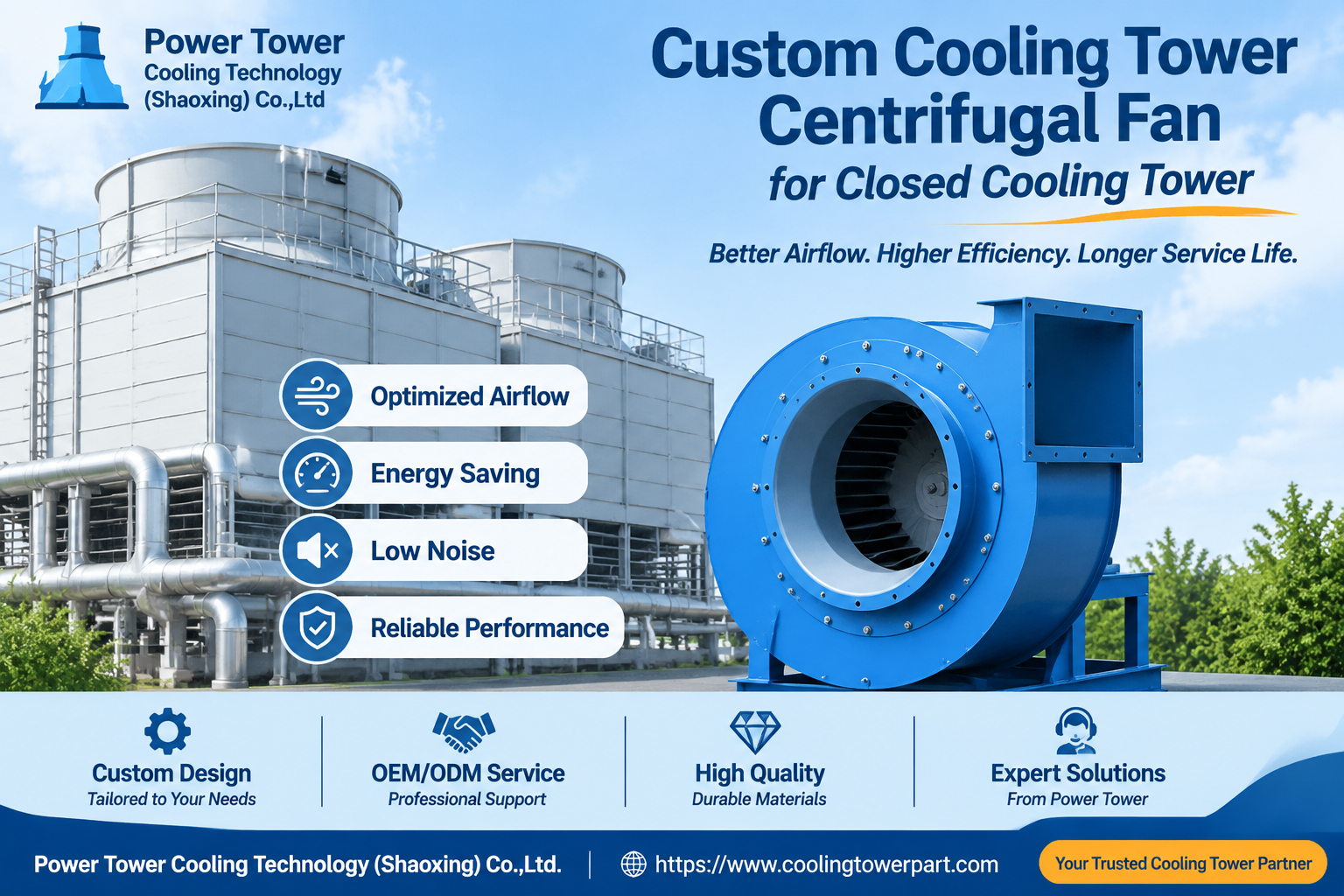
A closed cooling tower may look simple from the outside, but inside, several components must work together to remove heat efficiently. The heat-transfer coil, spray water system, air inlet, drift eliminator, motor, and fan all have a role to play.
Among these components, the cooling tower centrifugal fan is especially important because it controls how air moves through the system.
If the fan cannot provide enough airflow, the cooling tower may struggle to reject heat. If the fan produces excessive airflow or pressure, the motor may consume unnecessary energy. And if the fan is poorly matched to the tower, you may experience noise, vibration, high operating costs, or unstable cooling performance.
This is why a custom cooling tower centrifugal fan for a closed cooling tower can be a better solution than simply selecting a standard fan.
Every cooling tower has different airflow resistance, dimensions, cooling capacity, operating conditions, and installation requirements. Why force a standard fan to fit when the fan can be designed around the actual application?
As a professional cooling tower component manufacturer, Power Tower Cooling Technology (Shaoxing) Co., Ltd. focuses on customized cooling tower solutions for different industrial applications.
In this guide, we will explain how centrifugal fans work, why customization matters, what design factors should be considered, and how to choose the right fan for a closed cooling tower.
Why Closed Cooling Towers Need the Right Fan
A closed cooling tower, also called a closed-circuit cooling tower, removes heat from process fluid without allowing the process fluid to come into direct contact with the outside air or cooling water.
The hot process fluid flows through a coil inside the tower. Spray water flows over the outside of the coil while air passes through the tower. Heat is transferred from the process fluid to the coil, from the coil to the spray water, and finally from the water to the air.
The fan keeps this air movement going.
If the airflow is too low, heat transfer may be insufficient. The outlet process-fluid temperature may remain too high, especially during hot weather or high-load operation.
But more airflow is not automatically better.
Excessive airflow can increase fan power consumption, noise, vibration, and water evaporation. It may also place additional loads on the motor and mechanical components.
The real objective is to achieve the right airflow at the required static pressure with the lowest practical energy consumption.
That is where proper fan selection becomes critical.
What Is a Cooling Tower Centrifugal Fan?
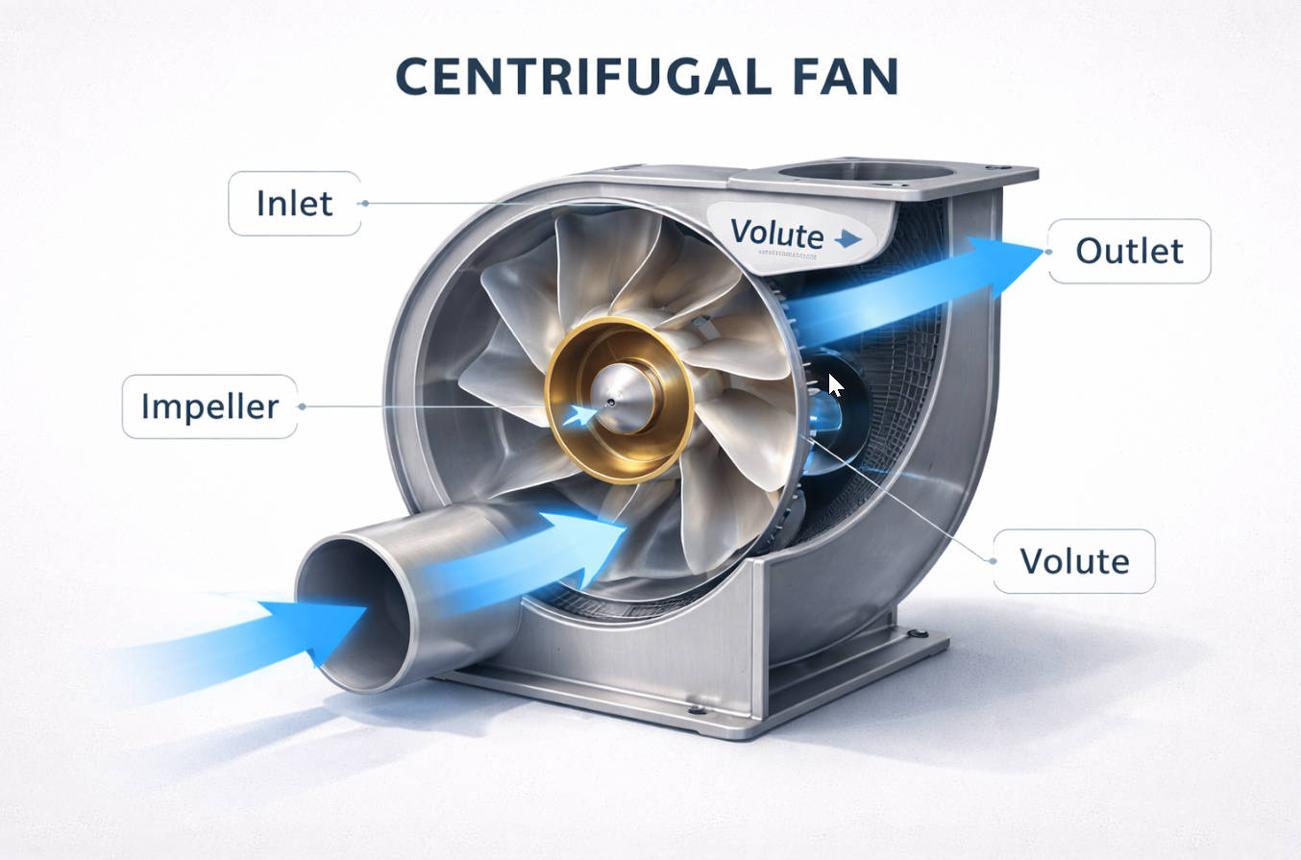
A centrifugal fan is a mechanical device that uses a rotating impeller to move air.
Unlike an axial fan, which moves air primarily in the same direction as the fan shaft, a centrifugal fan draws air into the center of the impeller and accelerates it outward. The fan housing then guides the air toward the outlet.
This design allows centrifugal fans to generate relatively high static pressure.
That characteristic makes them useful for cooling applications where air must overcome significant resistance.
For example, a closed cooling tower may have:
All these components influence the pressure required from the fan.
A properly selected centrifugal fan must therefore be designed for both air volume and static pressure, rather than airflow alone.
How a Centrifugal Fan Moves Air
The process begins when air enters through the fan inlet.
The rotating impeller pulls the air toward its center. As the impeller rotates, its blades transfer energy to the air and accelerate it outward.
The air then enters the fan housing.
The housing helps organize the airflow and convert part of the air's velocity into useful pressure before directing it through the outlet.
You can think of the impeller as the part that gives the air energy, while the housing acts like a carefully designed road that directs that energy where it needs to go.
Small changes in impeller diameter, blade shape, blade angle, housing geometry, or rotational speed can therefore change the fan's performance.
Centrifugal Fan vs. Axial Fan
Both centrifugal and axial fans are widely used in cooling systems, but they have different characteristics.
An axial fan moves air mainly along the axis of rotation. It is often a good choice when a large air volume is required and system resistance is relatively low.
A centrifugal fan changes the direction of airflow as it passes through the impeller and can generate higher static pressure.
So which one is better?
There is no universal answer.
The correct choice depends on the cooling tower design and operating point.
If the system has significant resistance caused by coils, ducts, filters, louvers, or other components, a centrifugal fan may be more appropriate.
For a closed cooling tower, the fan should always be selected based on the actual airflow and pressure requirements rather than simply choosing a fan because it is commonly used in another tower.
Why Customization Matters for Closed Cooling Towers
A standard fan is designed for a general range of applications.
A custom fan is designed around a specific application.
That difference can be important.
Imagine two closed cooling towers with similar cooling capacities. One has short airflow passages and relatively low resistance. The other has a more complicated internal structure, longer ducts, and higher pressure loss.
Both systems may require similar air volumes, but their static-pressure requirements can be very different.
Using exactly the same fan for both applications may not produce the best result.
A customized centrifugal fan can be engineered according to the actual operating point, installation dimensions, motor capacity, and airflow path.
This helps create a better balance between cooling performance and energy consumption.
Air Volume Requirements
Air volume is one of the first specifications to establish when designing a cooling tower centrifugal fan.
Airflow is commonly expressed in:
The required airflow depends on many factors, including cooling capacity, process-fluid temperature, ambient conditions, coil design, spray-water temperature, tower configuration, and heat-transfer requirements.
If the airflow is too low, the cooling tower may not reject enough heat.
If the airflow is too high, the fan may consume more electricity than necessary.
The best fan therefore does not necessarily move the maximum possible amount of air.
It moves the required amount of air efficiently.
Static Pressure Requirements
Static pressure is just as important as airflow.
Think about blowing air through a narrow pipe. The fan has to work harder to push the air through the restriction.
A cooling tower has the same basic challenge.
Coils, filters, louvers, ducts, drift eliminators, and internal air passages all create resistance.
The fan must generate enough pressure to overcome that resistance while maintaining the required airflow.
This is one of the main advantages of a properly designed centrifugal fan.
A fan selected only according to its maximum airflow rating may perform very differently once installed in the actual cooling tower system.
Fan Speed and Motor Selection
Fan speed has a direct effect on airflow, pressure, power consumption, noise, and mechanical stress.
Increasing RPM can increase fan performance, but it can also increase motor loading and energy consumption.
Therefore, fan speed should never be considered separately from motor power.
When designing a custom centrifugal fan, the following factors should be evaluated together:
Fan RPM
Motor power
Motor voltage
Operating frequency
Duty cycle
Starting conditions
Transmission method
Required airflow
Required static pressure
The goal is to select a fan and motor combination that can reliably operate at the required duty point.
Key Design Factors of a Custom Centrifugal Fan
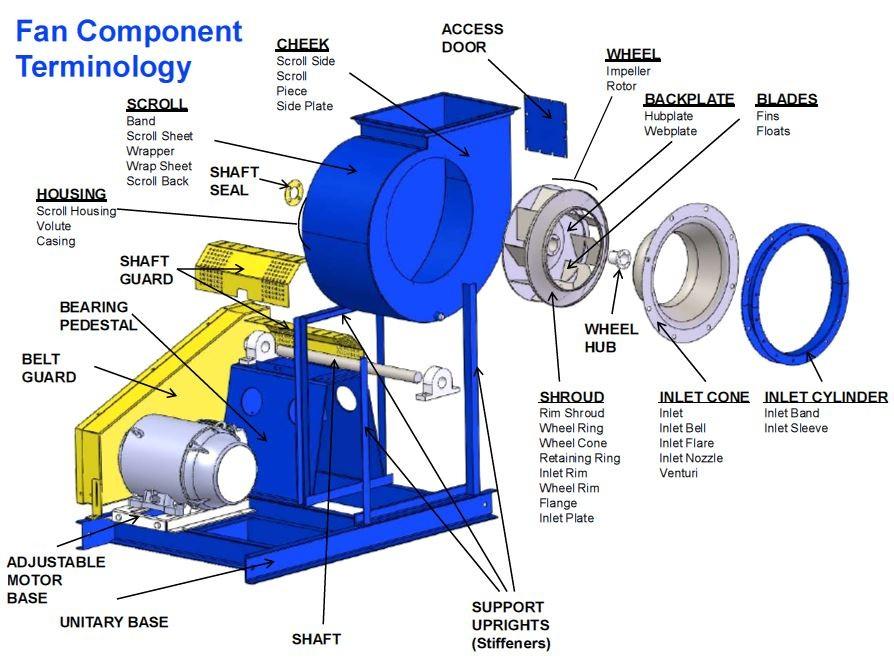
A custom cooling tower centrifugal fan involves much more than selecting an impeller.
Important design parameters include:
Air volume
Static pressure
Impeller diameter
Impeller width
Blade number
Blade profile
Blade angle
Fan housing
Inlet dimensions
Outlet dimensions
Rotation direction
Fan speed
Motor power
Material
Installation dimensions
Operating environment
These factors interact with one another.
Changing the impeller diameter, for example, can affect airflow, pressure, motor loading, and installation requirements at the same time.
That is why experienced engineering support is valuable when developing a custom fan.
Impeller Diameter
Impeller diameter has a major influence on centrifugal fan performance.
A larger impeller can provide greater airflow and pressure under suitable operating conditions. However, increasing the diameter also increases physical size, weight, rotational inertia, and mechanical loading.
The available installation space must therefore be considered.
For replacement applications, the new impeller must also fit the existing housing and drive system.
A custom fan manufacturer can adjust the impeller dimensions according to the customer's available space and performance requirements instead of relying only on standard sizes.
Blade Shape and Number
The impeller blades are at the center of the fan's aerodynamic performance.
Blade shape, angle, curvature, thickness, and number all influence airflow, pressure, efficiency, and noise.
More blades do not automatically mean better performance.
Likewise, fewer blades are not always more efficient.
The ideal configuration depends on the required operating point.
For a closed cooling tower, the blade design should be optimized for the required air volume and static pressure while keeping motor power and noise within acceptable limits.
Fan Housing Design
The fan housing plays an important role in directing airflow.
A properly designed housing allows air to leave the impeller smoothly and move toward the outlet with minimal unnecessary turbulence.
Housing geometry can influence:
Pressure generation
Airflow efficiency
Noise
Vibration
Energy consumption
Overall fan dimensions
For custom cooling tower applications, the housing can also be adapted to the available installation space and duct arrangement.
This is particularly useful when replacing an obsolete fan in an existing cooling tower.
Fan Inlet and Outlet Design
The inlet and outlet must match the cooling tower's airflow system.
Even an efficient impeller can perform poorly if the inlet creates excessive turbulence or the outlet introduces unnecessary resistance.
For custom projects, manufacturers should consider:
Proper connection design makes installation easier and helps maintain predictable airflow performance.
Fan Rotation Direction
Rotation direction is another important detail.
The impeller must rotate in the intended direction to produce the designed airflow and pressure.
If a replacement fan rotates incorrectly, performance can drop significantly. The fan may also produce abnormal noise or vibration.
For replacement projects, the original rotation direction should therefore be confirmed before manufacturing.
Photographs, technical drawings, or existing fan information can help eliminate confusion.
Materials for Cooling Tower Centrifugal Fans
Cooling towers operate in environments with moisture, temperature changes, chemicals, and outdoor exposure.
Material selection is therefore an important part of fan design.
Depending on the application, centrifugal fans may use:
The right choice depends on corrosion exposure, mechanical requirements, operating speed, expected service life, and budget.
FRP Centrifugal Fans
FRP, or fiberglass-reinforced plastic, is widely used in cooling tower applications where corrosion resistance is important.
FRP provides a useful combination of relatively low weight, structural strength, and resistance to moisture and many corrosive environments.
This makes it an attractive option for cooling tower fan components and housings.
Another advantage is design flexibility.
FRP components can be manufactured in different shapes and dimensions to suit specific cooling tower configurations.
For industrial environments where corrosion is a concern, FRP can help reduce long-term maintenance problems.
Aluminum and Steel Components
Aluminum is valued for its relatively low weight and good strength-to-weight ratio.
Steel provides high structural strength and is widely used for industrial fan structures and support components.
However, material selection should always consider the operating environment.
A fan installed in a humid or chemically aggressive environment may require different material protection from a fan operating in a relatively clean environment.
Sometimes a combination of materials provides the best balance between weight, strength, corrosion resistance, and cost.
How Custom Fan Design Improves Cooling Performance
A properly engineered centrifugal fan can improve cooling tower performance in several ways.
First, it provides the required air volume.
Second, it generates enough static pressure to overcome system resistance.
Third, it can help achieve more consistent airflow through the tower.
Fourth, it can be designed to operate efficiently instead of wasting energy through excessive airflow or pressure.
In simple terms, the fan helps the cooling tower breathe correctly.
When airflow is properly matched to the heat-transfer system, the tower can reject heat more consistently.
Better Air Distribution
Air distribution is often overlooked.
A cooling tower needs air to reach the heat-transfer surfaces effectively. If some areas receive too little airflow, those areas may contribute less to the overall cooling process.
A custom fan can be designed around the actual airflow path to support more uniform air distribution.
This can be more effective than simply increasing total fan capacity.
After all, moving more air does not help much if that air is not reaching the areas where heat transfer occurs.
Stable Heat Rejection
Industrial cooling systems often operate for long periods under changing loads.
The fan must therefore provide stable performance rather than short bursts of maximum output.
A correctly selected centrifugal fan helps maintain predictable airflow through the cooling tower.
This can support more stable outlet temperatures and improve the reliability of the overall cooling system.
For factories and process industries, stable cooling is often more valuable than simply achieving the highest possible peak cooling capacity.
Energy Efficiency and Fan Power Consumption
Fan power can represent a significant portion of a cooling tower's operating cost.
This becomes especially important when the cooling tower runs continuously or for several thousand hours per year.
A poorly matched fan may consume more electricity than necessary because it is oversized, operates at excessive RPM, or generates more pressure than the system actually requires.
A custom fan can instead be designed around the required operating point.
The goal is simple:
Deliver the required airflow and pressure without wasting motor power.
Even a modest improvement in fan efficiency can produce meaningful savings over years of operation.
Noise and Vibration Control
Noise and vibration are important indicators of fan quality and operating condition.
Excessive vibration can result from:
Impeller imbalance
Incorrect installation
Damaged bearings
Misalignment
Structural weakness
Incorrect RPM
Poor blade consistency
Unsuitable fan design
Because cooling tower fans often operate continuously, even small vibration problems can become serious over time.
Proper balancing, structural design, manufacturing accuracy, and installation are therefore essential.
A well-designed fan should not only move air efficiently but also operate smoothly.
Custom Centrifugal Fan for Cooling Tower Replacement
One of the most practical applications for custom centrifugal fans is replacement.
Older closed cooling towers may use fan models that are no longer manufactured. Replacement parts may be difficult to find, or the original fan may no longer provide the performance required by the application.
A custom replacement can solve this problem.
Instead of replacing the entire cooling tower, the fan can be redesigned according to the existing installation.
This can help extend the service life of the cooling tower while providing an opportunity to improve airflow and energy performance.
What Information Is Needed for Fan Replacement?
When requesting a custom centrifugal fan, customers should provide as much information as possible.
Useful information includes:
Photographs and technical drawings can also be extremely useful.
The more complete the information, the easier it is for the manufacturer to develop a suitable replacement.
Upgrading an Older Cooling Tower
A fan replacement does not have to be a simple one-for-one exchange.
It can also be an opportunity to improve the system.
Older cooling towers may use outdated fan designs, inefficient impellers, excessive motor capacity, or components that are no longer optimized for current operating conditions.
A custom fan retrofit can potentially improve:
Airflow
Cooling performance
Energy efficiency
Noise
Vibration
Reliability
Component availability
This can be a cost-effective approach when the cooling tower structure and heat-transfer system are still in good condition.
Common Problems with Incorrect Fan Selection
Selecting a fan only because it physically fits the installation can create problems.
A fan can have the correct dimensions but still have the wrong airflow, pressure, RPM, or motor requirements.
Common problems include insufficient airflow, excessive motor load, high energy consumption, noise, vibration, and unstable cooling.
Insufficient Airflow
If airflow is too low, the cooling tower may not reject enough heat.
Typical signs include:
Higher outlet water temperature
Reduced cooling capacity
Poor performance during hot weather
Longer operating cycles
Process temperature instability
The cause may be an undersized fan, incorrect impeller design, low RPM, excessive system resistance, or blocked airflow passages.
Excessive Motor Load
A fan with excessive aerodynamic loading can place too much demand on the motor.
The motor may draw higher current and operate at a higher temperature.
Energy consumption increases, while mechanical components may experience additional stress.
The solution is not necessarily a larger motor.
The better approach is to verify that the fan, impeller, RPM, and motor are correctly matched.
Excessive Noise and Vibration
Abnormal noise or vibration should never be ignored.
It can indicate an imbalance, installation problem, damaged component, unsuitable speed, or incorrect fan configuration.
For a new custom fan, these potential problems should be addressed during the design and manufacturing stages.
How to Select a Custom Centrifugal Fan Manufacturer
Choosing the right manufacturer is just as important as choosing the right fan.
Do not look only at price.
Ask whether the manufacturer can provide:
Customized fan dimensions
Airflow and pressure matching
OEM service
ODM service
Custom materials
Replacement fan solutions
Technical support
Manufacturing according to drawings
Application-specific recommendations
A capable manufacturer should be interested in understanding the application rather than simply selling a standard product.
The best supplier is one that can discuss the relationship between the fan, cooling tower, motor, airflow resistance, and cooling requirements.
Power Tower Cooling Technology Custom Fan Solutions
Power Tower Cooling Technology (Shaoxing) Co., Ltd. specializes in cooling tower components and customized solutions for industrial cooling applications.
For customers looking for a custom cooling tower centrifugal fan for a closed cooling tower, we focus on the actual operating requirements instead of relying solely on standard fan specifications.
Our customized approach can consider:
Required air volume
Static pressure
Fan dimensions
Impeller diameter
Blade configuration
Motor power
RPM
Rotation direction
Material
Installation space
Operating environment
Replacement requirements
This is particularly useful for customers who need a replacement centrifugal fan for an existing cooling tower or a customized fan for a new closed-circuit cooling system.
Instead of asking customers to redesign their equipment around a standard fan, the goal is to develop the fan around the actual equipment requirements.
OEM and ODM Cooling Tower Fan Services
OEM and ODM services can be especially valuable for cooling tower manufacturers, distributors, contractors, and industrial equipment companies.
A customized fan can be developed according to customer drawings, dimensions, performance requirements, and installation conditions.
Customization may include:
Fan size
Impeller configuration
Blade design
Material
Housing design
Outlet direction
Mounting configuration
Performance requirements
This approach can help reduce compatibility problems and simplify installation.
For customers with their own cooling tower designs, OEM/ODM manufacturing can also provide greater flexibility than purchasing generic components.
Application-Based Engineering Support
A cooling tower fan should always be selected according to its application.
That means understanding what the fan needs to achieve and what resistance it needs to overcome.
For this reason, operating information is valuable during the design process.
If you are requesting a custom centrifugal fan, providing the following information can help:
Cooling tower type + required airflow + static pressure + motor information + fan dimensions + operating conditions.
If the original fan is being replaced, photos, nameplate information, drawings, and measurements are also helpful.
This allows the manufacturer to evaluate the application more accurately.
Custom Centrifugal Fan Ordering Checklist
Before ordering a custom centrifugal fan for a closed cooling tower, prepare the following information whenever possible:
1. Cooling tower type
Confirm whether the application is a closed cooling tower or closed-circuit cooling tower.
2. Required air volume
Provide the required airflow in m³/h, m³/s, or CFM.
3. Required static pressure
Provide the required pressure in Pa or another preferred unit.
4. Existing fan dimensions
Include impeller diameter, width, inlet, outlet, and mounting dimensions.
5. Motor information
Provide motor power, voltage, frequency, and RPM.
6. Rotation direction
Confirm the required direction of rotation.
7. Material requirements
Specify whether FRP, aluminum, steel, stainless steel, or another material is preferred.
8. Operating environment
Include temperature, humidity, chemical exposure, corrosion conditions, and outdoor installation requirements.
9. Installation space
Provide drawings or accurate measurements whenever possible.
10. Cooling requirements
Provide process-fluid temperatures, cooling-water temperatures, required heat-rejection capacity, or other available operating data.
The more complete the information, the easier it is to develop a suitable custom solution.
Final Thoughts
A custom cooling tower centrifugal fan for a closed cooling tower is much more than a replacement mechanical component.
It is an important part of the tower's overall thermal performance and energy efficiency.
The right fan needs to provide sufficient airflow while overcoming system resistance. It must work correctly with the motor, fit the available installation space, tolerate the operating environment, and operate reliably over long periods.
That is why customization can make such a difference.
Instead of asking:
"Which standard fan should I buy?"
A better question is:
"What fan does my cooling tower actually need?"
Once the required airflow, static pressure, impeller size, motor power, RPM, material, and installation conditions are understood, a customized fan can be developed around the actual application.
For cooling tower manufacturers, contractors, distributors, and industrial users, Power Tower Cooling Technology (Shaoxing) Co., Ltd. provides customized cooling tower component solutions for different project requirements.
Whether you need a replacement centrifugal fan for an existing closed cooling tower or a customized fan for a new cooling system, selecting the correct fan design can help improve airflow, heat rejection, energy efficiency, reliability, and equipment service life.
In the end, good fan design is not about moving the most air possible.
It is about moving the right amount of air, at the right pressure, with the right amount of energy, for the right cooling tower.
For more information about cooling tower fans and customized cooling tower components, visit https://www.coolingtowerpart.com.


