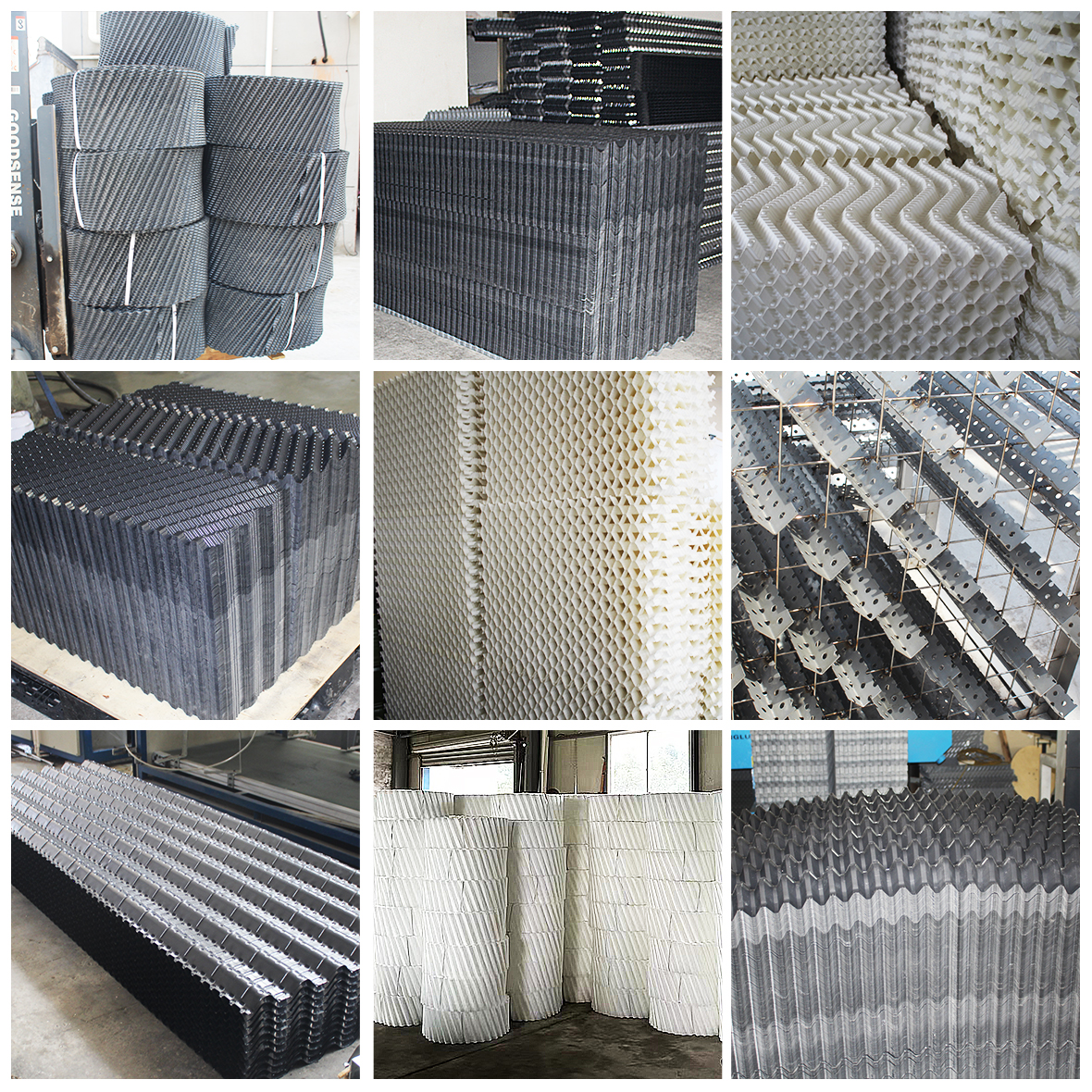
Choosing the right cooling tower fill is one of the most important decisions when designing, upgrading, or replacing a cooling tower. The fill media creates a large contact area between hot water and air, helping transfer heat efficiently and reduce the temperature of circulating water.
However, not every cooling tower fill is suitable for every application. Water quality, cooling tower design, operating temperature, fouling risk, and required thermal performance all affect the right choice.
This guide explains how to select the best cooling tower fill for industrial and commercial cooling applications.
What Is Cooling Tower Fill?
Cooling tower fill, also called cooling tower packing or fill media, is the internal material that increases the contact area between water and air.
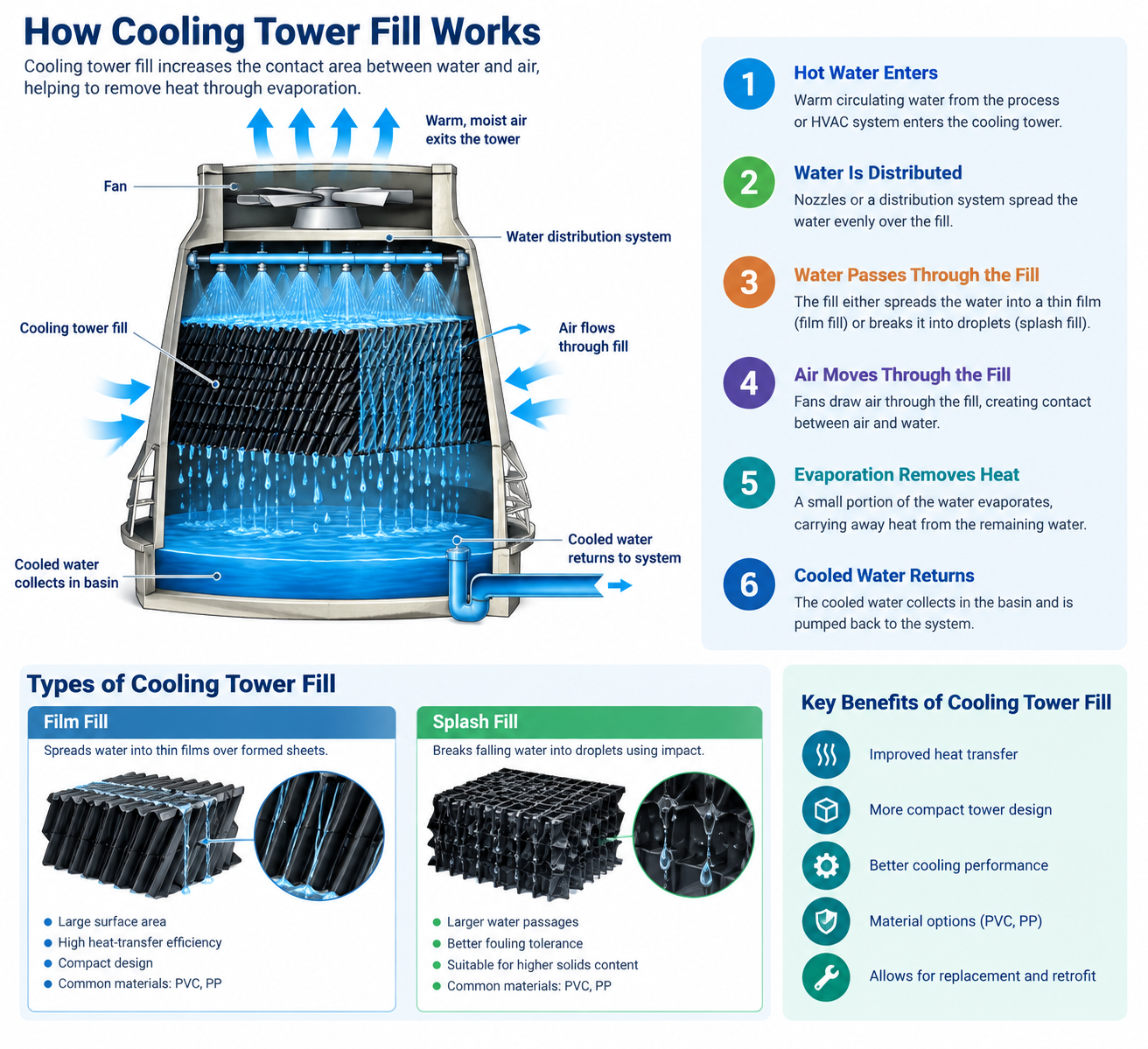
Hot water is distributed over the fill while air moves through the tower. As the water spreads into thin films or droplets, heat is transferred from the water to the air. A small amount of water also evaporates, removing additional heat from the system.
The main types of cooling tower fill include:
Film fill
Splash fill
Hybrid fill
The correct selection can improve heat transfer, maintain stable cooling performance, and reduce operating problems.
Why Is Cooling Tower Fill Selection Important?
The fill represents a major part of the tower's heat-transfer system. Selecting the wrong fill can lead to:
Poor cooling performance
Higher water temperature
Increased fan or pump energy requirements
Rapid fouling and clogging
Difficult maintenance
Shorter fill service life
Higher replacement costs
For this reason, buyers should consider more than the initial price. Cooling tower fill performance, material, geometry, water quality, and compatibility with the existing tower all matter.
1. Choose Between Film Fill and Splash Fill
The first decision is usually the type of fill.
Film Cooling Tower Fill
Film fill uses closely spaced sheets or channels to spread water into a thin film. This creates a large surface area for heat transfer.
Film fill is commonly selected when:
High thermal efficiency is required
The circulating water is relatively clean
Space inside the tower is limited
A compact cooling tower design is preferred
PVC and PP film fills are widely used in industrial and HVAC cooling towers.
Splash Cooling Tower Fill
Splash fill breaks falling water into droplets as it moves through layers of splash bars, grids, or other structures.
Splash fill is often preferred for applications where:
Water contains suspended solids
Fouling is a concern
Biological growth may occur
Easier cleaning is important
More robust fill is required
Splash fill generally has larger passages than film fill, which can make it more tolerant of dirty water.
Hybrid Cooling Tower Fill
Hybrid fill combines characteristics of film and splash designs. It can be useful when an application requires a balance between thermal performance and fouling resistance.
2. Consider Your Cooling Tower Design
The cooling tower configuration affects fill selection.
For example, counterflow cooling towers and crossflow cooling towers use different airflow and water-distribution arrangements. The fill dimensions, orientation, support system, and water distribution pattern must match the tower.
Before purchasing replacement fill, check:
A replacement fill should be compatible with the existing tower rather than selected only by material or appearance.
3. Evaluate Water Quality
Water quality is one of the most important factors in cooling tower fill selection.
If the circulating water is clean and properly treated, film fill can provide excellent heat-transfer performance.
However, water containing suspended solids, dirt, algae, scale, or other contaminants can block narrow film-fill channels.
For applications with high fouling potential, consider splash cooling tower fill or a fill design with larger passages.
Important water-quality factors include:
A good water treatment program can significantly improve cooling tower fill service life.
4. Select the Right Fill Material
The material should match the operating environment.
PVC Cooling Tower Fill
PVC cooling tower fill is widely used because it offers a practical combination of thermal performance, chemical resistance, availability, and cost.
PVC film fill is commonly used in HVAC and industrial cooling towers where operating conditions are suitable.
PP Cooling Tower Fill
PP cooling tower fill is another common choice. Polypropylene can provide good chemical resistance and higher temperature capability than standard PVC in many applications.
PP fill is often considered for demanding industrial environments.
Other Materials
Depending on the application, cooling tower fill may also use other plastics or specialized materials.
When selecting a material, consider:
5. Check Operating Temperature
Temperature is especially important when selecting plastic cooling tower fill.
The maximum water temperature should be compared with the manufacturer's recommended operating range. Continuous exposure to excessive temperatures can accelerate material deformation or aging.
Always consider:
For higher-temperature applications, a suitable PP or specialized fill may be more appropriate than standard PVC.
6. Consider Fouling and Maintenance
A highly efficient fill is not necessarily the best choice if the water quality makes it difficult to maintain.
Film fill has narrow passages that can provide excellent heat transfer, but these passages may be vulnerable to blockage.
Splash fill generally provides larger openings and can be easier to inspect and clean.
Ask these questions before selecting cooling tower fill:
How clean is the circulating water?
How frequently can the tower be cleaned?
Is biological growth a recurring problem?
Is suspended-solid loading high?
How important is easy maintenance?
For difficult water conditions, a more fouling-tolerant fill design may reduce maintenance problems.
7. Match Fill to the Required Thermal Performance
The fill should provide enough heat-transfer capability for the tower's required duty.
Important design parameters include:
Water flow rate
Airflow rate
Hot-water temperature
Cold-water temperature
Wet-bulb temperature
Cooling range
Approach temperature
Fill depth
Fill surface area
The cooling tower fill should be selected as part of the overall tower design rather than independently.
Increasing fill depth or changing fill geometry does not automatically guarantee better performance. Airflow, water distribution, and fan capacity must also be considered.
8. Choose the Correct Fill Size and Geometry
Cooling tower fills are available in different sheet thicknesses, flute patterns, surface structures, and block dimensions.
For replacement projects, measure the existing fill carefully.
Check:
Block length
Block width
Block height
Flute angle
Sheet thickness
Module arrangement
Support spacing
Incorrect dimensions can cause installation problems or create gaps that reduce cooling performance.
9. Consider Fire and Chemical Requirements
Industrial applications may have additional requirements for fire performance and chemical resistance.
Before ordering cooling tower fill, confirm whether the project requires:
Flame-retardant material
Specific chemical resistance
Special additives
Industrial compliance requirements
Environmental exposure resistance
The correct specification depends on the actual operating environment and project requirements.
Cooling Tower Fill Selection Comparison
| Factor | Film Fill | Splash Fill |
| Heat-transfer efficiency | High | Moderate to high |
| Clean-water applications | Excellent | Good |
| Fouling resistance | Moderate | Generally higher |
| Suspended solids | More sensitive | More tolerant |
| Cleaning | More demanding | Generally easier |
| Compact tower design | Excellent | May require more space |
| Common materials | PVC, PP | PP, PVC, other plastics |
The table is a general comparison. Actual performance depends on fill geometry, tower design, water quality, airflow, and operating conditions.
Cooling Tower Fill Replacement Tips
When replacing existing fill, do not select a product based only on the original material.
First identify:
Cooling tower manufacturer and model
Crossflow or counterflow design
Existing fill dimensions
Fill type
Water flow
Operating temperature
Water quality
Current cooling performance
A properly specified cooling tower fill replacement should fit the existing support structure and work with the tower's water distribution and airflow system.
For older towers, upgrading from an outdated fill design may also improve thermal performance, but the new fill should be evaluated against the tower's available airflow and water distribution.
How to Choose the Right Cooling Tower Fill
A simple selection process is:
1. Identify the tower type → 2. Check water quality → 3. Select film, splash, or hybrid fill → 4. Choose PVC, PP, or another suitable material → 5. Check temperature and chemical conditions → 6. Confirm dimensions → 7. Verify thermal requirements → 8. Compare supplier specifications.
This approach helps avoid purchasing fill based only on price.
Conclusion
Choosing the right cooling tower fill requires consideration of thermal performance, water quality, tower design, material, operating temperature, fouling risk, and maintenance requirements.
Film fill can provide high heat-transfer efficiency for relatively clean water, while splash fill can be a practical option for applications with higher fouling or suspended-solid risks. PVC and PP are two widely used materials, but the best choice depends on the actual operating conditions.
For a replacement project, always verify the existing fill dimensions and cooling tower configuration before ordering. A properly matched cooling tower fill can help maintain heat-transfer performance, improve reliability, and reduce long-term maintenance costs.
Frequently Asked Questions
What is the best cooling tower fill?
There is no single best fill for every application. Film fill is commonly selected for high thermal efficiency with relatively clean water, while splash fill can be better suited to applications with higher fouling risks.
What material is used for cooling tower fill?
PVC and PP are widely used materials. The appropriate material depends on operating temperature, chemical exposure, water quality, and project requirements.
How often should cooling tower fill be replaced?
Replacement frequency depends on water treatment, fouling, chemical exposure, operating temperature, and physical damage. Regular inspection can help determine when replacement is necessary.
Can cooling tower fill be replaced without replacing the whole tower?
Yes. In many retrofit projects, the fill can be replaced while retaining the existing tower structure, provided the new fill is compatible with the tower dimensions, supports, water distribution, and airflow system.
Is film fill better than splash fill?
The two designs serve different operating conditions. Film fill generally offers high heat-transfer efficiency, while splash fill can offer greater tolerance to fouling and suspended solids. The correct choice depends on the application.
Internal Links for Other CoolingTowerParts
Cooling Tower Nozzles
Cooling Tower Drift Eliminators
Cooling Tower Louvers
Cooling Tower Fan Blades
Cooling Tower Motors


