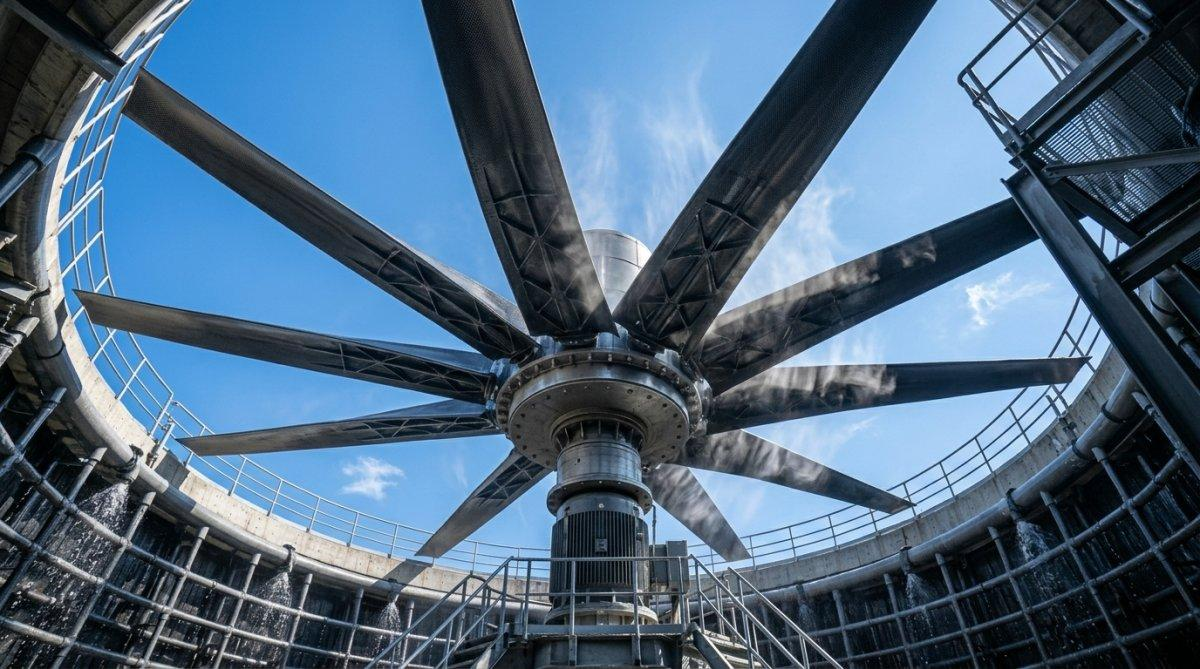
An industrial cooling tower fan is essential for maintaining proper airflow and heat transfer in industrial cooling systems. It helps remove heat from circulating water by moving large volumes of air through the cooling tower. However, continuous operation in humid, corrosive, and demanding environments can gradually damage fan blades, hubs, and other mechanical components.
Knowing when to replace an industrial cooling tower fan is important for preventing unexpected equipment failures, reducing energy consumption, and maintaining cooling efficiency.
But how do you know whether your cooling tower fan needs repair or complete replacement?
This article explains the major warning signs, factors affecting fan service life, replacement considerations, and practical maintenance recommendations.
1. Cracked or Damaged Fan Blades
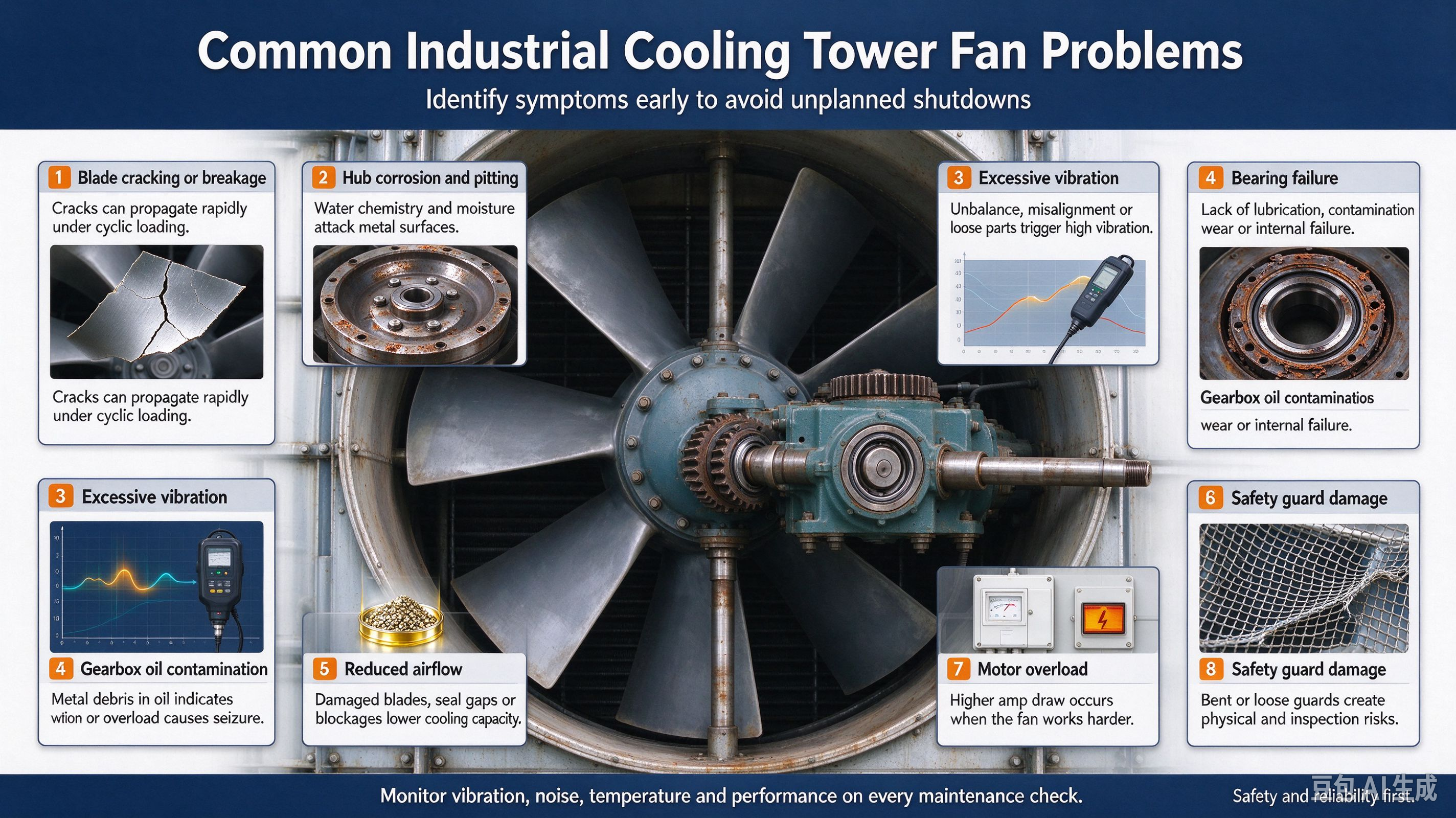
Cracked or damaged fan blades are among the most important warning signs that replacement may be necessary.
Cooling tower fan blades operate under continuous aerodynamic and centrifugal loading. Over time, fatigue, corrosion, impact, and environmental exposure can cause cracks, deformation, or material deterioration.
Common signs include:
Damaged blades can create imbalance and excessive vibration. In severe cases, blade failure may damage the fan hub, fan stack, or surrounding structures.
When to replace: Replace blades that have structural cracks, severe deformation, or damage beyond manufacturer-approved repair limits. If the hub or multiple components are also deteriorated, complete fan assembly replacement may be more appropriate.
2. Excessive Vibration and Unusual Noise
Excessive vibration is another common indication of cooling tower fan problems.
A properly installed fan should operate within the vibration limits specified by its manufacturer. Increasing vibration may indicate mechanical deterioration or incorrect installation.
Possible causes include:
Fan blade imbalance
Damaged bearings
Loose mounting bolts
Worn gearbox components
Shaft misalignment
Unequal blade pitch
Damaged fan hub
Unusual noises, including grinding, rattling, and repeated mechanical impacts, should also be investigated.
When to replace: If vibration continues after correcting alignment, balancing, and loose connections, inspect the fan assembly for structural damage. Replace components that cannot be safely restored to their specified operating condition.
3. Reduced Airflow and Cooling Efficiency
The primary function of an industrial cooling tower fan is to provide sufficient airflow for effective heat transfer.
When fan performance deteriorates, the cooling tower may struggle to maintain the required cold-water temperature.
Typical symptoms include:
Insufficient airflow through fill media
Higher cooling water outlet temperatures
Uneven airflow distribution
Reduced cooling capacity
Increased operating time
However, reduced cooling efficiency does not always mean the fan needs replacement. Blocked fill media, dirty air inlet louvers, damaged drift eliminators, and water distribution problems can produce similar symptoms.
When to replace: If airflow measurements show that the fan cannot meet its required performance after other airflow restrictions have been eliminated, consider replacing it with a properly engineered fan.
4. Increased Energy Consumption
An inefficient cooling tower fan can increase industrial electricity costs.
When fan blades deteriorate or aerodynamic performance decreases, the equipment may consume more power relative to the airflow delivered.
Other possible causes include:
Incorrect blade pitch
Excessive fan speed
Motor deterioration
Gearbox inefficiency
Mechanical friction
Incorrect fan selection
Monitoring motor current, power consumption, rotational speed, and airflow helps identify performance deterioration.
When to replace: Consider fan replacement when testing confirms that the existing fan cannot achieve the required airflow and efficiency, and repair or adjustment cannot provide an economical solution.
5. Severe Corrosion and Material Deterioration
Cooling tower fans operate in environments with continuous moisture, temperature changes, and sometimes chemical exposure.
These conditions can gradually damage fan materials.
Common problems include:
FRP (Fiberglass Reinforced Plastic) fan blades are widely used in industrial cooling towers because of their lightweight construction and corrosion resistance.
However, FRP components can also deteriorate due to UV exposure, chemical attack, fatigue, and mechanical damage.
When to replace: Replace blades or assemblies with severe structural deterioration, delamination, or corrosion that compromises their mechanical strength.
6. Frequent Repairs and Rising Maintenance Costs
Frequent maintenance is another reason to consider industrial cooling tower fan replacement.
If operators repeatedly replace damaged blades, repair hubs, correct vibration, or address mechanical failures, maintenance expenses can eventually exceed the cost of installing a new fan.
Consider replacement when:
Fan failures occur repeatedly.
Spare parts are difficult to obtain.
Repair costs continue increasing.
Equipment downtime affects production.
The existing fan no longer meets cooling requirements.
A complete replacement may provide better long-term reliability than repeatedly repairing severely deteriorated equipment.
7. How Long Does an Industrial Cooling Tower Fan Last?
There is no universal service life for industrial cooling tower fans.
Actual lifespan depends on several factors:
| Factor | Effect on Service Life |
| Operating hours | Continuous operation increases accumulated fatigue |
| Environmental conditions | Moisture and chemicals may accelerate deterioration |
| Fan material | Material properties influence corrosion and fatigue resistance |
| Installation quality | Poor alignment can increase mechanical stress |
| Maintenance frequency | Regular inspections help identify damage early |
| Operating conditions | Excessive speed and loading can shorten component life |
Regular inspections and operation within manufacturer specifications help extend fan service life.
8. Repair vs. Replacement: Which Is Better?
Before making a replacement decision, evaluate the condition of the complete fan assembly.
| Condition | Recommended Action |
| Minor blade surface damage | Inspect and repair if approved |
| Incorrect blade pitch | Adjust according to specifications |
| Loose mounting bolts | Tighten and inspect |
| Minor vibration | Investigate and correct the cause |
| Severe blade cracks | Replace damaged blades |
| Structural hub damage | Replace hub or assembly |
| Severe corrosion or delamination | Replace affected components |
| Repeated major failures | Evaluate complete fan replacement |
The decision should consider repair costs, replacement costs, downtime, safety, and expected remaining service life.
9. How to Choose a Replacement Industrial Cooling Tower Fan
Selecting the correct replacement fan is essential for maintaining cooling tower performance.
Before purchasing, evaluate the following specifications:
9.1 Fan Diameter
Measure the original fan diameter and confirm compatibility with the existing fan stack.
9.2 Airflow and Static Pressure
The replacement fan must deliver the required airflow at the actual system operating pressure.
9.3 Blade Material
FRP and aluminum alloy are common materials for industrial cooling tower fan blades. Select materials according to operating temperature, chemical exposure, and mechanical requirements.
9.4 Blade Pitch and Number
Confirm the original blade configuration and required aerodynamic performance.
9.5 Motor and Drive Compatibility
Check motor power, rotational speed, gearbox ratio, shaft dimensions, and drive configuration.
9.6 Hub and Installation Dimensions
Verify hub mounting dimensions, shaft compatibility, fastener specifications, and blade clearance.
For replacement projects, providing original equipment drawings, fan photographs, and technical specifications helps manufacturers recommend a suitable replacement.
10. Why Choose a Professional Cooling Tower Fan Replacement Supplier?
Working with an experienced manufacturer helps reduce compatibility problems and installation risks.
A reliable supplier should provide:
Customized industrial cooling tower fan blades
FRP fan blade manufacturing
Compatible fan hubs and mounting components
Technical drawings and dimensional verification
Aerodynamic performance recommendations
Quality inspection and balancing
Replacement and retrofit support
CoolingTowerPart.com provides industrial cooling tower replacement components, including FRP fan blades and customized fan solutions. Industrial buyers can submit original equipment specifications and project requirements to discuss suitable replacement options.
11. How to Extend the Service Life of a Cooling Tower Fan
Even high-quality industrial cooling tower fans require regular maintenance.
Recommended practices include:
Inspect fan blades regularly for cracks and deformation.
Check blade pitch and fastener tightness.
Monitor vibration and operating noise.
Inspect bearings, shafts, and drive components.
Clean accumulated dirt and deposits.
Check fan stack condition and blade clearance.
Monitor motor current and operating temperature.
Follow the manufacturer's inspection and maintenance schedule.
Always isolate electrical power and follow lockout/tagout procedures before performing maintenance.
12. Conclusion
Knowing when to replace an industrial cooling tower fan helps prevent equipment failure, improve cooling efficiency, and control maintenance expenses.
Cracked blades, excessive vibration, reduced airflow, increased energy consumption, severe corrosion, and repeated mechanical failures are important warning signs.
However, not every performance problem requires complete replacement. Proper inspection and troubleshooting should identify the actual cause before making a purchasing decision.
When replacement becomes necessary, selecting a compatible, properly engineered industrial cooling tower fan can help restore reliable airflow and improve long-term cooling tower performance.
Frequently Asked Questions (FAQ)
1. What are the main signs that a cooling tower fan needs replacement?
Common signs include cracked blades, excessive vibration, unusual noise, reduced airflow, increased power consumption, severe corrosion, and repeated mechanical failures.
2. Can I replace only the cooling tower fan blades?
Yes. Individual blades can often be replaced if the existing hub is structurally sound and compatible with the new blades. Confirm dimensions and specifications with the manufacturer.
3. Are FRP cooling tower fan blades suitable for replacement?
Yes. FRP blades are widely used in industrial cooling towers because they are lightweight, corrosion-resistant, and offer good mechanical strength.
4. Does a damaged cooling tower fan affect cooling efficiency?
Yes. Damaged or improperly adjusted fan blades can reduce airflow, increase vibration, and negatively affect cooling tower heat transfer performance.
5. Should I repair or replace an old industrial cooling tower fan?
Minor problems may be repaired economically. However, severe structural damage, repeated failures, and excessive repair costs may justify complete replacement.
6. What information is needed when ordering a replacement cooling tower fan?
Provide fan diameter, blade number, blade pitch, motor power, rotational speed, hub dimensions, fan stack dimensions, original equipment model, and available drawings.
Recommended internal links for CoolingTowerPart.com:


