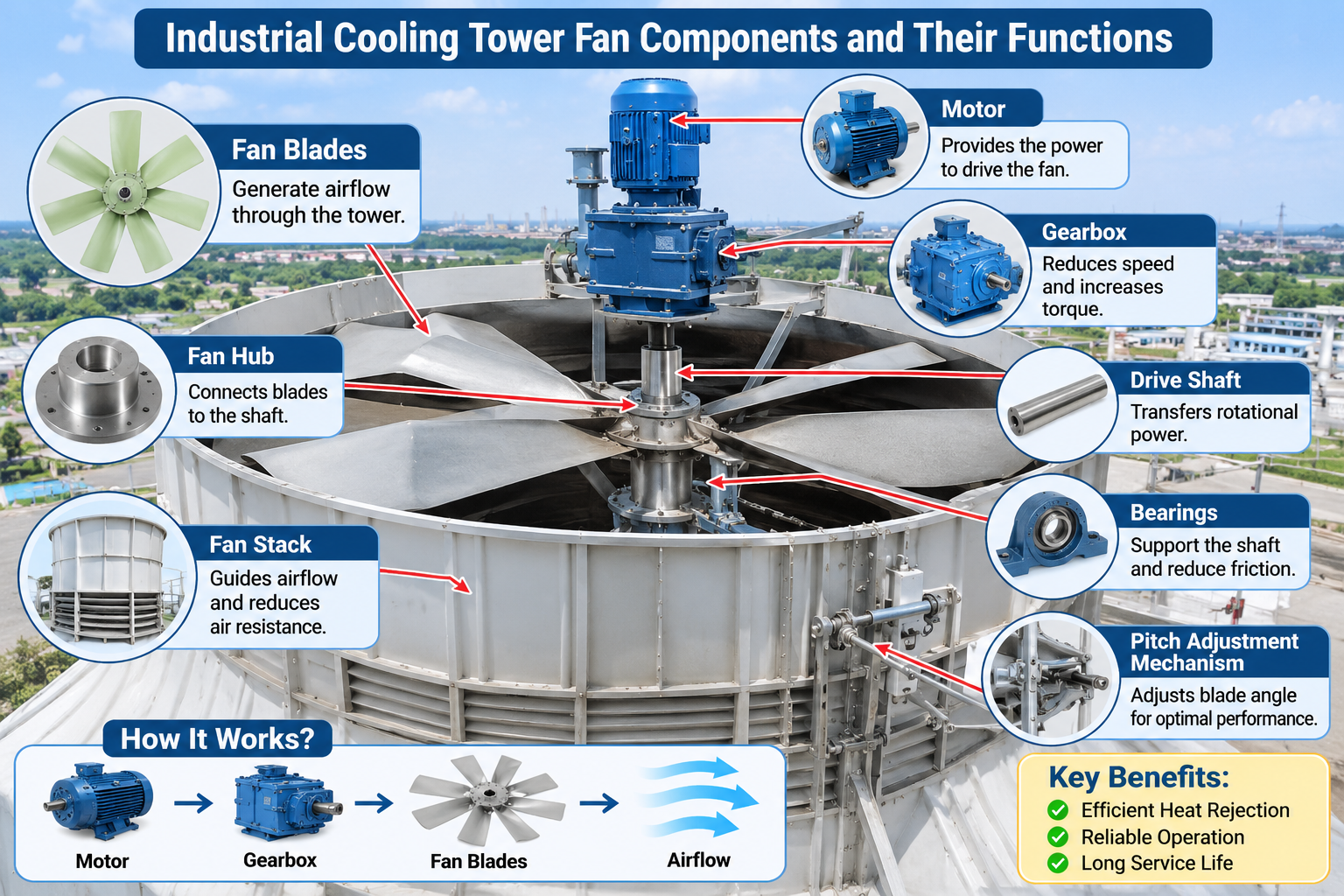
Industrial Cooling Tower Fan Components and Their Functions
Industrial cooling tower fans are essential components of mechanical-draft cooling towers. They move large volumes of air through the tower, helping transfer heat from circulating water into the atmosphere. The performance of a cooling tower fan depends not only on its blades but also on several supporting components, including the fan hub, gearbox, motor, drive shaft, bearings, and fan stack.
Understanding industrial cooling tower fan components and their functions helps engineers, maintenance technicians, and equipment buyers select suitable replacement parts, improve operating efficiency, and prevent unexpected equipment failures.
In this guide, we explain the main components of an industrial cooling tower fan, how they work together, and what to consider when purchasing replacement components.
1. Cooling Tower Fan Blades
Fan blades are the main aerodynamic components responsible for moving air through a cooling tower.
When the fan rotates, its blades generate airflow through the tower. Their shape, pitch angle, number, and diameter directly affect airflow volume, energy consumption, and cooling performance.
Main functions:
Generate the airflow required for heat rejection.
Maintain stable air movement through the cooling tower.
Improve airflow distribution.
Support efficient cooling tower operation.
Common materials:
FRP cooling tower fan blades are popular in corrosive environments because of their lightweight construction and corrosion resistance. Aluminum blades offer a good balance of weight and mechanical strength.
2. Fan Hub
The fan hub connects the fan blades to the rotating shaft. It supports the blades and transfers rotational power from the drive system.
The hub must maintain sufficient mechanical strength to withstand centrifugal forces, vibration, and operating loads.
Main functions:
Securely connect fan blades.
Transfer torque from the drive system.
Maintain blade positioning.
Support balanced fan rotation.
Fan hubs may be manufactured from aluminum alloy, steel, or other suitable materials.
When replacing a fan hub, buyers should check shaft dimensions, mounting configuration, bolt patterns, blade connections, and compatibility with the existing fan assembly.
3. Cooling Tower Fan Motor
The electric motor provides the power needed to rotate the cooling tower fan.
Industrial cooling tower motors are generally selected according to fan power requirements, operating speed, environmental conditions, and electrical specifications.
Main functions:
Convert electrical energy into mechanical power.
Drive the fan through the transmission system.
Maintain the required rotational speed.
Support continuous cooling tower operation.
Important motor specifications include:
Rated power (kW or HP)
Voltage and frequency
Rated speed (RPM)
Protection rating
Insulation class
Mounting arrangement
For replacement projects, motor power and speed must match the requirements of the fan and gearbox system.
4. Cooling Tower Gearbox
The cooling tower gearbox, also called a fan speed reducer, transmits power from the motor to the fan while reducing rotational speed and increasing available output torque.
Many large industrial cooling towers use gear reducers because the fan requires substantial torque at relatively low rotational speeds.
Main functions:
Reduce motor output speed.
Increase output torque.
Transfer mechanical power to the fan.
Maintain stable fan operation.
Gearbox selection should consider:
Input and output speed
Gear ratio
Rated power
Output torque
Shaft configuration
Lubrication requirements
Regular oil inspection, vibration monitoring, and gear condition checks help extend gearbox service life.
5. Cooling Tower Drive Shaft
The drive shaft connects the motor and gearbox in certain cooling tower fan drive arrangements.
It transmits rotational power between these components and must withstand torsional loads during operation.
Main functions:
Transfer mechanical power.
Connect the motor and gearbox.
Maintain reliable power transmission.
Accommodate the specified alignment and coupling arrangement.
Drive shafts may use steel or other materials suitable for the required operating loads.
Incorrect alignment can cause excessive vibration, coupling damage, bearing wear, and premature equipment failure.
6. Bearings and Bearing Supports
Bearings support rotating shafts and help reduce friction during operation.
Depending on the cooling tower design, bearings may be installed in the motor, gearbox, or other rotating assemblies.
Main functions:
Support rotating components.
Reduce friction.
Maintain shaft positioning.
Control radial and axial movement.
Common bearing problems include overheating, insufficient lubrication, contamination, excessive vibration, and premature wear.
Regular inspection is important for maintaining reliable fan operation.
7. Cooling Tower Fan Stack
The fan stack is the cylindrical or shaped structure surrounding the fan assembly, usually located near the top of an induced-draft cooling tower.
It helps guide airflow and reduce unnecessary air resistance around the fan.
Main functions:
Guide air through the fan outlet.
Improve airflow discharge.
Reduce turbulence and airflow losses.
Protect the fan assembly.
Support efficient fan operation.
FRP cooling tower fan stacks are widely used because of their corrosion resistance, relatively low weight, and structural durability.
Fan stack diameter, height, shape, and clearance should be designed according to the fan's aerodynamic requirements.
8. Fan Pitch Adjustment Mechanism
Some industrial cooling tower fans feature adjustable-pitch blades. The pitch adjustment mechanism allows technicians to change the blade angle to achieve the required airflow and power consumption.
Main functions:
Adjust fan airflow capacity.
Optimize fan power consumption.
Balance cooling performance and energy efficiency.
Support operational adjustments.
Incorrect blade pitch can cause excessive motor loading, reduced airflow, or uneven blade loading.
Always follow the fan manufacturer's adjustment procedures and verify that all blades have consistent pitch settings.
9. Couplings and Transmission Components
Couplings connect rotating equipment, such as motors, drive shafts, and gearboxes.
Depending on the drive arrangement, cooling tower fan systems may also include belts, pulleys, or other transmission components.
Main functions:
Transfer rotational power.
Connect separate drive components.
Accommodate specified alignment tolerances.
Reduce the transmission of certain operating disturbances.
Worn couplings, damaged belts, loose fasteners, and incorrect alignment can reduce transmission efficiency and increase vibration.
10. Cooling Tower Fan Components and Their Functions: Comparison Table
| Component | Main Function | Common Materials |
| Fan blades | Generate airflow | FRP, aluminum |
| Fan hub | Connect blades to shaft | Aluminum, steel |
| Electric motor | Provide driving power | Electrical and metal assemblies |
| Gearbox | Reduce speed and increase torque | Steel, cast iron |
| Drive shaft | Transmit rotational power | Steel |
| Bearings | Support rotating shafts | Bearing steel |
| Fan stack | Guide airflow | FRP, steel |
| Pitch mechanism | Adjust blade angle | Aluminum, steel |
| Couplings | Connect drive components | Steel, alloy materials |
Not every cooling tower uses exactly the same arrangement. Component selection depends on tower design, fan configuration, capacity, and drive system.
11. How Do Industrial Cooling Tower Fan Components Work Together?
All cooling tower fan components work as an integrated mechanical system.
The operating process generally follows these steps:
The electric motor converts electrical energy into mechanical power.
The gearbox reduces rotational speed when required.
The drive shaft or coupling transfers power to the fan assembly.
The fan hub transfers rotational force to the blades.
The fan blades rotate and generate airflow.
The fan stack guides the discharged air.
As air moves through the cooling tower, it supports heat and moisture transfer from the circulating water to the atmosphere.
If one component fails or operates inefficiently, the performance of the entire cooling tower can be affected.
12. How to Choose Replacement Industrial Cooling Tower Fan Components
When purchasing industrial cooling tower fan replacement parts, buyers should evaluate more than the component price.
Consider these important factors:
1. Original equipment dimensions
Measure the existing component carefully, including diameter, shaft dimensions, mounting holes, and connection arrangements.
2. Material selection
Choose FRP, aluminum alloy, steel, or other materials based on corrosion exposure, temperature, mechanical loads, and operating conditions.
3. Equipment compatibility
Check compatibility with existing cooling tower brands, fan assemblies, motors, gearboxes, and drive systems.
4. Operating requirements
Confirm airflow, rotational speed, motor power, torque, and other relevant operating parameters.
5. Manufacturer experience
Work with a manufacturer that can provide technical drawings, dimensional confirmation, material information, and replacement support.
For OEM-compatible and aftermarket replacement projects, accurate measurements are particularly important to ensure proper installation and reliable operation.
13. Industrial Cooling Tower Fan Maintenance Tips
Regular maintenance helps prevent unexpected breakdowns and improves equipment service life.
Recommended practices include:
Inspect fan blades for cracks, deformation, and corrosion.
Check fan hub bolts and blade mounting connections.
Monitor fan vibration and operating noise.
Inspect motor bearings and electrical connections.
Check gearbox oil levels and lubrication conditions.
Verify drive shaft and coupling alignment.
Inspect fan stack structure and mounting supports.
Check blade pitch angles and fan clearance.
Maintenance should always follow manufacturer instructions and appropriate industrial safety procedures.
Conclusion
Industrial cooling tower fan components work together to maintain airflow, transfer mechanical power, and support efficient heat rejection. Fan blades, hubs, motors, gearboxes, drive shafts, bearings, fan stacks, and transmission components all play important roles in cooling tower operation.
Understanding the function of each component makes it easier to identify equipment problems, select suitable replacement parts, and reduce long-term maintenance costs.
CoolingTowerPart.com supplies industrial cooling tower fan blades, FRP fan stacks, fan hubs, gearboxes, and other cooling tower replacement components. Contact our team with your equipment drawings, dimensions, or existing part numbers to discuss customized replacement solutions.
Frequently Asked Questions
1. What are the main components of an industrial cooling tower fan?
The main components include fan blades, fan hub, electric motor, gearbox, drive shaft, bearings, fan stack, pitch adjustment mechanism, and couplings.
2. What is the most important component of a cooling tower fan?
Fan blades are essential for generating airflow, but the motor, gearbox, hub, and transmission system are equally important for reliable operation.
3. What materials are commonly used for cooling tower fan blades?
Common materials include FRP, aluminum alloy, and stainless steel. FRP is particularly suitable for corrosive environments, while aluminum offers a good balance of weight and strength.
4. What does a cooling tower gearbox do?
A cooling tower gearbox reduces motor rotational speed and increases output torque to drive the fan at the required operating speed.
5. When should cooling tower fan components be replaced?
Replacement may be necessary when components show cracks, severe corrosion, deformation, excessive vibration, abnormal noise, bearing damage, or reduced operating performance.
6. Can cooling tower fan components be customized?
Yes. Manufacturers can customize fan blades, hubs, shafts, fan stacks, and other components according to equipment dimensions, technical drawings, operating conditions, and replacement requirements.
Recommended internal links for CoolingTowerPart.com:


