How Do Cooling Tower Fills Reduce Water and Energy Loss?
Cooling towers play a critical role in industrial plants, HVAC systems, power stations, data centers, and process cooling applications. While a cooling tower removes unwanted heat efficiently, it can also consume significant amounts of water and electricity if its internal components are poorly selected or maintained.
One of the most important components affecting cooling tower performance is the cooling tower fill. Also called cooling tower filler or fill media, it increases the contact area between hot water and air, improving heat transfer and allowing the tower to achieve the required cooling performance with less operating effort.
But how exactly does a cooling tower fill reduce water and energy loss? The answer involves several interconnected factors, including heat-transfer efficiency, airflow, water distribution, evaporation, drift control, fan power, pump requirements, and operating temperature.
This guide explains how modern cooling tower fills can contribute to lower water consumption and improved energy efficiency while maintaining reliable thermal performance.
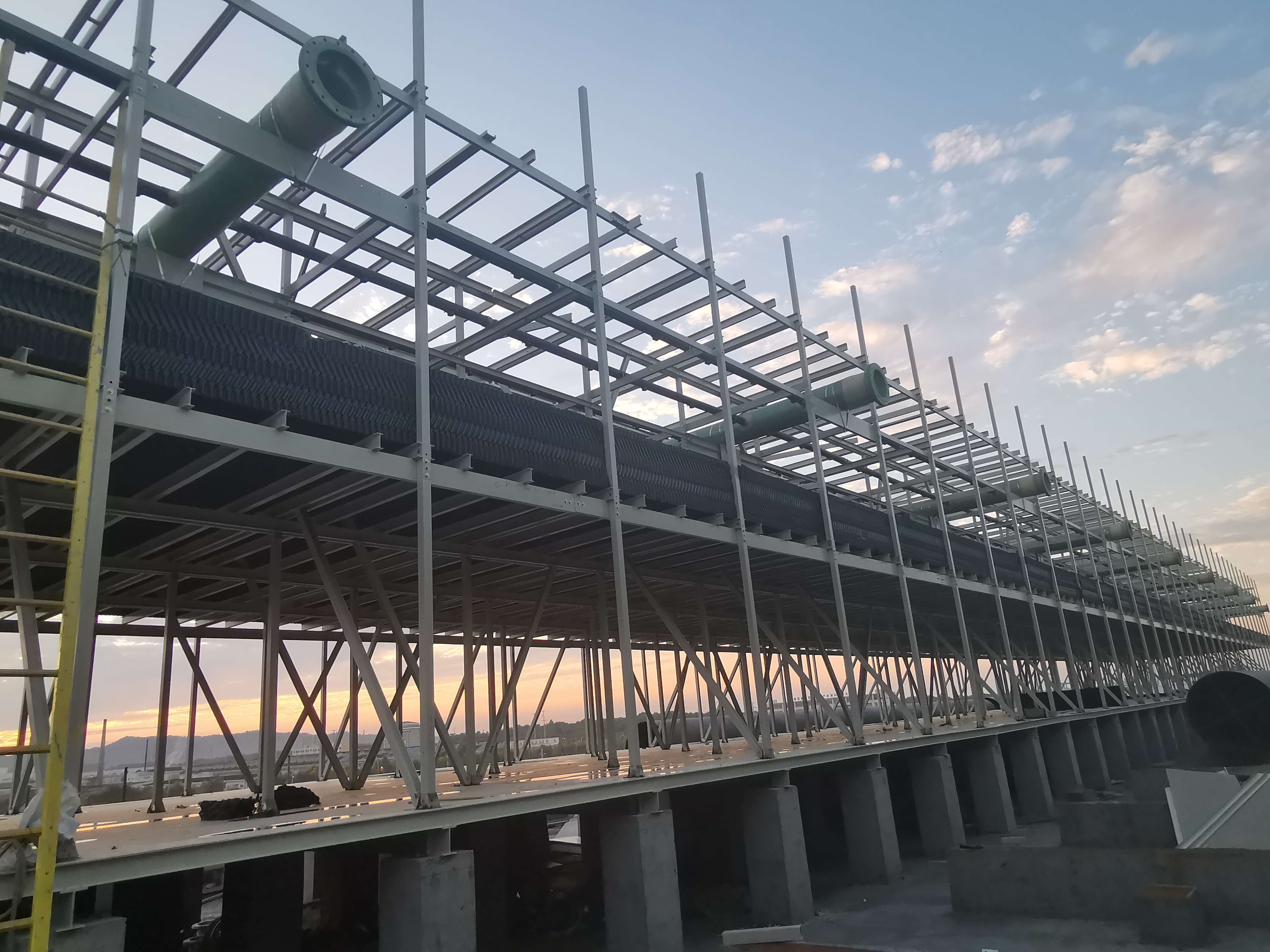
What Is a Cooling Tower Fill and Why Does It Matter?
A cooling tower fill is the internal heat-transfer media installed inside a wet cooling tower. Its primary function is to increase the effective contact area between circulating water and moving air.
Instead of allowing water to fall rapidly from the distribution system to the basin, the fill breaks the water into thin films or droplets and keeps it in contact with air for a longer period.
How Does Cooling Tower Fill Improve Heat Transfer?
The basic principle is simple:
More contact area + longer contact time = better heat transfer.
When hot water enters the fill section, it spreads across the surfaces of the fill material. Air moves through the passages created by the fill structure. Heat is transferred from the water to the air, while a small portion of the water evaporates and removes additional heat.
A well-designed cooling tower filler therefore helps the tower achieve its target cold-water temperature without requiring excessive airflow or water circulation.
Why Is Surface Area Important?
Traditional open-water systems have relatively limited air-water contact. Fill media dramatically increases the effective surface area.
For example, film-type fill creates thin layers of flowing water over a large structured surface. This allows significantly more water-air interaction within a relatively compact tower volume.
As a result, the cooling tower can potentially achieve the same thermal duty with a smaller footprint or lower operating load.
How Do Cooling Tower Fills Reduce Water Loss?
Water consumption is one of the major operating costs associated with evaporative cooling towers. However, not all water loss occurs for the same reason.
The main forms of cooling tower water loss include:
Evaporation loss
Drift loss
Blowdown loss
Leakage
Splashing and overflow
A properly selected cooling tower fill can directly or indirectly reduce several of these losses.
How Does Better Heat Transfer Reduce Evaporation-Related Water Consumption?
Evaporation is necessary for a wet cooling tower to reject heat. Therefore, a cooling tower cannot eliminate evaporation completely.
The goal is to achieve the required cooling duty with an efficient evaporation process.
Can Efficient Fill Media Reduce Unnecessary Water Consumption?
Yes, efficient fill media can improve the relationship between heat removal and water circulation.
A high-performance cooling tower filler promotes effective heat exchange throughout the fill pack. When the water distribution and airflow are properly matched to the fill design, the tower can remove the required amount of heat more effectively.
This does not mean that high-efficiency fill eliminates evaporation. Instead, it helps the cooling tower use its available water more effectively.
What Happens When Fill Efficiency Is Poor?
Blocked, damaged, or poorly selected fill can create:
Reduced heat-transfer area
Uneven water distribution
Increased hot-water bypass
Higher approach temperature
Longer operating time
Greater fan and pump demand
Poor overall thermal efficiency
The tower may then need additional airflow or water circulation to compensate for inadequate heat transfer.
How Do Cooling Tower Fills Help Control Drift Loss?
Drift is another source of water loss. It occurs when small water droplets are carried out of the cooling tower with the exhaust air.
The fill itself is not the primary drift-control component. Drift eliminators perform that function. However, the design and operation of the fill system can influence water distribution and droplet formation.
Why Is Proper Water Distribution Important?
A good cooling tower fill system works together with:
Spray nozzles
Water distribution pipes
Drift eliminators
Fans
Air inlet louvers
Cooling tower basin
When water is distributed evenly over the fill, excessive localized splashing and large droplets can be minimized.
This creates a more stable air-water contact process and helps the drift eliminator operate under appropriate conditions.
Why Should Fill and Drift Eliminators Be Selected Together?
Replacing fill without considering the drift eliminator can create an imbalance in the cooling tower.
The fill controls the heat-transfer environment, while the drift eliminator captures entrained droplets before they leave the tower.
For industrial cooling systems, these two components should therefore be considered as part of the same airflow and water-management system.
Can Cooling Tower Fill Reduce Energy Consumption?
Yes. One of the most important advantages of efficient cooling tower fill is its potential to reduce the energy required to achieve a specific cooling duty.
Cooling tower energy consumption mainly comes from equipment such as:
When the fill provides efficient heat transfer, the fan and pump systems may not need to operate as aggressively to achieve the required outlet-water temperature.
How Does Cooling Tower Fill Reduce Fan Energy?
Fans are often among the largest electrical loads in mechanical-draft cooling towers.
Fan energy depends on several variables, including airflow rate, static pressure, fan efficiency, motor efficiency, and operating conditions.
Why Does Fill Geometry Affect Fan Power?
The internal geometry of cooling tower fill creates resistance to airflow.
If the fill passage is properly designed, air can pass through the media while maintaining sufficient water-air contact.
However, heavily fouled or incorrectly selected fill can increase airflow resistance.
This may result in:
Higher fan pressure requirements
Reduced airflow
Increased fan operating load
Lower cooling performance
How Can Low-Resistance Fill Improve Efficiency?
A well-designed cooling tower filler aims to balance two competing requirements:
High heat-transfer performance + acceptable air-side pressure drop.
Increasing surface area alone is not enough. If the structure creates excessive airflow resistance, the additional heat-transfer area may not produce the expected energy savings.
This is why professional fill selection should consider both thermal performance and hydraulic/airflow characteristics.
How Does Cooling Tower Fill Affect Pump Energy?
Cooling tower pumps circulate hot water from the process or condenser system to the distribution section.
Pump energy is influenced by:
Can Efficient Fill Allow Lower Water Flow?
In some applications, higher-performance fill can help achieve the required thermal duty at an optimized water-to-air ratio.
However, the exact result depends on tower design, water temperature, airflow, fill type, and operating conditions.
The objective is not simply to reduce water flow. The objective is to optimize the entire cooling system.
What Is the Relationship Between Fill and Pump Energy?
A cooling tower fill with suitable wetting characteristics can help distribute water effectively across the available heat-transfer area.
If water distribution remains uniform, the system can avoid unnecessarily high circulation rates caused by poor wetting or dry zones.
This can contribute to lower pumping requirements over the long term.
Which Types of Cooling Tower Fill Support Water and Energy Efficiency?
Different applications require different fill designs. There is no single cooling tower filler suitable for every operating condition.
The most common categories include film fill and splash fill.
How Does Film Fill Improve Cooling Efficiency?
Film fill uses structured sheets to spread water into thin films.
This creates a large surface area for heat and mass transfer.
What Are the Advantages of PVC Film Fill?
PVC cooling tower fill is widely used in HVAC and industrial applications because it offers:
High effective surface area
Lightweight construction
Good heat-transfer performance
Easy modular installation
Cost-effective operation
Resistance to many common cooling-water conditions
PVC fill is particularly suitable where water quality is controlled and operating temperatures remain within the material's recommended range.
When Should PVC Fill Be Avoided?
PVC film fill may not be appropriate for every application.
High-temperature water, heavy suspended solids, biological fouling, and aggressive chemical conditions can affect fill performance and service life.
In these situations, engineers may consider alternative materials or splash-type fill.
How Does PP Cooling Tower Fill Compare?
PP cooling tower fill is another option for demanding applications.
Polypropylene can offer higher temperature resistance than standard PVC in suitable designs.
Why Is PP Fill Used in Higher-Temperature Applications?
The operating temperature range is one of the most important factors in selecting fill material.
If water temperatures approach the practical limits of PVC, PP may provide a more suitable solution depending on the application.
However, material selection should always be based on actual operating temperature, chemical exposure, water quality, and mechanical requirements.
How Does Splash Fill Reduce Fouling Problems?
Splash fill breaks falling water into droplets through repeated splashing.
This design can be advantageous in applications where water contains higher levels of suspended solids or where film fill would be more vulnerable to blockage.
Why Is Fouling Important for Energy Efficiency?
Fouled fill can create additional airflow resistance and reduce the effective heat-transfer area.
Over time, deposits can cause:
Therefore, fill selection should consider not only initial thermal performance but also long-term cleanliness.
How Does Clean Cooling Tower Fill Save Energy?
Even a high-quality cooling tower filler cannot perform efficiently when it is covered with scale, algae, sludge, or biological deposits.
Regular inspection and cleaning are therefore essential.
What Happens When Cooling Tower Fill Becomes Blocked?
Blocked fill passages can restrict both airflow and water movement.
The result may be a combination of:
Lower heat transfer → higher outlet-water temperature → longer fan operation → greater energy consumption.
In severe cases, operators may increase fan speed or water flow to compensate for declining performance.
How Often Should Cooling Tower Fill Be Cleaned?
There is no universal cleaning interval.
The appropriate frequency depends on:
Water chemistry
Makeup-water quality
Operating hours
Biological activity
Dust exposure
Seasonal conditions
Cooling tower design
Instead of relying only on a fixed calendar schedule, operators should monitor temperature performance, pressure drop, water distribution, and visible fouling.
Can Fill Replacement Reduce Cooling Tower Operating Costs?
Yes, replacing severely degraded fill can restore heat-transfer performance and reduce the need for compensating operating measures.
What Are the Signs That Fill Should Be Replaced?
Typical warning signs include:
Cracked or collapsed fill sheets
Severe scaling
Persistent blockage
Deformation caused by heat
Excessive biological growth
Poor water distribution
Increasing approach temperature
Declining cooling capacity
Why Is Partial Replacement Sometimes Possible?
Cooling tower fill is often installed in modular blocks or sheets.
Depending on the tower design, damaged sections may be replaced without rebuilding the entire fill system.
This can reduce maintenance downtime and help restore thermal performance more quickly.
How Should Cooling Tower Fill Be Selected for Maximum Efficiency?
Choosing the right cooling tower fill requires more than comparing price per sheet or per cubic meter.
The fill should be matched to the tower's operating conditions.
What Parameters Should Buyers Check?
Important parameters include:
Cooling tower type
Cross-flow or counter-flow configuration
Hot-water temperature
Cold-water temperature
Required cooling capacity
Design water flow
Airflow rate
Water quality
Suspended solids
Operating temperature
Chemical conditions
Expected service life
Why Does Water Quality Matter So Much?
Water quality strongly affects fill performance.
For relatively clean water, high-area film fill can provide excellent thermal performance.
For dirty or solids-laden water, a more open fill structure may be preferable because it reduces the risk of blockage.
What Should Be Considered for Industrial Cooling?
Industrial systems often operate under more challenging conditions than commercial HVAC towers.
Engineers should evaluate:
Process contamination
High temperature
Oil exposure
Chemical treatment
Scaling tendency
Biological fouling
Cleaning requirements
Selecting fill based only on laboratory thermal performance may therefore produce disappointing real-world results.
How Can a Cooling Tower Fill Improve Long-Term Energy Performance?
Energy efficiency is not determined by the fill's initial performance alone.
A cooling tower fill that performs well for several years can provide more value than a lower-cost product that rapidly becomes damaged or blocked.
What Makes a Cooling Tower Filler Durable?
Important characteristics include:
Appropriate material selection
Stable sheet structure
Good bonding quality
Adequate mechanical strength
Suitable temperature resistance
Chemical compatibility
Good wetting characteristics
A durable fill maintains its geometry, allowing air and water to continue flowing through the designed passages.
What Role Does Fill Maintenance Play in Water Conservation?
Water conservation is not simply about reducing makeup water.
Efficient tower operation also depends on maintaining proper cycles of concentration, controlling blowdown, preventing leaks, and minimizing drift.
Can Better Fill Performance Support Higher System Efficiency?
When the fill maintains good thermal performance, operators have greater flexibility to optimize the cooling tower's operating conditions.
However, water conservation must be managed at the complete system level.
Key practices include:
The fill is one important part of this broader water-management strategy.
What Is the Connection Between Cooling Tower Fill and Carbon Reduction?
Reducing electricity consumption can also reduce the indirect carbon footprint associated with cooling operations, depending on the electricity source.
A more efficient cooling tower may require less fan and pump energy for the same cooling duty.
Why Does Small Efficiency Improvement Matter?
Cooling towers often operate continuously for thousands of hours per year.
A small reduction in power consumption can therefore accumulate into meaningful annual savings.
For example, optimizing a fan motor, improving fill performance, correcting water distribution, and maintaining clean airflow paths can collectively improve system efficiency.
This makes cooling tower optimization a long-term operational strategy rather than a one-time equipment upgrade.
How Can Businesses Optimize Cooling Tower Fill Performance?
The best results usually come from treating the fill as part of a complete cooling system rather than as an isolated component.
Step 1: Measure Existing Performance
Record:
Hot-water temperature
Cold-water temperature
Wet-bulb temperature
Water flow
Fan speed
Motor power
Pump power
Approach temperature
Step 2: Inspect the Fill
Look for:
Scaling
Blockage
Broken sheets
Deformation
Dry areas
Uneven wetting
Step 3: Check Water Distribution
Inspect nozzles, pipes, headers, and spray patterns.
Uneven distribution can reduce the effective performance of otherwise high-quality fill.
Step 4: Check Airflow
Measure or assess:
Step 5: Select the Appropriate Replacement Fill
When replacement is necessary, match the new cooling tower filler to the tower's actual operating conditions rather than simply selecting the highest-surface-area product.
Why Is the Right Cooling Tower Fill More Than a Replacement Part?
A cooling tower fill is often treated as a consumable component, but its impact extends across the entire cooling system.
The right fill can help improve:
Heat-transfer efficiency
Cooling capacity
Fan utilization
Water distribution
Operating stability
Maintenance intervals
Equipment life
Energy performance
In contrast, incorrect fill selection can create excessive pressure drop, poor wetting, premature degradation, and unnecessary operating costs.
Conclusion: Can Cooling Tower Fills Reduce Water and Energy Loss?
A properly selected and maintained cooling tower fill can contribute significantly to efficient cooling tower operation.
By increasing air-water contact area and improving heat and mass transfer, a high-quality cooling tower filler can help the tower achieve its required cooling duty under optimized airflow and water-flow conditions.
The benefits can extend beyond heat transfer. Proper fill selection can support better water distribution, reduce operational inefficiencies, limit fouling-related performance losses, and help optimize fan and pump energy consumption.
However, the fill should not be viewed as a standalone solution. Real water and energy savings depend on the interaction between cooling tower fill, fan, pump, nozzle, drift eliminator, water treatment, airflow, and maintenance practices.
For industrial cooling systems, the most effective approach is to select cooling tower fills according to actual operating temperature, water quality, airflow, water loading, and thermal requirements. Regular inspection and timely cleaning or replacement can then help maintain the designed performance throughout the fill's service life.
When these factors are managed together, the cooling tower can deliver reliable heat rejection while using water and energy more efficiently.


