Energy Saving Axial Flow Cooling Tower Fan
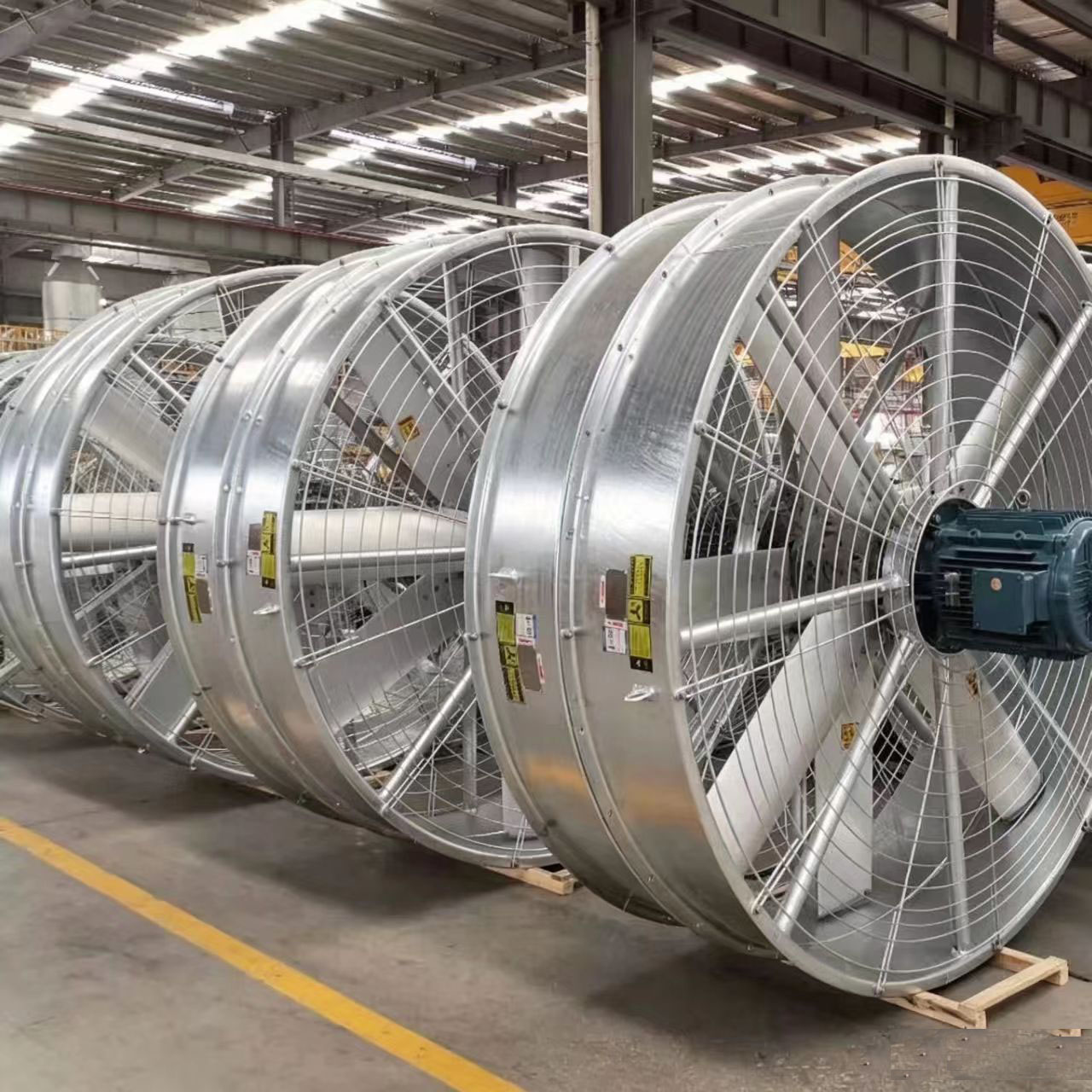 The Energy Saving Axial Flow Cooling Tower Fan is a high-efficiency air-moving solution designed for mechanical-draft cooling towers, HVAC systems, industrial process cooling equipment, and condenser cooling applications. The fan uses an axial-flow aerodynamic design to move a large volume of air through the cooling tower while maintaining efficient operation.
The fan assembly shown features a direct-drive electric motor, axial fan blades, protective wire guard, supporting structure, and circular fan shroud. Compared with traditional belt- or gearbox-driven cooling tower fan systems, a direct-drive configuration can reduce the number of mechanical transmission components and simplify routine maintenance.CoolingTowerPart.com supplies cooling tower fan assemblies and replacement components for a wide range of industrial and commercial applications. Fan diameter, blade configuration, motor power, rotation speed, mounting arrangement, and materials can be customized according to the cooling tower design and operating requirements.
Key Features
High-volume axial airflow
Energy-efficient fan design
Direct-drive motor configuration
Compact and integrated fan assembly
Reduced mechanical transmission components
Low routine maintenance requirements
Durable fan blades and structural components
Protective wire safety guard
Suitable for continuous industrial operation
Available in multiple fan diameters
Suitable for cooling tower replacement and retrofit projects
Custom configurations available
Why Choose an Axial Flow Cooling Tower Fan?
Cooling towers depend on continuous airflow to remove heat from circulating water. The fan creates the airflow needed to move warm, humid air out of the tower and draw or push ambient air through the heat-transfer section.
An axial flow fan moves air substantially parallel to the fan shaft. This design is particularly suitable for cooling towers because it can deliver a large airflow volume without requiring the compact high-pressure characteristics associated with centrifugal fans.
For applications where high airflow and energy efficiency are priorities, an axial cooling tower fan can provide an effective balance between airflow capacity, motor power, operating cost, and equipment reliability.
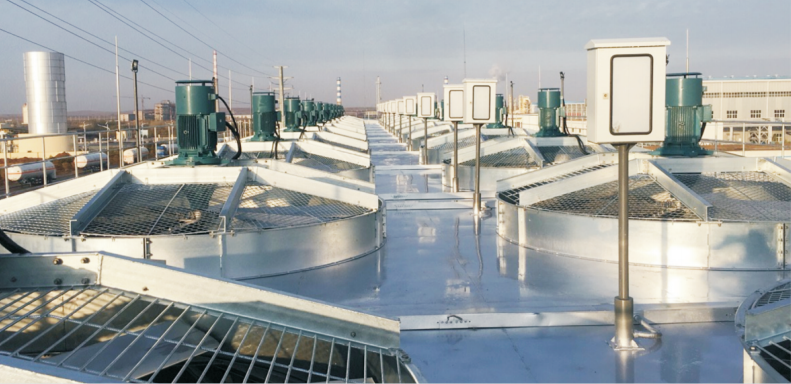
Product Structure
Axial Fan Blades
The fan blades are the primary air-moving components. Their aerodynamic profile is designed to generate the required airflow while minimizing unnecessary resistance.
Depending on the application, blade material, blade number, diameter, pitch, and geometry can be selected according to the required airflow and static pressure.
Proper blade pitch is important because an excessively aggressive pitch can increase motor load, while insufficient pitch may result in inadequate airflow.
Direct Drive Motor
The center-mounted electric motor provides rotational power directly to the fan.
A direct-drive arrangement eliminates many transmission components found in conventional belt-driven or gearbox-driven systems. This can reduce mechanical losses and simplify maintenance.
Motor specifications should be selected according to:
Protective Fan Guard
The wire safety guard surrounds the rotating fan and helps protect personnel from accidental contact with the blades.
It also provides an additional layer of protection for the fan assembly while allowing air to pass through with relatively low obstruction.
Fan Shroud
The circular shroud surrounds the fan and helps guide airflow through the cooling tower fan opening.
Correct clearance between the fan blade tips and shroud is important. Excessive clearance can increase air recirculation and reduce fan efficiency, while insufficient clearance can create a risk of blade contact.
Supporting Frame
The structural frame supports the motor and fan assembly and transfers operating loads to the cooling tower structure.
The frame should be rigid enough to minimize vibration during continuous operation.
Energy-Saving Design
One of the main advantages of this type of cooling tower fan is its focus on efficient airflow generation.
Cooling tower fans can represent a significant portion of the electrical consumption of mechanical cooling tower systems. Improving fan efficiency can therefore contribute to lower operating costs.
Energy savings can be influenced by several factors, including:
Aerodynamic Blade Design
Efficient blade geometry can produce the required airflow with less unnecessary power consumption.
Direct Drive
A direct-drive system eliminates belt and gearbox transmission losses associated with some conventional fan systems.
Correct Fan Selection
Selecting the correct fan diameter, blade pitch, speed, and motor power is essential. An oversized or incorrectly configured fan can consume more energy than necessary.
Proper Fan Clearance
Maintaining appropriate blade-tip clearance helps minimize airflow leakage and recirculation.
Variable Speed Operation
Where system requirements allow, variable-frequency drive (VFD) control can adjust fan speed according to cooling demand. Reducing fan speed can significantly reduce energy consumption when full airflow is not required.
Technical Specifications
The exact specifications should be selected according to the cooling tower and project requirements.
| Item | Specification |
| Product Type | Axial Flow Cooling Tower Fan |
| Drive Type | Direct Drive |
| Fan Type | Axial Flow |
| Application | Mechanical Draft Cooling Tower |
| Motor Type | Electric Motor |
| Fan Diameter | Custom / Project Specific |
| Blade Material | Aluminum Alloy / Engineering Plastic / Custom |
| Blade Quantity | Custom |
| Blade Pitch | Adjustable or Fixed, Depending on Model |
| Rotation Speed | Project Specific |
| Motor Power | Project Specific |
| Voltage | 220 V / 380 V / 400 V / 415 V or Custom |
| Frequency | 50 Hz / 60 Hz |
| Fan Guard | Protective Wire Guard |
| Installation | Cooling Tower Fan Stack |
| Drive Components | Direct Drive |
| Customization | Available |
| Application | Industrial, HVAC and Process Cooling |
Note: Final fan diameter, motor power, speed, airflow, static pressure, blade configuration, and electrical specifications should be confirmed against the cooling tower operating requirements before ordering.
Cooling Tower Fan Performance Factors
Choosing a cooling tower fan should not be based on fan diameter alone. Several operating parameters affect actual performance.
Airflow Capacity
Airflow is normally expressed in CFM or m³/h. The required airflow depends on the tower's heat load, entering and leaving water temperatures, ambient conditions, and tower configuration.
Static Pressure
The fan must overcome resistance caused by the cooling tower fill, drift eliminators, louvers, structural components, and other airflow restrictions.
Fan Diameter
A larger fan can move a greater volume of air at an appropriate operating speed, but the diameter must match the tower fan opening and available installation space.
Motor Power
Motor power must be sufficient to operate the fan at the required duty point without excessive loading.
Rotational Speed
Fan speed affects airflow, pressure, noise, and power consumption. The correct operating speed should be established from the fan performance requirements.
Applications
The Energy Saving Axial Flow Cooling Tower Fan can be used in many industrial and commercial cooling applications.
Industrial Cooling Towers
Suitable for cooling towers used in manufacturing facilities, process industries, chemical plants, steel plants, and other industrial installations.
HVAC Cooling Towers
The fan can be used in commercial HVAC systems where cooling towers reject heat from condenser water circuits.
Chiller Systems
Cooling tower fans work with water-cooled chillers to reject heat from the condenser water loop.
Power and Process Plants
Axial cooling tower fans can be used for heat rejection in large-scale process cooling systems.
Manufacturing Facilities
Factories requiring continuous process-water cooling can use replacement axial fans to maintain tower airflow and thermal performance.
Cooling Tower Retrofit Projects
The fan assembly can also be considered for replacement projects where an existing fan needs to be upgraded or replaced.
Direct Drive vs. Belt Drive Cooling Tower Fan
A direct-drive fan connects the motor directly to the fan assembly, while a belt-driven system uses pulleys and belts to transmit power.
| Feature | Direct Drive | Belt Drive |
| Transmission Components | Fewer | More |
| Belt Maintenance | Not Required | Required |
| Gearbox | Not Required | Usually Not Required |
| Mechanical Losses | Low | Belt losses possible |
| Maintenance | Generally Simple | Requires belt inspection |
| Speed Adjustment | VFD or motor configuration | Pulley ratio / VFD |
| Compact Design | Yes | Depends on arrangement |
| Retrofit Suitability | Project dependent | Widely used |
The best configuration depends on the cooling tower's original design, required airflow, motor arrangement, operating conditions, and available installation space.
Advantages of This Cooling Tower Fan
High Airflow
The axial design is optimized for moving large quantities of air, making it suitable for cooling tower applications.
Energy Efficiency
An optimized fan blade and direct-drive arrangement can help reduce unnecessary mechanical power losses.
Easy Maintenance
The direct-drive configuration eliminates routine belt replacement and reduces the number of mechanical transmission components requiring inspection.
Compact Construction
The integrated motor and fan assembly can provide a relatively compact installation arrangement.
Reliable Operation
A properly selected and balanced fan can provide stable airflow for continuous cooling tower operation.
Replacement Compatibility
The fan can be manufactured in different sizes and configurations for cooling tower repair, replacement, and retrofit applications.
Cooling Tower Fan Replacement
A cooling tower fan may require replacement when the original fan develops cracks, deformation, excessive vibration, corrosion, or aerodynamic damage.
Common indications that a fan should be inspected include:
Before replacing a fan, technicians should record the existing fan diameter, blade number, pitch, motor rating, rotational speed, rotation direction, shaft arrangement, and installation dimensions.
Installation Considerations
Correct installation is essential for reliable cooling tower fan performance.
Check Fan Rotation
The fan must rotate in the specified direction. Incorrect rotation can substantially reduce airflow and cooling performance.
Check Blade Balance
The fan assembly should be properly balanced before and after installation. Imbalance can produce vibration and accelerate bearing or motor wear.
Verify Blade Clearance
Maintain the recommended clearance between blade tips and the surrounding shroud.
Check Fasteners
Motor mounts, blade fasteners, structural bolts, and safety guard connections should be tightened according to the applicable installation requirements.
Verify Motor Alignment
The motor and fan assembly should be correctly positioned and securely mounted.
Check Electrical Connections
Electrical connections should be installed and tested by qualified personnel according to the motor and local electrical requirements.
Maintenance Guide
Although direct-drive axial fans can reduce mechanical maintenance, routine inspection remains important.
Monthly or Routine Inspection
Inspect:
Fan blades
Motor mounting bolts
Fan guard
Structural frame
Electrical connections
Abnormal vibration
Unusual operating noise
Corrosion
Blade clearance
Fan Blade Inspection
Look for cracks, deformation, erosion, corrosion, and loose fasteners. Damaged blades should not continue operating because a failed blade can cause severe mechanical damage.
Motor Inspection
Check motor temperature, vibration, noise, electrical current, and bearing condition according to the motor manufacturer's maintenance requirements.
Vibration Monitoring
Increasing vibration can indicate blade imbalance, loose components, bearing problems, structural issues, or other mechanical faults.
Early detection can help prevent unexpected cooling tower shutdowns.
Custom Cooling Tower Fan Solutions
CoolingTowerPart.com can supply cooling tower fan assemblies according to customer requirements.
Customization may include:
For replacement projects, providing drawings, photographs, nameplate information, existing fan dimensions, and operating parameters can help ensure accurate product selection.
How to Select the Right Axial Cooling Tower Fan
Before ordering, customers should provide as much of the following information as possible:
Cooling tower manufacturer and model
Existing fan diameter
Required airflow
Required static pressure
Existing motor power
Motor voltage and frequency
Fan rotational speed
Number of blades
Existing blade pitch
Fan stack/shroud diameter
Mounting dimensions
Operating environment
Cooling tower heat load
Water flow rate
Required replacement quantity
This information allows the fan configuration to be matched more accurately to the cooling tower.
Why Choose CoolingTowerPart.com?
CoolingTowerPart.com provides cooling tower components for industrial and commercial cooling applications, including fans, fan blades, motors, gearboxes, fills, nozzles, drift eliminators, louvers, belts, shafts, and other replacement parts.
For cooling tower fan projects, we can support customers with:
Replacement cooling tower fans
Direct-drive fan assemblies
Fan blades
Cooling tower motors
Custom fan configurations
OEM-compatible replacement components
Industrial cooling tower spare parts
Export packaging and delivery support
Frequently Asked Questions
What is an axial flow cooling tower fan?
An axial flow cooling tower fan is a mechanical fan designed to move large volumes of air through a cooling tower. Air travels substantially parallel to the fan shaft, making this fan type well suited to cooling tower applications.
What is an energy-saving cooling tower fan?
An energy-saving cooling tower fan is designed to deliver the required airflow with optimized aerodynamic performance and reduced unnecessary power consumption. Fan efficiency depends on blade design, motor efficiency, operating speed, system resistance, and correct installation.
Is this cooling tower fan direct drive?
The pictured assembly uses a direct-drive configuration, with the electric motor mounted directly to the fan assembly rather than using a belt or conventional gearbox transmission.
Can the fan replace an existing cooling tower fan?
Yes, replacement may be possible. However, fan diameter, airflow, static pressure, motor power, speed, mounting dimensions, blade pitch, and rotation direction should be checked before replacement.
What materials are available for the fan blades?
Depending on the design, cooling tower fan blades can be supplied in materials such as aluminum alloy or engineering plastics. The appropriate material depends on the operating environment and required mechanical performance.
Can the fan operate with a VFD?
A direct-drive fan motor may be suitable for variable-speed operation when the motor, drive, fan, and cooling tower system are designed for VFD control. The motor and operating range should be confirmed before implementation.
How can cooling tower fan energy consumption be reduced?
Energy consumption can be reduced by selecting an efficient fan, maintaining proper blade pitch and clearance, keeping the fan and motor correctly balanced, maintaining the motor, and using variable-speed control where appropriate.
What information is needed for a replacement cooling tower fan?
Useful information includes fan diameter, motor power, voltage, speed, blade number, blade pitch, airflow, static pressure, mounting dimensions, cooling tower model, and photographs of the existing assembly.
Is custom manufacturing available?
Yes. Cooling tower fan dimensions, blades, motor specifications, mounting structures, guards, and other components can be customized according to project requirements.
Suggested Internal Links for CoolingTowerPart.com
Use relevant anchor text to connect this product page with related products and informational pages:


 The Energy Saving Axial Flow Cooling Tower Fan is a high-efficiency air-moving solution designed for mechanical-draft cooling towers, HVAC systems, industrial process cooling equipment, and condenser cooling applications. The fan uses an axial-flow aerodynamic design to move a large volume of air through the cooling tower while maintaining efficient operation.


