Cooling Tower Filler Manufacturer: Complete Guide to Cooling Tower Fill
Choosing the right cooling tower filler manufacturer is essential for improving heat transfer, reducing water consumption, and maintaining stable cooling tower performance. The cooling tower fill is one of the most important components inside an evaporative cooling tower because it increases the contact area between hot water and air.
A reliable manufacturer can provide different types of cooling tower fill according to cooling tower design, water quality, operating temperature, airflow, and industrial requirements. From PVC film fill to PP fill and splash fill, the right material and structure can significantly influence cooling efficiency and service life.
This guide explains what a cooling tower filler manufacturer does, the major types of cooling tower fill, manufacturing processes, material selection, quality standards, maintenance requirements, and how to select a reliable supplier.
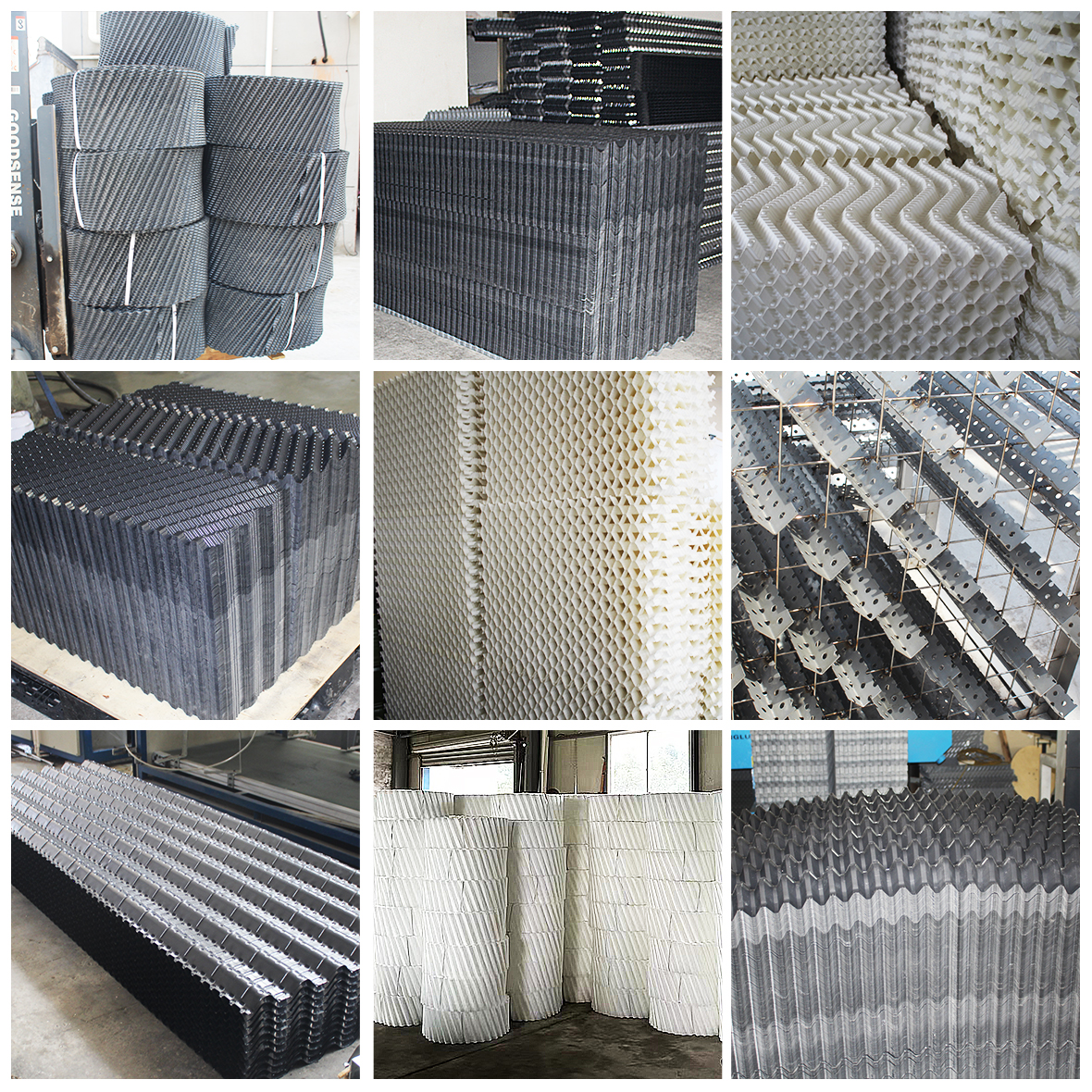
What Is a Cooling Tower Filler?
A cooling tower filler, also called cooling tower fill or cooling tower packing, is the heat-transfer media installed inside a cooling tower.
Its primary function is to increase the surface area available for water-air contact. When hot circulating water flows over the fill, it spreads into thin films or droplets. At the same time, air passes through the fill. A portion of the water evaporates, removing heat from the remaining water.
How Does Cooling Tower Fill Work?
The basic cooling process can be divided into several stages:
Hot water enters the cooling tower.
The distribution system spreads water across the fill.
Water flows through the cooling tower filler.
Air moves through the fill by natural draft or mechanical airflow.
Heat and a small amount of water are transferred to the air.
Cooled water collects in the basin.
The cooled water returns to the industrial process.
Why Surface Area Matters
A larger effective contact area generally improves heat and mass transfer. This is why a well-designed cooling tower fill uses channels, sheets, corrugations, or splash structures to distribute water and increase contact with air.
What Does a Cooling Tower Filler Manufacturer Do?
A professional cooling tower filler manufacturer does much more than simply produce plastic sheets.
Manufacturers normally provide material selection, fill design, molding or forming, cutting, assembly, quality inspection, and technical support.
Cooling Tower Fill Design
Different cooling towers require different fill geometries.
A manufacturer may develop or supply:
Cross-flow cooling tower fill
Counter-flow cooling tower fill
Film fill
Splash fill
High-temperature fill
Low-clogging fill
PVC cooling tower fill
PP cooling tower fill
Replacement fill for branded cooling towers
Customized Fill Dimensions
Cooling tower filler can be customized according to:
This flexibility is particularly important when replacing old or discontinued cooling tower packing.
Main Types of Cooling Tower Fill
A reliable cooling tower filler manufacturer should understand the differences between various fill technologies.
Film Fill
Film fill uses specially shaped sheets to create thin water films over a large surface area.
It is commonly used in HVAC systems, industrial cooling systems, process cooling, and power-generation applications.
Advantages of Film Fill
High heat-transfer efficiency
Large effective surface area
Compact design
Relatively low water volume
Suitable for many counter-flow towers
However, film fill can be more sensitive to suspended solids and biological fouling.
Splash Fill
Splash fill breaks water into droplets as the water passes through a series of splash bars or grids.
It is often selected for applications where water contains more suspended solids or where fouling resistance is a major concern.
Advantages of Splash Fill
Better resistance to clogging
Suitable for dirtier water
Easier cleaning
Suitable for some industrial applications
Splash fill may require a larger tower volume than high-efficiency film fill to achieve the same thermal performance.
Cross-Flow Cooling Tower Fill
In a cross-flow tower, air travels horizontally through the fill while water moves downward.
Cross-flow cooling tower fill is commonly installed in large HVAC and industrial cooling towers.
Cross-Flow Fill Features
A good cross-flow filler should provide:
Uniform water distribution
Low air resistance
Stable structural strength
Good wetting characteristics
Easy installation and replacement
Counter-Flow Cooling Tower Fill
In a counter-flow cooling tower, water travels downward while air moves upward.
Counter-flow fill is widely used because the opposing airflow and water directions can provide effective heat and mass transfer.
Cooling Tower Filler Materials
Material selection is one of the most important decisions when purchasing cooling tower fill.
PVC Cooling Tower Fill
PVC is one of the most commonly used materials for cooling tower filler.
PVC fill offers a combination of cost efficiency, chemical resistance, lightweight construction, and good thermal performance.
It is commonly used in:
Commercial HVAC cooling towers
Industrial cooling systems
Central air-conditioning systems
Process cooling applications
Advantages of PVC Fill
Lightweight
Cost-effective
Easy to process
Good corrosion resistance
Good heat-transfer performance
Suitable for normal operating temperatures
PP Cooling Tower Fill
Polypropylene is another popular material used by cooling tower filler manufacturers.
PP generally provides better temperature resistance than standard PVC and can be considered for applications with higher operating temperatures.
When Should You Choose PP?
PP cooling tower fill may be suitable when:
Operating water temperature is relatively high
Higher thermal resistance is required
Chemical exposure is more demanding
Long-term dimensional stability is important
FRP and Other Materials
Depending on the application, manufacturers may also provide fiberglass-reinforced plastic or other specialized fill structures.
Material selection should consider temperature, water chemistry, UV exposure, mechanical loading, and expected service life.
Cooling Tower Filler Manufacturing Process
The manufacturing process directly affects the consistency and performance of cooling tower fill.
Step 1: Raw Material Selection
The manufacturer selects suitable raw materials based on the required application.
For plastic fill, the formulation may include polymers and appropriate additives designed to improve processing, strength, durability, or resistance to environmental conditions.
Step 2: Sheet Extrusion or Forming
Plastic material is processed into thin sheets.
The sheet thickness needs to remain consistent because significant variations can affect the final geometry and mechanical strength.
Step 3: Corrugation and Shaping
The sheets are formed into specific corrugated or structured patterns.
Why Is Corrugation Important?
Corrugation helps:
Increase contact area
Improve water distribution
Guide airflow
Create turbulence
Promote better heat transfer
Maintain spacing between sheets
Step 4: Cutting
The formed sheets are cut to the required dimensions.
Automated cutting equipment can improve dimensional accuracy and production efficiency.
Step 5: Gluing or Assembly
Individual sheets may be assembled into fill packs using suitable bonding methods.
The final fill blocks must maintain their designed geometry during transportation and installation.
Step 6: Quality Inspection
A professional cooling tower filler manufacturer should inspect finished products before shipment.
Important inspection points include:
Dimensions
Thickness
Surface condition
Bonding quality
Structural strength
Fill geometry
Block size
Material consistency
Key Factors When Choosing a Cooling Tower Filler Manufacturer
Not every supplier offers the same level of manufacturing capability.
Before placing an order, buyers should evaluate several factors.
Manufacturing Experience
An experienced manufacturer is more likely to understand different cooling tower designs and replacement requirements.
Look for suppliers with experience in:
Industrial cooling towers
HVAC cooling towers
Cross-flow towers
Counter-flow towers
Fill replacement projects
Customized cooling tower packing
Product Range
A manufacturer with a broad product range can provide a better solution for different applications.
Ideally, the supplier should offer several types of cooling tower fill, rather than only one standard product.
Material Quality
Ask the supplier what material is used and whether the material is suitable for the operating temperature and water chemistry.
Important Material Questions
Buyers can ask:
Is the fill made from PVC or PP?
What is the nominal sheet thickness?
What operating temperature is recommended?
Is UV resistance available?
Is flame-retardant material available?
What chemicals can the material tolerate?
Production Capacity
For large cooling tower refurbishment projects, production capacity is critical.
A reliable manufacturer should be able to provide:
Stable monthly production
Consistent product quality
Flexible packaging
Reliable delivery schedules
Large-volume order support
Customization Capability
Replacement projects often require non-standard dimensions.
A capable cooling tower filler manufacturer should be able to customize the fill according to existing tower dimensions.
How to Select the Right Cooling Tower Fill
Selecting cooling tower fill based only on price can lead to poor long-term results.
Consider Cooling Tower Type
First determine whether the tower is:
Cross-flow
Counter-flow
Mechanical draft
Natural draft
Open circuit
Closed circuit
The cooling tower configuration determines which fill geometry is appropriate.
Consider Water Quality
Water quality has a major impact on fill selection.
If the circulating water contains high levels of suspended solids, biological matter, oil, or other contaminants, a highly compact film fill may experience faster blockage.
Clean Water Applications
Film fill is often appropriate for relatively clean water.
Dirty Water Applications
Splash fill or specially designed low-clogging fill may be more appropriate for applications with higher fouling potential.
Consider Operating Temperature
Temperature must always be considered when selecting plastic cooling tower filler.
PVC is suitable for many conventional applications, while PP or specialized materials may be considered for higher-temperature services.
Consider Pressure Drop
Cooling tower fill should provide effective heat transfer without creating unnecessary airflow resistance.
An optimized design balances:
Heat Transfer + Airflow + Pressure Drop + Fouling Resistance
This balance is more important than simply selecting the fill with the largest nominal surface area.
Cooling Tower Fill Replacement
Even high-quality fill eventually requires inspection and replacement.
Signs That Cooling Tower Fill Needs Replacement
Common warning signs include:
Reduced cooling capacity
Increased approach temperature
Uneven water distribution
Broken fill sheets
Deformation
Excessive biological growth
Mineral scaling
Severe clogging
Increased fan energy consumption
Why Replace Cooling Tower Fill?
A deteriorated cooling tower filler can restrict airflow and water flow.
Damaged fill may also create uneven water distribution, reducing the effective heat-transfer area.
Benefits of New Cooling Tower Fill
Replacing old fill can help:
Restore thermal performance
Improve water distribution
Reduce airflow resistance
Improve system reliability
Extend cooling tower operating life
Cooling Tower Fill Maintenance
Proper maintenance can significantly extend the useful life of cooling tower packing.
Regular Inspection
Inspect the fill periodically for:
Scaling
Slime
Algae
Sediment
Broken sheets
Structural deformation
Cleaning
Cleaning frequency depends on water quality and operating conditions.
Gentle cleaning methods should be used to avoid damaging thin plastic sheets.
Avoid Excessive Mechanical Force
High-pressure cleaning or aggressive mechanical cleaning can deform or break cooling tower filler.
Cleaning procedures should be selected according to the fill material and manufacturer's recommendations.
Common Problems With Cooling Tower Fill
Fill Blockage
Blockage is one of the most common problems.
Dust, sediment, algae, scale, and biological growth can accumulate between fill sheets.
How to Reduce Blockage
Operators can reduce blockage by:
Improving water treatment
Maintaining filtration
Monitoring cycles of concentration
Cleaning the fill regularly
Choosing a suitable fill design
Fill Deformation
Excessive temperature, chemical exposure, or mechanical loading can cause deformation.
A deformed fill block may reduce water distribution and increase airflow resistance.
Poor Water Distribution
Even the best cooling tower fill cannot perform properly if water is not distributed evenly.
The spray nozzle, water distribution system, fill arrangement, and drift eliminator should therefore be considered as a complete system.
Cooling Tower Filler Manufacturer vs. Trading Company
Buyers often need to decide whether to purchase directly from a manufacturer or through a trading company.
Advantages of Buying From a Manufacturer
Direct cooperation may provide:
A trading company can still be useful when it provides strong project management or access to multiple product categories, but buyers should understand who actually manufactures the fill.
What Should You Ask a Cooling Tower Filler Manufacturer?
Before requesting a quotation, prepare basic technical information.
Technical Information
Provide:
Cooling tower model
Tower type
Existing fill dimensions
Required quantity
Operating temperature
Water quality
Fill material preference
Application
Delivery destination
Commercial Information
You may also ask about:
Providing accurate information allows the manufacturer to recommend a more suitable cooling tower fill.
Cooling Tower Fill Packaging and Transportation
Cooling tower filler is lightweight but occupies significant volume.
Packaging design therefore has a major influence on transportation costs.
Common Packaging Methods
Manufacturers commonly use:
Container Loading
For international orders, buyers should compare the total fill volume with container capacity.
A professional manufacturer can help optimize packing dimensions to reduce unused container space and transportation costs.
Quality Control for Cooling Tower Filler
Quality control should cover the entire production process.
Raw Material Inspection
The incoming material should be checked before production.
Production Inspection
During production, manufacturers should monitor:
Sheet thickness
Sheet dimensions
Corrugation
Temperature
Forming consistency
Bonding quality
Finished Product Inspection
Final inspection verifies that the cooling tower fill meets the agreed specifications.
A strong quality-control system helps maintain consistency across large orders.
Why Work With a Professional Cooling Tower Filler Manufacturer?
The cooling tower fill has a direct relationship with thermal performance, airflow, maintenance, and operating costs.
A professional manufacturer can help customers choose the appropriate fill structure instead of simply selling a standard product.
Technical Support
Manufacturers with engineering experience can recommend suitable fill according to tower design and operating conditions.
OEM and Custom Solutions
For replacement projects, OEM-style or customized cooling tower filler can help solve dimensional compatibility problems.
Stable Supply
Direct manufacturing capability can provide better supply continuity for large projects and repeat orders.
Frequently Asked Questions
What Is the Main Function of Cooling Tower Fill?
The main function is to increase water-air contact area and improve heat and mass transfer inside the cooling tower.
What Is the Most Common Cooling Tower Fill Material?
PVC is widely used for conventional cooling tower fill because it offers a good balance between cost, performance, and chemical resistance.
Is PP Better Than PVC Cooling Tower Fill?
Not necessarily. PP can provide better temperature resistance, while PVC is often more economical for standard operating conditions. The correct choice depends on the application.
How Long Does Cooling Tower Fill Last?
Service life varies significantly depending on water quality, temperature, chemical treatment, UV exposure, mechanical conditions, and maintenance. Regular inspection is more reliable than assuming a fixed replacement interval.
Can Cooling Tower Fill Be Customized?
Yes. Many professional manufacturers can customize dimensions, sheet thickness, flute design, fill block size, and other specifications for replacement or new tower projects.
How Do I Find a Reliable Cooling Tower Filler Manufacturer?
Compare manufacturing experience, material quality, product range, customization capability, quality control, production capacity, technical support, and export experience before making a decision.
Final Guide to Choosing a Cooling Tower Filler Manufacturer
The right cooling tower filler manufacturer can have a significant impact on the performance and operating cost of a cooling tower.
When selecting a supplier, do not evaluate cooling tower fill only by unit price. Consider the complete solution, including fill type, material, thermal performance, water quality, airflow resistance, durability, installation requirements, packaging, and technical support.
For standard HVAC systems, PVC film fill may provide an effective and economical solution. For higher-temperature or more demanding applications, PP or specialized cooling tower filler may be more appropriate. For applications with severe fouling risks, splash or low-clogging designs should also be considered.
By selecting the right fill technology and working with an experienced manufacturer, cooling tower operators can improve heat-transfer performance, reduce maintenance problems, and achieve more reliable long-term cooling performance.


