Cooling Tower Filler | High-Performance Fill for Industrial Cooling Towers
A cooling tower filler is one of the most important heat-transfer components inside an industrial cooling tower. It increases the contact area between circulating water and air, allowing heat to transfer more efficiently through evaporation. The right fill design can improve cooling performance, reduce operating costs, and support stable operation under demanding industrial conditions.
Modern cooling tower fill is available in different materials, shapes, thicknesses, and configurations. PVC film fill, PP fill, splash fill, and high-temperature fill are among the common solutions used for different cooling applications.
However, choosing the right cooling tower filler requires more than simply selecting a material. Water quality, temperature, airflow, suspended solids, cooling load, tower configuration, and maintenance requirements should all be considered.
This guide explains how cooling tower filler works, what types are available, how to select the right fill media, and how proper maintenance can improve the long-term performance of industrial cooling towers.
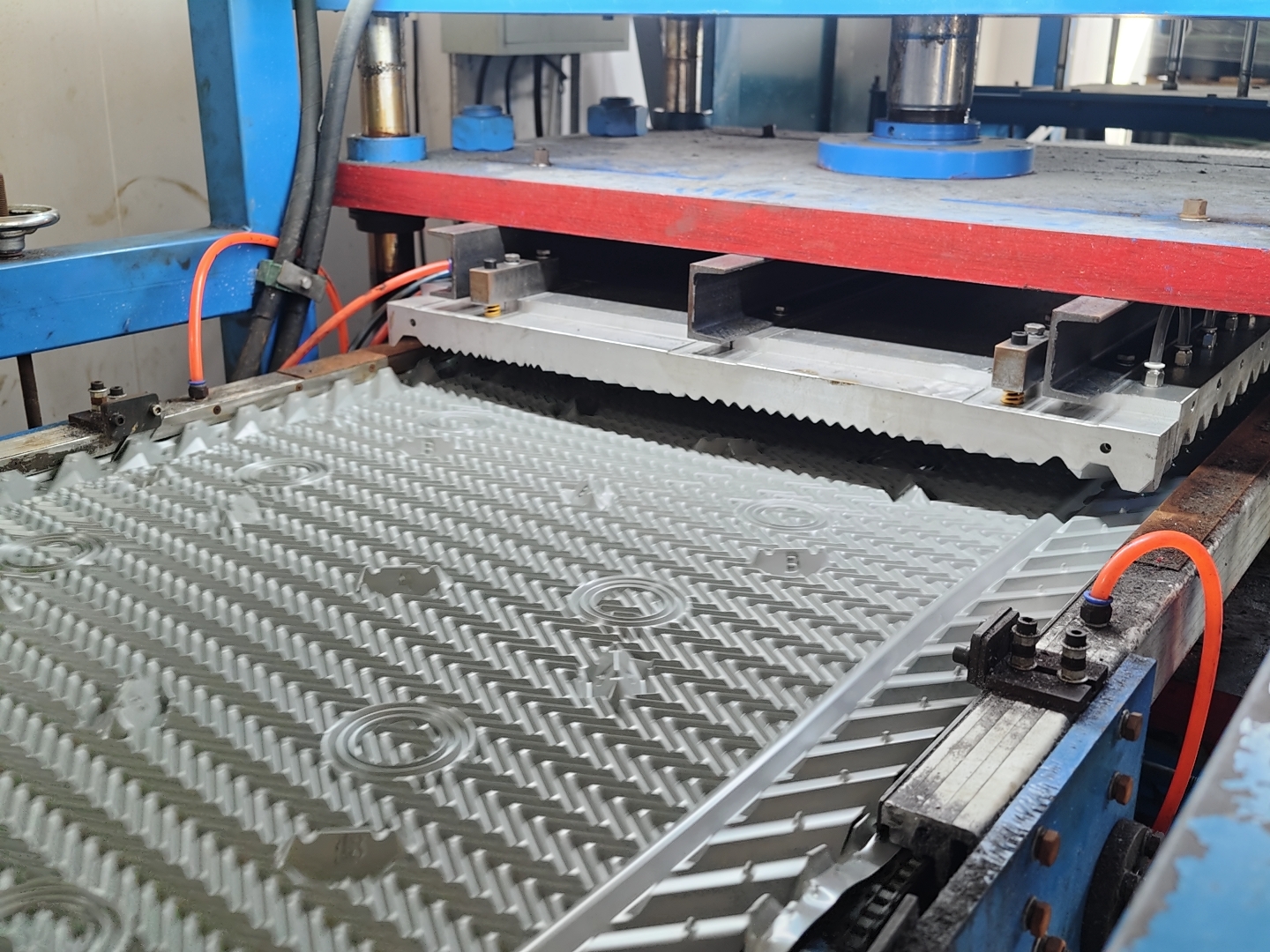
What Is a Cooling Tower Filler?
A cooling tower filler is a structured or splash-type material installed inside a cooling tower to increase the contact area between water and air.
When hot circulating water enters the cooling tower, it is distributed over the fill. Air passes through the fill in either a cross-flow or counter-flow direction. A portion of the water evaporates, removing heat from the remaining water.
What Is the Main Function of Cooling Tower Fill?
The primary function of cooling tower fill is to improve heat and mass transfer.
A well-designed fill helps:
Increase water-air contact area
Extend water contact time
Improve evaporative cooling
Promote uniform water distribution
Reduce the required tower size for a given heat load
Improve overall cooling efficiency
Why Is Contact Area So Important?
The greater the effective contact area between air and water, the more opportunity there is for heat and mass transfer.
The cooling tower filler therefore plays a direct role in determining how efficiently the tower can reject heat.
How Does Cooling Tower Filler Work?
The operating principle is relatively simple.
Hot water enters the tower and flows over the fill surface. At the same time, air moves through the fill. The water spreads across the fill surface, creating a large interface between water and air.
How Does Film Fill Improve Heat Transfer?
Film fill divides the water into thin films that flow over specially shaped surfaces.
This creates a large effective surface area while allowing air to contact the water over an extended path.
Film fill is particularly common in industrial and HVAC cooling towers where high thermal efficiency is required.
How Does Splash Fill Work?
Splash fill uses specially designed bars or grids to break falling water into smaller droplets.
Each impact increases the water-air interface and improves evaporation.
When Is Splash Fill a Better Choice?
Splash fill can be advantageous when circulating water contains higher concentrations of suspended solids or when resistance to fouling is more important than achieving maximum compact heat-transfer performance.
What Are the Main Types of Cooling Tower Filler?
Different cooling tower designs require different types of fill.
The most common categories include film fill, splash fill, PVC fill, PP fill, and high-temperature fill.
What Is PVC Cooling Tower Fill?
PVC is one of the most widely used materials for cooling tower fill.
PVC film fill is lightweight, economical, and suitable for many industrial and commercial cooling applications.
What Are the Advantages of PVC Cooling Tower Filler?
PVC cooling tower filler typically offers:
Good heat-transfer performance
Low weight
Easy installation
Cost-effective production
Good resistance to many water-treatment chemicals
Flexible manufacturing options
Wide application compatibility
Where Is PVC Fill Commonly Used?
PVC fill is widely used in:
What Is PP Cooling Tower Fill?
Polypropylene, or PP, is another important material for cooling tower filler.
PP generally offers higher temperature resistance than standard PVC, making it suitable for certain applications where circulating-water temperatures are elevated.
Why Choose PP Cooling Tower Filler?
Potential advantages include:
Higher temperature resistance
Good chemical resistance
Good mechanical stability
Long service life under suitable conditions
Compatibility with demanding industrial environments
The actual temperature limit depends on the specific PP formulation, fill geometry, operating conditions, and manufacturer specifications.
What Is Splash Cooling Tower Fill?
Splash fill is designed to break water into droplets instead of spreading it primarily as a thin film.
What Are the Benefits of Splash Fill?
Splash fill can offer:
Relatively open water passages
Better tolerance of suspended solids
Reduced risk of narrow-channel blockage
Easy inspection and maintenance
Good performance in heavily contaminated water applications
Is Splash Fill Suitable for Dirty Water?
It can be.
For industrial processes where water contains significant suspended solids, an open splash-fill configuration may provide advantages over tightly spaced film-fill channels.
However, the final choice should be based on actual water chemistry and cooling requirements.
What Is High-Temperature Cooling Tower Fill?
High-temperature fill is designed for applications where standard PVC cooling tower filler may not provide adequate temperature resistance.
Why Is Temperature Resistance Important?
Excessive temperature can soften or deform certain plastic materials.
A high-temperature cooling tower fill may use materials such as specially selected PP or other heat-resistant materials.
What Applications Require High-Temperature Fill?
Typical applications may include:
Industrial process cooling
Steel production
Chemical processing
Power generation
High-temperature manufacturing
Specialized process cooling systems
The exact fill material should be selected according to the actual inlet-water temperature and operating conditions.
How Do You Select the Right Cooling Tower Filler?
Choosing the right filler is critical for cooling tower performance.
Several technical factors should be evaluated before purchasing.
Does Water Quality Affect Cooling Tower Fill Selection?
Yes.
Water quality is one of the most important factors.
What Happens When Water Contains High Suspended Solids?
Suspended solids can accumulate inside the fill passages and gradually reduce water flow.
If the fill has narrow channels, fouling may develop more quickly under poor water-quality conditions.
Which Fill Is Better for High-Fouling Applications?
Open-structure splash fill or specially designed fouling-resistant film fill may be considered depending on the application.
A water-treatment program should also be used to control suspended solids, scale, corrosion, and biological growth.
Does Cooling Water Temperature Affect Fill Selection?
Absolutely.
PVC fill is suitable for many conventional cooling applications, but higher-temperature systems may require PP or other heat-resistant materials.
Before ordering a cooling tower filler, confirm:
Hot-water inlet temperature
Cold-water outlet temperature
Maximum operating temperature
Temperature fluctuations
Chemical exposure
Does Cooling Tower Design Affect Filler Selection?
Yes.
The tower configuration determines how air and water interact.
What Fill Is Used in Cross-Flow Cooling Towers?
Cross-flow cooling towers generally use fill through which air flows horizontally while water moves vertically downward.
The fill geometry must support effective water distribution and airflow.
What Fill Is Used in Counter-Flow Cooling Towers?
In counter-flow towers, air moves upward while water flows downward.
Counter-flow film fill can provide a high surface-area-to-volume ratio, making it suitable for compact and efficient tower designs.
Why Does Fill Geometry Matter?
Fill geometry affects:
Heat-transfer area
Pressure drop
Water distribution
Airflow resistance
Fouling tendency
Cleaning requirements
Therefore, fill should be selected as part of the complete cooling tower system rather than as an isolated component.
How Does Cooling Tower Filler Improve Industrial Cooling Efficiency?
Industrial cooling towers operate continuously and often handle substantial heat loads.
The performance of the filler can therefore have a direct effect on overall system efficiency.
Can Better Fill Reduce Tower Size?
Potentially.
A high-performance cooling tower fill can provide greater effective heat-transfer area within a given volume.
This may allow engineers to achieve the required thermal performance within a more compact tower design.
Can Cooling Tower Fill Reduce Operating Costs?
Efficient heat transfer can contribute to lower overall operating costs.
When the tower can achieve the required cold-water temperature efficiently, the cooling system may avoid unnecessary fan operation, excessive water circulation, or extended operating periods.
Actual energy savings depend on the complete cooling tower system.
What Causes Cooling Tower Fill Performance to Decline?
Even high-quality cooling tower filler can lose performance if it is poorly maintained.
What Is Fill Fouling?
Fouling occurs when unwanted materials accumulate on the fill.
Common contaminants include:
Scale
Algae
Slime
Dirt
Mud
Dust
Corrosion products
Suspended solids
How Does Fouling Affect Heat Transfer?
Fouling can reduce the effective surface area and interfere with water distribution.
Blocked passages can also increase airflow resistance and reduce the effectiveness of the cooling tower.
How Should Cooling Tower Fill Be Maintained?
Routine maintenance is essential for protecting the performance of cooling tower fill.
How Often Should Fill Be Inspected?
Inspection frequency should depend on operating conditions.
Towers operating in dusty environments, areas with poor water quality, or heavily contaminated industrial processes may require more frequent inspection.
How Can Cooling Tower Filler Be Cleaned?
Cleaning methods depend on the type and severity of fouling.
Common approaches include:
Low-pressure water flushing
Mechanical cleaning
Chemical cleaning
Descaling
Biological deposit treatment
Why Should Excessive Water Pressure Be Avoided?
Excessive pressure can damage plastic fill sheets or deform structured fill.
Controlled cleaning is generally preferable to aggressive pressure washing.
When Should Cooling Tower Fill Be Replaced?
Cleaning can restore performance when the fill remains structurally sound.
However, severely damaged filler should be replaced.
What Are the Signs of Fill Replacement?
Replacement may be appropriate when you find:
Cracked fill sheets
Severe deformation
Collapsed fill packs
Persistent blockages
Significant material degradation
Loss of structural strength
Excessive biological or chemical damage
Is Replacing Fill Better Than Repeated Cleaning?
If the fill is reaching the end of its service life, repeated cleaning may only provide temporary improvement.
A new cooling tower filler can restore the designed heat-transfer surface and improve system reliability.
What Should You Look for in a High-Performance Cooling Tower Filler?
A high-performance filler should match the thermal and operating requirements of the tower.
What Are the Most Important Performance Factors?
Consider:
Heat-transfer efficiency
Airflow resistance
Fouling resistance
Material durability
Temperature resistance
Chemical compatibility
Water distribution
Mechanical strength
Maintenance requirements
Why Is Material Quality Important?
The filler remains exposed to water, air, chemicals, temperature changes, and mechanical stress.
Consistent material quality can help maintain dimensional stability and service performance.
Does Fill Thickness Matter?
Yes.
Fill thickness affects structural strength, weight, heat-transfer characteristics, and manufacturing cost.
The appropriate thickness depends on the fill design and application rather than simply choosing the thickest available material.
How Can You Improve Cooling Tower Fill Performance?
Selecting the correct filler is only the first step.
Maintain Proper Water Distribution
Nozzles and distribution pipes should deliver water evenly across the fill.
Poor distribution can create dry areas and overloaded sections.
Control Water Chemistry
Proper water treatment can reduce:
Scale
Corrosion
Biological growth
Suspended solids
This helps protect the fill and maintain heat-transfer efficiency.
Keep Airflow Balanced
The fan, fan stack, louvers, and fill should work together as an integrated system.
Excessive airflow resistance can reduce fan efficiency and affect tower performance.
How Do You Choose a Reliable Cooling Tower Filler Supplier?
Supplier selection is important when purchasing replacement or new fill media.
What Technical Information Should a Supplier Provide?
A reliable supplier should be able to provide information such as:
Can Custom Cooling Tower Fill Be Manufactured?
Depending on the supplier's production capabilities, custom dimensions, sheet thicknesses, configurations, and packing solutions may be available.
This can be useful when replacing filler in an existing cooling tower where standard dimensions may not fit.
Why Is Cooling Tower Fill Important for Industrial Cooling Towers?
The cooling tower filler is not simply a plastic component placed inside the tower. It is a critical heat-transfer medium that directly influences how efficiently water and air interact.
The right cooling tower fill can provide:
Efficient heat transfer
Stable cooling performance
Suitable airflow characteristics
Better water distribution
Reduced fouling risk
Longer service life
Easier maintenance
For industrial cooling applications, filler selection should therefore be based on the complete operating environment rather than price alone.
Conclusion: How Can the Right Cooling Tower Filler Improve Cooling Performance?
A high-quality cooling tower filler plays a central role in efficient evaporative cooling. By increasing water-air contact area and improving heat and mass transfer, the right fill media can help industrial cooling towers achieve stable thermal performance.
PVC film fill is a popular solution for many standard applications, while PP and specialized high-temperature materials can be considered for more demanding conditions. Splash fill can also be valuable where suspended solids and fouling are major concerns.
The best solution depends on water quality, temperature, tower configuration, cooling load, airflow, maintenance practices, and expected service life.
For new cooling towers and replacement projects, selecting the right cooling tower fill and maintaining it properly can improve heat-transfer performance, reduce fouling-related problems, and support reliable long-term industrial cooling.


