Professional Fiberglass Cooling Tower Fan Stack Manufacturer in China
Choosing a professional fiberglass cooling tower fan stack manufacturer in China is an important decision for industrial cooling tower projects. A high-quality fan stack does more than provide a protective enclosure for rotating fan blades. It also plays an important role in airflow guidance, aerodynamic efficiency, structural stability, and overall cooling tower performance.
With the development of FRP composite manufacturing technology, fiberglass cooling tower fan stacks have become increasingly popular in power plants, chemical facilities, steel mills, HVAC systems, and other industrial applications. Compared with traditional metal structures, fiberglass fan stacks offer excellent corrosion resistance, relatively low weight, and flexible customization options.
China has become an important manufacturing center for industrial cooling tower components. Professional Chinese manufacturers can provide customized FRP fan stacks, replacement components, and complete solutions for international cooling tower projects.
This article explains the advantages of fiberglass cooling tower fan stacks, their manufacturing processes, material selection, quality requirements, and how to choose a reliable manufacturer in China.
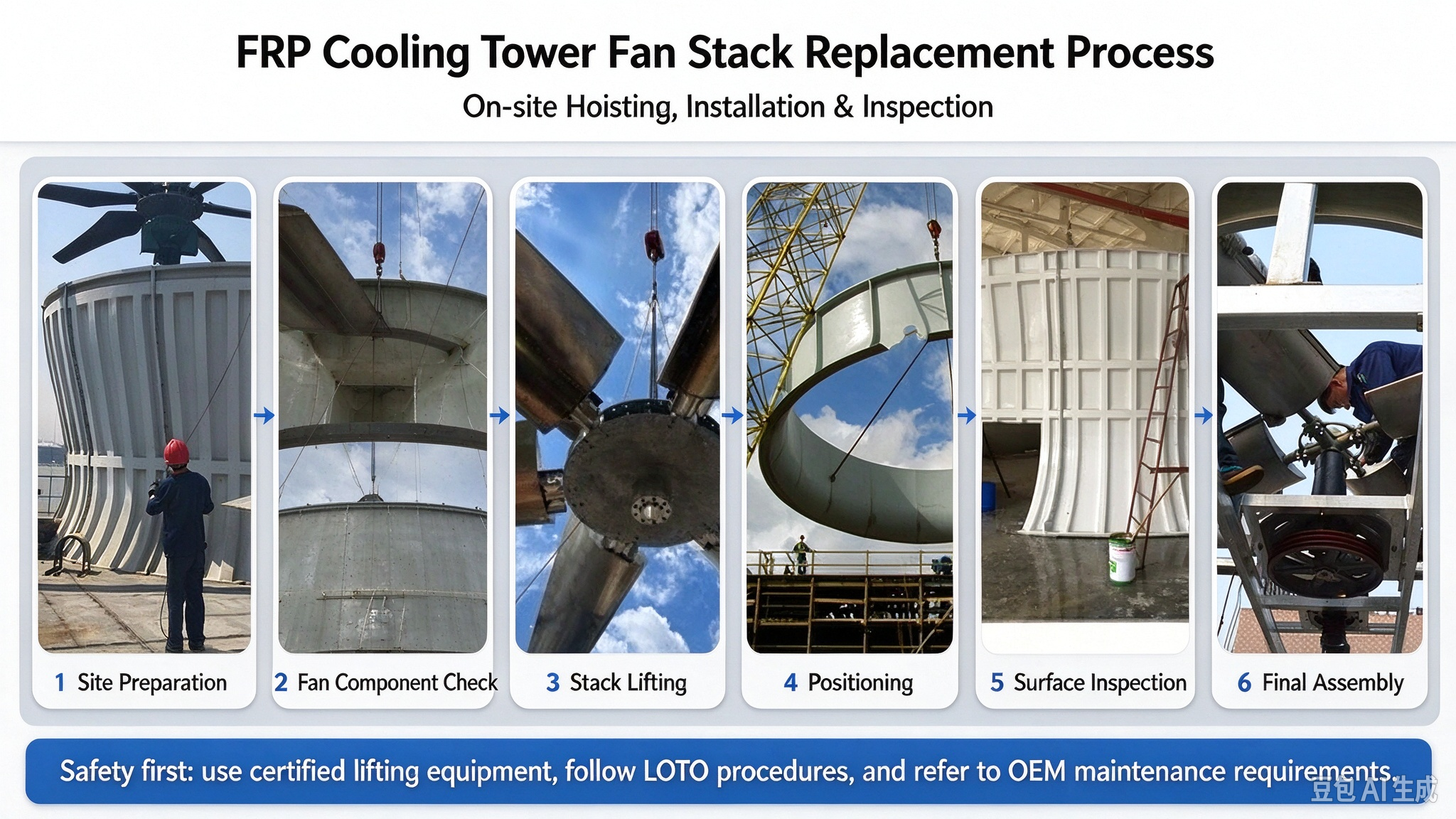
1. What Is a Fiberglass Cooling Tower Fan Stack?
A fiberglass cooling tower fan stack is an FRP structure installed around the cooling tower fan. It is commonly designed as a cylindrical or slightly tapered enclosure that guides hot air upward and away from the cooling tower.
It is also known as an FRP cooling tower fan cylinder, fiberglass fan shroud, or cooling tower fan stack.
1.1 Main Functions of an FRP Cooling Tower Fan Stack
The fan stack is an important component of the cooling tower air discharge system.
Its primary functions include:
Guiding exhaust air in the correct direction.
Supporting stable airflow through the fan system.
Helping reduce undesirable air recirculation.
Providing a protective enclosure around fan blades.
Supporting the aerodynamic performance of the cooling tower.
Maintaining suitable clearance around rotating fan blades.
How Does the Fan Stack Improve Airflow?
The aerodynamic shape of the fan stack helps guide discharged air upward.
A properly designed stack can reduce unnecessary airflow disturbance and help maintain favorable operating conditions around the fan.
Its performance depends on several factors, including stack diameter, height, internal geometry, fan blade configuration, and installation accuracy.
1.2 Why Is Fiberglass Used for Cooling Tower Fan Stacks?
Fiberglass reinforced plastic combines glass fiber reinforcement with a resin matrix to create a lightweight composite material.
This material is particularly suitable for cooling tower environments where humidity, chemical exposure, and outdoor weather conditions may affect conventional materials.
Important advantages include:
Excellent corrosion resistance.
High strength-to-weight ratio.
Good dimensional flexibility.
Relatively low maintenance requirements.
Resistance to many industrial environmental conditions.
Convenient transportation and installation.
2. Why Choose a Professional Fiberglass Cooling Tower Fan Stack Manufacturer in China?
China has an established industrial supply chain for cooling tower components and FRP products.
Working with a professional Chinese manufacturer can offer several advantages for international buyers, engineering contractors, and cooling tower distributors.
2.1 Competitive Manufacturing Costs
One important reason international buyers source fiberglass cooling tower fan stacks from China is manufacturing cost efficiency.
Chinese manufacturers benefit from established fiberglass production facilities, material supply networks, and experienced industrial manufacturing teams.
These advantages can help reduce production costs while maintaining appropriate product specifications and quality standards.
Lower Total Procurement Costs
When evaluating suppliers, buyers should consider more than the initial product quotation.
Other important costs include:
Mold and tooling expenses.
Product customization.
Packaging and transportation.
Installation requirements.
Maintenance expenses.
Expected service life.
A professional manufacturer should provide a quotation based on actual technical requirements rather than offering an unnecessarily low price with unclear specifications.
2.2 Flexible Customization Capabilities
Different cooling towers have different structural designs and fan configurations.
A professional fiberglass cooling tower fan stack manufacturer in China should be capable of producing customized products according to customer drawings, measurements, and project requirements.
Customization options may include:
Different fan stack diameters.
Customized stack heights.
Different laminate thicknesses.
Various flange configurations.
Different resin systems.
Customized colors and surface finishes.
Special reinforcement structures.
Custom FRP Fan Stack for Replacement Projects
For replacement applications, dimensional accuracy is particularly important.
The new fan stack should match the original cooling tower structure and provide sufficient clearance for the rotating fan blades.
Manufacturers can use existing drawings, physical measurements, or technical specifications to develop a suitable replacement solution.
2.3 Professional Manufacturing Experience
Manufacturing experience directly influences product consistency and reliability.
An experienced supplier understands the requirements of industrial cooling tower structures, including aerodynamic considerations, mechanical loading, environmental exposure, and installation conditions.
Professional manufacturers should also have established production procedures for fiberglass reinforcement, resin application, curing, trimming, and final inspection.
2.4 Convenient International Export Services
China has extensive experience exporting industrial cooling tower components to international markets.
A professional supplier should be able to support overseas buyers with:
Technical communication.
Customized quotations.
Product drawings.
Export packaging.
Shipping coordination.
Quality documentation.
Installation guidance.
These services help simplify international procurement and project coordination.
3. Key Features of High-Quality Fiberglass Cooling Tower Fan Stacks
Not all fiberglass fan stacks have the same structural quality or operating performance.
Buyers should understand the important product characteristics before selecting a manufacturer.
3.1 High Structural Strength
A cooling tower fan stack must withstand various loads during operation.
These may include wind pressure, vibration transmitted from the fan assembly, self-weight, and loads transferred through mounting connections.
Factors Affecting Structural Strength
A professional manufacturer should determine the appropriate laminate structure according to the actual project requirements.
3.2 Excellent Corrosion Resistance
Cooling tower environments are generally humid and may contain chemicals, dissolved minerals, and industrial pollutants.
Traditional carbon steel structures may require protective coatings to prevent rust.
Fiberglass materials offer excellent resistance to many corrosive environments without relying on conventional metal coatings.
Selecting the Right Resin System
Different resin systems provide different chemical and temperature resistance characteristics.
Common options include:
The final choice should consider operating temperature, chemical exposure, water quality, and expected service conditions.
3.3 Lightweight Construction
Fiberglass cooling tower fan stacks are generally lighter than comparable steel structures.
This provides several practical advantages:
Easier transportation.
Reduced lifting requirements.
More convenient installation.
Lower handling difficulty.
Reduced structural dead load.
However, the final weight depends on product dimensions, laminate thickness, and reinforcement design.
3.4 Good Weather and UV Resistance
Outdoor cooling tower equipment is exposed to sunlight, rain, wind, and temperature fluctuations.
High-quality FRP fan stacks can use UV-resistant gel coats and suitable protective surface systems to improve resistance to outdoor aging.
Proper surface protection helps maintain appearance and reduce long-term deterioration.
4. Fiberglass Cooling Tower Fan Stack Manufacturing Process in China
The manufacturing process is one of the most important factors affecting product quality.
A professional fiberglass cooling tower fan stack manufacturer should control each production stage to ensure consistent dimensions, laminate quality, and structural performance.
4.1 Raw Material Selection
Production begins with selecting suitable fiberglass reinforcement and resin materials.
Common reinforcement materials include:
Fiberglass chopped strand mat.
Fiberglass woven roving.
Multiaxial fiberglass fabrics.
Other engineered reinforcement materials.
The resin system is selected according to the intended operating environment and product requirements.
Why Does Raw Material Quality Matter?
Low-quality fiberglass or unsuitable resin may cause insufficient mechanical strength, poor bonding, surface defects, or premature material deterioration.
Reliable manufacturers should maintain raw material inspection and supplier evaluation procedures.
4.2 Mold Preparation and Product Design
Before production, manufacturers prepare the required mold and confirm product dimensions.
The design process should consider the cooling tower fan diameter, stack height, connection structure, installation requirements, and aerodynamic profile.
Important Design Parameters
Parameter | Main Consideration |
Stack diameter | Fan size and tower configuration |
Stack height | Air discharge requirements |
Wall thickness | Structural loading |
Flange design | Installation and connection |
Resin type | Environmental resistance |
Surface finish | Appearance and protection |
Reinforcement | Mechanical strength |
Accurate mold preparation helps maintain dimensional consistency across production batches.
4.3 Fiberglass Lamination
Lamination is a critical manufacturing stage.
Fiberglass reinforcement is placed into the mold and combined with resin to form the composite structure.
Depending on product design and manufacturing capabilities, manufacturers may use hand lay-up or other suitable composite molding methods.
Important Lamination Requirements
Uniform resin distribution.
Proper fiberglass layer placement.
Controlled laminate thickness.
Effective air bubble removal.
Consistent reinforcement arrangement.
Appropriate curing conditions.
Poor lamination can create weak areas and reduce the mechanical reliability of the finished fan stack.
4.4 Curing and Demolding
After lamination, the product must undergo an appropriate curing process.
Curing allows the resin system to develop its intended mechanical properties.
The curing time and conditions depend on the selected resin, laminate structure, manufacturing method, and environmental conditions.
After sufficient curing, the fiberglass fan stack can be removed from the mold for further processing.
4.5 Trimming and Surface Finishing
The demolded product is trimmed to the required dimensions.
Flange edges, connection areas, and other installation sections are finished according to the technical drawings.
Surface finishing may include:
4.6 Final Quality Inspection
Before delivery, the finished fiberglass cooling tower fan stack should undergo a series of inspections.
Important inspection items include:
Overall dimensions.
Diameter and roundness.
Wall thickness.
Surface appearance.
Laminate quality.
Flange dimensions.
Structural defects.
Packaging condition.
Inspection requirements should be agreed upon before production, especially for customized industrial projects.
5. Applications of Fiberglass Cooling Tower Fan Stacks
Fiberglass fan stacks are used in various industrial and commercial cooling tower systems.
Their corrosion resistance, lightweight construction, and customization capabilities make them suitable for many applications.
5.1 Power Plants
Power generation facilities require reliable cooling systems to remove excess process heat.
FRP cooling tower fan stacks can provide durable airflow structures for industrial cooling towers.
Their corrosion resistance is particularly valuable in humid operating environments.
5.2 Chemical and Petrochemical Plants
Chemical facilities may expose cooling tower equipment to aggressive atmospheric conditions and chemical contaminants.
Fiberglass fan stacks manufactured with suitable resin systems can help reduce corrosion-related maintenance.
5.3 Steel and Metallurgical Industries
Steel plants use cooling towers in different production processes, including equipment cooling and industrial water circulation.
Custom fiberglass cooling tower fan stacks can be designed for different tower capacities and installation configurations.
5.4 HVAC and Commercial Cooling Systems
Large commercial buildings, shopping centers, hospitals, and industrial facilities use cooling towers for air-conditioning systems.
FRP fan stacks provide a lightweight and corrosion-resistant option for these installations.
5.5 Industrial Manufacturing Facilities
Factories in textile, food processing, electronics, and other manufacturing industries depend on stable cooling systems.
A properly designed fiberglass cooling tower fan stack helps support reliable air discharge and cooling tower operation.
6. How to Choose the Right Fiberglass Cooling Tower Fan Stack Manufacturer in China?
Finding a reliable manufacturer requires more than comparing prices.
International buyers should evaluate production capabilities, product quality, customization experience, and technical support.
6.1 Check Factory Manufacturing Capabilities
A professional supplier should have suitable manufacturing facilities and production equipment.
Buyers can request:
Factory photographs.
Production process information.
Product samples or previous project examples.
Manufacturing equipment details.
Quality control procedures.
Why Is Factory Experience Important?
A manufacturer with relevant production experience is more likely to understand the technical requirements of fiberglass cooling tower components.
This can reduce communication problems and help avoid unnecessary production errors.
6.2 Evaluate Customization Experience
Not every cooling tower uses the same fan stack dimensions.
A reliable manufacturer should be able to handle customized projects instead of offering only standard sizes.
Ask whether the supplier can manufacture products according to engineering drawings, existing samples, or detailed measurements.
6.3 Review Quality Control Standards
Quality control should cover both raw materials and finished products.
Buyers should pay attention to:
Where required, buyers can request inspection records and relevant material documentation.
6.4 Compare Technical Support and Communication
Technical communication is important when purchasing customized industrial components.
A professional manufacturer should be able to discuss product dimensions, installation details, material selection, and delivery requirements clearly.
Fast and accurate communication can help international buyers reduce procurement risks.
6.5 Consider Delivery and Export Experience
Before confirming an order, buyers should understand the manufacturer's production lead time, packaging methods, shipping arrangements, and export documentation capabilities.
For oversized FRP fan stacks, packaging and transportation planning are particularly important.
7. Custom Fiberglass Cooling Tower Fan Stack: What Information Should Buyers Provide?
Providing accurate technical information helps manufacturers recommend the right product and prepare a more precise quotation.
7.1 Product Dimensions
The most important information includes:
If the original product is available, buyers can also provide photographs and physical measurements.
7.2 Cooling Tower Information
Additional cooling tower information can help the manufacturer understand the application.
For example:
7.3 Material and Surface Requirements
Buyers should communicate their expectations regarding material selection and product appearance.
These may include:
FRP or SMC construction.
Resin type.
Fiberglass reinforcement.
UV-resistant surface treatment.
Required color.
Special chemical resistance.
7.4 Drawings and Reference Samples
Engineering drawings are particularly helpful for customized manufacturing.
If drawings are unavailable, manufacturers may evaluate the project using measurements, photographs, and existing equipment samples.
The more accurate the technical information, the easier it is to avoid dimensional discrepancies during production.
8. Fiberglass Cooling Tower Fan Stack vs. Steel Cooling Tower Fan Stack
When purchasing a replacement fan stack, industrial buyers often compare fiberglass with traditional steel.
Both materials have different advantages depending on the project.
8.1 Corrosion Resistance
Fiberglass provides excellent resistance to many industrial corrosive environments.
Steel fan stacks generally require suitable protective coatings or corrosion prevention measures, particularly in humid locations.
8.2 Weight and Transportation
FRP structures are generally lighter than comparable steel structures.
This can simplify transportation and lifting during installation.
8.3 Customization
Fiberglass molding processes allow manufacturers to produce different shapes and dimensions according to project requirements.
Steel also supports customization, but certain complex shapes may require additional fabrication processes.
8.4 Maintenance and Operating Costs
FRP can reduce corrosion-related maintenance requirements.
However, the total lifecycle cost depends on material quality, structural design, operating conditions, maintenance requirements, and initial investment.
8.5 Which Material Is Better?
For many cooling tower applications where corrosion resistance and lightweight construction are priorities, fiberglass is an attractive option.
Steel may remain suitable for projects with specific structural or fabrication requirements.
The final decision should be based on engineering evaluation rather than material price alone.
9. Why Is Proper Fan Stack Design Important for Cooling Tower Performance?
A fiberglass cooling tower fan stack is not simply an enclosure. Its geometry and installation can influence the airflow characteristics of the entire cooling tower.
9.1 Aerodynamic Design
The internal shape and dimensions of the fan stack should be compatible with the fan system.
An appropriate aerodynamic profile helps guide exhaust air and minimize unnecessary airflow losses.
9.2 Fan Blade Clearance
Correct clearance between fan blade tips and the fan stack is essential.
Insufficient clearance can increase the risk of contact during operation, especially when blade movement, structural deformation, or installation tolerances are considered.
9.3 Structural Reinforcement
The fan stack must maintain its designed shape under expected operating loads.
Reinforcement should be selected according to stack dimensions, wind conditions, vibration exposure, and connection requirements.
9.4 Installation Accuracy
Even a high-quality fiberglass fan stack may not perform as intended if installation dimensions are incorrect.
Professional installation should verify alignment, mounting security, flange connections, and fan blade clearance before commissioning.
10. Common Problems with Fiberglass Cooling Tower Fan Stacks and Their Solutions
Understanding common product defects can help buyers evaluate manufacturer quality and establish an effective maintenance program.
10.1 Surface Cracking
Cracks may result from impact damage, excessive mechanical stress, poor laminate quality, or improper installation.
Minor surface damage may be repairable, while structural cracks require professional assessment.
10.2 Delamination
Delamination occurs when fiberglass layers separate or lose bonding strength.
Manufacturers can reduce this risk through proper material selection, resin application, reinforcement placement, and curing control.
10.3 Dimensional Deviation
Incorrect dimensions may cause installation difficulties and insufficient fan blade clearance.
Accurate mold preparation and final dimensional inspection are important for customized products.
10.4 UV Aging
Long-term sunlight exposure may cause surface fading and degradation.
Using suitable UV-resistant coatings and conducting regular inspections can help protect the FRP surface.
10.5 Loose Connections
Improper flange installation or insufficient fastening may lead to vibration and structural instability.
Correct connection design and installation procedures help reduce these risks.
11. FAQ About Fiberglass Cooling Tower Fan Stack Manufacturers in China
11.1 What Is the Advantage of Buying a Fiberglass Cooling Tower Fan Stack from China?
Chinese manufacturers can offer competitive manufacturing costs, flexible customization, established FRP production capabilities, and international export services.
Buyers should still evaluate individual suppliers based on technical capability, quality control, and project experience.
11.2 Can Chinese Manufacturers Produce Custom FRP Fan Stacks?
Yes. Professional manufacturers can produce customized fiberglass cooling tower fan stacks according to drawings, dimensions, samples, and project specifications.
11.3 What Materials Are Used to Manufacture Fiberglass Fan Stacks?
Common materials include fiberglass reinforcement and resin systems such as polyester and vinyl ester.
The appropriate combination depends on structural requirements, temperature, and environmental exposure.
11.4 How Long Does It Take to Manufacture a Custom Fiberglass Fan Stack?
Production time depends on product size, mold availability, design complexity, order quantity, and manufacturing schedule.
Standard products may require less preparation than completely customized designs. Buyers should confirm the delivery schedule before placing an order.
11.5 Can FRP Fan Stacks Replace Existing Steel Fan Stacks?
In many applications, yes. However, replacement requires checking dimensions, structural support, connection arrangements, fan clearance, and operating conditions.
A technical assessment should be completed before manufacturing.
11.6 What Information Is Required for an FRP Fan Stack Quotation?
Buyers should ideally provide fan stack diameter, height, wall thickness, flange dimensions, material requirements, quantity, and delivery destination.
Drawings and photographs can help manufacturers prepare more accurate quotations.
11.7 How Can I Identify a Reliable Fiberglass Cooling Tower Fan Stack Supplier?
Evaluate the supplier's manufacturing experience, factory capabilities, material specifications, quality inspection procedures, customization experience, export record, and technical support.
Avoid making purchasing decisions based exclusively on the lowest quotation.
12. Conclusion: Find a Professional Fiberglass Cooling Tower Fan Stack Manufacturer in China
A high-quality fiberglass cooling tower fan stack is essential for maintaining reliable airflow guidance, structural stability, and long-term cooling tower operation.
Compared with traditional metal structures, FRP fan stacks offer several advantages, including corrosion resistance, lightweight construction, flexible customization, and reduced corrosion-related maintenance requirements.
Choosing a professional fiberglass cooling tower fan stack manufacturer in China allows international buyers to access customized industrial products and competitive manufacturing solutions.
Before selecting a supplier, buyers should carefully evaluate raw material quality, manufacturing processes, structural design, dimensional accuracy, and quality inspection capabilities.
For cooling tower replacement projects and new industrial installations, working with an experienced FRP manufacturer can help ensure that the fan stack matches the equipment requirements and operating environment.
Whether you need a standard fiberglass cooling tower fan stack, a custom FRP fan cylinder, or a complete replacement solution, selecting the right manufacturer is an important step toward achieving dependable cooling tower performance.
SEO Keywords: fiberglass cooling tower fan stack, fiberglass cooling tower fan stack manufacturer, FRP cooling tower fan stack, cooling tower fan stack supplier in China, custom fiberglass fan stack, FRP fan cylinder manufacturer, cooling tower fan shroud, industrial cooling tower components.


