How Does a Fiberglass Cooling Tower Fan Stack Improve Airflow?
Airflow is one of the most important factors affecting cooling tower performance. A cooling tower must move sufficient air through its heat exchange section to remove heat from circulating water and discharge warm, moisture-laden air into the atmosphere. The fan system provides the necessary airflow, while the fan stack helps guide and control the discharged air.
A fiberglass cooling tower fan stack is an important component of this airflow system. It surrounds the cooling tower fan and creates a defined passage for air discharge. With suitable dimensions, aerodynamic geometry, and structural design, an FRP fan stack can help reduce unnecessary airflow disturbances, support stable air movement, and improve the overall discharge arrangement.
Fiberglass Reinforced Plastic (FRP) has become increasingly popular in cooling tower applications because of its lightweight construction, corrosion resistance, and flexible manufacturing characteristics. These properties make it suitable for industrial cooling towers operating in humid and demanding environments.
However, a fan stack does not improve airflow simply because it is made of fiberglass. Its actual performance depends on the relationship between stack geometry, fan diameter, blade pitch, operating speed, and the complete cooling tower design.
This article explains how a fiberglass cooling tower fan stack influences airflow, which structural features matter most, and how to select a suitable FRP fan stack for industrial cooling systems.
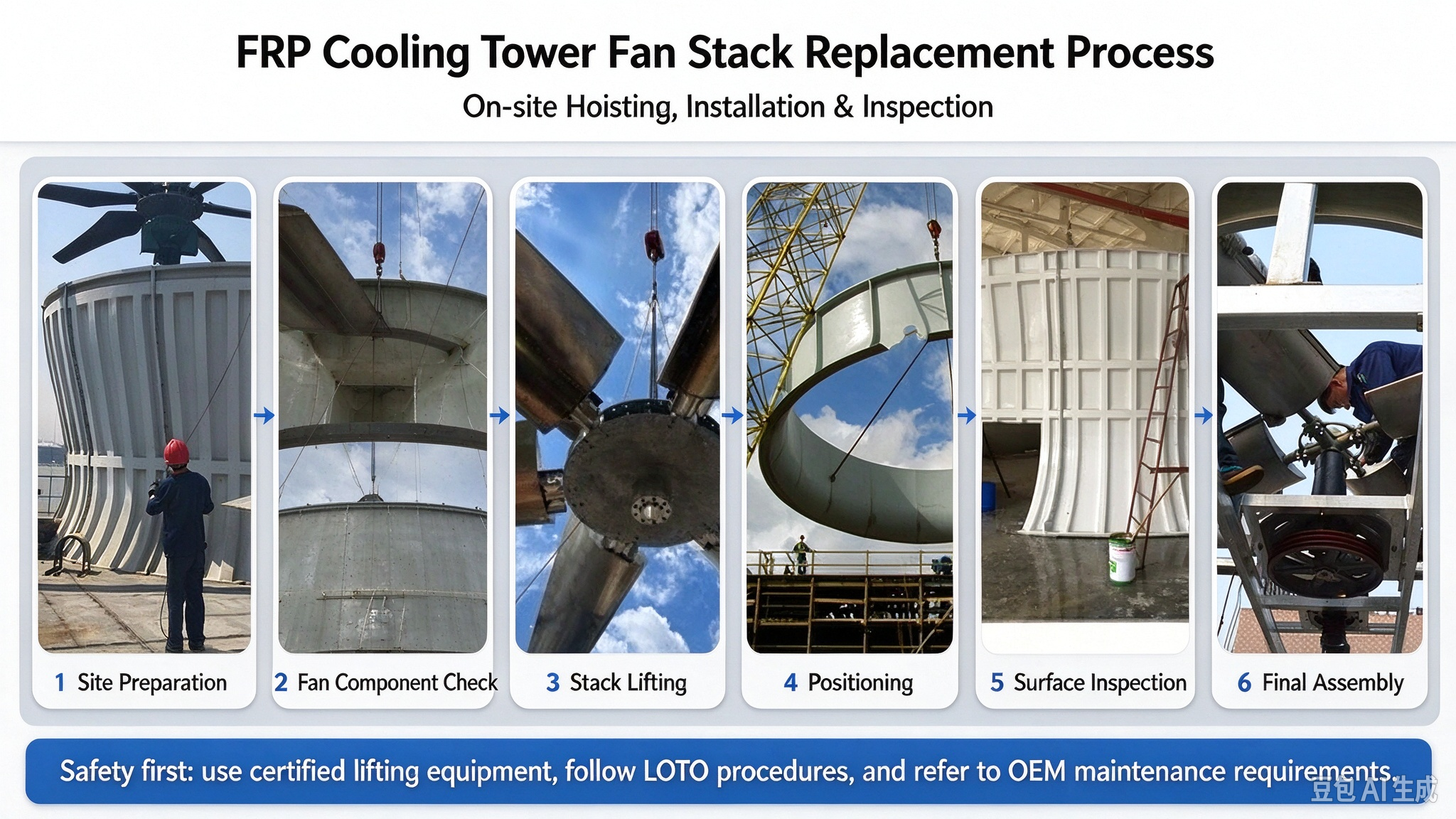
1. What Is a Fiberglass Cooling Tower Fan Stack?
A fiberglass cooling tower fan stack is a cylindrical or specially shaped enclosure installed around the fan assembly of a cooling tower. Its main purpose is to guide the air discharged by the fan toward the atmosphere.
It is commonly manufactured using fiberglass reinforcement and resin to create a lightweight composite structure with suitable mechanical strength and environmental resistance.
1.1 Main Functions of a Cooling Tower Fan Stack
The fan stack performs several functions within the cooling tower ventilation system.
Directing Discharged Air
The fan stack creates a defined passage for air leaving the fan.
Instead of allowing discharged air to spread immediately in different directions, the stack helps guide the airflow upward and away from the cooling tower.
Supporting Stable Airflow
A properly designed fan stack provides a suitable internal flow passage.
Its dimensions and geometry can influence local airflow separation, turbulence, and pressure losses.
Protecting the Fan Assembly
The fan stack forms an enclosure around rotating fan blades and helps maintain the intended blade-tip clearance.
It also provides a physical boundary around the fan discharge area.
Supporting the Cooling Tower Structure
The stack is connected to the cooling tower through flanges or other mounting arrangements.
Its structural design must accommodate the relevant environmental and operating loads.
1.2 Why Is the Fan Stack Important for Airflow?
A cooling tower fan generates airflow, but the surrounding structure influences how that air moves after passing through the fan.
An unsuitable fan stack may create additional flow resistance or disturb the discharge pattern.
A properly engineered stack can help maintain a more organized airflow passage and support the intended fan operating conditions.
2. How Does a Fiberglass Cooling Tower Fan Stack Improve Airflow?
The main airflow benefit of a cooling tower fan stack comes from its ability to guide discharged air through a controlled passage.
The effectiveness of this arrangement depends on the relationship between the fan and the stack.
2.1 Creates a Controlled Air Discharge Passage
Without an appropriate fan enclosure, discharged air may spread into the surrounding area more quickly.
A fan stack provides a defined passage that guides air vertically.
How Does This Help Air Movement?
A suitable discharge passage can:
Direct warm air away from the cooling tower.
Reduce unnecessary changes in airflow direction.
Help maintain a consistent discharge pattern.
Support the intended fan operating arrangement.
The stack should be designed to match the fan system rather than simply using a standard cylinder with arbitrary dimensions.
2.2 Helps Reduce Unnecessary Airflow Disturbances
Airflow disturbances may develop when the stack geometry does not match the fan discharge characteristics.
Abrupt changes in cross-sectional area, poor inlet transitions, and unsuitable internal geometry can contribute to flow separation and turbulence.
Why Is Smooth Internal Geometry Important?
A reasonably smooth internal surface and properly designed transition can help avoid unnecessary flow disturbances.
The design should consider:
A well-designed FRP fan stack can therefore support a more stable airflow passage.
2.3 Helps Reduce Hot Air Recirculation
Hot air recirculation occurs when warm air discharged from the cooling tower is drawn back into the air inlet.
This can increase the entering air temperature and reduce the cooling tower's ability to reject heat.
How Does Fan Stack Height Influence Recirculation?
The fan stack helps elevate the discharge location and direct exhaust air away from the tower.
Its height and outlet arrangement should be considered together with surrounding buildings, prevailing winds, and nearby structures.
A properly designed discharge arrangement may help reduce the likelihood of hot air returning to the cooling tower air inlets.
However, the fan stack alone cannot eliminate recirculation in every installation. Site layout and wind conditions are also important.
2.4 Supports More Consistent Fan Discharge
A suitable fan stack provides a consistent passage around the fan assembly.
This can help maintain the intended airflow direction and reduce the influence of poorly matched surrounding geometry.
Why Does Consistent Discharge Matter?
Stable discharge conditions are important for cooling tower operation because the fan, fill media, drift eliminators, and air inlet arrangement work together as one system.
The fan stack should therefore be considered as part of the complete ventilation design.
3. How Does FRP Material Contribute to Fan Stack Performance?
The material used to manufacture a cooling tower fan stack influences its structural properties, maintenance requirements, and long-term reliability.
Fiberglass reinforced plastic offers several characteristics that make it suitable for industrial cooling towers.
3.1 Lightweight Construction
One of the most noticeable advantages of FRP is its relatively low weight compared with many traditional metal structures.
Benefits of Lightweight Design
Easier transportation and handling.
More convenient installation.
Reduced lifting requirements.
Potentially lower loads on supporting structures.
Greater flexibility for replacement projects.
A lighter structure can simplify installation planning, especially when replacing large fan stacks on existing cooling towers.
3.2 Corrosion Resistance
Cooling towers operate in environments with continuous moisture exposure.
Metal fan stacks may require protective coatings or other corrosion-control measures depending on the material and operating conditions.
FRP does not undergo conventional rusting like carbon steel.
Why Is Corrosion Resistance Important?
Corrosion can gradually weaken metallic structures and increase maintenance requirements.
A properly manufactured fiberglass fan stack can provide good resistance to many common cooling tower environmental conditions.
This helps maintain the structural integrity of the airflow passage over time.
3.3 Structural Strength and Stability
Although FRP is lightweight, properly engineered composite structures can provide suitable mechanical strength.
The structural performance depends on:
Maintaining the Fan Stack Shape
A fan stack must retain its intended geometry under expected environmental and operating loads.
Excessive deformation may affect blade-tip clearance and airflow geometry.
Therefore, structural design is essential for maintaining reliable fan operation.
3.4 Flexible Aerodynamic Design
FRP manufacturing allows fan stacks to be produced in different shapes and dimensions.
This is useful when a cooling tower requires a customized airflow passage.
Common Customization Options
Different internal diameters.
Customized stack heights.
Cylindrical configurations.
Tapered profiles.
Special inlet transitions.
Customized mounting flanges.
The most suitable configuration depends on the fan characteristics and cooling tower design.
4. Important Structural Features That Affect Fan Stack Airflow
The aerodynamic performance of a fiberglass cooling tower fan stack depends heavily on its structural dimensions and geometry.
Several design parameters should be carefully evaluated before manufacturing.
4.1 Fan Stack Diameter
The internal diameter determines the available airflow passage around the fan.
Relationship Between Fan Diameter and Stack Diameter
The stack must accommodate the fan blades while maintaining the required blade-tip clearance.
If the diameter is too small, the clearance may become insufficient.
If the diameter is unnecessarily large, the airflow arrangement may not match the intended design.
Therefore, the stack diameter should be determined according to the fan manufacturer's specifications and engineering requirements.
4.2 Fan Stack Height
Stack height influences the discharge location and the surrounding airflow pattern.
How Should Stack Height Be Selected?
Important considerations include:
Cooling tower configuration.
Fan discharge characteristics.
Local wind conditions.
Nearby buildings and structures.
Potential air recirculation.
Installation restrictions.
A taller stack is not automatically more efficient. The correct height must be evaluated according to the entire cooling tower installation.
4.3 Inlet Geometry
The lower section of the fan stack surrounds the fan discharge region.
Its shape can influence how air enters and moves through the stack.
Benefits of Appropriate Inlet Geometry
A properly designed transition can help reduce abrupt changes in airflow direction and avoid unnecessary local flow separation.
The inlet configuration should be compatible with the fan outlet and surrounding deck structure.
4.4 Outlet Configuration
The upper outlet is where warm air leaves the fan stack.
Its shape and dimensions influence the discharge arrangement.
Important Outlet Design Considerations
Outlet diameter.
Discharge direction.
Stack height.
Wind exposure.
Surrounding obstacles.
An appropriate outlet arrangement helps direct discharged air away from the cooling tower.
4.5 Internal Surface Quality
The internal surface of a fiberglass fan stack should be reasonably smooth and free from significant manufacturing defects.
Why Does Surface Quality Matter?
Large irregularities, protrusions, or damaged areas may disturb local airflow.
Consistent surface finishing also helps maintain product quality and makes visual inspection easier.
5. The Relationship Between Cooling Tower Fan Blades and Fan Stack Performance
A fan stack cannot be evaluated independently of the fan assembly.
The fan blades generate airflow, while the stack helps guide the discharged air.
Both components must work together.
5.1 Fan Blade Diameter and Stack Compatibility
The fan blade diameter determines the basic size requirements of the surrounding stack.
What Should Be Checked?
Actual fan diameter.
Stack internal diameter.
Blade-tip clearance.
Fan rotation direction.
Installation alignment.
Incorrect compatibility may create mechanical interference or an unsuitable airflow arrangement.
5.2 Blade Pitch and Airflow Volume
Cooling tower fan blade pitch affects the amount of air moved by the fan and the power required for operation.
Why Must Blade Pitch Be Considered?
An inappropriate blade angle may cause the fan to operate outside its intended performance range.
This can increase motor loading, reduce airflow, or create excessive vibration.
The fan blade pitch should be adjusted according to the fan manufacturer's recommendations and motor operating limits.
5.3 Fan Speed and Discharge Velocity
Fan rotational speed influences airflow volume and discharge velocity.
Higher speeds may increase airflow, but they can also increase power consumption and mechanical loading.
Coordinating Fan Speed with Fan Stack Design
The fan stack should be designed for the expected operating conditions of the fan.
For variable-speed cooling tower systems, the design should also account for the operating range rather than only one nominal speed.
5.4 Fan Blade Balancing and Vibration Control
An unbalanced fan can create excessive vibration.
This vibration may be transmitted to the fan hub, supporting structure, and surrounding fan stack.
Recommended Checks
A properly manufactured fan stack should be installed and maintained as part of a mechanically sound fan system.
6. Fiberglass Cooling Tower Fan Stack vs. Metal Fan Stack
When choosing a fan stack, industrial buyers often compare fiberglass with metal alternatives.
Both materials have advantages, but FRP offers several practical benefits for many cooling tower environments.
6.1 Material Performance Comparison
| Comparison Factor | Fiberglass Fan Stack | Metal Fan Stack |
| Weight | Relatively lightweight | Depends on material and thickness |
| Corrosion resistance | Good with suitable resin selection | Depends on alloy and protective coating |
| Design flexibility | High | Depends on fabrication method |
| Maintenance | Generally low corrosion-related maintenance | May require corrosion protection |
| Customization | Suitable for molded configurations | Suitable for fabricated configurations |
| Surface protection | Gel coat or protective coating | Paint or other protective treatment |
6.2 Why Choose an FRP Cooling Tower Fan Stack?
FRP is especially attractive when the project requires corrosion resistance, lightweight construction, and customized dimensions.
Main Advantages
Suitable for humid industrial environments.
Good strength-to-weight ratio.
Flexible manufacturing options.
Reduced risk of conventional rusting.
Convenient customization.
Generally low routine corrosion-related maintenance.
However, material selection should always consider the actual operating temperature, chemical exposure, structural loads, and project budget.
7. How to Choose the Right Fiberglass Cooling Tower Fan Stack
Selecting the right FRP fan stack requires evaluating the cooling tower's technical requirements and the manufacturer's capabilities.
7.1 Confirm the Cooling Tower Specifications
Before requesting a quotation, prepare the basic technical information.
Information Buyers Should Provide
Cooling tower brand and model.
Fan diameter.
Required stack diameter.
Stack height.
Existing mounting dimensions.
Operating environment.
Required material specifications.
Providing accurate information helps manufacturers recommend a suitable configuration.
7.2 Evaluate Material Quality
A reliable manufacturer should explain the fiberglass reinforcement and resin system used in production.
Questions to Ask
What type of fiberglass reinforcement is used?
Which resin system is recommended?
What is the laminate thickness?
Is UV protection available?
Can material specifications be provided?
Material selection should be based on the project's actual operating conditions.
7.3 Check Manufacturing Capabilities
A professional FRP fan stack manufacturer should have suitable molds, production equipment, and quality control procedures.
Manufacturing Quality Factors
Consistent laminate thickness.
Uniform fiberglass distribution.
Proper curing conditions.
Accurate dimensions.
Smooth internal surfaces.
Reliable flange construction.
7.4 Request Technical Drawings
Before production, buyers should review engineering drawings showing all critical dimensions.
These drawings should include the internal diameter, overall height, flange dimensions, bolt-hole positions, and mounting details.
Approved drawings help reduce installation errors and improve compatibility.
8. Manufacturing Process of Fiberglass Cooling Tower Fan Stacks
The manufacturing process has a direct influence on the final quality of an FRP fan stack.
Different production methods may be used depending on the product size, shape, and manufacturing requirements.
8.1 Mold Preparation
The mold determines the basic shape and dimensions of the fan stack.
Preparation Requirements
8.2 Fiberglass Reinforcement and Resin Application
Fiberglass reinforcement is arranged according to the laminate design.
Resin is then applied to bind the reinforcement and form the composite structure.
Important Process Controls
8.3 Curing and Demolding
The composite material must undergo suitable curing before demolding.
Proper curing helps the finished product develop its intended mechanical properties.
8.4 Trimming and Finishing
After demolding, the fan stack is trimmed and finished according to the approved drawings.
The manufacturer should check flange areas, edges, surface quality, and overall dimensions.
8.5 Final Quality Inspection
Before shipment, the completed product should undergo dimensional and visual inspection.
Important inspection items include:
9. Common Airflow Problems Caused by Improper Fan Stack Design
An unsuitable fan stack may contribute to airflow problems and mechanical difficulties.
Understanding these issues helps buyers and cooling tower operators identify potential design weaknesses.
9.1 Excessive Airflow Resistance
An unsuitable internal diameter or abrupt geometric transition may increase local airflow resistance.
Possible Consequences
Additional pressure losses.
Changes in fan operating conditions.
Reduced system efficiency.
Increased energy consumption under certain operating conditions.
The fan stack should be evaluated together with the fan performance curve and system resistance.
9.2 Hot Air Recirculation
If warm exhaust air returns to the cooling tower air inlets, the entering air temperature may increase.
Common Contributing Factors
Insufficient discharge height.
Poor site arrangement.
Nearby buildings or obstacles.
Unfavorable wind conditions.
Inappropriate exhaust direction.
A properly designed fan stack may help improve the discharge arrangement, but broader site-level solutions may also be necessary.
9.3 Excessive Vibration
Vibration may result from an unbalanced fan, loose connections, misalignment, or structural problems.
How to Reduce Vibration Risks
Balance the fan assembly.
Check hub and blade connections.
Inspect mounting bolts.
Confirm shaft alignment.
Verify structural rigidity.
Follow recommended maintenance procedures.
9.4 Incorrect Fan Blade Clearance
If the fan stack is manufactured with incorrect dimensions, the blade-tip clearance may fall outside the required range.
This can create mechanical contact risks or affect the intended fan arrangement.
Always confirm the required clearance before production and installation.
10. Maintenance Tips for Better Fan Stack Performance
Even a high-quality fiberglass cooling tower fan stack requires periodic inspection.
Regular maintenance helps preserve structural condition and maintain a suitable airflow passage.
10.1 Inspect the FRP Surface
Look for visible cracks, scratches, exposed fibers, and other surface damage.
What Should Be Checked?
10.2 Check Flange Connections
Inspect the mounting flanges and bolts to confirm that the fan stack remains securely connected to the supporting structure.
10.3 Monitor Fan Operation
Check for abnormal noise, vibration, and changes in fan operating conditions.
If unusual vibration occurs, inspect the fan blades, hub, bearings, motor, and supporting structure.
10.4 Keep the Discharge Passage Clear
Remove foreign materials and debris that could interfere with airflow or mechanical operation.
10.5 Schedule Professional Inspections
Large industrial cooling towers should follow a maintenance schedule based on operating conditions and manufacturer recommendations.
Any suspected structural damage should be evaluated before continued operation.
11. Industrial Applications of Fiberglass Cooling Tower Fan Stacks
FRP fan stacks are suitable for many cooling tower applications where corrosion resistance and customized construction are important.
11.1 Power Plants
Power generation facilities use large cooling towers to remove heat from industrial processes.
Fiberglass fan stacks can provide lightweight, corrosion-resistant structures for suitable cooling tower configurations.
11.2 Chemical Processing Facilities
Chemical plants may expose cooling tower components to aggressive environmental conditions.
Appropriate resin selection helps determine whether an FRP fan stack is suitable for the specific installation.
11.3 HVAC Cooling Systems
Commercial and industrial HVAC systems use cooling towers to reject heat from central cooling equipment.
FRP fan stacks can provide a practical option for outdoor cooling tower installations.
11.4 Manufacturing Plants
Steel, textile, paper, food processing, and other manufacturing facilities depend on reliable cooling systems.
Customized fiberglass fan stacks can be manufactured to meet different cooling tower dimensions and installation requirements.
12. How to Improve Cooling Tower Airflow Through Integrated System Design
A fiberglass cooling tower fan stack is only one part of the complete airflow system.
For better results, engineers should evaluate the fan stack together with other cooling tower components.
12.1 Optimize Cooling Tower Fan Blades
Fan blade geometry, material, diameter, and pitch influence airflow volume and energy consumption.
Important Fan Blade Considerations
12.2 Maintain Cooling Tower Fill Media
Cooling tower fill media provides the heat exchange surface where water and air interact.
Blocked or damaged fill can increase airflow resistance and reduce heat transfer performance.
Regular inspection and cleaning help maintain the intended air and water distribution.
12.3 Inspect Drift Eliminators
Drift eliminators reduce the amount of water droplets carried out of the cooling tower by moving air.
Improper installation or excessive blockage can influence airflow resistance.
12.4 Check Air Inlet Conditions
Air inlet openings should remain sufficiently clear.
Obstructions around the cooling tower can affect air distribution and increase the possibility of uneven airflow.
12.5 Coordinate Fan, Motor, and Gearbox Performance
The motor and gearbox must provide suitable power and rotational speed for the fan.
Incorrect operating conditions may affect airflow, energy consumption, and mechanical reliability.
An integrated evaluation helps identify performance problems that cannot be solved by replacing the fan stack alone.
13. Conclusion: Choose the Right Fiberglass Cooling Tower Fan Stack for Better Airflow
A fiberglass cooling tower fan stack plays an important role in guiding exhaust air and supporting the overall airflow arrangement of an industrial cooling tower.
Its structural geometry, internal diameter, stack height, material properties, and manufacturing quality all influence its suitability for a particular fan system.
A properly designed FRP fan stack can help establish a controlled discharge passage, reduce unnecessary airflow disturbances, and support effective exhaust air management. Its lightweight construction and corrosion resistance also make it an attractive option for many industrial cooling environments.
However, the best results come from treating the fan stack as part of an integrated cooling tower system. Fan blades, motor speed, fill media, drift eliminators, and site conditions must all be considered when evaluating airflow performance.
For cooling tower operators, contractors, and equipment distributors, selecting a reliable fiberglass cooling tower fan stack manufacturer is an important step toward achieving stable operation, manageable maintenance requirements, and long-term equipment reliability.


