Fiberglass Cooling Tower Fan Stack for Industrial Applications
A reliable cooling tower fan stack plays an important role in maintaining stable airflow and improving the overall performance of industrial cooling systems. As industrial facilities increasingly demand higher efficiency, longer service life, and lower maintenance costs, fiberglass cooling tower fan stacks have become a popular solution for various cooling tower applications.
A Fiberglass Cooling Tower Fan Stack is designed to guide air discharged by the cooling tower fan, reduce unnecessary airflow resistance, and help direct warm, moisture-laden air away from the cooling tower structure. Manufactured using fiberglass reinforced plastic (FRP), this component offers excellent corrosion resistance, lightweight construction, and strong structural performance.
Compared with traditional metal fan stacks, fiberglass designs provide several advantages in humid, corrosive, and outdoor operating environments. They are suitable for power plants, chemical processing facilities, steel factories, petrochemical plants, HVAC systems, and other industrial cooling applications.
This article explores the structure, materials, working principles, advantages, applications, manufacturing processes, and selection considerations of fiberglass cooling tower fan stacks.
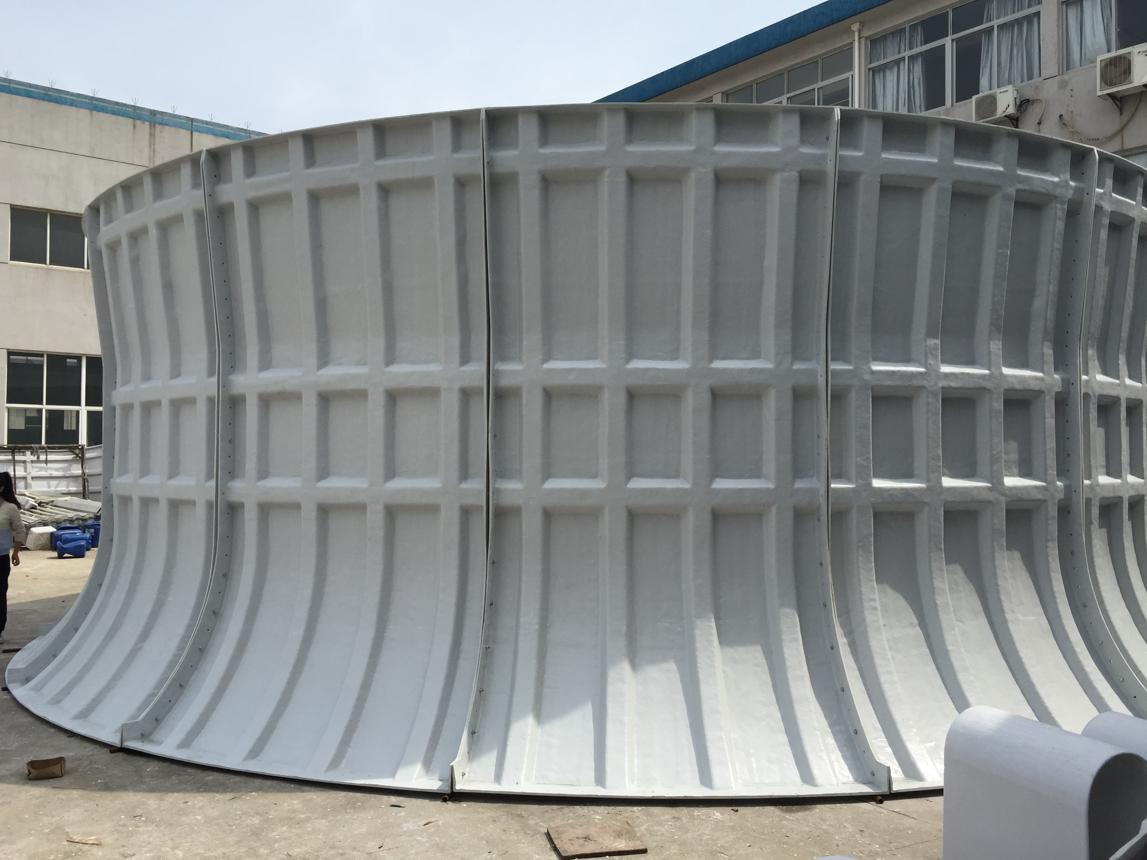
What Is a Fiberglass Cooling Tower Fan Stack?
A fiberglass cooling tower fan stack is a cylindrical or specially shaped airflow structure installed around the cooling tower fan. Its primary purpose is to guide the discharged air upward and improve airflow management within the cooling tower.
The fan stack is commonly manufactured from FRP, which combines glass fiber reinforcement with a resin matrix. This material provides a balance of mechanical strength, corrosion resistance, and dimensional stability.
Main Functions of a Cooling Tower Fan Stack
The fan stack is more than a protective enclosure surrounding the fan. It contributes directly to the airflow performance and operating reliability of a cooling tower.
1. Directing Exhaust Air
The fan stack guides warm air discharged by the cooling tower fan toward the outlet. Proper airflow direction helps reduce the possibility of discharged air returning to the cooling tower air intake.
2. Supporting Airflow Efficiency
A properly designed fan stack provides a suitable airflow passage around the fan blades. Its geometry, height, diameter, and internal surface condition can influence pressure losses and discharge characteristics.
3. Protecting Fan Components
The fan stack helps define the fan operating area and can provide a structural mounting interface for certain protective accessories, depending on the cooling tower design.
4. Improving Operational Safety
When designed with appropriate dimensions and safety provisions, the fan stack helps establish a controlled enclosure around the rotating fan assembly. Additional guards and access arrangements may be required to meet site safety standards.
Common Fiberglass Fan Stack Configurations
Fiberglass cooling tower fan stacks can be manufactured in different configurations according to cooling tower structure and operating requirements.
Cylindrical Fan Stack
Cylindrical designs are widely used in mechanical draft cooling towers. They provide a relatively straightforward airflow passage and can be customized to match the fan diameter and tower layout.
Tapered Fan Stack
A tapered fan stack has a changing diameter along its height. Its geometry can be engineered to support suitable airflow discharge characteristics while maintaining structural stability.
Custom-Designed FRP Fan Stack
Some industrial cooling towers require non-standard dimensions or special connection arrangements. Custom FRP fan stacks can be manufactured to match existing steel supports, concrete structures, and replacement requirements.
Why Choose Fiberglass for Cooling Tower Fan Stacks?
Material selection directly affects the service life, maintenance requirements, and operating reliability of a cooling tower fan stack.
Fiberglass reinforced plastic is widely used in industrial cooling equipment because it combines relatively low weight with good mechanical and environmental resistance.
Excellent Corrosion Resistance
Cooling towers operate in environments containing moisture, oxygen, airborne contaminants, and water-treatment chemicals. These conditions can accelerate corrosion in conventional metal structures.
Fiberglass offers excellent resistance to many common industrial environmental conditions.
Suitable for Humid Environments
The FRP structure does not rust like ordinary carbon steel. This makes it particularly useful in cooling tower areas exposed to continuous moisture and water vapor.
Resistance to Chemical Exposure
Depending on the resin formulation, fiberglass can provide resistance to different acids, alkalis, salts, and industrial chemicals.
The resin system should be selected according to the actual operating environment. Chemical compatibility should be confirmed before production, especially for applications involving concentrated chemicals or elevated temperatures.
Lightweight Construction
Compared with many conventional metal structures, fiberglass fan stacks can offer substantial weight advantages.
A lighter structure can help reduce the load placed on supporting components and simplify transportation and installation.
Easier Handling During Installation
Lower component weight may reduce lifting requirements and make on-site assembly more manageable.
Reduced Structural Loading
For cooling tower renovation projects, weight is an important consideration. Replacing a heavy metal fan stack with an appropriately engineered FRP alternative may reduce the additional load on the existing structure.
High Mechanical Strength
Although fiberglass is lightweight, it can provide good tensile strength, stiffness, and structural performance when properly designed.
The final mechanical properties depend on fiber type, resin system, laminate thickness, reinforcement orientation, and manufacturing quality.
Structural Reinforcement
Additional reinforcement can be incorporated into areas exposed to higher mechanical stress, including mounting flanges, connection points, and support sections.
Resistance to Environmental Stress
A properly manufactured FRP fan stack can withstand normal operating loads and environmental exposure when its design accounts for wind, vibration, temperature, and other site-specific conditions.
Long Service Life and Lower Maintenance
Corrosion-related repairs and repainting can increase the lifecycle cost of traditional metal fan stacks.
Fiberglass structures generally require less corrosion-related maintenance. Routine inspection is still necessary to identify surface damage, loose connections, aging, or other potential problems.
How Does a Fiberglass Cooling Tower Fan Stack Work?
The working principle of a fiberglass cooling tower fan stack is closely related to the mechanical draft system of the cooling tower.
During operation, the fan draws air through the tower and discharges warm air through the fan stack. The stack provides a defined passage that guides the exhaust airflow away from the fan outlet.
Airflow Process Inside the Fan Stack
Step 1: Air Enters the Cooling Tower
Ambient air enters the cooling tower through the air inlet openings. It passes through the heat-transfer section, where it comes into contact with circulating water.
Step 2: Heat and Moisture Transfer Occurs
A portion of the circulating water evaporates as heat transfers from the water to the air. The air temperature and moisture content change during this process.
Step 3: The Fan Generates Air Movement
The cooling tower fan creates the airflow required to move air through the tower. The fan blade design, rotational speed, pitch angle, and operating conditions influence the airflow volume and pressure.
Step 4: The Fan Stack Guides Exhaust Air
The fiberglass fan stack guides the discharged air upward. Its dimensions and internal geometry influence the flow path and outlet conditions.
Step 5: Warm Air Is Discharged into the Atmosphere
The exhaust air leaves the cooling tower through the stack outlet. Appropriate stack height and discharge design can help reduce the risk of hot, humid exhaust air being drawn back into the air intake.
Why Is Fan Stack Geometry Important?
Fan stack geometry affects how air moves through the outlet section.
Important design parameters include:
An unsuitable fan stack design may increase airflow resistance, create uneven flow distribution, or cause interference with the fan operating area.
For this reason, the fan stack should be designed as part of the overall cooling tower airflow system rather than treated as an isolated fiberglass component.
Key Design Features of an Industrial Fiberglass Cooling Tower Fan Stack
An industrial FRP cooling tower fan stack must meet both aerodynamic and structural requirements. A good design should provide a suitable airflow passage while withstanding long-term environmental exposure.
Aerodynamic Design
The aerodynamic shape of a fan stack influences exhaust air movement and system resistance.
Smooth Internal Surface
A relatively smooth internal surface helps reduce unnecessary surface-related airflow resistance and makes the structure easier to inspect and clean.
Proper Fan Clearance
Adequate clearance between the fan blades and the stack is essential. Insufficient clearance can create mechanical interference risks, while excessive or poorly configured clearance may affect airflow behavior.
The correct clearance must follow the fan manufacturer's engineering recommendations.
Optimized Outlet Geometry
The outlet geometry should be selected according to the fan operating point and cooling tower configuration. A suitable design helps direct exhaust air without introducing unnecessary restrictions.
Structural Design
The fan stack must withstand various loads throughout its service life.
Wind Load Considerations
Outdoor cooling towers may be exposed to strong winds and severe weather. Stack dimensions, support arrangements, laminate thickness, and reinforcement should be evaluated according to local design requirements.
Vibration and Dynamic Loads
Cooling tower fans generate vibration during operation. The fan stack and its supporting structure should be designed to avoid excessive vibration transmission and fatigue-related damage.
Connection and Mounting Design
Connection details are essential for reliable installation. Flanges, bolt holes, support brackets, and sealing arrangements should match the cooling tower structure.
Customized Dimensions and Specifications
Industrial cooling towers differ in size, capacity, and structural configuration. A customized fiberglass fan stack can be manufactured to suit specific project requirements.
Common customization parameters include:
Overall height
Top and bottom diameters
Wall thickness
Flange dimensions
Reinforcement structure
Resin formulation
Surface finish
Color
Bolt-hole positions
Accurate drawings and site measurements help prevent installation difficulties and dimensional mismatches.
Manufacturing Process of Fiberglass Cooling Tower Fan Stacks
The manufacturing process has a direct influence on the quality, strength, and dimensional accuracy of an FRP fan stack.
A controlled production process helps ensure that the finished component meets project requirements.
1. Engineering Design and Material Preparation
Before production begins, the manufacturer reviews the required dimensions, operating conditions, installation method, and structural requirements.
Technical Drawing Review
The engineering team confirms the overall dimensions, connection details, reinforcement locations, and installation tolerances.
Resin and Fiber Selection
The resin system and glass fiber reinforcement should be selected according to the required mechanical properties and environmental conditions.
Common resin options include polyester and vinyl ester systems. The appropriate choice depends on chemical exposure, temperature, and project specifications.
2. Mold Preparation
The mold determines the basic geometry and surface quality of the fiberglass component.
Mold Cleaning and Inspection
The mold should be cleaned and inspected before production to reduce surface defects and dimensional deviations.
Release Agent Application
A suitable release agent is applied to support demolding and protect the finished surface.
3. Fiberglass Layup and Reinforcement
Glass fiber materials are placed in the mold and combined with resin to form the composite structure.
Layer Arrangement
The reinforcement layers should follow the approved laminate design. Different fiber orientations may be used to provide suitable strength in different directions.
Local Reinforcement
Additional layers can be applied around mounting flanges, connection points, and other stress-concentrated areas.
4. Curing and Demolding
The laminate is allowed to cure under controlled conditions. Proper curing is important for achieving the intended mechanical properties.
After curing, the component is carefully removed from the mold.
5. Trimming and Surface Finishing
The edges and connection areas are processed to meet dimensional and installation requirements.
Dimensional Inspection
Important dimensions, including diameter, height, thickness, and flange position, should be checked against the approved drawings.
Surface Quality Inspection
The finished component should be inspected for visible cracks, exposed fibers, delamination, resin-rich areas, and other defects.
6. Final Quality Control
Before delivery, the manufacturer should verify that the product meets the agreed specifications.
Depending on the project, quality control may include laminate thickness checks, dimensional measurements, visual inspections, mechanical testing, and documentation review.
Industrial Applications of Fiberglass Cooling Tower Fan Stacks
Fiberglass cooling tower fan stacks are suitable for many industries where reliable airflow and corrosion resistance are important.
Power Plants
Power plants use cooling towers to remove heat from circulating cooling water. Fan stacks must withstand continuous operation and outdoor environmental conditions.
Advantages in Power Generation
FRP fan stacks offer corrosion resistance and lightweight construction, which can be valuable for large cooling tower installations and renovation projects.
Chemical and Petrochemical Plants
Chemical facilities may expose cooling tower components to corrosive substances and aggressive atmospheric conditions.
Corrosion-Resistant Cooling Tower Structures
A suitable fiberglass resin system can help protect the fan stack from environmental degradation and reduce corrosion-related maintenance.
Steel and Metallurgical Industries
Steel plants require reliable cooling systems for equipment, production processes, and auxiliary facilities.
Heavy-Duty Operating Conditions
Fiberglass fan stacks can be engineered for industrial environments where continuous operation, high humidity, and airborne contaminants are common.
HVAC and Commercial Cooling Systems
Large commercial buildings, data centers, shopping centers, and industrial HVAC facilities use cooling towers to reject heat from refrigeration and air-conditioning systems.
Energy-Efficient Airflow Management
A properly designed fan stack supports the airflow arrangement of the cooling tower and works together with the fan, motor, and other components to maintain system performance.
Manufacturing and Processing Facilities
Food processing plants, paper mills, textile factories, and other manufacturing facilities often rely on cooling towers for process cooling.
Fiberglass fan stacks can be customized to meet different equipment layouts and environmental requirements.
Fiberglass Cooling Tower Fan Stack vs. Metal Fan Stack
Choosing between fiberglass and metal depends on operating conditions, structural requirements, budget, and maintenance expectations.
Corrosion Resistance
Fiberglass generally provides better resistance to rust and many corrosive environments than ordinary carbon steel.
Metal structures may require protective coatings, regular inspections, and repainting to maintain corrosion protection.
Weight and Installation
FRP fan stacks are often lighter than comparable metal structures. This can simplify transportation and lifting operations.
Metal fan stacks may require heavier lifting equipment and stronger supporting arrangements, depending on their dimensions and material thickness.
Maintenance Requirements
Fiberglass structures generally require less corrosion-related maintenance. However, they still need periodic inspection for cracks, impact damage, delamination, and connection problems.
Metal structures require attention to corrosion, coating deterioration, and possible section loss.
Initial and Lifecycle Costs
The purchase price of an FRP fan stack may vary according to its size, resin type, laminate thickness, reinforcement, and production method.
A proper comparison should consider not only the initial purchase price but also installation expenses, maintenance costs, expected service life, and replacement frequency.
How to Choose the Right Fiberglass Cooling Tower Fan Stack
Selecting the correct fan stack is important for maintaining cooling tower performance and ensuring reliable operation.
Buyers should evaluate the following factors before placing an order.
Confirm the Cooling Tower Model and Fan Specifications
The fan stack must match the cooling tower configuration and fan assembly.
Important Information to Provide
Cooling tower manufacturer and model
Fan diameter
Fan type and operating speed
Existing fan stack dimensions
Required stack height
Installation location
Available drawings and photographs
These details help the manufacturer understand the project and recommend a suitable design.
Evaluate Material Quality
Not all fiberglass products have the same performance. Buyers should understand the material composition and manufacturing specifications.
Check the Resin System
The resin should be compatible with the operating environment. Chemical exposure and operating temperature should be considered.
Review Fiber Reinforcement
The reinforcement type, orientation, and laminate thickness influence the mechanical properties of the finished product.
Consider Structural Requirements
The fan stack should be suitable for site-specific loads and support conditions.
Wind and Weather Conditions
Outdoor installations require appropriate consideration of wind loads, temperature changes, and weather exposure.
Existing Tower Structure
For replacement projects, the new FRP fan stack should match the existing support structure or include an engineered adaptation plan.
Select a Manufacturer with Technical Experience
A qualified manufacturer should provide more than a standard product quotation.
Look for a supplier that can offer:
Engineering drawing support
Customized dimensions
Material specification details
Consistent production quality
Dimensional inspection
Installation guidance
Export packaging and delivery support
Technical communication is especially important for international projects where the manufacturer and installation team may be in different countries.
Installation and Maintenance of Fiberglass Fan Stacks
Correct installation is essential for obtaining the expected service life and performance of a fiberglass cooling tower fan stack.
Installation Recommendations
Check the Supporting Structure
Before installation, inspect the existing support structure for deformation, corrosion, loose bolts, and other damage.
Confirm Dimensional Compatibility
Check the stack diameter, height, flange dimensions, and bolt-hole positions against the installation drawings.
Use Suitable Lifting Equipment
Although fiberglass is lightweight compared with many metal alternatives, large fan stacks still require proper lifting arrangements to prevent bending, impact, or localized damage.
Tighten Connections Properly
Bolts should be tightened according to the specified installation procedure. Excessive tightening may damage fiberglass connection areas, while insufficient tightening may cause loose joints.
Check Fan Clearance
After installation, verify that the fan blades have sufficient clearance from the stack under the expected operating conditions.
The fan should be checked for free rotation before the cooling tower is returned to service.
Routine Maintenance
FRP fan stacks require regular inspection even though they are resistant to many common corrosion problems.
Visual Inspection
Inspect the external and internal surfaces for cracks, scratches, impact damage, exposed fibers, and signs of delamination.
Connection Inspection
Check bolts, flanges, brackets, and sealing areas for looseness or deterioration.
Vibration Monitoring
Unusual vibration may indicate problems with the fan assembly, drive system, mounting structure, or other rotating components. The root cause should be identified rather than assuming the stack itself is responsible.
Cleaning
Remove accumulated dirt, debris, and other deposits when necessary. Use cleaning methods and chemicals compatible with the resin system.
Common Problems and Solutions for Fiberglass Cooling Tower Fan Stacks
Even a high-quality FRP fan stack can experience problems if it is incorrectly designed, installed, or maintained.
Cracks and Surface Damage
Cracks may result from impact, excessive local stress, improper lifting, or unsuitable support conditions.
Recommended Solution
Inspect the damaged area and evaluate the extent of the defect. Repairs should use compatible fiberglass materials and an approved repair procedure. Structural damage may require professional assessment or component replacement.
Excessive Vibration
Vibration can be caused by fan imbalance, shaft misalignment, loose connections, or insufficient structural support.
Recommended Solution
Inspect the complete fan drive system, including blades, hub, gearbox, motor, and mounting structure. Check the fan balance and verify that all connections are secure.
Airflow Performance Problems
Poor airflow may result from an unsuitable fan stack design, incorrect fan clearance, damaged fan blades, or other cooling tower system issues.
Recommended Solution
Review the fan operating point, stack geometry, air inlet conditions, and cooling tower performance. An engineering assessment can help identify the actual source of the problem.
Delamination
Delamination occurs when layers within the fiberglass laminate separate. It may be associated with manufacturing defects, impact damage, excessive stress, or environmental degradation.
Recommended Solution
Identify the affected area and determine whether the damage is superficial or structural. Follow a qualified FRP repair procedure or replace the component if its structural integrity cannot be restored.
Custom Fiberglass Cooling Tower Fan Stack Solutions for Replacement Projects
Many industrial facilities operate cooling towers that have been in service for years. Original fan stacks may eventually suffer from corrosion, physical damage, or structural deterioration.
Replacing an existing metal or fiberglass fan stack can improve equipment reliability and reduce maintenance requirements.
Benefits of Customized Replacement
Compatibility with Existing Equipment
A replacement fan stack can be manufactured according to the original dimensions and connection arrangements, reducing the need for extensive modifications.
Improved Material Selection
A new FRP design can use a resin system and reinforcement structure selected for the actual site environment.
Reduced Installation Complexity
Accurate measurements and engineering drawings help minimize on-site fitting problems.
Information Required for a Replacement Quotation
To prepare an accurate quotation, buyers should provide:
Existing fan stack diameter and height.
Fan diameter and model.
Required material and resin specifications.
Flange and mounting dimensions.
Quantity required.
Operating environment and site conditions.
Delivery destination and expected schedule.
Drawings, photographs, or samples if available.
Providing complete technical information helps the manufacturer evaluate the project and recommend a suitable solution.
Future Trends in Fiberglass Cooling Tower Fan Stack Design
Industrial cooling systems are increasingly focused on energy efficiency, equipment reliability, and lifecycle cost reduction. These requirements are influencing the development of FRP fan stack technology.
Improved Composite Materials
Advances in resin systems and glass fiber reinforcement are creating opportunities for improved mechanical performance and environmental resistance.
Manufacturers are also focusing on more consistent laminate quality and better control of production processes.
More Accurate Aerodynamic Engineering
Computer-aided design and airflow simulation can help engineers evaluate stack geometry, fan clearance, and discharge conditions before manufacturing.
These methods support more project-specific designs and can reduce the risk of dimensional or performance problems.
Customized Modular Construction
Large cooling tower components may require modular designs to simplify transportation and installation.
Segmented fiberglass fan stacks can be considered for projects where transportation dimensions or site access limit the use of one-piece structures.
Greater Focus on Lifecycle Performance
Industrial buyers increasingly evaluate products based on their total cost of ownership rather than purchase price alone.
Corrosion resistance, installation efficiency, inspection requirements, and replacement frequency are all important factors in evaluating fiberglass fan stacks.
Conclusion
A Fiberglass Cooling Tower Fan Stack is an important component in industrial cooling tower systems. Its main functions include guiding exhaust airflow, supporting the cooling tower fan arrangement, and helping maintain reliable system operation.
Compared with conventional metal alternatives, fiberglass fan stacks offer several advantages, including corrosion resistance, lightweight construction, customizable dimensions, and reduced corrosion-related maintenance.
However, product performance depends on more than material selection. Aerodynamic geometry, laminate quality, structural reinforcement, installation accuracy, and regular inspection all contribute to long-term reliability.
For industrial buyers, choosing a manufacturer with suitable FRP production capabilities and engineering experience is essential. By evaluating fan specifications, operating conditions, structural requirements, and project dimensions, companies can select a fiberglass cooling tower fan stack that meets their application needs and supports dependable cooling tower operation.


