Fiberglass Cooling Tower Fan Stack: Advantages and Applications
A fiberglass cooling tower fan stack is an important component of modern industrial cooling tower systems. It is designed to guide exhaust airflow, improve air discharge conditions, and provide a protective enclosure around the cooling tower fan. With the development of fiberglass reinforced plastic (FRP) manufacturing technology, fiberglass fan stacks have become a popular alternative to traditional metal structures.
Compared with conventional steel fan stacks, fiberglass cooling tower fan stacks offer several advantages, including excellent corrosion resistance, lightweight construction, good structural strength, and flexible customization. These characteristics make them suitable for power plants, chemical factories, steel mills, HVAC systems, and other industrial cooling applications.
For cooling tower manufacturers, engineering contractors, and industrial equipment buyers, understanding the advantages and applications of fiberglass fan stacks can help improve equipment selection and reduce long-term maintenance costs.
This article explores the structure, materials, key advantages, manufacturing processes, industrial applications, and selection considerations of fiberglass cooling tower fan stacks.
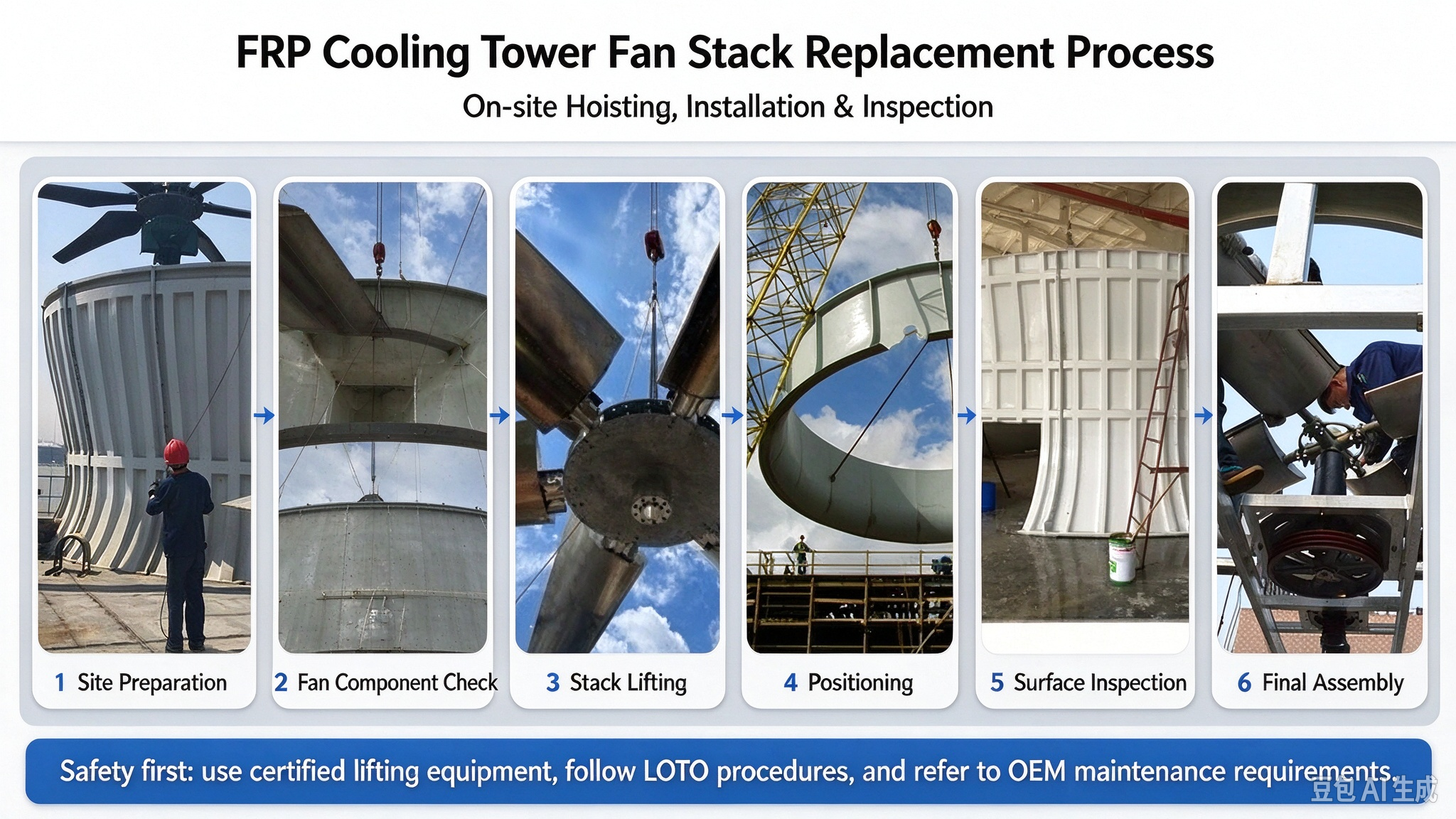
1. What Is a Fiberglass Cooling Tower Fan Stack?
A fiberglass cooling tower fan stack is a cylindrical or specially shaped FRP structure installed around the cooling tower fan. It is commonly positioned above the fan deck to guide discharged air upward and reduce unnecessary airflow disturbance.
It is also known as an FRP cooling tower fan cylinder, fiberglass fan shroud, or cooling tower fan stack.
1.1 Main Functions of a Cooling Tower Fan Stack
The fan stack plays an important role in the cooling tower air discharge system.
Its main functions include:
Guiding exhaust air away from the cooling tower.
Supporting stable airflow through the fan system.
Helping reduce undesirable air recirculation.
Providing an enclosure around rotating fan blades.
Supporting the aerodynamic performance of the cooling tower.
Helping maintain appropriate airflow conditions.
How Does the Fan Stack Affect Airflow?
When the cooling tower fan operates, it draws air through the cooling tower and discharges warm, moisture-laden air upward.
The fan stack provides a defined passage for this exhaust air. Its diameter, height, and internal profile influence airflow conditions and pressure losses.
A properly designed fan stack can help improve discharge airflow and reduce unnecessary aerodynamic resistance.
1.2 Why Is Fiberglass Used for Fan Stacks?
Fiberglass reinforced plastic is a composite material made by combining glass fiber reinforcement with a resin matrix.
This combination provides a balance of strength, weight, and environmental resistance.
Fiberglass is particularly suitable for cooling tower applications because the operating environment often involves:
High humidity.
Continuous water exposure.
Temperature fluctuations.
Outdoor sunlight.
Industrial pollutants.
Potentially corrosive chemicals.
2. Main Advantages of Fiberglass Cooling Tower Fan Stacks
Fiberglass cooling tower fan stacks provide several advantages over conventional metal structures.
Their performance depends on material selection, laminate design, manufacturing quality, and installation conditions.
2.1 Excellent Corrosion Resistance
Corrosion resistance is one of the most important advantages of fiberglass materials.
Cooling towers operate in environments with high humidity and continuous moisture exposure. Depending on the application, equipment may also encounter chemical contaminants and industrial pollutants.
Traditional carbon steel structures generally require protective coatings to reduce corrosion.
Fiberglass, however, offers excellent resistance to many corrosive environments.
Benefits of Corrosion-Resistant Construction
Reduces rust-related maintenance.
Helps maintain structural integrity.
Reduces the need for conventional anti-rust coatings.
Supports long-term outdoor operation.
Provides flexibility for industrial environments.
Why Is Resin Selection Important?
Different resin systems provide different levels of chemical and temperature resistance.
Common options include:
For cooling towers exposed to aggressive chemicals, manufacturers should select the resin according to the actual chemical composition, temperature, and operating conditions.
2.2 Lightweight Construction and Easy Installation
Another major advantage of a fiberglass cooling tower fan stack is its relatively low weight.
Compared with similar-sized steel structures, FRP fan stacks are generally lighter.
This characteristic offers several practical benefits.
Advantages During Transportation
Easier handling during loading and unloading.
Reduced transportation weight.
Convenient packaging arrangements.
Lower lifting requirements in many installations.
Advantages During Installation
Because fiberglass structures are relatively lightweight, installation may require less heavy lifting equipment than comparable metal structures.
This can help simplify replacement projects, especially when working on existing cooling tower structures.
However, lifting points and handling procedures must still follow the manufacturer's recommendations to prevent localized damage.
2.3 High Strength-to-Weight Ratio
Fiberglass combines glass fiber reinforcement with resin to create a composite structure with useful mechanical properties.
The reinforcement provides strength, while the resin matrix binds the fibers together and helps distribute loads.
Factors Affecting FRP Structural Strength
A professionally manufactured fiberglass cooling tower fan stack can be designed to withstand expected operating loads, including wind pressure and loads transferred through its mounting structure.
2.4 Excellent Design Flexibility
Fiberglass manufacturing technology allows fan stacks to be produced in different sizes and shapes.
This flexibility is particularly valuable for customized cooling tower projects.
Manufacturers can develop products according to:
Custom Fiberglass Fan Stack Solutions
For replacement applications, the new fan stack can be manufactured according to original drawings, physical measurements, or equipment samples.
Custom manufacturing helps ensure compatibility with existing cooling tower structures.
2.5 Good Weather and UV Resistance
Outdoor cooling tower equipment is exposed to sunlight, rain, wind, and changing temperatures.
High-quality fiberglass fan stacks can use UV-resistant gel coats or protective surface treatments to improve weather resistance.
How to Reduce UV Aging?
Manufacturers can improve outdoor durability through:
Suitable resin selection.
UV-resistant gel coat.
Appropriate surface protection.
Proper curing procedures.
Regular surface inspections.
These measures help reduce surface deterioration and maintain the appearance of fiberglass structures.
2.6 Lower Corrosion-Related Maintenance Requirements
Fiberglass fan stacks generally require less corrosion-related maintenance than conventional carbon steel structures.
They do not develop ordinary iron rust, and their protective surface systems can help reduce environmental degradation.
However, regular inspections remain necessary.
Maintenance personnel should check for cracks, delamination, surface damage, deformation, and loose mounting connections.
3. Fiberglass Cooling Tower Fan Stack Structure and Design
The structural design of a fiberglass cooling tower fan stack directly affects its strength, stability, and airflow characteristics.
Professional manufacturers consider both mechanical and aerodynamic requirements during product development.
3.1 Cylindrical and Tapered Designs
Most cooling tower fan stacks use cylindrical or tapered structures.
A cylindrical design offers a relatively straightforward manufacturing and installation arrangement.
A tapered design may be used when specific aerodynamic or structural requirements call for a changing diameter.
Choosing the Right Shape
The appropriate geometry depends on:
Fan blade diameter.
Cooling tower configuration.
Air discharge requirements.
Structural loading.
Installation space.
Engineering design specifications.
The final design should be compatible with the entire fan system.
3.2 Laminate Thickness and Reinforcement
The fiberglass laminate is the main structural body of an FRP fan stack.
Its thickness and reinforcement arrangement should be determined according to the required mechanical performance.
Important Manufacturing Considerations
A reliable manufacturer should control:
Fiberglass reinforcement placement.
Resin distribution.
Laminate thickness.
Curing conditions.
Structural consistency.
Surface quality.
Inadequate reinforcement or poor resin distribution may create weak areas that reduce product reliability.
3.3 Flange and Connection Design
Flanges connect the fiberglass fan stack to the supporting cooling tower structure.
Incorrect flange dimensions may create installation difficulties and uneven loading.
Important flange design factors include:
Why Is Flange Accuracy Important?
Accurate flange dimensions help ensure that the fan stack can be installed correctly.
They also help distribute connection loads and reduce the risk of unnecessary stress around mounting areas.
3.4 Fan Blade Clearance
The clearance between the fan blade tips and the inner wall of the fan stack is an important design consideration.
Insufficient clearance may increase the risk of contact during operation.
Engineers should consider fan blade dimensions, rotational movement, installation tolerances, and possible structural deformation.
4. Manufacturing Process of Fiberglass Cooling Tower Fan Stacks
Manufacturing quality has a direct influence on the service performance of FRP fan stacks.
A professional fiberglass cooling tower fan stack manufacturer should maintain strict control throughout the production process.
4.1 Raw Material Preparation
The first step is selecting appropriate fiberglass reinforcement and resin materials.
Common reinforcement materials include:
Fiberglass chopped strand mat.
Fiberglass woven roving.
Multiaxial fiberglass fabrics.
Other suitable composite reinforcement materials.
The resin system should be selected according to the expected operating environment.
4.2 Mold Preparation
The manufacturer prepares the mold according to the required fan stack dimensions.
Important parameters include diameter, height, profile, flange configuration, and surface finish.
Accurate mold preparation helps maintain product consistency.
4.3 Fiberglass Lamination
During lamination, fiberglass reinforcement is combined with resin to create the composite structure.
Depending on the product design, manufacturers may use hand lay-up or other suitable molding processes.
Key Lamination Requirements
Uniform resin distribution.
Correct reinforcement placement.
Controlled laminate thickness.
Effective removal of trapped air.
Appropriate curing conditions.
These factors help improve the mechanical properties and consistency of the finished product.
4.4 Curing and Demolding
After lamination, the product undergoes curing.
The resin must develop sufficient mechanical properties before the fan stack is removed from the mold.
Curing time depends on the resin system, manufacturing method, and environmental conditions.
4.5 Trimming and Surface Finishing
After demolding, excess material is removed and the product is finished according to the required dimensions.
The manufacturer should inspect edges, flanges, surfaces, and other connection areas.
4.6 Final Quality Inspection
Before shipment, finished products should undergo dimensional and visual inspections.
Inspection Item | Quality Requirement |
Overall diameter | Matches approved drawings |
Stack height | Meets project specifications |
Laminate thickness | Meets design requirements |
Surface quality | No unacceptable visible defects |
Flange dimensions | Matches installation requirements |
Structural condition | No unacceptable cracks or delamination |
Packaging | Suitable for export transportation |
5. Industrial Applications of Fiberglass Cooling Tower Fan Stacks
Fiberglass cooling tower fan stacks are suitable for many industrial and commercial cooling systems.
Their lightweight construction and corrosion resistance make them attractive for applications where equipment must operate continuously in humid environments.
5.1 Power Generation Industry
Power plants use cooling towers to remove excess heat from circulating water systems.
Large cooling tower fans require suitable fan stacks to guide discharged air.
Fiberglass structures can provide corrosion-resistant and lightweight solutions for these applications.
5.2 Chemical and Petrochemical Plants
Chemical and petrochemical facilities may expose cooling tower equipment to aggressive atmospheric conditions.
FRP fan stacks manufactured with suitable resin systems can provide reliable resistance to many chemical environments.
Application Advantages
Corrosion-resistant construction.
Reduced rust-related maintenance.
Flexible customized dimensions.
Suitable material options for different environments.
5.3 Steel and Metallurgical Industries
Steel mills and metallurgical facilities use cooling towers for equipment cooling and industrial water circulation.
Fiberglass fan stacks can be customized according to different cooling tower sizes and operating conditions.
5.4 HVAC and Commercial Buildings
Large shopping centers, office buildings, hospitals, and industrial parks often use cooling towers as part of their central air-conditioning systems.
FRP fan stacks offer a lightweight alternative to traditional metal structures.
5.5 Food and Pharmaceutical Industries
Food processing and pharmaceutical facilities require reliable cooling systems to support manufacturing processes.
Fiberglass cooling tower components may be suitable for these applications when the selected material system meets the relevant environmental and operational requirements.
6. Fiberglass Cooling Tower Fan Stack vs. Steel Fan Stack
When selecting a cooling tower fan stack, buyers often compare fiberglass with traditional steel.
Both materials have their own advantages, but their suitability depends on the application.
6.1 Corrosion Resistance Comparison
Fiberglass provides excellent resistance to many corrosive environments.
Steel structures generally require protective coatings and periodic corrosion inspections.
For cooling towers operating in humid or chemically aggressive environments, FRP may offer maintenance advantages.
6.2 Weight Comparison
FRP fan stacks are generally lighter than comparable steel products.
This can reduce transportation and installation difficulties.
6.3 Manufacturing and Customization
Fiberglass molding processes allow different shapes, diameters, and configurations.
Steel fabrication also supports customization but may require additional cutting, welding, and surface treatment.
6.4 Maintenance Requirements
Fiberglass structures typically require less corrosion-related maintenance.
However, they still need inspections for mechanical damage, surface deterioration, and structural defects.
6.5 Which Material Should You Choose?
Comparison | Fiberglass Fan Stack | Steel Fan Stack |
Corrosion resistance | Excellent in suitable environments | Depends on protective treatment |
Weight | Generally lightweight | Generally heavier |
Customization | Flexible molding options | Cutting and fabrication |
Surface maintenance | Usually lower corrosion-related maintenance | May require coating maintenance |
Structural design | Composite reinforcement | Metal structural design |
Best suited for | Corrosive and humid environments | Applications with suitable metal structures |
For many industrial cooling tower applications, fiberglass is an attractive option when corrosion resistance and reduced structural weight are important priorities.
7. How to Choose the Right Fiberglass Cooling Tower Fan Stack?
Choosing the right fan stack requires considering product dimensions, materials, manufacturing quality, and installation requirements.
7.1 Confirm Fan Stack Dimensions
Before purchasing, buyers should confirm:
These measurements help ensure compatibility with the existing cooling tower.
7.2 Select Suitable Fiberglass Materials
Different industrial environments require different material specifications.
Buyers should communicate the operating temperature, chemical exposure, humidity, and outdoor conditions to the manufacturer.
The supplier can then recommend an appropriate resin and reinforcement system.
7.3 Evaluate Manufacturer Experience
A reliable manufacturer should have experience producing industrial FRP components.
Buyers should evaluate:
Factory manufacturing capabilities.
Production equipment.
Material sourcing.
Quality control procedures.
Previous industrial projects.
Customized manufacturing experience.
7.4 Check Product Quality Documentation
Before placing an order, buyers can request relevant product specifications, dimensional drawings, material information, and inspection records.
This helps verify that the product meets the project's technical requirements.
8. Common Problems and Maintenance of Fiberglass Cooling Tower Fan Stacks
Although fiberglass fan stacks offer excellent durability, regular maintenance is necessary to preserve their structural condition.
8.1 Surface Cracking
Cracking may occur because of impact damage, excessive mechanical stress, manufacturing defects, or improper installation.
Minor surface damage may be repairable, but structural cracks require professional evaluation.
8.2 Delamination
Delamination occurs when fiberglass layers separate or lose bonding strength.
Proper resin application, reinforcement placement, and curing control during manufacturing help reduce this risk.
8.3 Excessive Vibration
Excessive fan vibration may be transmitted to the fan stack and its supporting structure.
Common causes include fan blade imbalance, loose bolts, gearbox problems, and shaft misalignment.
Maintenance personnel should identify and correct the original mechanical cause.
8.4 Surface Aging
Long-term UV exposure may cause fading and surface deterioration.
Suitable protective coatings and regular inspections help maintain the condition of the fiberglass surface.
8.5 Recommended Maintenance Schedule
Maintenance Item | Suggested Frequency |
Surface condition inspection | Monthly |
Mounting bolt inspection | Monthly |
Fan vibration monitoring | Monthly or continuous |
Flange connection inspection | Quarterly |
Structural condition assessment | Quarterly |
Comprehensive inspection | Annually |
Actual inspection frequency should be adjusted according to operating conditions and manufacturer recommendations.
9. Why Work with a Professional FRP Cooling Tower Fan Stack Manufacturer?
Choosing a professional manufacturer is important for obtaining reliable products and technical support.
9.1 Customized Manufacturing Solutions
Professional suppliers can manufacture fiberglass cooling tower fan stacks according to customer drawings and project requirements.
Customized solutions help improve compatibility with existing cooling tower equipment.
9.2 Consistent Product Quality
Experienced manufacturers establish production and inspection procedures to control material quality, laminate thickness, dimensions, and surface condition.
9.3 Technical Support
A reliable manufacturer should provide assistance with:
Product dimension confirmation.
Material selection.
Technical drawings.
Installation considerations.
Replacement recommendations.
Export packaging.
9.4 Competitive Pricing and Delivery
Manufacturers with established production capabilities can often provide competitive quotations and more predictable manufacturing schedules.
Buyers should compare total procurement costs, product specifications, delivery arrangements, and after-sales support rather than focusing exclusively on unit price.
10. Frequently Asked Questions About Fiberglass Cooling Tower Fan Stacks
10.1 What Is the Main Advantage of a Fiberglass Cooling Tower Fan Stack?
Its main advantages include corrosion resistance, lightweight construction, good strength-to-weight ratio, and flexible customization.
These features make fiberglass suitable for many industrial cooling tower environments.
10.2 How Long Can a Fiberglass Cooling Tower Fan Stack Last?
Its service life depends on resin quality, fiberglass reinforcement, manufacturing standards, installation, and environmental exposure.
Proper material selection and regular maintenance can help extend service life.
10.3 Can Fiberglass Fan Stacks Be Customized?
Yes. Manufacturers can customize fan stack diameter, height, laminate thickness, flange configuration, and other structural details according to project requirements.
10.4 Is FRP Better Than Steel for Cooling Tower Fan Stacks?
FRP offers advantages in corrosion resistance and weight, while steel may be suitable for specific structural and fabrication requirements.
The best option depends on operating conditions, design specifications, and lifecycle costs.
10.5 Can an Existing Steel Fan Stack Be Replaced with Fiberglass?
Yes, in many applications. However, engineers should verify dimensions, structural support, mounting connections, and fan blade clearance before replacement.
10.6 Does a Fiberglass Cooling Tower Fan Stack Need Special Maintenance?
It does not usually require conventional rust prevention, but it still needs regular inspection for cracks, delamination, UV aging, deformation, and connection problems.
10.7 What Information Is Needed to Request a Quotation?
Buyers should provide the fan stack diameter, height, wall thickness, flange dimensions, material requirements, quantity, and delivery destination.
Technical drawings and product photographs are also helpful.
11. Conclusion
A fiberglass cooling tower fan stack is a practical solution for industrial cooling systems that require corrosion resistance, lightweight construction, and customized structural design.
Its advantages include excellent environmental resistance, flexible manufacturing options, relatively low maintenance requirements, and good structural performance.
From power generation and chemical processing to HVAC and industrial manufacturing, fiberglass fan stacks can support reliable cooling tower airflow systems.
When selecting a fiberglass cooling tower fan stack, buyers should carefully consider material quality, laminate structure, product dimensions, aerodynamic design, and manufacturing experience.
Working with a professional FRP manufacturer helps ensure that the product matches the cooling tower's operating requirements and installation conditions.
For industrial buyers looking for durable cooling tower components, a properly designed fiberglass cooling tower fan stack can be a valuable long-term investment.


