Cooling Tower Fan Blade Angle Guide for Industrial Applications
Cooling tower fan blade angle is an important design and operating parameter that directly influences airflow, cooling performance, energy consumption, and mechanical reliability. In industrial cooling systems, the correct blade angle helps the fan generate the required airflow while maintaining an appropriate operating load on the motor and drive system.
Whether a cooling tower uses FRP fan blades, aluminum fan blades, or other industrial fan blade materials, selecting and maintaining the correct pitch angle is essential for stable operation. An unsuitable blade angle may cause insufficient airflow, excessive motor current, increased vibration, and reduced cooling tower efficiency.
For power plants, chemical factories, steel mills, petrochemical facilities, and large HVAC systems, understanding cooling tower fan blade angle is particularly important because these facilities often operate cooling equipment continuously under demanding conditions.
This guide explains what cooling tower fan blade angle means, how it affects fan performance, which factors determine the correct setting, and how industrial operators can inspect, adjust, and maintain fan blade pitch for reliable operation.
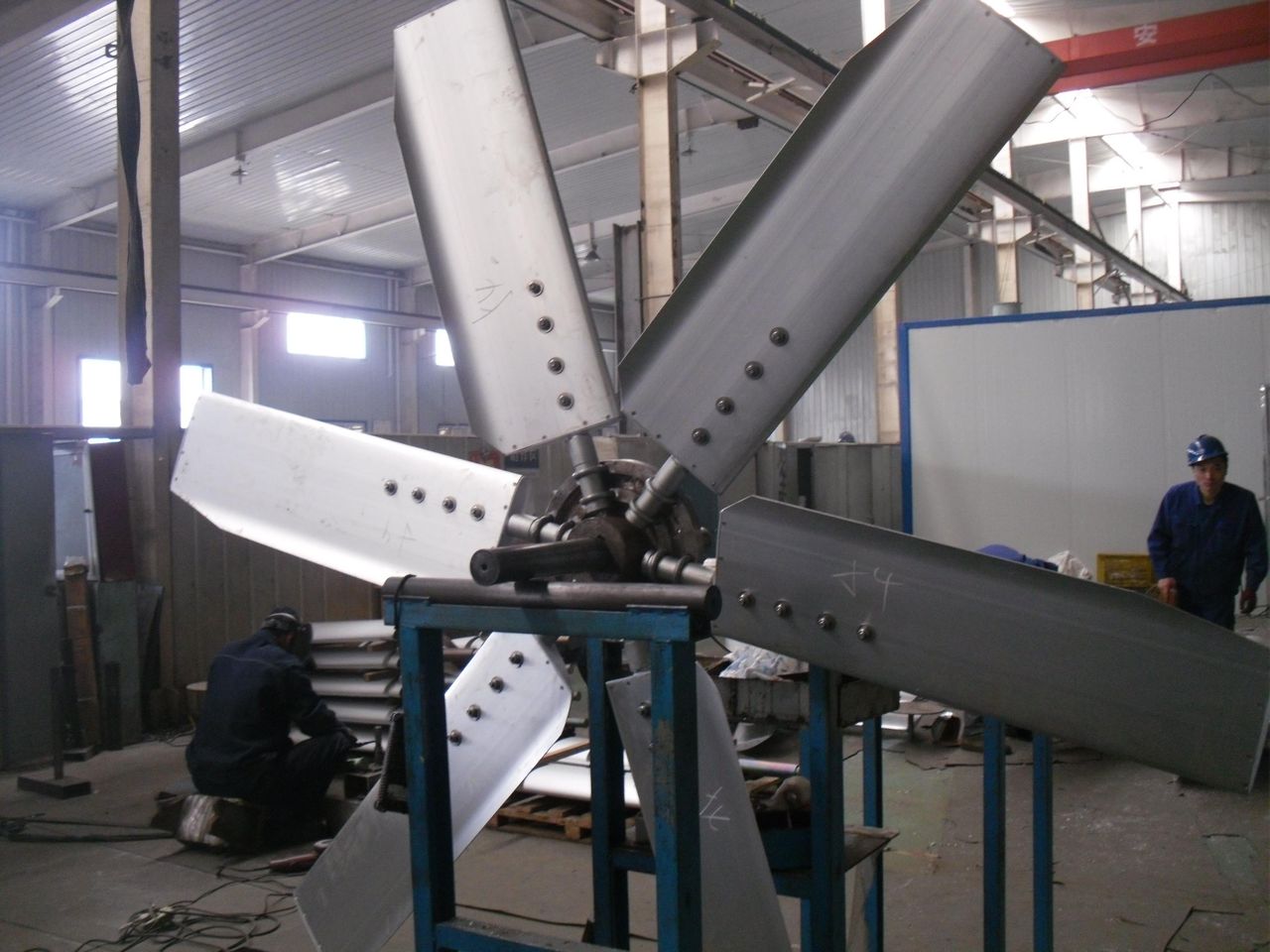
What Is Cooling Tower Fan Blade Angle?
Cooling tower fan blade angle, also known as fan blade pitch angle, describes the orientation of a fan blade relative to a defined reference plane or direction of rotation.
In an axial-flow cooling tower fan, the blades rotate to move air through the cooling tower. Their aerodynamic shape and installation angle determine how they interact with the surrounding air.
The blade angle is therefore an important factor in determining the fan's airflow characteristics and power requirements.
Understanding Fan Blade Pitch
Fan blade pitch is commonly measured at a specified radial position on the blade using a suitable angle-measuring instrument.
However, the angle is not necessarily identical along the entire blade.
Blade Root
The blade root connects the fan blade to the hub assembly. Its geometry is designed to transfer mechanical loads and maintain a secure mounting arrangement.
Blade Mid-Section
The middle section of the blade contributes significantly to the aerodynamic performance of the fan. It is often used as a measurement location when specified by the fan manufacturer.
Blade Tip
The blade tip travels at a higher linear speed than the root because of its larger rotational radius. Its aerodynamic shape and local pitch are important for controlling airflow and pressure distribution.
The blade may have a twisted profile, meaning its local geometric angle changes from the root to the tip. Therefore, measurements must follow the manufacturer's specified reference location and method.
Difference Between Blade Angle and Blade Rotation
Blade angle and fan rotational speed are two different operating parameters.
Blade angle determines the geometric pitch of the fan blade.
Rotational speed determines how quickly the fan rotates.
Blade diameter determines the overall size of the rotating assembly.
Blade profile influences the aerodynamic characteristics of the fan.
These parameters work together to determine the fan's operating performance.
Why Is Cooling Tower Fan Blade Angle Important?
The cooling tower fan blade angle affects the relationship between airflow generation, motor power, and cooling tower heat rejection.
A properly selected angle allows the fan to operate within its intended performance range.
Influence on Airflow Volume
The blade angle influences how much air the fan can move under specific operating conditions.
Insufficient Blade Pitch
If the pitch angle is too low for the required operating point, the fan may not provide sufficient airflow.
Possible consequences include:
Reduced cooling tower heat rejection
Higher circulating water outlet temperature
Lower cooling capacity
Increased difficulty maintaining process temperatures
Excessive Blade Pitch
An excessively large pitch can increase aerodynamic loading and motor power requirements.
Possible consequences include:
The best blade angle is not necessarily the largest angle. It is the angle that delivers the required airflow without exceeding equipment limits.
Influence on Cooling Tower Efficiency
Cooling towers depend on adequate air movement to transfer heat from circulating water to the atmosphere.
When the fan blade angle is correctly selected, the fan can provide the airflow required by the thermal design.
If airflow is insufficient, heat rejection may decrease and cooling water temperatures may rise.
However, cooling tower efficiency also depends on water distribution, fill condition, drift eliminators, ambient wet-bulb temperature, and other operating factors. Blade pitch should not be evaluated in isolation.
Influence on Energy Consumption
Cooling tower fans consume electrical power during operation.
An unsuitable blade pitch may cause the fan to operate inefficiently or place unnecessary demand on the motor.
Balancing Airflow and Power
Industrial operators should evaluate both airflow requirements and electrical loading when selecting a blade angle.
Avoiding Unnecessary Overloading
Increasing blade pitch without checking motor capacity can increase power demand beyond the permitted operating range.
The correct adjustment should follow the fan performance data and motor specifications.
Main Factors That Determine the Correct Cooling Tower Fan Blade Angle
There is no universal blade angle suitable for every industrial cooling tower. The correct value depends on the complete fan design and the operating conditions.
Fan Diameter and Blade Design
Fan diameter and blade geometry influence airflow characteristics.
Fan Blade Profile
The blade profile, curvature, chord length, and twist distribution affect how air moves across the blade.
Different fan manufacturers may use different aerodynamic designs, even when their fans have similar diameters.
Number of Fan Blades
The number of blades influences aerodynamic loading and the operating characteristics of the fan.
The correct pitch should be selected for the complete fan assembly rather than determined by blade count alone.
Fan Rotational Speed
Rotational speed is another major factor affecting fan performance.
For geometrically similar fans operating under comparable conditions, the approximate fan affinity laws indicate:
Airflow varies with rotational speed.
Pressure varies with the square of rotational speed.
Power varies with the cube of rotational speed.
These relationships are approximate and should be applied with consideration of the actual fan and system characteristics.
Fixed-Speed Fan Systems
For fixed-speed cooling tower fans, blade pitch is commonly selected according to the required operating point and motor capacity.
Variable-Frequency Drive Systems
Cooling towers equipped with variable-frequency drives can adjust fan speed according to cooling demand.
The blade pitch must remain compatible with the manufacturer's approved speed range and operating limits.
Motor Power and Gearbox Capacity
The motor and gearbox must be able to handle the aerodynamic load generated by the fan.
Motor Rated Power
Before increasing blade pitch, check the motor nameplate, rated current, and permitted operating conditions.
Gearbox Loading
The gearbox must also be suitable for the required fan torque and operating speed.
An excessive fan load may increase mechanical stress and affect gearbox reliability.
Cooling Tower System Resistance
The fan operates against the resistance created by the cooling tower airflow path.
Important components include:
Blocked Cooling Tower Fill
Scale, dirt, and biological growth may restrict airflow through the fill section.
Dirty Drift Eliminators
Deposits and accumulated debris can affect airflow conditions.
Changing the fan blade angle cannot solve every airflow problem. The complete cooling tower should be inspected before making adjustments.
Environmental and Operating Conditions
Industrial cooling towers operate under different temperatures, humidity levels, wind conditions, and process loads.
The required fan operating point may change according to seasonal conditions and cooling demand.
The selected blade angle should therefore be evaluated against the actual operating requirements.
Common Cooling Tower Fan Blade Angle Types and Adjustment Methods
Industrial cooling tower fans may use different blade mounting and pitch adjustment arrangements.
Understanding the fan structure helps technicians perform correct maintenance.
Fixed-Pitch Fan Blades
Fixed-pitch fan blades are manufactured or installed with a predetermined angle.
Characteristics
Simple blade mounting arrangement
Defined operating configuration
Limited adjustment flexibility
Suitable for applications with relatively stable operating requirements
If the pitch needs to be changed, the fan manufacturer's approved procedure should be followed.
Adjustable-Pitch Fan Blades
Adjustable-pitch fans allow the blade angle to be changed within a specified range.
Characteristics
Flexible airflow adjustment
Suitable for certain industrial operating conditions
Requires accurate measurement
Requires correct bolt tightening and inspection
Adjustable pitch does not mean that any angle is acceptable. The adjustment range must follow the manufacturer's engineering specifications.
Individual Blade Pitch Adjustment
Some fan assemblies allow each blade to be positioned individually during installation or maintenance.
Consistent Blade Settings
All blades should be adjusted to the specified setting using the same reference location and measuring method.
Final Pitch Verification
After tightening the mounting bolts, technicians should measure every blade again to confirm consistency.
How to Measure Cooling Tower Fan Blade Angle Correctly
Accurate measurement is essential for maintaining the intended fan performance.
Tools for Blade Angle Measurement
Common tools include:
Step-by-Step Measurement Procedure
Step 1: Isolate the Fan
Stop the cooling tower fan, isolate the electrical power supply, and apply lockout/tagout procedures.
Verify that the fan cannot restart unexpectedly.
Step 2: Confirm the Measurement Reference
Review the manufacturer's technical documentation to identify the correct measurement position and reference plane.
Step 3: Measure Each Blade
Place the measuring instrument at the specified position on each blade.
Record the angle of every blade separately.
Step 4: Compare the Measurements
Check whether the blades have consistent pitch settings within the permitted tolerance.
Large differences may indicate incorrect installation, blade movement, damage, or measurement errors.
Step 5: Record the Results
Keep the original measurement values for comparison during future maintenance.
Why Consistent Measurement Matters
Different fan designs may use different reference methods.
Measuring one blade near the root and another near the tip can produce misleading comparisons.
For reliable results, the same measuring tool, position, and reference method should be used for every blade.
How to Adjust Cooling Tower Fan Blade Angle for Industrial Applications
Correct adjustment requires engineering information, proper tools, and strict safety procedures.
Step 1: Review the Fan Specifications
Before adjustment, obtain the manufacturer's recommended pitch angle and installation instructions.
Important information includes:
Step 2: Inspect the Fan Assembly
Check the blades, hub, mounting bolts, and other components.
Inspect FRP Fan Blades
Look for cracks, delamination, exposed fibers, and damage around the blade root.
Inspect Aluminum Fan Blades
Check for corrosion, deformation, surface damage, and mounting problems.
Inspect the Fan Hub
Look for cracks, loose fasteners, and signs of movement.
Step 3: Measure the Existing Blade Angle
Use a suitable inclinometer or blade pitch gauge.
Record the angle of every blade before making any adjustment.
Step 4: Adjust the Blade Pitch
Loosen the mounting components according to the manufacturer's procedure.
Position each blade at the required angle while supporting it properly.
Avoid applying excessive force to the blade surface or mounting area.
Step 5: Tighten the Mounting Bolts
Use a calibrated torque wrench to tighten the fasteners to the specified torque.
Incorrect tightening can cause blade movement or damage to the hub and blade root.
Step 6: Verify the Final Blade Angle
Measure every blade again after tightening.
Confirm that all measurements meet the manufacturer's requirements.
Step 7: Check Mechanical Clearance
Inspect the clearance between the fan blades and the fan stack.
Confirm that the rotating assembly can operate without mechanical interference.
Step 8: Conduct a Controlled Test Run
After all tools and personnel are clear, return the fan to service according to the approved startup procedure.
Monitor:
Any abnormal condition should be investigated before continued operation.
Cooling Tower Fan Blade Angle for Different Industrial Applications
Different industries have different cooling requirements. Fan blade angle should be selected according to the required airflow, cooling load, equipment configuration, and operating conditions.
Power Plants
Power plants use cooling towers to remove heat from large circulating water systems.
High Airflow Requirements
The fan must provide the airflow required by the cooling tower's thermal design.
Blade pitch should be selected according to the fan performance curve and motor capacity.
Continuous Operation
Because power generation facilities may operate for extended periods, stable fan operation and accurate maintenance are particularly important.
Chemical and Petrochemical Plants
Chemical plants often operate cooling towers under demanding environmental conditions.
Corrosion-Resistant Fan Blades
FRP cooling tower fan blades are commonly considered for environments where corrosion resistance and reduced weight are important.
Stable Airflow
Correct blade pitch helps maintain the airflow required for process cooling while avoiding excessive motor loading.
Steel and Metallurgical Industries
Steel plants use cooling towers for equipment cooling, process water circulation, and auxiliary systems.
Heavy-Duty Fan Operation
Fan blade pitch must be compatible with the required airflow and operating conditions.
Regular inspection of blade roots, hubs, and mounting components is essential.
HVAC and Commercial Cooling Systems
Large commercial buildings, hospitals, shopping centers, and data centers depend on cooling towers for heat rejection.
Seasonal Cooling Requirements
Cooling demand can change with outdoor temperature and building load.
Variable-frequency drive control can help adjust fan speed, while blade pitch should remain within the manufacturer's approved configuration.
Paper, Textile, and Manufacturing Industries
Manufacturing facilities often require continuous process cooling.
A suitable fan blade angle helps the cooling tower deliver the required airflow under changing production conditions.
Cooling Tower Fan Blade Angle and Different Blade Materials
Blade material affects the weight, mechanical properties, environmental resistance, and installation requirements of the fan assembly.
FRP Cooling Tower Fan Blades
FRP fan blades are widely used in industrial cooling towers.
Lightweight Construction
FRP blades generally offer a favorable strength-to-weight balance.
Corrosion Resistance
Fiberglass reinforced plastic provides good resistance to many humid and corrosive operating environments.
Pitch Adjustment Considerations
Technicians should pay attention to blade root condition, laminate integrity, mounting surfaces, and specified bolt torque.
Aluminum Cooling Tower Fan Blades
Aluminum blades are another common option for industrial fan systems.
Lightweight Metal Construction
Aluminum provides a relatively low-weight alternative to many traditional metal materials.
Maintenance Considerations
Inspect blades for corrosion, deformation, and damage around mounting areas.
Stainless Steel Fan Blades
Stainless steel blades may be used in selected applications where their mechanical properties and environmental resistance are suitable.
Structural Compatibility
The blade weight, hub capacity, mounting arrangement, and fan operating speed must be considered during selection.
Choosing the Right Blade Material
Material selection should consider:
The blade angle should always be selected for the specific fan design, regardless of material.
Common Problems Caused by Incorrect Cooling Tower Fan Blade Angle
An incorrect blade angle can create several operating problems.
Insufficient Airflow
A blade pitch that is too low for the required operating point may result in insufficient airflow.
Possible Causes
Incorrect installation angle
Wrong replacement blades
Fan operating outside its design range
Excessive system resistance
Incorrect fan rotational speed
Recommended Solutions
Check the blade pitch, fan speed, air inlet conditions, fill media, and drift eliminators before changing the angle.
Excessive Motor Current
An excessively large blade pitch can increase the fan's aerodynamic loading.
Possible Causes
Excessive blade angle
Incorrect fan configuration
Fan speed above the permitted range
Unexpected system operating conditions
Recommended Solutions
Check the manufacturer's fan data, motor current, fan speed, and operating limits. Do not continue operating an overloaded fan.
Abnormal Vibration
Incorrect or inconsistent blade pitch may contribute to uneven aerodynamic loading.
However, vibration can also result from fan imbalance, shaft misalignment, loose fasteners, gearbox problems, or structural issues.
Recommended Solutions
Inspect the entire rotating assembly and supporting structure. Perform balancing and alignment checks where necessary.
Excessive Noise
Unusual fan noise may be associated with airflow disturbances, blade damage, mechanical interference, or loose components.
Recommended Solutions
Inspect blade condition, fan clearance, mounting bolts, and the complete drive system.
Reduced Cooling Tower Performance
Insufficient airflow can reduce heat rejection and cause higher cooling water outlet temperatures.
Recommended Solutions
Evaluate fan pitch together with water distribution, fill condition, ambient wet-bulb temperature, and overall cooling tower operating conditions.
How to Optimize Cooling Tower Fan Blade Angle for Energy Efficiency
Energy optimization should focus on achieving the required cooling performance with reasonable electrical consumption.
Establish the Required Cooling Duty
Before changing the fan angle, identify the cooling tower's actual thermal requirements.
Important operating information includes:
Circulating water flow rate
Hot water temperature
Cold water temperature
Ambient wet-bulb temperature
Cooling tower operating load
Required airflow
Evaluate the Fan Operating Point
Review the fan performance curve and compare the current operating conditions with the intended design point.
Check Motor Power Consumption
Measure motor current and evaluate it against the motor nameplate and applicable operating limits.
Consider Variable-Speed Operation
For systems equipped with VFDs, fan speed can be adjusted to match changing cooling loads.
A suitable control strategy may reduce energy consumption while maintaining the required cooling water temperature.
Monitor Performance After Adjustment
Compare operating data before and after adjustment under reasonably similar conditions.
Important indicators include airflow, motor current, vibration, fan speed, and cooling water temperatures.
A successful optimization should improve or maintain cooling performance without introducing excessive mechanical or electrical loading.
Cooling Tower Fan Blade Angle Maintenance and Inspection
Regular inspection helps prevent unexpected fan problems and maintains the intended pitch setting.
Routine Inspection Items
Blade Surface Inspection
Check for cracks, erosion, corrosion, deformation, and other visible damage.
Blade Root Inspection
Inspect the blade root and mounting area for looseness, cracking, and signs of movement.
Hub Assembly Inspection
Check hub components, fasteners, and locking arrangements.
Blade Pitch Verification
Measure the blade angle according to the manufacturer's recommended inspection procedure.
When Should Blade Angle Be Checked?
Blade pitch should be checked:
During initial fan installation
After blade replacement
After fan hub maintenance
Following abnormal vibration
After suspected blade movement
During scheduled inspections when required by the maintenance plan
Importance of Maintenance Records
A complete maintenance record should include:
These records help technicians identify changes in fan condition and support future maintenance decisions.
How to Select the Right Cooling Tower Fan Blade for Your Application
Blade angle is only one factor in fan selection. The blade itself must also be compatible with the cooling tower and operating conditions.
Confirm Fan Specifications
Check the fan diameter, rotational speed, number of blades, hub configuration, and required airflow.
Evaluate Blade Material
Consider FRP, aluminum, and other suitable materials according to the environmental conditions and mechanical requirements.
Check Aerodynamic Performance
Review the blade profile and fan performance data rather than choosing blades based only on external appearance.
Confirm Installation Compatibility
The blade root, mounting holes, hub structure, and pitch adjustment arrangement must match the existing fan system.
Work with an Experienced Manufacturer
A professional cooling tower fan blade manufacturer should be able to provide:
This is especially important for industrial replacement projects where the original fan specifications may be incomplete or unavailable.
Conclusion
The Cooling Tower Fan Blade Angle is a critical parameter affecting airflow, cooling performance, motor power consumption, and mechanical reliability in industrial cooling systems.
The correct blade pitch depends on fan diameter, blade profile, rotational speed, motor capacity, cooling tower resistance, and operating requirements. There is no single universal angle that applies to every cooling tower fan.
For reliable operation, industrial operators should follow the manufacturer's specifications, use consistent measurement methods, inspect blade and hub conditions, and verify motor current and vibration after any adjustment.
Whether using FRP cooling tower fan blades or aluminum fan blades, proper pitch selection and routine maintenance help maintain stable airflow and extend equipment service life.
By understanding the relationship between blade angle, airflow, and energy consumption, industrial facilities can make better maintenance and equipment selection decisions while supporting efficient and dependable cooling tower operation.


